
A strong keyword strategy is the guiding force behind any SEO success. While there are many other elements to consider, your SEO keyword strategy will help you identify the most and least competitive search queries to target in your content.
In this blog, Ignite Visibility’s Sr. SEO Digital Strategist, Eric Solomon, will take you through the steps in building an effective keyword strategy for your campaigns.
What We’ll Cover:
- What Keyword Research Is
- Looking at Search Intent – Keyword Research for SEO
- How to Find the Best Keywords for SEO
- FAQs: Keyword Research for SEO
My Expert Opinion on Keyword Research for SEO
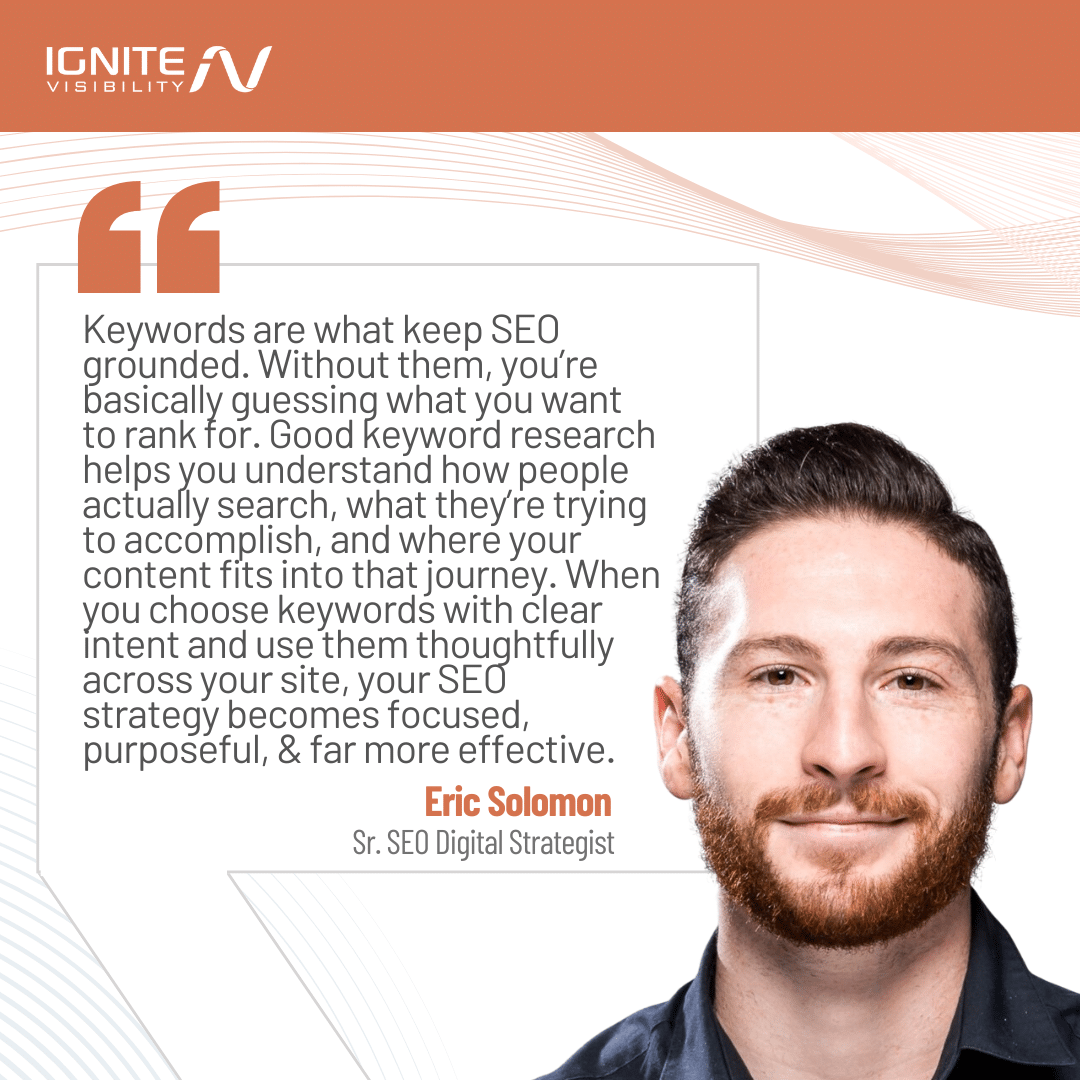
Without keywords as the backbone for your content, you’ll leave rankings to luck when optimizing for SEO. Keywords give your strategies a clear direction and are some of the most integral pieces of the SEO puzzle.
Knowing which keywords to target and when will help you succeed with your efforts as you integrate them into everything from web page and blog content to image alt text and video descriptions. So, what is keyword research for SEO and how can you use it to your advantage?
When conducting keyword research, I recommend using tools like Google’s Keyword Planner to conduct initial research based on your industry targets. Group the different keywords based on which audiences they target, which is where search intent is a valuable consideration.
What Keyword Research Is (and What It Isn’t)
SEO keyword research is an important part of digital marketing. It refers to the process of identifying potential new keywords and analyzing how they might help your brand.
The correct keywords can make or break your digital marketing efforts. If you want to find achievable success, you have to do research to find out which keywords your preferred audience is searching for. Through this process, you can identify words or phrases that are resonating with them and, in turn, are more likely to get you noticed on the SERPs.
The right keywords are essential to driving organic traffic to your site. Learning how to do keyword research correctly will help you understand your searchers’ intent, optimize your content, and improve your overall marketing strategy.
As keyword strategy continues to evolve into 2026, it’s not just about incorporating as many relevant terms as possible into your content—intent is everything. Today, the best keyword strategy will target terms based on where audiences are throughout the buyer’s journey, with highly specific terms that speak to this intent.
Based on the keywords you select and the intent behind them, you can use them to inform your content strategy to connect with audiences throughout their journeys. The ideal terms will also help you align your strategy with your business goals to get real results, from boosting brand awareness to driving conversions and sales.
The ability to target terms based on user intent is particularly crucial in the “messy middle” of the search journey. Here, you’ll want a keyword strategy that can connect with audiences looking to learn more about the pain points they experience, your solutions, and why your offerings are better than your competitors’. The different types of keywords you target at each stage here will streamline the journey from the top of the funnel to the bottom.
Keep in mind that organic keyword research isn’t just about finding keywords with high search volume and low difficulty; you also need to factor in demand, intent, feasibility, and business value. All of these elements contribute to “money” keywords that help you determine more precisely how to research keywords for SEO.
Understanding Search Intent in SEO
When conducting keyword research, it’s crucial to understand the search intent behind queries. Search queries can be broken down into four distinct categories:
- Informational: Keywords where users are seeking information (e.g., “How do I renew my passport?”).
- Navigational: Keywords where users are trying to reach a specific website (e.g., “Facebook login”).
- Transactional: Keywords that indicate a user’s intent to complete a purchase (e.g., “buy iPhone 13”).
- Commercial: Keywords where users are looking to compare products (e.g., “best laptops 2026”).
By classifying search queries into these categories, you can better match content with user intent.
Optimizing for Zero-Click Searches and Featured Snippets (2026)
In 2026, zero-click searches have expanded beyond featured snippets to include Google’s AI Overviews, where users get answers directly on the results page without visiting a website. To stay visible, brands must optimize for AI-driven summaries, featured snippets, and People Also Ask by providing clear, authoritative answers and well-structured content. Using schema markup, concise explanations, and entity-focused content helps ensure your information is surfaced even when clicks don’t happen.
The Different Types of Keywords
Based on the intent behind them, it’s important to know about the different types of keywords and their place in your keyword strategy.
The following are the primary keyword types to consider when developing an SEO keyword strategy:
Head Terms
One type of term that can drive keyword research for SEO is a head term, which refers to highly popular keywords with high search volume. These keywords are typically very competitive short-tail terms of no more than one or two words.
It’s often best to incorporate head terms into your SEO keyword research if you want to reach people at the top of the funnel and boost brand awareness. People may simply want more information around a broader topic here with vague educational intent.

Long-Tail Keywords
When you want to get more specific with intent and connect with people at specific stages of the customer journey, you’ll want to target long-tail keywords when conducting SEO topic research.
Long-tail keywords are longer than head terms, usually comprising three or more terms or entire phrases. These keywords tend to be more specific and subsequently have lower search volume than head terms, but they’re essential for maximizing your reach in search engines.
You’ll target long-tail terms at every stage in your keyword strategy, from informational keywords toward the beginning of the journey to transactional keywords toward the bottom.

Seasonal Keywords
If your offerings experience shifting demands based on season, chances are you will also incorporate seasonal keywords into keyword search for SEO.
For instance, people might conduct searches for “Halloween costumes” or “best shoes for summer,” along with “tax preparation services.”
Looking at Google Trends and other resources could help you determine how to pick keywords for SEO in your niche that connect with people at various times throughout the year.

Local Keywords
If your business targets specific service areas or local audiences near your physical locations, you could also target local search keywords for SEO.
“Near me” and other related keywords could help you connect with people seeking your products or services in their areas, whether you use geo-targeting or geofencing to support local marketing efforts.
Branded vs. Non-Branded Terms
Depending on where your audience is along their customer journey, you may want to target certain branded keywords.
Branded terms could help people find your specific offerings or business information during the navigational or commercial stages.
Meanwhile, for brand awareness efforts and broader targeting, you might want to stick with non-branded keywords.
Tips for Analyzing Keyword Metrics
Understanding how keywords perform is just as important as finding them. Here are some key metrics to keep in mind:
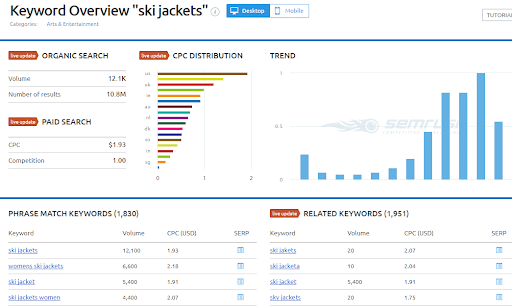
Search Volume
Search volume refers to how often a keyword is searched within a given timeframe. Generally, higher search volumes mean more competition. Finding keywords with moderate search volumes can often provide the best opportunities for organic traffic.
Keyword Difficulty
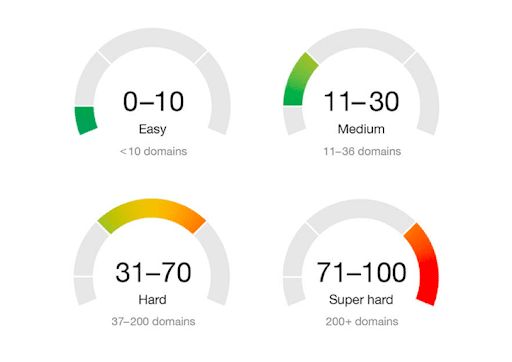
This metric measures how difficult it is to rank for a specific keyword. High keyword difficulty indicates fierce competition. Focus on a mix of high and low-difficulty keywords to optimize your chances of ranking.
Search Intent
In addition to specific metrics, consider the reason why people are entering each query to prioritize and organize keywords. For example, you’ll want to create informational blog posts based on keyword research for questions around base topics, while people entering terms like “best places to buy” are in the market for a potential solution. You can also rename metrics to fit in with each stage of the buyer’s journey, from the awareness to the decision stage.
How to Find the Best Keywords for SEO
To find the best keywords, it’s essential to start by understanding your audience’s needs and behaviors. A simple but effective strategy is to ask questions like:
- Who is searching for pizza?
- What types of pizza are people searching for?
- Where are potential pizza customers located?
Once you have these questions, you can dive deeper into keyword research using tools.
Here are some key steps to guide you on how to do keyword research for SEO:
Step 1: Define Goals and Success Metrics
Start by mapping your goals to the specific stages of the customer journey.
For example, you would target informational keywords at the top of the funnel during the awareness phase, followed by implementing commercial keywords at the consideration stage and transactional keywords during conversion.
Based on the goals you set, you would then determine which key performance indicators (KPIs) to track throughout your campaign, such as:
- Leads: Measure the total number of leads you gather through conversion events with effective keyword research techniques for improved organic SEO traffic.
- Pipeline: Track the entire sales pipeline from initial interaction with your content all the way to sales and repeat business.
- Cost-per-acquisition (CAC)/Cost-per-lead (CPL): Measure the total cost of acquiring a new customer as well as the cost of obtaining a lead in your sales funnel.
- Assisted Conversions: Identify specific points and content that contribute to conversions in an attribution model.
Step 2: Build Seed Topics From Offerings and Audience Language
In learning how to do keyword research for SEO, you can also generate more seed keywords by looking deeper into different areas of your business, such as:
- Your offerings and the terms associated with them
- Pain points that your customers experience, which could help identify informational search keywords for SEO
- Use cases for your products or services that could apply to different audience segments
- Objections that people may have about your offerings or those of your competitors
- Competitors and the keywords they target to rank high in search engines
- “Jobs to be done” that people are likely to search based on their goals and what they want to achieve with your offerings
Step 3: Expand Keyword Ideas
To dive deeper into how to do keyword research for SEO, let’s explore some sources you can use to expand on your existing keyword ideas:
- Google Search Console Queries: Take a look at the queries that appear in Google Search Console, as you might be surprised to find some keywords you rank for that you didn’t initially target, including expanded versions or other variants of your keywords.
- Internal Site Search: Also, if your website has a search function, see what kinds of keywords people enter to assist with organic keyword research, such as terms people enter in your blog to find various topics.
- Competitor Pages: Check out your competitors’ websites to see what they’re optimizing for, alongside their rankings in Semrush and other platforms.
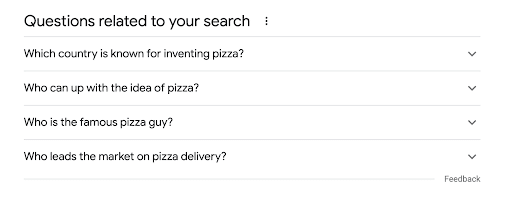
- People Also Ask: In Google results, you may get some ideas for related keywords to target in the People Also Ask section. Add these to FAQ sections on your pages as short answers to rank for those results.
- Related Searches: When conducting a search on Google, look at “People also search for” at the bottom of the first SERP page to see what people are entering similar to that initial search query.
- Forums: People in your industry might also be exploring certain key topics in forums, some of which threads you might come across on Reddit or dedicated forums when you enter a particular search.
- Sales Calls: Your sales team could also have some ideas for search keywords for SEO based on certain questions or concerns that prospects express.
- CRM Notes: Throughout your interactions with customers through a CRM, you may identify keyword opportunities in notes.

Step 4: Validate Intent Using SERP Analysis
This is one of the most effective keyword research techniques for improved organic SEO traffic.
First, when entering a keyword into Google, look for the dominant content type, whether it’s a blog post, product, category, or even a Rich Snippet.
Additionally, check for the freshness of results and citations in SERP features like AI Overviews and AI Mode.

Based on the above example, you can also see a specific angle, as people want to find a doctor accepting a particular type of coverage.
Through AI search results alone, you can see what Google “expects” based on the results returned for a query, helping you determine how to cater your content to both search engines and user needs.
Step 5: Measure Opportunity (Not Just Volume)
Gauge the overall viability of certain opportunities for keyword rankings using the following key criteria:
- Business value
- Relevance
- Feasibility of the opportunity based on competition
- Content effort required to rank
- Conversion likelihood after attracting visitors
- Click potential, as certain SERP features like AI results can reduce clicks
On a scale of 1 to 5, with 1 being minimally viable and 5 being the most viable, you can rank the opportunity in each of these categories to determine whether a keyword is worth targeting.
Step 6: Cluster Keywords and Build Topic Architecture
To avoid keyword cannibalization (where multiple pages on your site compete for the same keyword), use topic clusters and pillar pages. These strategies help organize your content and ensure you rank for broader terms while maintaining depth on specific topics. Pillar pages serve as comprehensive hubs for major topics, while supporting content (the cluster) targets specific subtopics.
Not only can pillar pages and clustering help prevent cannibalization, but these strategies will also ultimately help you establish industry authority. The more topics and subtopics you cover, the more you’ll dominate rankings while gaining credibility in your audience’s eyes.
Cluster your content in alignment with the intent behind your keywords, topics, and similarity to other SERP results. As you develop a “hub and spoke” model for your pages, you can also identify primary keywords for that primary pillar page (your hub) and secondary variations for your branching pages (the spokes).
How to Perform a Competitor Analysis
One of the best strategies for staying ahead in your industry is to analyze your competitors’ keywords. Tools like Semrush and Ahrefs allow you to see the keywords your competitors are ranking for, giving you insights into what you’re missing.
The following are some basic steps to follow when analyzing your competitors’ performance as you work to build the best keyword strategy:
- Log into a tool like Semruch or Ahrefs and open up your competitor analysis tool.
- See what keywords your competitor is ranking for around specific topics.
- Compare rankings to your existing keyword targets and those of other competitors.
- Look at the competitor’s website, including their blog, and see if there are any relevant topics they aren’t covering.
- Continue to do keyword research around content gaps that you could fill.
- Determine if there are any high-value keywords you can target with lower competition.
How Do You Decide What Keywords to Target?
With the answer to “What is keyword research for SEO?” you might wonder how to select keywords for SEO based on your campaign’s unique needs.
There are a few key ways to find the best keywords for SEO, including:
Grouping By Place in Buyer Decisions
Begin by grouping keywords into specific places based on users’ position along the buyer’s journey. Specifically, collect informational, commercial, transactional, an navigational keywords and place them in either the awareness, consideration, or decision stages of the journey.
Based on these placements, you can better determine the intent behind each keyword and align them with your goals. For instance, informational and navigational keywords are often great for building brand awareness, while commercial keywords can persuade people to turn to your brand over competitors.
Finally, keywords at the bottom of the funnel will help you meet conversion and sales goals
Voice Search SEO in 2026
As of 2026, voice search is responsible for 30-50% of online searches, particularly for local searches. Optimizing for voice search requires targeting long-tail, conversational keywords, as users tend to speak queries differently than they type them. Integrate more question-based and natural language keywords to capture this traffic.
What to Do Once You’ve Found Your Keywords
After you’ve determined how to do keyword research for SEO, it’s time to operationalize them.
You can put your keywords into action with the following steps:
1. Develop Content Briefs
Refer back to your hub-and-spoke model that you used to map out your content. Using this, begin producing your content incorporating your organic SEO keyword research throughout.
Remember, content should read naturally and not use black hat SEO techniques like keyword stuffing for simple optimization.
You can then edit these briefs to ensure they’re well-optimized, readable, fitted with video and other multimedia content, and ready for publishing.
With updates like Google’s Helpful Content Update and Core Web Vitals, SEO strategies must now focus heavily on content quality, page experience, and usability. Core Web Vitals measure factors such as loading speed, interactivity, and visual stability. Optimizing for these metrics ensures your website ranks higher and provides a better user experience.
2. Publish Your Optimized Content
With your content ready to go, it’s time to publish it. Try to set a regular posting schedule for blog posts and articles to keep your site updated, ideally with a content calendar, and ensure your content is connected to your rank tracker keyword research tool for measurement.
3. Measure the Results
Covering more of what to do after keyword research, you must effectively track and measure your campaigns, making any updates as needed to get the best possible results.
To keep track of your keywords once implemented, you can use analytical tools like Google Search Console and Google Analytics 4 (GA4). These and other tools will help you monitor rankings and fluctuations in real time.
When measuring the results against your goals, you should decide when to make any necessary adjustments to your strategy. If keywords are underperforming, for instance, you may want to incorporate them into more high-value content. At the same time, you might determine that certain keywords aren’t worth optimizing for based on minimal search volume or intense competition.
As you monitor your keyword strategy, there are some pitfalls to avoid, such as:
- Targeting Too Many Difficult Keywords: If you’re targeting a large number of keywords with too much competition, you may struggle to get anywhere with them in your rankings. Try to go after only the most important keywords to your campaign or target low-hanging fruit terms, which could include valuable long-tail keywords that competitors aren’t targeting as heavily.
- Cannibalization: Another risk is cannibalization, when multiple pages targeting the same term attempt to rank at once. Superficially, it might seem like a good idea to dominate results with as many pages as possible, but this could actually lead Google to punish your pages if it’s not sure which to rank highest. Developing pillar pages and plenty of other pages covering subtopics can help you prevent cannibalization. You should also ensure multiple pages don’t target the same term when possible.
- Stuffing: One of the biggest mistakes that SEOs can make today with keyword implementation is stuffing. This method entails integrating as many instances of a keyword as possible into content in ways that are unnatural and negatively impact readability. While this black-hat SEO technique used to work in the early days of SEO, it comes across as spammy to search engine crawlers and users alike, potentially hurting your rankings. Make sure keyword instances complement the surrounding content rather than impeding it.
4. Refresh as Needed
If you find that your keywords are underperforming at any point, conduct a refresh of your content to potentially restore or even surpass your previous rankings. Doing so will also give you a chance to update blog posts and other content to be more topically relevant.
Tools to Help You Find the Best Keywords for SEO
As of 2026, the leading tools for keyword research for different tasks are:
Ahrefs (for Traffic Analysis and Intent Mapping)
Ahrefs is great for backlink and organic traffic analysis in addition to keyword research for SEO. Ultimately, it’s a great solution for helping track your overall SEO research and development efforts extending beyond your keyword strategy.

Semrush (for Intent Mapping and Gap Analysis)
Semrush is a comprehensive tool for keyword gap analysis and content research. It offers plenty of tools to help you monitor your website’s performance, find the best keywords for SEO, assist with SEO topic research based on competitive analysis, and perform other tasks related to your campaigns.
For help with every aspect of your SEO campaigns, you may want to implement this all-in-one solution.

Moz (for Performance Tracking and Content Audits)
Moz is another easy-to-use comprehensive tool for SEO, including SEO keyword research and much more. This platform includes a site crawler, performance tracker, and a keyword research tool, along with content audits, link research, and analytics and reporting capabilities.
Again, this tool works well for initial research and overall performance monitoring, helping you with every element to build the best keyword strategy.

Google Keyword Planner (for Keyword Analysis)
For basic keyword research, you can use Google’s free Keyword Planner tool. This solution will give you many keyword strategy examples to give you some ideas, with metrics for all keywords such as volume and competition.
It’s also a great tool to help you select keywords for PPC ads.

Google Autocomplete (for Intent Research)
For some initial keyword research when exploring basic ideas around specific topics, you can just go into Google and enter the base term on Google. In the autocomplete results, you can see some of the other popular searches for related terms.
However, keep in mind that these are often limited to local searches, but this could help indicate who to target in your area for local SEO campaigns.

People Also Ask (for Long-Tail Question Keyword Research)
After performing a search on Google, you can take a look at the “People also ask” FAQ section on the first page of results, which will help with keyword research for questions that people often ask about a certain topic.
These topics could be ideal to cover in blog posts and primary web pages, as answering them could help you appear in their results.

These tools help you identify high-volume and relevant keywords to target in your SEO strategy.
FAQs: Keyword Research for SEO
Have some questions beyond, “What is keyword research for SEO?” Get some answers to some popular questions about keyword research for SEO with the FAQs below:
1. What is keyword research in SEO?
Organic SEO keyword research involves finding target search terms to optimize content for better rankings on Google. Different stages of the sales funnel will influence which types of keywords to target, along with business type, seasonality, and locality.
2. How do I find keywords my competitors rank for?
When learning how to research keywords for SEO, you can use various keyword research tools like Google’s Keyword Planner and Semrush to see what keywords competitors rank for and which position.
3. How do I determine search intent for a keyword?
There are multiple ways to figure out the search intent behind a keyword, such as:
- Determining which stage of the buyer’s journey the keyword falls under
- Looking up the keyword and seeing which results rank highest
- Looking at tools like Ahrefs and Semrush, which tend to have “intent” columns
4. How do I choose keywords to target first?
Here are some steps on how to pick keywords for SEO to begin your campaign:
- Develop seed keywords based on core terms for your business and offerings
- Explore long-tail keywords with more specific intent
- Analyze search volume, difficulty, intent, and business value
- Map keywords according to customer journey stages
5. What is keyword mapping (and how does it prevent cannibalization)?
Keyword mapping involves matching search terms to various points of the customer journey, such as informational keywords during the awareness stage and commercial keywords during the consideration stage, all while ensuring each content piece targets unique keyword opportunities to avoid cannibalization.
Ready to Take Your Keyword Research for SEO to the Next Level?
By now, you should have a solid understanding of keyword research for SEO. Keep in mind that search algorithms evolve and so should your keyword strategy. By integrating the latest trends in voice search, zero-click searches, and Core Web Vitals, you can ensure your SEO strategy remains competitive in 2026.
Ignite Visibility has a team of expert digital marketing professionals ready to leverage the power of keyword research to help businesses improve their search engine results rankings.
Through our search engine optimization services for keyword research and more, we can help you with:
- On-page optimization
- Boost organic rankings
- Customize SEO
- Maximize ROI
Our expert strategists work closely with clients to understand their unique needs, whether it’s creating optimal content or catering to user intent, we handle every aspect of SEO to ensure our clients receive optimal results.
Ready to get started? Reach out now!