If you want to know how to rank higher on Google, good search engine optimization is essential to any marketing strategy. Today, organic search results still attract 53% of all trackable website traffic, with Google remaining the top search engine with over 90% of all searches.
In this blog, Seth Kluver, AVP SEO/AI SEO, will provide everything you need to know about how to stay at the top of the SERP in 2026.
What You’ll Learn
My Expert Insight on How to Rank Higher on Google
If your goal is to figure out how to rank higher on Google search results pages, you need to keep up with the latest strategies and practice consistent diligence.
To rank higher on Google, you need to consider the latest developments in SEO, with one of the biggest being an increased emphasis on AI SEO to appear in zero-click results like AI Overviews and AI Mode.
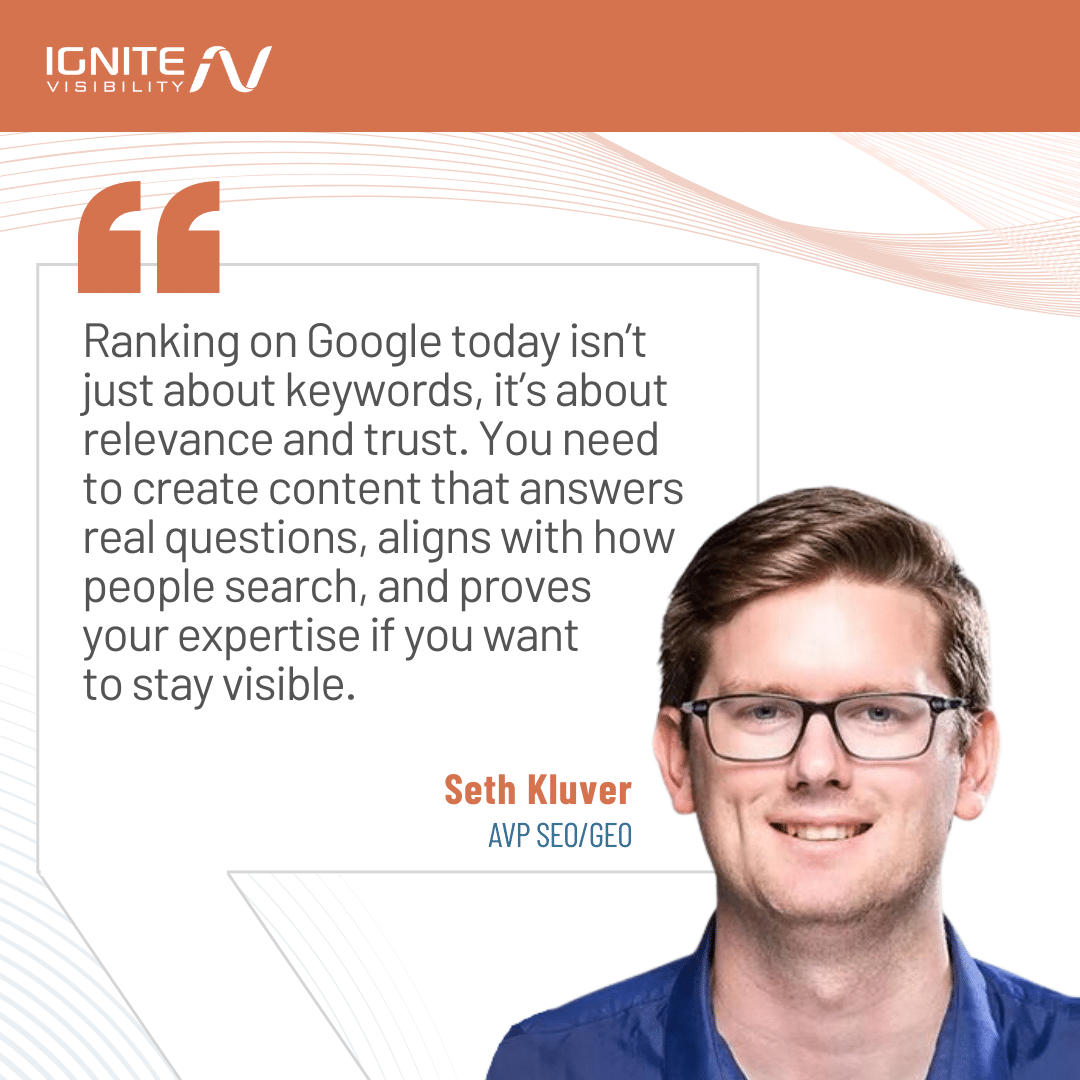
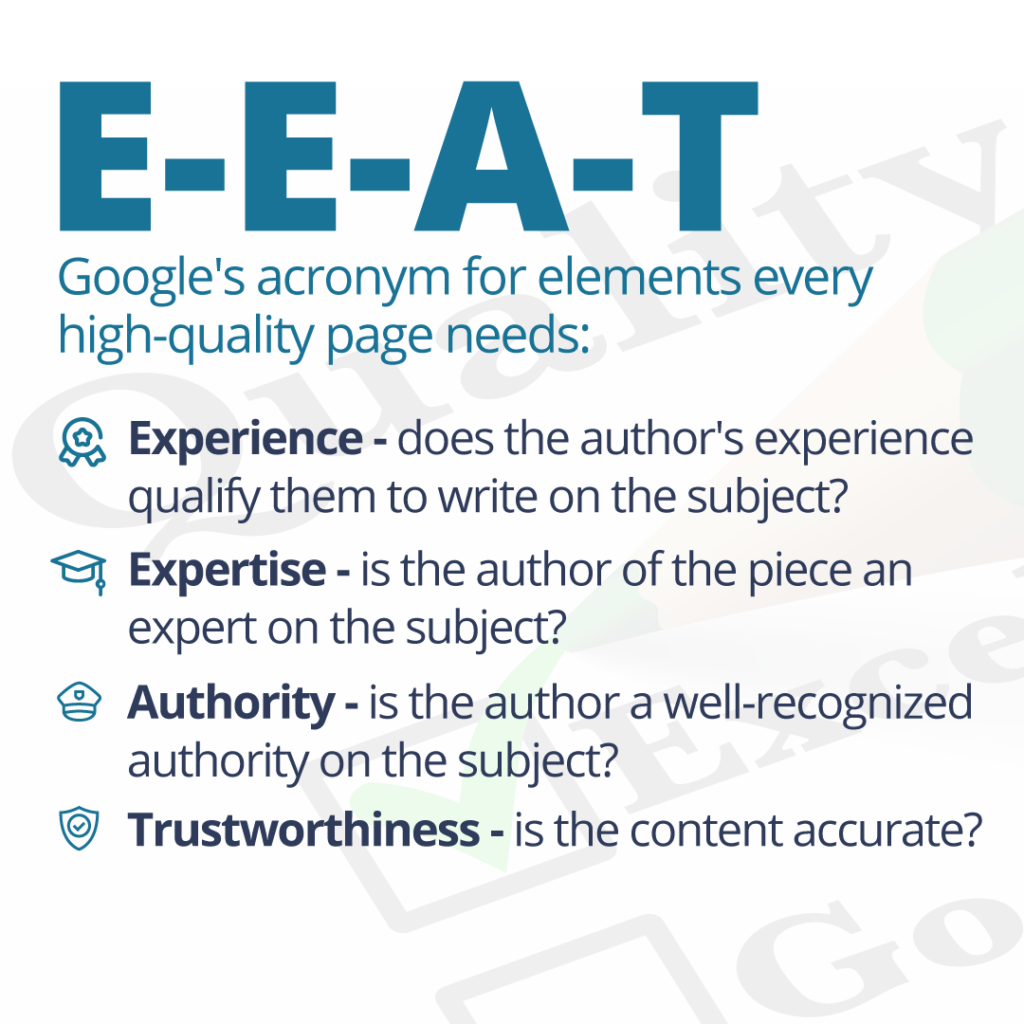
A lot of SEO today involves optimizing content for the user, taking into account more natural-language queries and the need for fresh, helpful content that complies with Google’s E-E-A-T guidelines that prioritize content displaying Experience, Expertise, Authority, and Trustworthiness. Combining these elements with keyword optimization, backlinks, and other effective traditional SEO tactics will help you increase Google rankings in the long term.
Understanding the Current SEO Landscape
Google has a rich history of algorithm updates, so what worked in 2020 won’t necessarily work in 2026. Staying up to date on the current SEO landscape is key to how to rank 1 in Google.
AI and the impact it will have on organic search is important to keep in mind. At Ignite we’ve found that there is a lot of overlap in the nuances to being recommended within an LLM like ChatGPT or Gemini and AI Overviews, and ranking well within organic search engines. The ways these systems work are different; however, the ultimate goal of these platforms is to provide users with the best recommendation, so quality and reputation are important for each.
In short, SEO has largely transitioned from keyword matching to more search intent-driven signals that AI platforms can understand, connecting users with the most relevant content based on their specific objectives.
One thing has become clear: Google is not going to tolerate spam content for much longer. With AI’s increased reliability and the focus on decreasing spam, the importance of E-E-A-T (Experience, Expertise, Authority, and Trustworthiness) has increased.
Writing content based on your experience and expertise will help build your brand’s authority and increase your audience’s trust in it. When your audience learns to trust you, the algorithm will, too.
Understanding Search Intent
As mentioned, determining your audience’s search intent is key to discovering how to rank higher on Google these days.
There are four main types of intent to consider when picking keywords for your strategy, including:
- Informational: At the top of the marketing funnel will be informational queries, when people want to learn more about a given topic, e.g., tutorials, “how-to” guides, and industry blog topics.
- Commercial: Moving down the funnel, people will seek more information about certain solutions to specific problems, including brands, products, and services, entering queries like “best treatments for eczema” and “top healthcare providers near me.”
- Transactional: When people are ready to make a purchase, they’ll enter the transactional stage, where they’re likely to enter terms like “buy men’s footwear” and “car repair estimate.”
- Local: People looking for specific services or businesses near them will ultimately perform localized searches like “best landscapers near me” or “home renovators in [town].”
If you want to know how to get higher rankings on Google, you need to make sure your optimization aligns with the intent behind the query.
For instance, a query like “how to make tomato sauce” should yield blog posts, videos, or other content providing a recipe instead of a product page for tomato sauce. Meanwhile, someone searching for “best doctor in [town]” will be in the commercial phase and want to weigh options, not come across blog posts about “how to find a doctor.”
With the help of keyword intent mapping, you can determine what goal lies behind each of your target terms, helping you figure out how to rank higher on Google search results pages with matching content types.
2026 Core SEO Strategies to Help Rank Higher on Google
Staying in the know about trends and algorithm updates is just part of the SEO puzzle. You must also become familiar with core SEO strategies that will help you propel your site to the top of the search results page.
1. Keyword Research and Optimization
Keywords have always been a huge part of SEO but now they’re really taken center stage.
If you want to capture a specific, niche audience, consider using long-tail keywords. These highly specific keywords will help you rank higher on search engine results pages that align with your target market’s search intent, driving more qualified traffic to your website.

You can use tools like Google Keyword Planner, SEMrush, and Ahrefs to find keywords that are currently popular with your target audience. Once you have a good list, integrate them naturally throughout your content.
A big warning here: do not keyword stuff your content. This is an old SEO tactic that no longer works and will probably get your website marked as spam.
2. Focus on High-Quality Content Creation
Speaking of your website getting marked as spam, be careful with the type of content you’re creating. It’s never a good idea to create content for the sake of creating content. AI tools can accelerate content creation, but all published content should be reviewed, enriched with genuine expertise, and meet E-E-A-T standards. AI-generated content that lacks originality or experience signals can harm your rankings.
Instead, always create high-quality content that will educate, inform, or entertain your audience.
Creating content your potential customers search for is the cornerstone of ranking success. That means researching your target audience’s needs and interests with thorough keyword research.
Your content doesn’t need to just be copy. You should also incorporate different forms of media. Videos, infographics, and photos can add value to your content and make it even more engaging.
Content that comes from first -hand experience will always win. The difference between using a product and writing about your experience instead of describing what you think it would be like is something the algorithm and users can often distinguish.
Just like SEO, the tips of content marketing are always evolving. Be sure to continually go back and update or refresh your old content on a regular basis.
Use this list as a collection of ideas to refresh your content:
- New copy
- Multimedia elements
- New graphics
- FAQs
- Instructional videos
- Reviews
- Updated statistics
- Recent Studies
- Resources or downloads
3. On-Page SEO Techniques
SEO doesn’t just mean your content. There are plenty of on-page SEO tasks to incorporate into your strategy to ensure your website doesn’t get lost in the abyss.
In addition to creating helpful content by following the E-E-A-T guidelines, incorporating a few (or all!) of these on-page SEO techniques is one of the best SEO tips in 2026:
- Title tags and meta descriptions: Make sure your titles and descriptions are accurate and captivating
- Optimize header tags: Use keyword-rich headings that improve readability
- Optimize Images: Use unique images when possible, size them appropriately and create accurate image alt tags
- Incorporate schema markup: Schema markup helps search engines to better understand your content
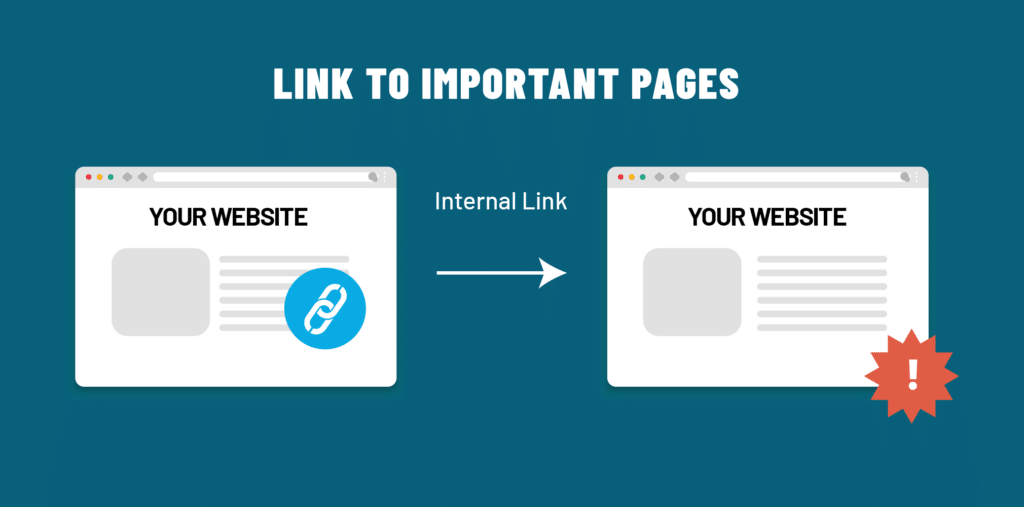
- Lean on internal linking: Link to other pages on your website that are also relevant to the topic at hand
4. Website Accessibility
Accessibility practices go hand-in-hand with good SEO.
By making your website accessible across all devices, you’ll reach a broader audience and provide a better overall user experience.
Here’s a quick checklist to consider:
- Using alt text for images and diagrams
- Ensure all interactive elements such as forms and buttons can be activated by the keyboard
- Use proper HTML tags like headings and landmarks
- Make sure your link text describes the function of the link
- Balance the color contrast between your background and text
- Keep your text scalable by using relative units
- Add captions to videos and transcripts for audio
- Keep your website responsive so it works across all devices
- Maintain a consistent layout and navigation structure

5. Technical SEO
Technical SEO is another factor that can impact your ability to rank as it directly relates to crawlability, indexablility or user experience.
Conduct a technical SEO audit to ensure you aren’t doing things that could affect your ranking.
Check for the following:
- rel=canonical issues
- Title tag issues
- H1 tag issues
- Missing meta descriptions
- Sitemap accuracy
- Indexation issues
6. User Experience (UX)
Google wants to know that they are sending users to a website that they will benefit from. That’s why your user experience is so important when learning how to rank higher on Google.
It is important to have a clean and intuitive website design. An easy-to-navigate site will help your users find what they’re looking for while providing a good overall user experience. It is also important to think of other things, such as page loading speed, interactivity, visual stability, and mobile friendliness, when attempting to increase your user experience.
One way to improve your user experience is to pay attention to your Google Core Web Vitals report in Google Search Console. This report will tell you what your website lacks and how to improve it. To ensure your website is optimized for Core Web Vitals, regularly test its performance. Monitor its loading times and navigation speeds to ensure everything performs well.
7. Backlink Building with Digital PR Strategies
High-quality backlinks will help boost your site’s authority. When other sites see you as reputable, Google knows that you are a quality site to send its users to. Focus on quality over quantity when working on your digital PR strategies.
Some ways to earn high-quality backlinks include guest posting on other sites, influencer outreach, and content marketing. You can also focus on nofollow, sponsored, and UGC links. The more you get your brand out there, the better.
As you’re working to generate high-quality backlinks, don’t forget to monitor your existing ones. You can use online tools like Ahrefs, Moz, or SEMRush to keep your eye on ones that could be affecting your SERP ranking.

8. Local SEO to Rank Higher in Google
In 2026, we’ve seen SERPs provide more localized results than ever for everything from B2B to ecommerce. Local SEO strategies can improve your visibility for highly relevant traffic. Typically localized searches including terms like a city name or ‘near me’ convert at a much higher rate when it’s relevant to your business model.
Google Business Profile (previously Google My Business) is an important free tool that will increase your local organic traffic. Make sure that all of your important information, like your name, address, and phone number (or NAP), is consistent across your entire digital presence, including your website, social platforms, and any local directories you’re listed in.
You can also optimize your on site content with local keywords. Keyword phrases like “near me,” “local____” and “___[city]” will help you capture all of the local audience searching for those words.

Examples of Local SEO Rank “Near Me”
9. Voice Search Optimization
The SEO industry has been talking about optimizing for voice search for a very long time. However, with the evolution of AI and LLMs this conversation is likely more relevant than ever. Users are holding conversations with platforms like ChatGPT or CoPilot in a way that’s very similar to how people speak with a voice assistant on a mobile device.
As you work voice search SEO through your content, remember to incorporate your keywords naturally. Thinking about the ways people may ask questions will help you understand how to optimize. By focusing on solving your audience’s problems and answering their questions, you can help improve your content quality and optimization simultaneously.
10. Visual Search Optimization
With the rise of platforms like Pinterest, Google Lens, and more visual search features, more users are testing out their visual search options.
Visual search helps users discover products they might not have known how to describe. All they have to do is take a picture or screenshot of an object, upload it to a visual search engine, and in return, they’ll see a wide variety of search results with objects similar to the one they searched.
Early adopters of visual search might see a competitive edge as it helps improve the user experience and speeds up the customer journey.
Simple steps to optimize for visual search engines include:
- Using high-quality images
- Including descriptive file names
- Adding specific and accurate alt text
- Incorporating relevant captions
- Adding structured data markup
- Optimizing image sizes

11. Multimedia Asset Creation
Keep in mind that content marketing isn’t just copy. You also need to incorporate other media assets, including video content.
Short-form video, in particular, is huge right now, so don’t ignore it! Use it to your advantage by finding out who is watching this content and where. You may find that your audience is very active on YouTube, whereas other brands will shine on TikTok or Instagram Reels. Once you find where your audience is, it’s time to capitalize on it.
Optimize your multimedia content in various ways, including your titles, headings, descriptions, meta tags, video thumbnails, and more. Remember to add subtitles and use hashtags to increase your reach even more.
12. AI and SEO
AI is gaining steam in all areas of digital marketing, including SEO. Leverage AI tools to help you create better content, develop blog outlines, do hashtag and keyword research, and more.
You can find free and paid tools to help you use AI to increase your SEO results, including Claude, ChatGPT, and Perplexity. These tools can help you optimize your content and learn how to rank higher on Google.
SERP Feature Optimization
In helping you learn how to rank higher on Google, let’s look at some SERP features that are crucial to target with your content:
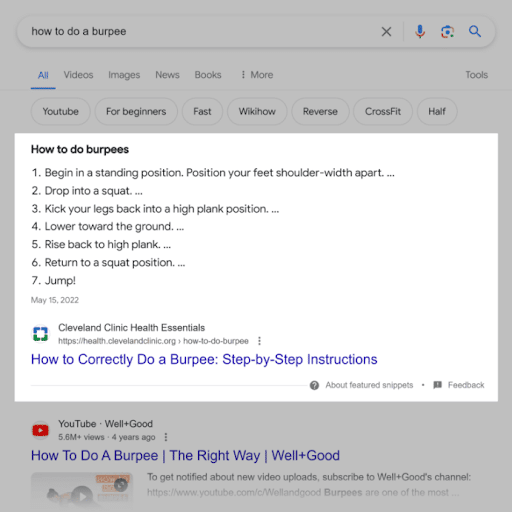
Featured Snippets
These are results that summarize key information at the top of Google SERPs, often known as “position zero.”
These snippets can appear as paragraphs relaying an answer to a question, a list of items or steps, tables with structured data, and videos from YouTube embedded, usually with links to the most relevant moments within them.
People Also Ask
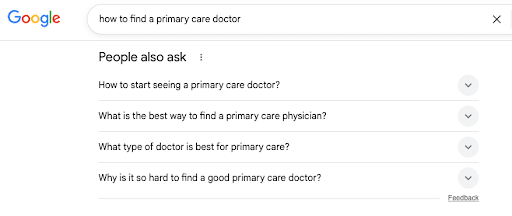
Another SERP feature you could target is the People Also Ask section, which lists questions related to an initial query with dropdown answers beneath them. Each related question will feature a paragraph of content with a link to the cited source, which could entice users to click through for more information.
Local Map Packs
For local and multi-location SEO, you may also try to optimize for Google’s local map packs.
These results list businesses when people conduct a local search like “best [business type] near me.” Results display the business names, aggregate ratings, and other key information about businesses.
To rank for these, you should develop a complete and verified Google Business Profile with accurate information. When people click on individual results within the map pack, they’ll see a corresponding GBP for additional information.
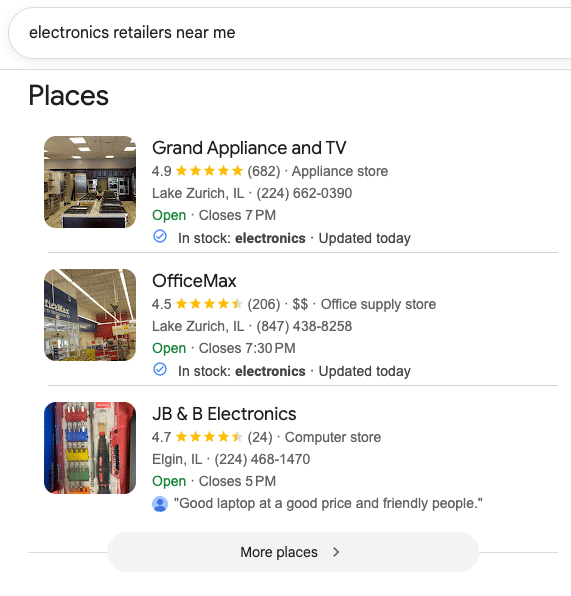
Image and Video Results
You can also appear in rankings with images and video content. To increase Google rankings with these snippets, your videos and images must be well-optimized with high-quality footage, alt text, keyword-rich titles and descriptions, and chapters, when relevant.
For video content, keep in mind that both YouTube Shorts and traditional videos rank, giving you the chance to maximize visibility with both content pieces.
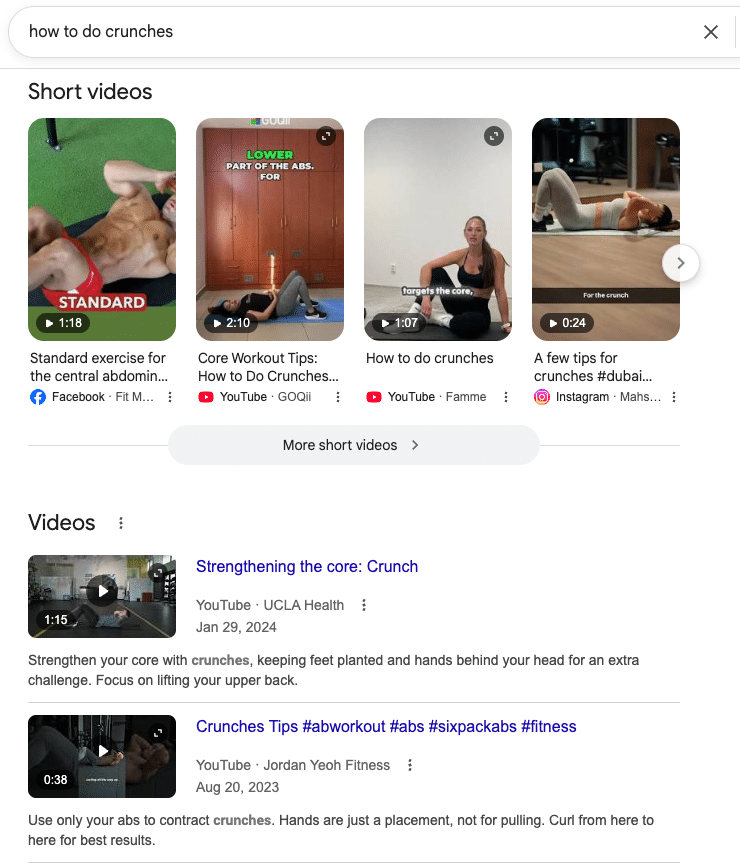
How to get on the top of Google results with images and videos.
How to Measure SEO Success in 2026
Now that you know how to improve your Google Search Rankings, let’s talk about how to measure your SEO success.
Tracking Key Metrics
Keeping track of certain metrics will help you visualize your success and see where you can improve your strategy. Be sure to monitor stats, including:
- Organic Traffic Rate
- Keyword Rankings
- Click-Through Rate
- Conversion Rate
- Backlinks
- User Engagement
SEO Metric Tracking Tools
Worried about tracking all of these numbers? Don’t be! There are plenty of online tools that can help make this job easier for you.
Some of the most popular include free tools like Google Analytics and the Google Search Console. Although these tools are robust, if you need more flexibility and data, check out some of the most popular third-party SEO tools like SEMRush, Ahrefs, or Moz. Third-party platforms might be able to provide more granular data regarding search intent and individual query insights, such as Semrush’s Keyword Magic Tool.
Perform Regular Audits
Armed with your analyzed metrics, set aside time to perform regular audits of your entire marketing funnel, including all of your content.
Regularly auditing your content will help you keep it fresh and updated with new information, statistics, and graphics. It will also expose holes in your user experience and opportunities to incorporate new ideas into your content.
Just like your brand changes, your audience’s likes and interests will change, too. By regularly auditing your content and reviewing your performance, you’ll improve your chances of holding on to your high SERP ranking.
FAQs
1. How do I rank higher on Google?
If you want to know how to rank 1 on Google, contemporary SEO involves a blend of more traditional strategies and targeting queries based on the intent behind them. High-quality and well-optimized content that connects with audiences at every stage of their customer journey can significantly improve Google rankings.
2. How does user intent impact SEO?
To rank higher on Google, you need to match search queries with specific types of intent, including informational, commercial, transactional, and local intent, depending on what the user wishes to find with each search. Optimizing for intent can increase Google rankings by connecting with users based on their needs.
3. What is the difference between AEO and SEO?
Answer engine optimization (AEO) involves structuring content to optimize for AI-based search results like AI Overviews and ChatGPT with concise and direct answers, functioning as a type of search engine optimization (SEO) that can help increase a website ranking on Google.
4. How important are Core Web Vitals for ranking?
Google’s Core Web Vitals are essential for helping improve Google rankings, as they gauge the quality of the user experience on a web page, including how long it takes to load a page, the consistency of the experience as the page loads, and other key metrics signaling to Google that a site is worth ranking based on usability.
5. How do you optimize content for featured snippets?
If you want to figure out how to get on the top of Google search results, you can optimize for featured snippets by providing high-value and concise content that answers users’ questions directly, whether through short paragraphs, tables, charts, or other helpful content pieces.
Discover How to Rank Higher on Google with Ignite Visibility
Whether you want to rank number 1 for “plumbers in Chicago” or for “restaurants in New Orleans,” Ignite Visibility can help!
Thousands of businesses across the country use our skilled and talented team of experts to:
- Improve their content strategy
- Boost their social media presence
- Maximize their SEO ROI
- Analyze their reporting data
- And more!
Sound good? Let’s get started! Get in touch with our experts today!