When developing your website’s SEO, topical authority is an essential factor in helping you climb to the top of search engines while building trust among your audiences. You might be familiar with this concept if you’re digging into SEO as you learn the techniques to get ahead of competitors.
In this blog, Sr. SEO Digital Strategist. Eric Solomon, will explain topical authority in SEO, how to build it, and some topical authority tools you can use to help you optimize and monitor content performance.
What’s Covered:
- The Rise of Topical Authority in SEO
- Topical Authority vs Domain Authority
- Why Topical Authority Matters for SEO
- Building Topical Authority: Step-by-Step Guide
- Measuring and Monitoring Topical Authority
- Common Pitfalls and How to Avoid Them
- Advanced Strategies for Enhancing Topical Authority
- FAQs
What is Topical Authority?
So what exactly is topical authority?
It refers to how well a website demonstrates expertise, depth, and trustworthiness around a specific subject or niche. Instead of covering broad, surface-level content, a site with strong topical authority will consistently publish high-quality, relevant content.
Using internal and external linking, sites with greater topical authority will signal to search engines they are a trusted source on the topic. By building topical authority, businesses can improve their search rankings, attract the right audience, and establish themselves as thought leaders in their industry.
My Expert Opinion on Topical Authority
In today’s SEO, authority is everything if you want to get ahead of competitors. While conventional optimization with keywords, links, and various technical SEO elements can help you index and rank on search engines, you need to show that your site is authoritative and trustworthy.
Keep in mind that today’s SEO tactics are user-centric, as Google’s E-E-A-T guidelines prioritize sites that demonstrate Experience, Expertise, Authority, and Trustworthiness. In short, search engines favor sites that focus on the visitor rather than search engine bots.
By developing and showcasing expertise in every aspect of a particular topic, you will not only maximize keyword coverage with high-quality content, but you will also establish a stronger connection with your target audiences. After all, people want to do business with the brands they see as experts in a given niche.

The Rise of Topical Authority in SEO
As SEO becomes increasingly about the user experience, topical authority is more important than ever for websites to dominate search results.
Google and other search engines favor sites that people perceive as authoritative and reliable, largely through their demonstrable expertise. The more a site appears to know about its niche, the more people are likely to stay on it and engage, which signals to Google that the site is favored among users.
At the same time, as you develop topical authority, you can also implement various complementary SEO techniques like on-page SEO and off-page optimization to boost performance.
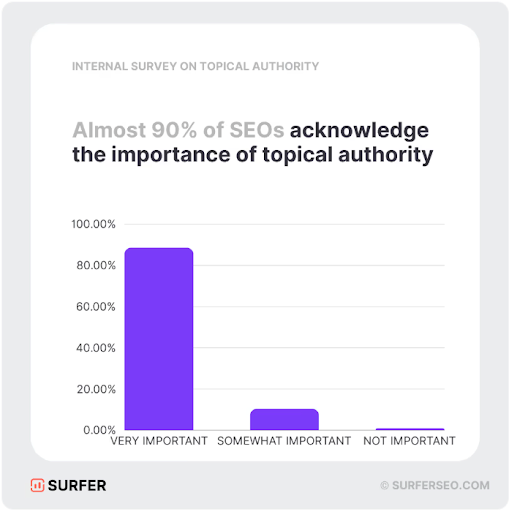
Today, 88% of SEOs understand the value of topical authority as they see how it benefits them, which shows just how relevant it is and why you should be on top of this technique.
Topical Authority vs Domain Authority
You may wonder what makes topical authority different from domain authority. Although both are crucial for SEO, they work somewhat differently: While topical authority demonstrates expertise within an industry, domain authority refers to a website’s reputation via the development of backlinks, with other authoritative sites linking back to it.
Together, topical authority SEO and domain authority can work together to boost and maintain rankings for target keywords. They can also build overall brand authority.
While domain authority is more technical and directly communicates to search engine bots that your site is worth ranking, its topical counterpart is largely important for connecting with your audience. The more authority you display around a certain topic, the more people will view you as the go-to for information and, eventually, your offerings.
Why Topical Authority Matters for SEO
Building authority on a topic offers multiple benefits for rankings and more, including:
- Improved Rankings: Of course, the primary benefit of topical authority in SEO is the ability to get to the top of search engine rankings. The more topics you cover and the more natural keyword inclusions appear within your content, and the more people engage with said content, the more you’ll appeal to Google and other platforms.
- Increased Trust: You’ll also be able to earn people’s trust as you show the level of expertise you have within your niche. Ultimately, more people will come to you for information as they trust you over competitors.
- Better User Engagement: If people can learn everything there is to know about a topic and subtopics under one roof, they’ll be more inclined to engage with you consistently, leading to more engagement that can further feed into your SEO strategy.
Building Topical Authority: Step-by-Step Guide
Now that you know more about how SEO topical authority works, here is some guidance on how to get started with your next topical authority map:
1. Identify Core Topics
The very first step here will entail identifying the main topics within your niche. Consider what the main focus of your site and industry will be, what kind of expertise you want to be known for, and the kinds of topics that apply to your offerings.
From there, you can identify various subtopics to cover with the skyscraper technique and extending pages, such as blog posts exploring subtopics in greater depth.
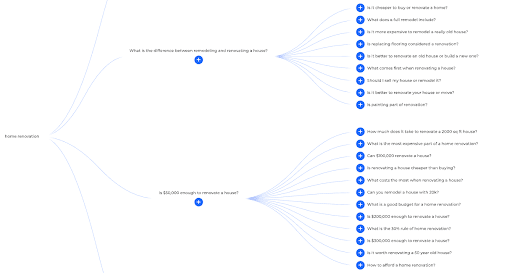
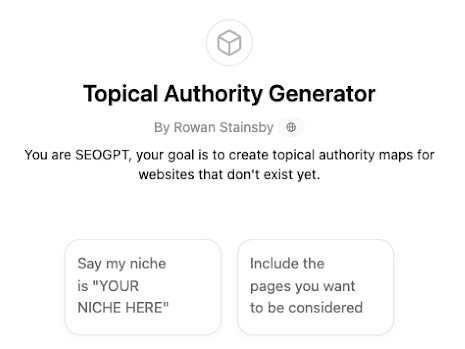
You can also use tools like Topical Authority GPT to develop detailed topical authority maps. Topical Authority GPT can also assist in developing entirely new websites based on your niche.
2. Conduct Keyword Research
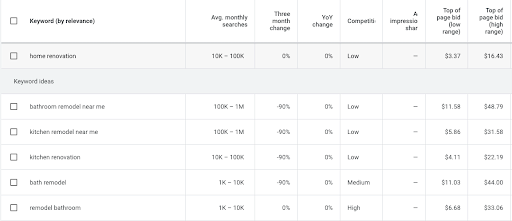
Once you’ve figured out what kinds of topics to cover, you can initiate keyword research to find related terms to target.
You’ll want to target a mix of short- and long-tail keywords of varying competition and search volume, ideally targeting low-hanging fruit that competitors aren’t targeting with their content before going after more competitive terms.
As you build your content, you can branch out to more keywords. Of course, long-form content like pillar pages will often naturally include various keyword phrases, helping you avoid over-optimization.
3. Create Content Clusters
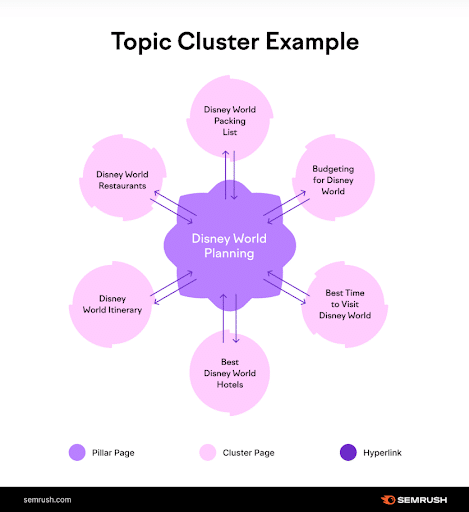
When structuring your content, you will have a hierarchy that has pillar pages at the top covering a particular topic in great detail, with content clusters underneath delving into specific subtopics.
For instance, a website might have a pillar page about “how to build an SEO strategy” that covers all of the elements needed to improve rankings. From there, content clusters could go into detail about specific elements, such as keyword research, on-page optimization, and content marketing.
Each content cluster would target different keywords than the pillar page to prevent potential keyword cannibalization, and the pillar page and cluster content would link back to each other, ideally using anchor text containing one of the linked pages’ target keywords.
The content cluster structure would look something like this:
4. Optimize Internal Linking
As mentioned, you should make sure your pillar pages and clusters link back to each other. For instance, your pillar page might link to blog posts covering specific subtopics, with internal links using keywords that the blog post should rank for, such as a pillar page about “home renovations” linking to a blog post about “the cost of a bathroom renovation.”
Over time, as pages gain authority, they will have more domain authority in Google’s eyes, leading to better link equity in your hyperlinking strategy as pages spread authority between them.
5. Update Content Regularly
In maintaining topical authority, you should consistently refresh your content to ensure it’s always up-to-date.
Go through your content from time to time and include updated information, including general details and statistics that keep your content relevant.
You can determine whether your content could benefit from a refresh with an SEO audit as you look at rankings and other factors. If you notice a drop in rankings or other metrics as you try to stay on top, you may want to spruce up your pillar pages or content clusters.
Keep in mind that evergreen content that lasts longer will help eliminate the need for frequent updates, but you should still refresh your optimization strategy if you notice any negative changes.
Measuring and Monitoring Topical Authority
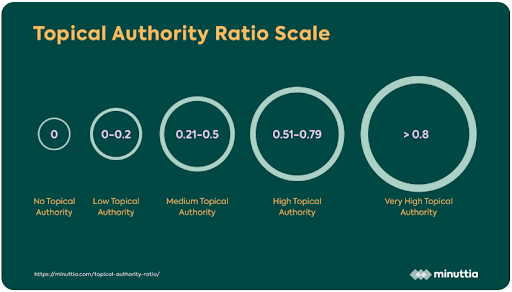
If you want to excel with your content optimization efforts, you must regularly measure and track your site’s topical authority SEO based on your goals.
Some key metrics you might track could include:
- Keyword Rankings: One of the primary metrics to measure will be your pages’ keyword rankings. Once you begin your strategy and optimize pillar pages and clusters, start keeping an eye on rankings over time and see if there are any changes. If you notice any decrease in rankings, you can find ways to further optimize or otherwise refresh your content.
- Organic Traffic: Another metric to keep track of is organic traffic, i.e., the number of visitors who come to your site from traditional and AI Overviews or other SEO search results. Reduced traffic could indicate that your pages need some additional optimization or refreshes.
- Backlink Profiles: Also, track your website’s backlink profile to determine what kind of domain authority you’re achieving. Having a large number of high-quality backlinks on other authoritative websites will supplement your content optimization efforts.
There are plenty of topical authority tools you can use to track these and other metrics.
For instance, you can use Google Analytics 4 to see what kinds of terms are bringing in organic traffic to your website and any fluctuations. Meanwhile, Semrush and Ahrefs can keep track of keyword rankings and reveal any drops or improved rankings.
Common Pitfalls and How to Avoid Them
When trying to build topical authority in SEO, here are some common mistakes that people make and ways to avert them:
Inconsistent Content Themes
When trying to become the foremost authority on a particular topic and all it encompasses, you want to make sure your content themes are consistent and focused.
Once you’ve identified a topic to create a primary pillar page around, make sure all connected content clusters apply to that topic in some capacity, usually as an extension of a specific subtopic under its umbrella.
Neglecting User Intent
Another big mistake is failing to focus on the user with content. While keyword stuffing used to be a viable practice in SEO, it simply doesn’t work and is likely to turn readers away, which could lead to higher bounce rates and, subsequently, lower rankings.
Always write content primarily for the reader, and optimization for search engines will follow with natural keyword inclusions and other optimization efforts.
Publishing Thin or Low-Quality Content
Google likes rich, high-quality content that keeps people reading. If you try to publish a lot of thin or poor-quality content, you’ll hurt the user experience and likely get on Google’s bad side.
Instead, try to write top-quality, high-value content that readers find useful and rich with information, which will build trust and maximize engagement.
Forgetting to Include Internal Links
To get the most from your content, you should also integrate a strong interlinking strategy. Neglecting to do so could leave each page to fend for itself, or you might rely too heavily on backlinks on other sites to lift them in search results.
Try to give your pages more of a boost by using internal links for better link equity.
Advanced Strategies for Enhancing Topical Authority
Here are some additional strategies to try to make your brand an even bigger authority:
- Semantic SEO: One advanced strategy to try is semantic SEO, which involves developing content specifically for topics instead of merely targeting keywords. The idea is that by naturally writing about a particular topic, semantic keywords and phrases will tend to show up without purposeful optimization. As of Google’s Hummingbird algorithm update, the search engine will rank content that best covers a particular topic vs. simply optimizing for specific keywords.
- Structured Data: You can also give search engines more context about content via structured data and schema markup, which adds code to pages detailing what a page is specifically about.
- Expert Collaborations: You don’t have to be the only expert to help you establish your brand as an industry authority; you could also invite other experts to collaborate with you through guest posts on your site and influencer marketing, getting people to associate you with other experts in your niche while further enhancing SEO.
FAQs
1. Why is topical authority important for search rankings?
When trying to get on top of rankings, SEO topical authority is one of the most important elements because it indicates to users and search engines that your website is a hub of expertise and worth trusting over less authoritative competitors.
2. What’s the difference between topical authority and domain authority?
While there is some overlap between these two concepts, topical and domain authority work differently. While topical authority refers to a website’s expertise and trustworthiness based on the coverage and optimization for various industry-related topics, domain authority comes largely from the strength of its backlink profile and the number of high-quality links on other websites.
3. How do I build topical authority for my website?
There are multiple steps you will need to take to build topical authority SEO for your site, including:
- Identifying the most important topics to cover in your industry
- Creating high-quality, well-optimized content around these topics, including content clusters
- Focusing on the user with engaging content that appeals to readers
- Continually tracking and optimizing content performance
4. How can I measure my website’s topical authority?
There are numerous metrics you can measure to gauge your site’s performance using the right topical authority tool, such as Ahrefs to measure traffic share, Moz for determining brand authority and social proof, and Semrush to track keyword rankings.
Build Topical Authority SEO With Ignite Visibility
To establish and maintain topical authority effectively, it helps to have some SEO professionals by your side who can help with content creation and optimization across your website. Ignite Visibility has extensive experience with SEO, as well as other key aspects of digital marketing, including paid media advertising and email marketing.
When you work with our team of experts, you’ll have the chance to:
- Identify critical industry topics to cover and content opportunities
- Conduct in-depth keyword research around each topic
- Develop high-quality content that appeals to users and search engines
- Continually measure performance based on your goals
- Optimize content over time to perfection
- And more!
If this sounds like a plan to you, get in touch with us today to get started with a free proposal.