

While SEO used to focus primarily on keyword targeting, today’s strategies are all about optimizing for concept- and relationship-centric searches. Specifically, this entails targeting Google entities to give search engines more context as to what your content is about to rank based on search intent.
In this blog, Karen Devlin, VP of AI-SEO, will explore entity SEO, how to find entities for SEO optimization, and tips for optimizing content to appeal to search engines today.
What’s Covered:
- What Is Entity SEO and Why Is It Essential in 2026?
- How Search Engines Interpret Entities
- Entity SEO vs. Traditional SEO
- Mapping User Intent Through Entities
- Structuring Content for Entity SEO
- Schema Markup and Structured Data
- Measuring Entity SEO Success
- Future Trends and AI Search
- Entity SEO FAQs
What Is Entity SEO and Why Is It Essential in 2026?
What are entities in SEO, exactly? In this context, entities refer to specific concepts or things that are distinct and clearly defined, including people, places, objects, and relationships that search engines understand.
Let’s look at an example—here is what pops up when someone asks Google how often they should get an oil change:
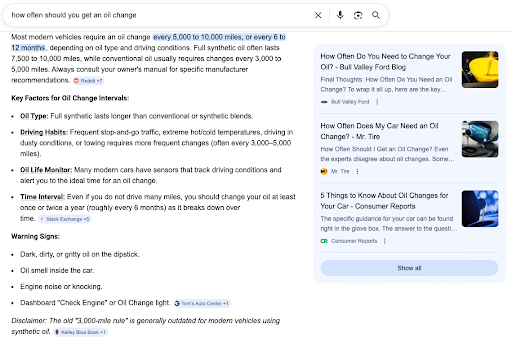
Based on this AI Overview, we can see that Google understands a few key things:
- Variable ranges for oil changes
- Factors like oil type and driving conditions
- The dependency on owner’s manuals for different vehicles
- Warning signs that you need to get an oil change
- That the 3,000-mile rule no longer applies today (and that people still tend to follow it)
The content ranking for this term covers these nuances to provide users with truly helpful information about the topic, which in turn helps it rank for these types of results.
Why Entity-Based SEO Matters
As the above example shows, search engines are no longer simply matching results with the words in a query; they’re going deeper to determine more context based on the intent behind the search.
Modern search engines work using a Knowledge Graph that gathers billions of entities and connects them together for better understanding. Generative AI tools like Google’s AI Mode and ChatGPT can then comb through this Knowledge Graph to help them determine what search results would be the most relevant to the base query, based on the intent behind it and what people might want to know.
This differs heavily from keyword-based SEO, which focuses solely on the words in a search query to yield a match rather than the meaning behind them.
Keep in mind that entity SEO can impact other types of rankings, such as rich snippets and other organic results. It also helps websites maintain adaptability in the face of algorithm updates, enabling sustained long-term organic visibility.
Expert Opinion on Entity SEO
Over the years, I’ve seen search engine optimization (SEO) go from basic keyword targeting and inclusion to an emphasis on more user-centric content coupled with off-page SEO tactics like backlinks. Today, it’s all about giving users what they want with each search by understanding their specific wants and needs.
Enter entity SEO, which is an essential approach for every business to take, as it accounts for intent while also appealing large language models (LLMs) and AI-powered search engines, which are becoming increasingly popular—more than 15 million people already use generative AI as their main online search platform, and that number is expected to grow to more than 36 million within the next few years.
The key is knowing how to find entities for SEO optimization and create high-quality content around them. This entity SEO guide will explore this concept in greater depth and help you develop a winning strategy.
How Search Engines Interpret Entities
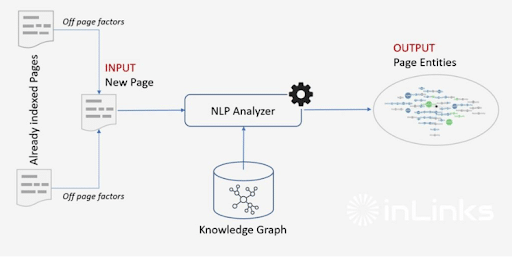
Search engines decide how to rank pages by interpreting a page’s entities and the connections between them.
There are two key concepts at work here:
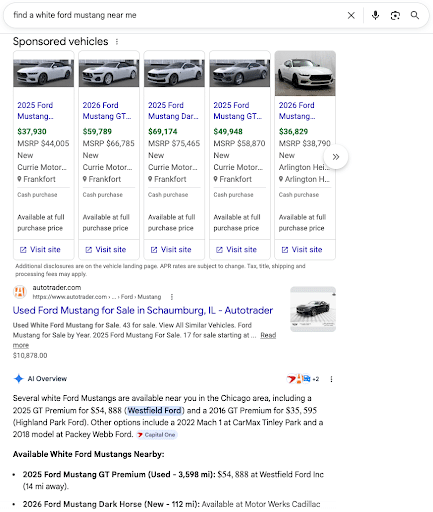
- Named Entity Recognition (NER): This is a process that entails scanning text and both identifying and placing named entities into certain categories like person (PER), location (LOC), and organization (ORG). For instance, in a voice search for “Find a white Ford Mustang near me,” the NER breakdown would label “white” as a color, “Ford” as a brand, and “Mustang” as a model, structuring the text.
- Semantic Network: This refers to the way search engines determine the relationship between various concepts, with objects or concepts making up nodes and their relationships forming edges to connect them. In the above query example, Google might connect the Google entities to the nodes “Ford” (representing Ford Motor Company), “Mustang” (vehicle model), and “near me” (location based on the user’s coordinates), with certain edges, e.g., “Mustang [manufactured-by] Ford” and “Mustang [has-color] white,” giving these terms more context.
Search engines use these components in natural language processing (NLP) to accurately interpret queries based on the user’s intent, which could subsequently inform the specific type of search result that comes up, such as a Knowledge Panel for searches with informational intent or a local map pack for locally based transactional intent.
Taking the Ford Mustang query example, a “Sponsored vehicles” block appears as the top result, followed by a link to a dealership and an AI Overview with a list of models for sale and their locations.
Entity SEO vs. Traditional SEO
To highlight the benefits of entity-based SEO for LLMs, let’s compare it to other types of SEO strategies:
| Strategy Type | Relevance Focus | Intent Matching | Future-Proofing |
| Keyword SEO | High relevance for exact phrases but low for context, with an emphasis on targeting search volume | Matches specific queries regardless of intent and may not focus as much on clearer long-tail and more conversational queries | Low; can’t adapt to algorithm changes and comes with the risk of over-optimization with keyword stuffing |
| Entity SEO | High relevance for topic-based and conceptual searches, covering related semantics and relationships | Connects directly with people’s intent, going beyond mere keyword and topic matching | High; critical for ranking for AI-powered search features and SERP features like Knowledge Panels |
| Semantic SEO | High relevance for certain topics and subtopics | Focuses on covering all related topics and subtopics without necessarily aligning with intent | High; targeting specific semantic meanings and long-tail keywords can help strategies adapt in the long term |
Mapping User Intent Through Entities
If you want to learn how to find entities for SEO optimization, you must map your content to the specific types of search intent, including:
- Informational: People at this stage want to find more details about a particular topic, potentially looking for more information about a particular problem or a solution to that problem at the top of the sales funnel.
- Navigational: At this stage, people might be trying to find a particular page on a website, like “Facebook login” or “Amazon contact page.”
- Transactional: When people are ready to make a purchase, they’ll wind up here, entering queries such as “buy [product]” or “find [product/service] in [town].”
Certain long-tail keywords will connect to each of these, and you can build your content around them with natural inclusions in meta titles, descriptions, and the pages themselves.
For more effective mapping, you can analyze SERPs to see what kinds of content appear for a given query and look at related entity networks using certain entity tracking tools.
Structuring Content for Entity SEO
Once you’ve mapped your content, you need to structure it to integrate entity-based SEO for LLMs to understand it.
There are three main pieces of content that should include entities with clear relationships between them:
- Title Tags: Your title tag is what appears in blue text in search results, and it should include a primary entity and, when possible, contextual terms, but it should not exceed 60 characters. For instance, a medical blog might have a post with the title tag “[Medical Condition] Symptoms | Early Warning Signs”
- Meta Descriptions: This is text that appears beneath title tags and gives users more context as to what the page is about, although it doesn’t directly impact SEO. These descriptions could also include your key entity and related terms, and they should cut off at around 155-156 characters. The above example might look like “What are the signs and symptoms of [condition]? Learn more about what to look for, including key early warning signs.”
- Headers: Throughout your pages, you might include various headers with related entities, covering various subtopics throughout to break up page content. On the corresponding page for that medical blog, headers might include “What Are the Signs of [Condition]?” and “How Is [Condition] Diagnosed?” Keeping each section short and well-structured with short paragraphs and bullets could help each appear in featured snippets and other SERP features.
Schema Markup and Structured Data
Another core component that can help search engines understand your content is structured data, including schema markup.
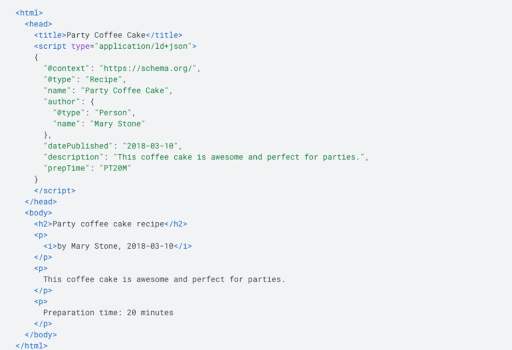
Instrumental to technical SEO, structured data integrates entities into a web page’s code to indicate to search engine crawlers what that page is about. This code can subsequently increase the chances of that page ranking for particular related queries and achieving spots in certain SERP features.
For example, here is schema markup for a recipe:
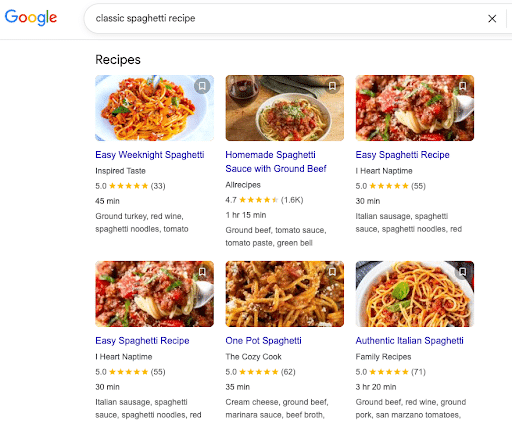
Similar pages using this kind of structured data could appear in Recipes snippets, such as this one for “classic spaghetti recipe:”
There are multiple types of schema labels you could use to establish entities, such as Organization, Product, or Person.
You can also test your structured data to validate your code and determine if your content shows up for rich snippets. Start by conducting generic testing using the Schema Markup Validator, followed by implementing the Rich Results Test tool on Google to find out what kinds of results you can appear for with entity-based SEO.
Measuring Entity SEO Success
When gauging the success of your efforts, there are certain metrics to track, such as:
- Knowledge Panel appearances for certain queries
- Rich snippet frequency
- Entity performance based on how much traffic you get from entity-based searches
There are multiple tools you can use to measure these as well. For instance, Google Search Console features a rich snippets reporting capability to show you how pages perform in product snippets, merchant listings, and other SERP features.
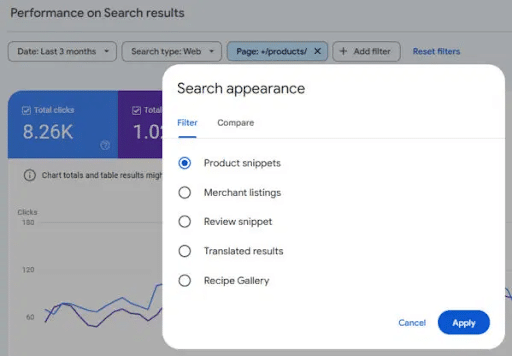
You can also use schema validation and Google’s Rich Results Test tool to regularly determine whether structured data is getting results.
Certain entity trackers, like Techsalerator, will also help you analyze and visualize entities, ultimately helping you determine how to find related entities for SEO that can help you rank and drive traffic.
Future Trends and AI Search
With the continued development of AI search, marketers need to consider how entity SEO will influence generative search results.
AI Overviews, AI Mode, ChatGPT, and other generative engines rely heavily on entity-based SEO for LLMs to relay the most accurate and helpful results, and they’re responsible for most zero-click searches. As such, appearing for these will be increasingly important, especially considering those engines include citations for the most relevant websites.
Also, consider the growth of voice search and how people use Apple Siri, Amazon Echo, and other platforms to perform more conversational searches. Taking these queries and their intent into account will guide your optimization strategy, especially when targeting long-tail search patterns.
FAQs
1. What is entity SEO in simple terms?
In short, entity-based SEO involves optimizing a website for specific concepts, relationships, places, people, and brands instead of simply keywords. This approach helps search engines better understand your content to rank more effectively based on users’ intent.
2. Why is entity SEO important for modern search engines?
Entity-based SEO for LLMs is essential for good SEO, as it can enable search engines to better understand your content and what it’s about, optimize your content for AI-powered searches through entity recognition, and achieve higher rankings for multiple related queries instead of a single target keyword.
3. How do entities improve search intent alignment?
Knowing how to find related entities for SEO will help search engines understand the context of your content and connect it to users based on their specific intent. When people are looking for particular information, your content will be more likely to appear if it matches their intent, whether seeking topical information or looking to make a purchase.
4. How do I measure entity SEO success?
You can measure the success of your entity-based SEO strategy by tracking certain metrics like:
- Knowledge Panel appearances
- Rich snippet frequency
- Entity performance based on rankings, traffic, and other KPIs
You can also use multiple tools to track progress, including Google Search Console, entity trackers, and structured data testing tools.
Optimize for Google Entities With Ignite Visibility
Based on this entity SEO guide, you should have a better idea of how to achieve top rankings with the right strategy. However, it can take a lot of effort to get it right, which is why you may benefit from working with Ignite Visibility to give your strategy the direction it needs.
With our experts behind your entity-based SEO strategy, you can:
- Determine how to find entities for SEO optimization
- Conduct keyword research with in-depth intent mapping
- Develop high-quality content that covers all relevant topics
- Implement schema and other on-page and technical SEO tactics
- Continually measure results with detailed reporting and analytics
- And more!
Contact us to discover how to use entity-based SEO for LLM optimization and get started on your next campaign.

