

Google’s search box used to be a mere keyword input field, but that’s changing. Now, Google AI search has transformed the search bar into a more interactive platform. People can now use it to engage in conversation with a multimodal, AI-powered search function that synthesizes answers based on longer queries and uploaded context.
It’s arguably the biggest shift to organic search we’ve seen in 25 years, as it’s completely changing the way people engage with search engines.
In turn, AI visibility is shifting, but fear not: SEO is far from dead.
In this blog, Jason Carleton, Sr. Director of AI SEO, will go over the new Google search bar, how it works, and how it’s changing the way marketers do SEO.
What’s Covered:
- What’s Changed With the New Google Search Bar?
- Why This Matters for Online Visibility
- How the New Google Search Bar Could Affect Organic Traffic
- Best Practices for Optimizing Content for Google’s AI Search Experience
- Measurement: How to Track Visibility in an AI Search Era
What’s Changed With the New Google Search Bar?
In May, Google announced that it would revamp its search bar with new AI features, allowing users to ask more complex questions with a dynamic box that adapts to each user. It effectively brings the features of AI Overviews and AI Mode directly into the search function, creating a more engaging experience that keeps people exploring after that initial search.
In short, it’s bringing AI to the forefront of the Google experience as the default functionality, which has major implications on the way people will search moving forward. Gone are the days when most queries consisted of basic two-, three-, or four-word terms, as we can expect people to get highly specific with their searches.
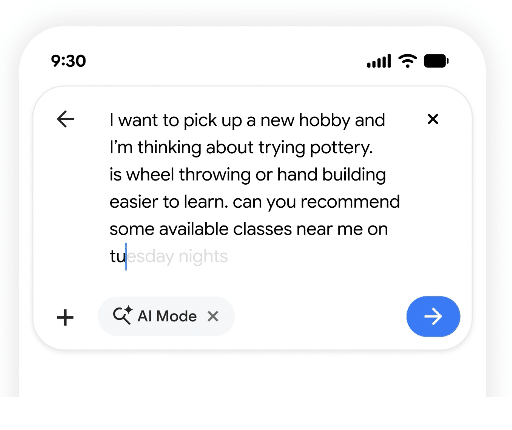
So, what is the AI search called on Google? The search engine uses Google Gemini, with the new search bar using Gemini Flash 3.5 to add features like:
- Longer, Conversational Prompts: AI mode in Google search now allows users to enter longer prompts in more conversational language, complete with a dynamic box that expands as they type.
- Multimodal Inputs: People can also give Google more context by uploading videos, images, and audio, including voice and text inputs. For example, a user could take a photo and upload it to Google with a text prompt asking what’s in the image.
- AI-Powered Follow-Ups: After completing a search, Google may encourage them to continue exploring a topic with AI Mode and converse with an agent, keeping them more consistently engaged.
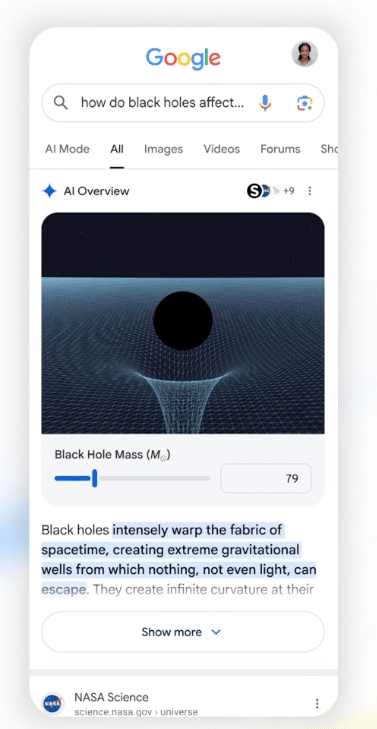
- Agent-Like Search Tasks: Also taking users beyond the basic Google search is the inclusion of agent-like responses right within the search window, providing users with a synthesized answer in the most appropriate format, with components like interactive visuals and simulations tailored to each search.
Why This Matters for Online Visibility
With the upgrade to more AI-powered search, visibility in search results is quickly changing in a big, big way.
Instead of relying on old-fashioned rankings in traditional results with blue links, websites now need to use AI search optimization to appear in citations, summarizations, and recommendations within Google’s AI ecosystem.
The latest stats show just how significantly these changes are leading the shift in organic search: Semrush found that AI Mode sees a 93% zero-click rate among all results, while Seer Interactive observed a 61% decrease in click-through rates for AI Overviews. Subsequently, Gartner predicts a staggering 50% decline in organic traffic by 2028.
Not that traditional rankings don’t matter, it’s just that to maximize your AI visibility, you need to provide your audiences with useful, authoritative, clear, and contextual content. And AI visibility is an absolute must today.
As a result, appealing to Google’s E-E-A-T guidelines for Experience, Expertise, Authority, and Trustworthiness is now more important than ever.
Expert Opinion on Google AI Search
With the continuous integration of AI into the search experience, the SEO landscape is consistently changing, but we’ve rarely, if ever, seen any change as substantial as this. AI has already altered the way most people conduct searches, and that change is only going to continue as AI plays an even more central role in the search experience.
Because of this shift, many marketers claim that “SEO is dead” and that working to optimize in a world of AI search is essentially useless, but this couldn’t be further from the truth. So much of what determines whether your site appears in AI results, from regular results to extensive AI Mode responses, involves the development of high-quality and well-optimized content.
With the right approach to your strategy, using a combination of practical on-page and off-page SEO with helpful and well-structured content, you’ll be able to boost your brand’s visibility across all types of search results.
I’ve seen how good SEO practices can still make a difference, as long as those practices adapt to AI-driven search results. We were able to optimize the content for one big home services franchise to yield a 458% increase in AI visibility, a 20% increase in leads, and 60% faster content deployment to help them show up in AI Overviews, ChatGPT, and other generative engine results.
If you know how to adapt your SEO to the shift toward zero-click experiences, you can ensure Google continues to highlight and recommend your brand over competitors. Subsequently, you’ll be able to optimize conversions and continually acquire high-value leads and customers.
SEO Isn’t Dead, but “Search Visibility” Is Expanding
With the rise of AI in Google search and across other search engines, you might wonder whether traditional SEO still matters.
The fact is that the fundamentals of SEO will stay relevant indefinitely, as Google AI search features still require and seek out crawlable, indexable, and high-quality content. Search engines continue to prioritize the most helpful and authoritative content when including it in both AI Overviews and AI Mode.
However, to account for the new Google search bar, you will need to make sure your content is also clear enough for AI agents to summarize, cite, compare, and use as valuable evidence to maintain better visibility.
For example, you may want to answer various likely queries around a topic in concise FAQ sections on certain pages. You should also use bulleted lists and the right combinations of H1, H2, and other headings throughout to break up your content into various subtopics.
How User Intent Is Changing in AI-Powered Search
Seeing as AI-powered search encourages more in-depth conversation, search intent is also changing as people become more likely to enter complex queries.
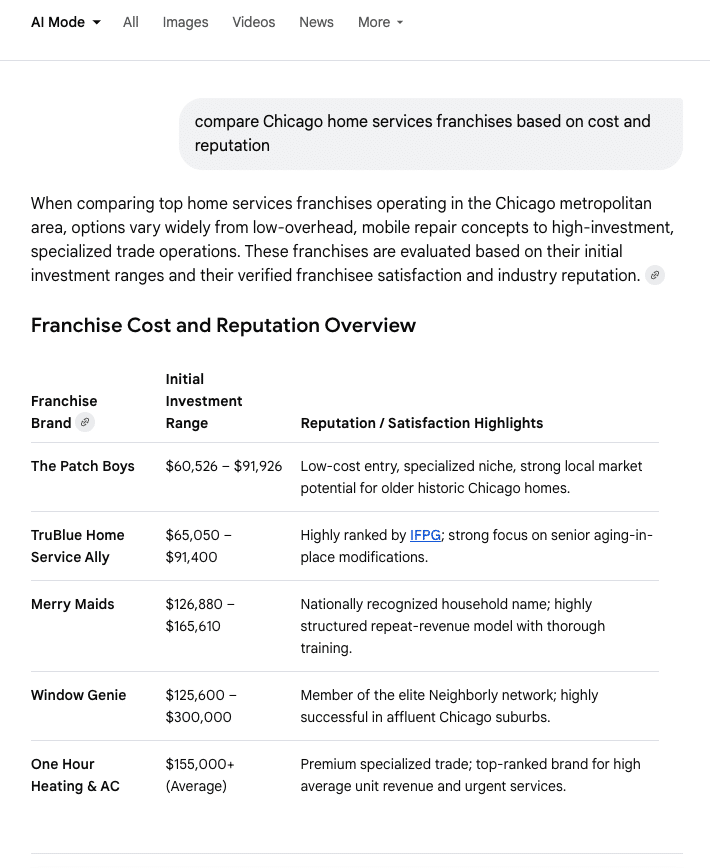
For instance, people might have entered a basic commercial query like “best CRM software” in a traditional search. Meanwhile, when chatting with AI Mode, a query might look more like “compare CRM software for a 20-person B2B SaaS team with HubSpot integration and low onboarding time,” seeking a detailed comparison with specific features.
As a result, you’ll want to target more specific, contextual, and task-oriented intent in your content to increase the chances of getting cited and recommended.
How the New Google Search Bar Could Affect Organic Traffic
Also, consider how Google AI search features will impact your website’s traffic.
While some queries might lead to more zero-click experiences for users, others could lead people to visit your website as they look for more reliable and accurate information, intend to purchase or try out tools and products, or request help from industry experts.
Even if you appear in zero-click results, potential leads could come to know and trust your brand over time as AI cites you multiple times or even recommends you when comparing top brands. Eventually, those leads looking for information at the top of the funnel might be more inclined to click over to your site instead of competitors.
An example here could be a healthcare practice that initially appears in citations for an AI Overview detailing a particular medical condition or symptom that a prospective patient is researching. After searching for information about their condition, they may then compare doctors in their area and come across the same practice, eventually leading them to seek more information directly on the practice’s site before they ultimately wind up booking an appointment.
What This Means for Brand Visibility and Digital PR
In addition to high-quality, helpful, and well-structured content, you need strong reputation management across the web to appear in more citations.
AI search will pull surface information from across all relevant sources, but it also prioritizes those with established off-site credibility through brand mentions and a good overall reputation.
To help you maximize brand visibility, you’ll need to boost your reputability through:
- Digital PR: Official press releases, content countering negative press, influencer seeding, and other digital PR methods can help maintain or restore your brand’s reputation.
- Third-Party Brand Mentions: Use social listening tools to keep track of and conduct sentiment analysis for brand mentions all over the web, including those on news articles, forum threads, and social media.
- Review Sites: Track reviews on your Google Business Profile and other review platforms, working to provide the best experiences to encourage more positive reviews while responding thoughtfully to any negative ones.
- Industry Publications: Appearing in trusted industry magazines and other publications, including online sources with backlinks to support your link-building efforts, can make AI more likely to cite and recommend you.
- Consistent Brand Messaging: Develop a strong brand messaging strategy to set your business apart from competitors and build more trust, with a recognizable brand voice and clearly expressed values across your content.
How Multi-Location Brands Should Respond
Some industries will see a bigger hit from AI than others due to the nature of their businesses. One of these industries is multi-location businesses, such as franchises, home services, and urgent care.
In our 12-month forecast for organic traffic across industries, we found that publishers and media brands would suffer the most, with a predicted 40-60% organic decline, while local and multi-location businesses would see a much lower drop of 5-15%.
The latter businesses appear to do better than most in maintaining organic traffic for a number of reasons, such as:
- The Google Map Pack remains structurally protected through personalized content that AI Mode can’t summarize.
- Transactional local intent directs users to business contact details instead of paragraphs of informational content.
- Users complete actions beyond AI search, whether they need to travel to a location, make a call, or schedule an appointment.
- Citations for local queries bring back local business entities that business operators control, primarily from directories.
If you operate a local business with multiple locations, there are some specific considerations to help with AI search optimization.
To boost visibility for these brands, you may need to incorporate:
- Accurate business profiles on Google Business Profile and other platforms
- Product feeds complete with images and pricing
- Reviews on your GBP and sites like Yelp or other industry platforms
- Availability with consistently updated business hours
- Pricing for your products or services
- Location information
- Service details
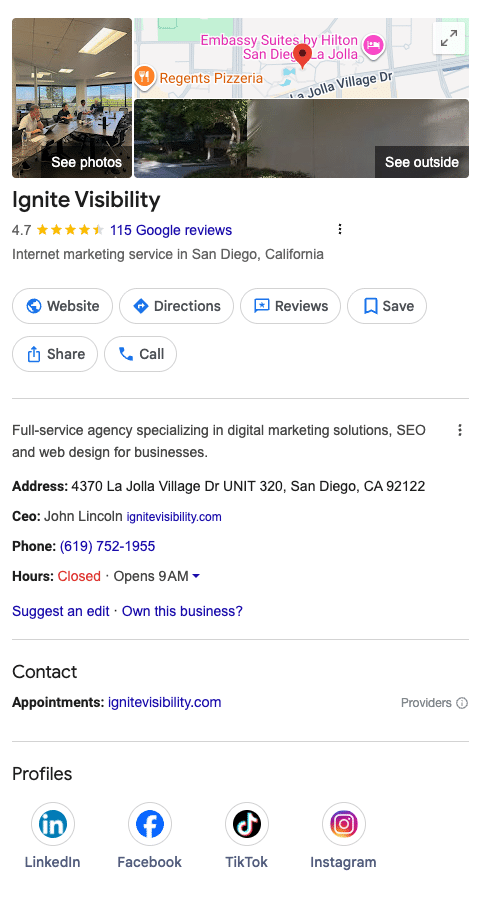
Your Google Business Profile will matter most here, as it is often the central hub from which Google AI pulls information about businesses in traditional results and citations.
How Ecommerce Brands Can Also Thrive
Like multi-location and local businesses, ecommerce brands are less likely to struggle amid the AI takeover, with a predicted 10-25% organic traffic decline in the next 12 months.
In fact, ecommerce businesses have the chance to thrive in the AI ecosystem with structured data for products and a defined, reputable brand identity.
People will want to find the best products quickly and ultimately buy them, with a short journey from interest to purchase if you offer the most compelling and trustworthy products and brand experience.
Here are some steps that ecommerce brands can take to maximize visibility in the AI era:
- Developing strong structured product data for product pages
- Content detailing use cases for each product to suit every customer’s needs
- Maintaining product reviews and star ratings to appear in recommendations
- Creating in-depth product comparisons
- Writing guides around size, care, and other aspects of product offerings
- Curating and building accurate, in-depth, and consistently updated product feeds
What Types of Content Are More Likely to Stay Visible?
When trying to appeal to Google AI search, you need to avoid producing commodity content. This type of content is generic and lacks unique characteristics that set it apart from other online sources. Even if it’s well-written and optimized, content could still fall under Google’s definition of commodity content if it offers nothing of real value to users.
Instead, try to produce content that goes beyond generic summaries and explanations, such as:
- Original Research: Include your own or industry-specific studies and reports to enrich your content, with detailed statistics and cited sources.
- Expert Commentary: Provide a unique perspective with your content through expert opinions and insights, with a bio establishing the professional’s credentials and reputation in your industry.
- Comparison Guides: Help audiences make the right choice with comparisons of different products, services, or brands based on the kinds of features and other criteria people prioritize.
- Data-Backed Explainers: In blog posts, explainer videos, and other content, back your claims up with data from credible sources.
- Industry Benchmarks: Take a look at your competitors to see what kinds of content they produce and use those tactics to set benchmarks for your own and fill any gaps that competitors miss.
- First-Party Insights: Integrate first-hand experience into your content, whether it’s from an expert on your team or even from your customers or clients who’ve been happy with their experience.
- FAQs: When appropriate, you could add an FAQ section to your pages to answer questions that people are likely to ask (possibly informed by Google’s “People Also Ask” section in search results), or you might create a dedicated FAQ page to answer a wider range of questions.
- Tutorials: Provide some guidance to your audiences with detailed tutorials, as AI in Google search is likely to cite video tutorials (including specific sections) when people enter certain “how to” queries.
- Multimedia Resources: Combine text with images, videos, and interactive media to create rich content that informs Google AI’s new search experience while increasing the chances of appearing in visual search and other results.
Best Practices for Optimizing Content for Google’s AI Search Experience
To help with AI search optimization through durable SEO and content quality improvements, follow these best practices:
Create Non-Commodity, Expert-Led Content
Avoid generic content by developing content that’s uniquely helpful and compelling.
Non-commodity content will offer original perspectives with expert points of view, first-party insights and experiences, a clear structure, and high-quality media with a user-centric focus.
Structure Content for Humans First, AI Systems Second
This has been a long-standing SEO trend, and it’s even more crucial for appearing in AI search results.
Create content with the user in mind, developing blog posts, web pages, videos, and other content types with the primary purpose of helping, informing, and guiding your audiences. All other optimization efforts should come secondary.
Build Strong Entity and Topic Associations
Practice good entity SEO and establish topical authority by producing content around a wide range of relevant topics.
For example, you could produce pillar pages that explore a core topic in great depth, with branching blog posts and other pages that do a deeper dive into individual subtopics. Throughout, your content is likely to naturally incorporate a lot of long-tail keywords that contribute to entity SEO, giving AI crawlers more context to match your content to complex, specific queries.
Use Evidence, Data, and Examples
To support your content and establish authority for AI and users alike, support your content with plenty of evidence and data. Evidence could come in the form of expert insights and experiences, industry studies, and statistics that enhance your points.
Also, include specific examples to further enrich your content and make it stand out from the mountains of commodity content.
Optimize Technical SEO and Crawlability
To help with indexing and ranking, you must integrate technical SEO techniques that assist AI crawlers.
Optimize your robots.txt (and llms.txt), XML sitemaps, and schema structured data to make it easy for crawlers to scan, index, and understand your website’s structure and content.
Measurement: How to Track Visibility in an AI Search Era
To track your brand’s progress and determine whether you’re achieving your specific goals, there are many metrics you should measure using Google Search Console, Google Analytics 4, and other tools.
These metrics can include:
- Impressions: How often your content shows up in AI chat responses and traditional results.
- Clicks: The number of users who click your link from AI responses.
Brand Search Demand: The volume of users entering your brand name in search queries. - Assisted Conversions: Interactions involving AI referrals to your site that lead to conversions, helping with attribution tracking.
- Referral Quality: The overall conversion rate and value of traffic from AI responses.
- AI Citation Appearances: The frequency of citations in AI responses linking to your site as a source.
- Featured Snippets: Traditional search results that summarize information similarly to AI Overviews.
- Engagement: User behavior following clicks from AI responses, such as time on page, scroll depth, and bounce rates.
- Content-Assisted Pipeline: The total sales leads or revenue that come from AI-crawled and -cited content.
Optimize for Google AI Search With AI SEO From Ignite Visibility
There’s a lot that goes into effective AI search optimization, which is why it helps to have experts who understand what these strategies require. Ignite Visibility can develop high-quality content and implement tailored SEO strategies to help you achieve top rankings in both AI and traditional results.
With our professionals backing you, you’ll be able to:
- Produce and curate top-quality, user-centric content
- Incorporate technical SEO tactics to improve crawlability and indexability
- Monitor rankings and conversions from AI responses
- And more!
To find out how we can develop a tailored solution that helps optimize AI visibility, learn more about our AI SEO services today.

