

Search engine optimization (SEO) is one of the most important aspects of any digital marketing strategy, but there is a lot that goes into it beyond optimizing content with keywords. A complete strategy involves a combination of tactics, from on-page optimization and user intent mapping to developing rich content and structuring content for AI search results.
In this blog, we will provide you with a complete SEO starter guide to get you going with your next strategy.
Make sure to subscribe to our YouTube channel for the latest SEO strategies!
What You’ll Learn:
- How Google Search Works
- SEO Foundations Checklist
- Keyword Research as Demand Research (Not Just Words)
- User Intent Mapping
- E-E-A-T in Practice
- On-Page SEO That Still Matters
- Content Structure for Featured Snippets and AI Overviews
- Authority and Off-Page SEO
- Measuring SEO
- 30/60/90-Day SEO Starter Plan
How Google Search Works
In plainest terms, SEO involves optimizing a website to appear toward the top of search engine results pages (SERPs) for various keywords.
When selecting content to rank, Google and other search engines crawl pages on the internet, indexing them and ranking them for various terms based on relevance.
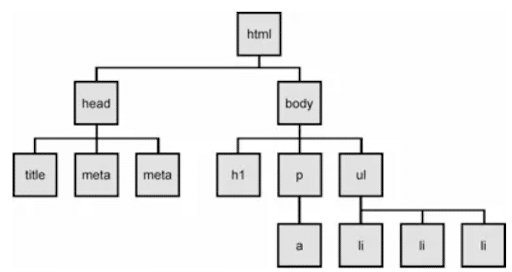
Rendering is crucial here to allow search engines to access pages and index them, with crawlable structures, such as HTML code and corresponding tags.
SEO Foundations Checklist
To open our Google SEO starter guide, let’s look at some of the foundational elements of a good SEO strategy:
- Verify Indexability: You can confirm whether search engines are able to index your site by searching “site:yourdomain.com” in Google and seeing which pages appear in the results; you can also check for “noindex” tags in your code that might prevent pages from getting indexed.
- HTTPS Structure: With an SSL certificate, you can ensure your website uses a secure HTTPS protocol instead of HTTP.
- Mobile Optimization: Make sure your site is mobile-friendly with a responsive design that adjusts to users’ screen sizes, and run Google’s mobile-friendly test tool.
- Analytics Setup: Install analytics tools to track SEO performance, including Google Analytics 4 (GA4) to measure user behavior and Google Search Console (GSC) for identifying crawling and indexing issues.
- Sitemap Structure: Create an XML sitemap that lists all of the most important pages on your website for ease of access to site crawlers, and submit this sitemap URL to Google via GSC to accelerate the crawling and indexing process.
- Robots.txt Setup: Your website should also have a robots.txt file that allows Googlebot to crawl pages and render them.
- Core Web Vitals & Page Speed: Google uses a set of metrics called Core Web Vitals to measure the actual “user experience” of your site. This includes how fast the main content loads (LCP), how quickly the page responds to a user’s first click (INP), and whether elements jump around while loading (CLS). Use tools like PageSpeed Insights to ensure your site is snappy; a slow site will drive users, and rankings, away.
Keyword Research as Demand Research (Not Just Words)
The next step in our Google Search Central starter guide entails one of the core components of any SEO strategy: keyword research.
But how do we find keywords? While the focus used to be primarily on keywords with the highest volume and lowest competition, it’s most important to find keywords that align with user intent.
Try to prioritize topics to target with long-tail keywords over simply the keywords themselves. Topic clusters comprising a main topic and subtopics can give you content ideas that help you build topical authority in your industry.
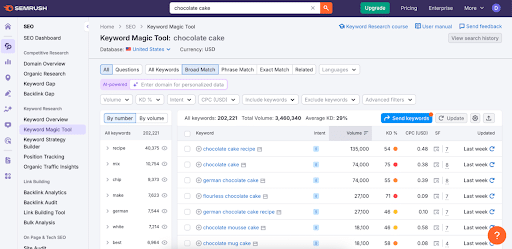
Once you locate the keywords to target, categorize them into “primary” and “secondary” terms. For example, a website for a fitness business might have a page covering the primary topic of “best home workouts” as a primary term, with “best workouts for leg muscles” as a secondary term covered under a subheader.
Keywords should also be the most relevant to your business, and you should avoid targeting too many broad keywords with unclear intent behind them.
If possible, you should also go for “low-hanging fruit” keywords that offer high value with low difficulty, helping you establish topical authority without needing to build domain authority first.
User Intent Mapping (The Step Most Teams Skip)
Next up in our SEO starter guide is something that many marketers often overlook, and that aspect is intent.
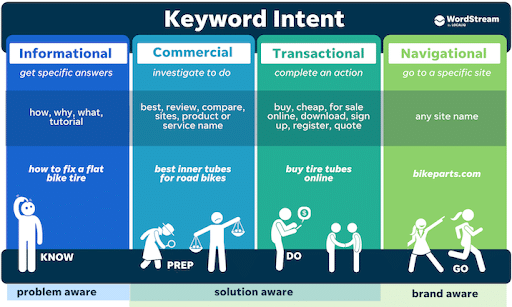
Your keywords must align with specific types of search intent based on what users want to achieve with each search. By mapping keywords to intent, you’ll be able to move more people down the sales funnel toward a sale as they engage with your brand and content.
There are four main types of intent to map, including:
- Informational: At this stage, audiences want to learn more about certain topics, such as problems they’re trying to resolve or educational information from a reliable expert. Here, some content types that might resonate most include blog posts, articles, and how-to guides.
- Commercial: Here, users are getting ready to make a purchase but still want more information to help them make a sound decision. The content you could use at this level might include comparisons, reviews, customer testimonials, and other materials that convince audiences that your products or services are right for them.
- Transactional: When audiences reach this stage, they will be interested in buying, entering terms with words like “buy” or “pricing” or branded searches for particular offerings. Free trials, demos, checkout pages, and clear calls-to-action will help move people toward a sale during the transactional phase.
- Navigational: This intent involves finding specific locations, web pages, or brands. For instance, people might search for a login or customer service page, complete with a brand name in the query. Optimized login pages, location pages, and homepages can help you appear for these searches.
Create Helpful, People-First Content (E-E-A-T in Practice)
One of the most important Google Search Central SEO starter guide best practices is to develop high-quality content that people find useful.
More specifically, you want to create content that appeals to Google’s E-E-A-T SEO guidelines, which emphasize the need for sites to display Experience, Expertise, Authority, and Trustworthiness.
To appeal to E-E-A-T, your content should demonstrate unique, original industry insights that help differentiate you from competitors. Showcasing first person experience through blog posts, articles, guest posts across the web, videos, and other high-value content will signal to Google that your brand comes from a place of true authority and trustworthiness.
In the process, you must develop people-first content that naturally incorporates keywords and other optimization tactics throughout instead of focusing primarily on SEO.
On-Page SEO That Still Matters
What SEO starter guide would be complete without covering on-page optimization? This element involves multiple aspects that gear individual pages for top rankings.
Title Tags and Meta Descriptions
To start with, consider title tags and meta descriptions, which appear in search results. Title tags are those clickable headings that lead people to the page, and they can directly impact SEO with relevant keywords and phrases. Meanwhile, meta descriptions supplement title tags with brief summaries of underlying page content, and while they do not have a direct effect on SEO, they can encourage people to trust the page and click through.
Here are some formulas to follow for title tags and descriptions:
- Title Tags: A maximum of 70 characters, but should ideally be no more than 60 to ensure everything fits within search results, and should include a top keyword phrase and, if there’s room for it, a secondary keyword or brand name separated by a pipe, e.g., “Used Cars for Sale in [City] | [Company Name]”
Watch Video on Title Tags
- Meta Descriptions: A maximum of 160 characters, but 156 or fewer will help guarantee all of the text appears in search results. Descriptions should clearly describe the content of the page and may include a call to action, e.g., “Find many of the best used cars for sale in [city] here at [company name]. Call us today at XXX-XXX-XXXX.” Look at the description like ad copy supplementing the main header.
Watch a Video on the Descriptions Meta Tag
Keep in mind that Google measures title tags and descriptions based on pixel width rather than character count, which is why the ideal length may vary based on characteristics like the number of capital letters included in the text.
Headings
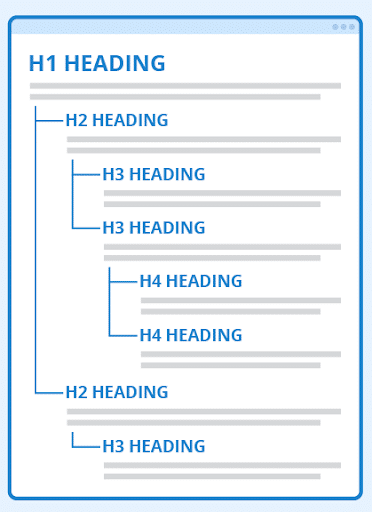
Another key component in our Google SEO starter guide, headings help break up content into scannable sections for easy skimming. At the same time, optimized H1s, H2s, H3s, and other subheadings can include keywords and help with direct optimization.
Internal Links
You must also include internal links on your pages that support other pages on your site where appropriate.
Links should include anchor text with keywords that the linked page needs to rank for, and more authoritative pages will help support those corresponding pages through good link equity.
Learn How to Do an Internal Linking Structure For SEO
Image Optimization (Alt Text)
Search engines can’t “see” images the way humans do. To help them understand your visuals, always include Alt Text
This is a brief, descriptive sentence about the image that includes a relevant keyword if natural.
Beyond SEO, this is vital for web accessibility, as screen readers use this text to describe images to visually impaired users.
Additionally, always compress your images to keep file sizes small and load times fast.
Watch a Video on Image Optimization for SEO
Content Structure for Featured Snippets and AI Overviews
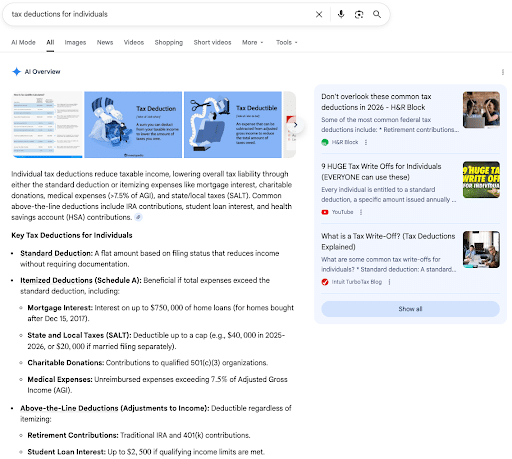
A good SEO starter guide should also cover featured snippets and AI search results, which are essential for maximizing SERP visibility, especially for zero-click searches.
To optimize content for paragraph snippets, lists, tables, videos, People Also Ask sections, and other types featured snippets, as well as AI Overviews, AI Mode, and other AI search engine results, you need to properly structure your content.
Offering concise content pieces in the form of the following can increase your chances of achieving these results:
- Definition blocks for certain industry terms
- Lists, including bullets with multiple items or steps for completing a certain process
- Tables
- FAQs answering related questions
- TL;DR summaries toward the top of the page
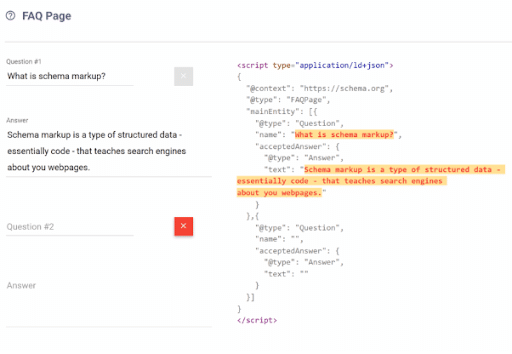
- Schema structured data that gives Google more context regarding what a page is about
As more and more people turn to AI search, ranking for AI Overviews and Mode results is becoming particularly important.
Helpful and well-structured content will help you rank for these, complete with citations that encourage people to click through for more information from reputable sources.
Authority and Off-Page SEO
Yet another major component of strong SEO entails building brand authority outside of your website through effective off-page SEO.
You can build authority in a number of ways to establish your brand as a reliable source, signaling to Google that your site is authoritative and a shining example of E-E-A-T compliance.
For instance, you can get earned links through guest posts on other websites in your industry that have domain authority. Partnerships can be a great way to get more links to your site from trusted sources.
Developing data-led studies and surveys, covering trending topics, offering expert commentary, participating in industry Q&As and interviews, and using other digital PR strategies will further get your brand out there to build authority.
Positive brand mentions on social media, forums, and other sites can also help you develop an authoritative online presence.
However, you must avoid manipulative tactics like fear-based marketing, creating a false sense of urgency with your content, and fabricating reviews and social proof for brand mentions. Black-hat strategies like this will only serve to hurt your reputation in the end.
Measuring SEO
To start wrapping up our Google SEO starter guide, let’s go over how to measure the results of your SEO strategies.
While many marketers may be tempted to focus on vanity metrics like rankings and traffic, you must choose relevant key performance indicators (KPIs) that align with your specific goals.
Depending on what you want to achieve with your strategy, your SEO report could include metrics like:
- Impressions indicating how many people encounter you in search engines
- Click-through rates
- Selective rankings for high-value keywords, such as those that bring in the most clicks and conversions
- Conversions based on people’s completed actions, such as contacting your business after engaging with a high-ranking landing page
- Assisted revenue attributing SEO efforts to income and ROI
- Content decay via metrics like dropped traffic, rankings, and overall relevance, signaling the need for refreshes and updates
30/60/90-Day SEO Starter Plan
To conclude our beginners guide to SEO, here is a basic plan to help you develop a strategy that gets real results:
| Time Frame | Focus Area | Key Objectives |
| 0-30 Days | Foundational Elements |
|
| 31-60 Days | Content and Internal Links |
|
| 61-90 Days | Refining and Authority |
|
Develop a Winning SEO Strategy With Ignite Visibility
With the help of this SEO starter guide, you can be on your way to achieving top search results with high-quality, helpful content that helps you stand apart from competitors. It can take a lot of effort to create a successful strategy, as you can see, which is why you may benefit from turning to experienced pros to help handle your SEO.
With Ignite Visibility behind your strategy, you will be able to:
- Identify the best keyword opportunities
- Establish relevant KPIs and metrics based on your goals
- Align keywords with user intent
- Develop top-quality, well-optimized content covering all relevant topics
- Build external and internal links
- Optimize for AI search results
- And much more!
To find out how we can help you with your next strategy, reach out to us today to request a free proposal.

