

Facebook algorithm changes are nothing new, but these can be a thorn in the side of businesses who rely on social media to increase brand awareness.
In this post, I’ll cover the recent Facebook updates, what they mean for your brand, and how you can keep your content relevant on the channel.
What We’ll Cover:
- The recent major Facebook algorithm changes:
- How the Facebook algorithm works
- How brands can stay relevant (and seen) on Facebook:
In 2018, Facebook did something that shocked the marketing world: it significantly limited organic reach for businesses on Facebook.
This year, Facebook took another step that has hurt businesses using Facebook Pages. The company is promoting content from close friends more often than businesses.
It’s getting a little harder for brands to make a name for themselves on Facebook. But it’s not impossible.
It is absolutely still possible with ads. But how about organic reach?
The Facebook Algorithm in 2020
Before diving into past changes which have a big impact today there are a few things to know about Facebook as it stands.
Facebook considers three major categories for how it ranks content:
- User interaction: Who and what are users interacting with on the platform
- Media type: Are they mainly interacting with videos, links, photos, and other options.
- Post popularity.
Amazingly, Facebook has tried to make its algorithm more transparent because as of March 2019 you have the option to find out more with the “Why am I seeing this post?” option.
This allows user to exert a little more control over the experience they have on Facebook.
Below are other recent changes which you need to know about.
Facebook Algorithm Change #1: “Meaningful Interactions”
I like to call this one “the Facebook change heard ‘round the world.”
But on a less dramatic note, let’s just say it was a big one.
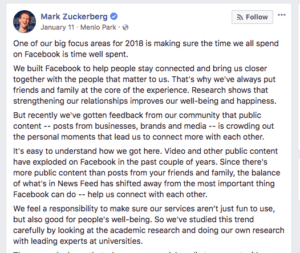
On January 11, 2018, Mark Zuckerberg released a memo on Facebook stating a complete overhaul of the traditional newsfeed in favor of “meaningful interactions.”
And as you can imagine, the (business) world let out a collective: “Huh?”
So here’s the gist: this Facebook update intends to give priority to posts that create meaningful conversations (especially from close friends and family).
To make it happen, the Facebook algorithm will be prioritizing posts from friends and family over content from Pages.
“As we roll this out,” wrote Zuckerberg, “you’ll see less public content like posts from businesses, brands, and media. And the public content you see more will be held to the same standard — it should encourage meaningful interactions between people.”
He goes on to cite “a responsibility to make sure our services aren’t just fun to use, but also good for people’s well-being” as the major reason behind the update.
Zuckerberg also concedes that users will have to work harder than ever to gain attention and awareness on Facebook.
What it Means for Brands: Sorry to say, you’ll likely see a decline in the overall reach and referral traffic from Facebook. You’ve probably already noticed this decline, and that’s why you’re reading this article now.
Facebook Change #2: “High-Quality News”
Right on the heels of the meaningful conversations update, Facebook announced its intention to also prioritize high-quality, trustworthy news.
This means that clickbait and controversial posts will not be going viral as quickly as before. This Facebook update is meant to make the user experience on the platform more peaceful and enjoyable with less fake news circulating around.
Remember, Facebook is big on news, and historically has given priority to those operating in the news industry (it’s called the newsfeed for a reason, after all).
But the recent Facebook update announced a crackdown on the kind of news and the sources it comes from, with the platform now prioritizing:
- News from publications that the community rates as trustworthy
- News that people find informative and useful
- News that is relevant to people’s local community
The trustworthiness of a source will be determined largely by user survey.
Facebook recently conducted a survey known as News Feed to find out what users liked to see.
The Facebook algorithm then weighs the following factors to determine whether or not certain content will be promoted on the user’s feed:
- Type of link posted
- Source of the link
- Engagement rate on the post
With the new Facebook updates, the algorithm is able to determine (based on the factors listed above) if the post is worthwhile to show the user.
Is it similar to other posts that the user has liked in the past?
As consultant and author Marie Kondo would say, “Does it spark joy?”
If the answer is no to either of those questions, Facebook probably won’t promote it on user’s feeds.
Additionally, Facebook also removed its Trending Topics section in 2018. The section, meant to highlight interesting conversations happening on the platform and around the world, used to a prime opportunity for brands to use hashtags and capitalize on topics that were getting attention.
Without the Trending Topics, brands will have to really hone in on their audience’s interests and use other means to stay on top of breaking industry news or niche interests.
What it Means For Brands: Facebook says it best: In its official announcement, the platform states “publications deemed trustworthy by people using Facebook may see an increase in their distribution. Publications that do not score highly as trusted by the community may see a decrease.”
Facebook Change #3: Limiting Repetition
One of the newer Facebook updates has limited the number of posts that users will see from the same source.
This might be a little bit confusing for some, since many are under the impression that if a user likes one post from a certain source, they will want to see everything that source puts out.
This is not the reality.
People can get tired of seeing news from the same source constantly and the new Facebook updates take this into consideration.
To get the information regarding closest contacts, Facebook ran surveys to users on which people they were closest to and which links they found most worthwhile. Based on that data, they’ve established linking factors and combined it with usage data to show more relevant information in an individual’s newsfeeds.
This comes on the heels of another recent update specifically targeting clickbait and links to low-quality sites. Additionally, Facebook began to decrease the frequency of “borderline” content, which is content that comes close to but doesn’t technically break its rules.
What this means for brands: You should be posting regularly, but don’t overdo it. It could get you flagged as spam or cause a decline in your reach. Also, be very wary of anything that could be considered clickbait.
Brands will be most impacted by the platform’s push to show more worthwhile content. As mentioned above, in one of its recent surveys Facebook set out to find which links were most worthy of user’s time.
Based on that aggregate data, Facebook narrowed down on the type of posts, publishers, and engagement levels most closely matched the results of those surveyed. Now Facebook can use that data to determine if new posts match that pattern. Posts that do will be shown more frequently, while those that don’t, well, won’t.
While we aren’t privy to the exact survey results, brands will benefit from really digging into their past data to determine the types of posts that have seen the most engagement in the past, and replicating those in their ongoing strategies.
Doing a solid competitor analysis will be beneficial as well. Do some sleuthing into your top competitor’s strategies. What kind of posts perform best for them, and how can you incorporate them into your own strategy?
If you do notice declining engagement, it’s likely time to mix up your content.
Facebook Change #4: Limiting Stories
Previously, Facebook would show users what stories their friends were liking and commenting on.
This isn’t the case anymore.
Now, stories that a user’s friends are liking appear lower on the News Feed. This is meant to keep the user’s feed full of relevant content that they like. Not everyone cares what their old college roommate is watching on Facebook.
What this means for brands: If you were relying on your followers seeing Stories their friends had interacted with, you should come up with a different strategy. Try posting stories that are likely to be shared with clearer calls-to-action. This will help you reach a broader audience.
How the Facebook Algorithm Works
There’s no cut-and-dry answer to this one.
Like most algorithms, its inner workings are a closely guarded secret only the Facebook elite are privy to.
What we do know, according to a recent Facebook News Feed Webinar, is that there are four major parts to the new algorithm with Facebook updates:
- Inventory (available content)
- Signals (consideration about content)
- Predictions (considerations about person)
- Overall score
Together, these four parts work to provide the best overall experience for each user.
As a brand, you want to focus on the signals aspect.
Before the earth-shattering 2018 Facebook update, the platform took a bunch of signals into consideration as it decided what was best to show to users. We can sort those signals into two categories: active and passive.
- Commenting (active)
- Sharing (active)
- Reacting (active)
- Clicking (passive)
- Watching (passive)
- Viewing/hovering (passive)
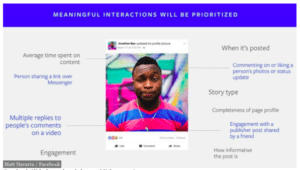
Post-algorithm update, Facebook is putting a vast majority of its emphasis on active signals. That means likes, comments, and shares are more important than ever.
How to Stay Relevant on Facebook
With all the recent algorithm updates, Facebook optimization may seem like a lost cause to many. And I won’t lie, it isn’t easy.
But there’s still a place for brands on Facebook. They just have to be very strategic with what content they choose to share and why they’re sharing it.
Remember, Facebook is putting an emphasis on active signals. With that in mind, there are few ways brands can try to recover from the latest Facebook updates.
Facebook Updates Continue to Focus on Engagement – And Start Valuable Conversation
The first step to producing engagement? Knowing exactly who you are speaking to.
I don’t mean casual acquaintance basis; I mean knowing their hopes, dreams, fears, and what they ate for breakfast.
When Facebook ranks your posts, they look at how close you are to a given person, and how your post relates to stories they would share with their friends and families. It looks at that, and broader engagement signals like how often they’ve interacted with your posts in the past.
To crack the Facebook algorithm change code, you need a laser-sharp knowledge of who this person is. Beyond the buyer persona you’ve already created, you need to look at factors like the following:
- Page and Video Insights – Look at the audience that most commonly engages with your content; what do they like, where are they from? What kind of content do they share?
- Look at your competitors – Before you publish a post, run a search to see if they’ve published something similar. How did it perform? Closely monitor any topics or posts that are particularly popular
- Do the same with influencers – What are they posting? Why is it resonating? Of course, a little influencer outreach will be key here as well.
- Use the tools that Facebook gives you – They’re the experts here, and their tools are designed with interaction in mind; to make the best use of the Facebook updates, make sure you’re experimenting with Instant Articles, Facebook Live, video, etc.
You’re probably thinking this is just more of what you’re already doing. But the key here is making sure your content is 100% audience-focused.
So when you’re telling your brand story, don’t focus on the parts you want to tell. Focus on the parts your audience wants to tell.
And remember, we dubbed it the Meaningful Interaction update for a reason. Facebook updates are all about increasing those meaningful conversations (which is why they’ve given so much priority to family and friends – they tend to spark the best conversations.)
Which means you should leave your posts open-ended. Invite the conversation, don’t just wait for it to come to you.
…But Beware of “Engagement Bait”
This is a Facebook update that is an algorithm change in itself.
In December of last year, Facebook let the world know it would be demoting any post that “seeks to take advantage of our News Feed algorithm by boosting engagement in order to get greater reach.”
Known as engagement bait, this includes “spammy posts on Facebook that goad them into interacting with likes, shares, comments, and other actions. For example, “LIKE this if you’re an Aries!”
Just when you thought you found an easy way around the Facebook updates, the platform hits with this whammy!
Facebook listed five types of engagement bait:
- Vote baiting
- React baiting
- Share baiting
- Tag baiting
- Comment baiting
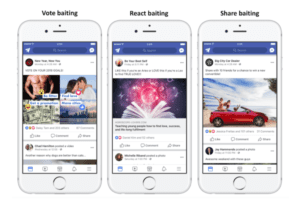
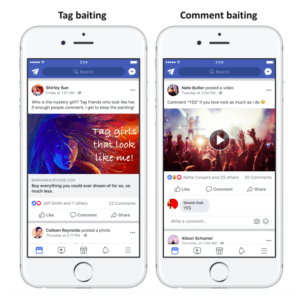
That means that Pages can no longer rely on soliciting likes and comments, and need to find more authentic ways to produce reactions.
It also means that those that do “systematically and repeatedly” participate in the above tactics will suffer the consequences (i.e. strict demotions in the newsfeed).
Use Facebook Live to Beat the Facebook Algorithm Changes From Facebook Updates
Facebook Live is killing it right now.
Like, really killing it:
- “Facebook Live Stream” search popularity has risen over 330% since Facebook Live’s rollout
- Facebook Live videos are watched 3x longer than videos that aren’t live
- Users comment on Facebook Live videos at 10x the rate of regular videos
- Daily watch time for Facebook Live broadcasts has grown by more than 4x
- 1 in every 5 Facebook videos is a live broadcast
The content’s completely unique, it’s cost-effective, and clearly, it works.
It’s also one of the few sure things you can do to rank higher in the newsfeed, as Facebook favors live videos over other types of content in its algorithm.
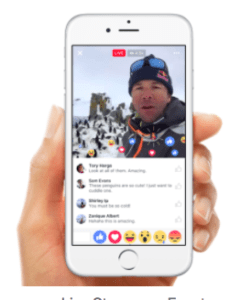
Here’s why I think it’s so successful: it’s simple.
This is one of the Facebook updates that paves the way for authentic storytelling, without sales gimmicks, page boosts, or clickbait captions.
It’s an opportunity to not just stage a show but to also hold a real conversation.
You can show people your brand story and invite them to comment and ask questions. In that sense, a live video becomes just as much about the audience as it is your brand.
And that, my friends, is meaningful interaction.
But beyond the philosophical stuff, one of the major benefits for brands is that when they begin a live video, your followers will receive a notification. And even after the video has ended, they can still receive a notification simply saying that you were live and they still have time to check it out.
It’s a great way to remain visible to your following by side-stepping the newsfeed completely and going straight to the notifications.
To make the most of Facebook Live, here are a few tips:
- Announce your broadcast ahead of time – Don’t just hope people tune in; give them advanced warning, and give yourself the time to build anticipation and a bigger audience by letting your followers know when you intend to broadcast.
- Add text – 85% of Facebook video is viewed with the sound off, so text to make your video more accessible
- Address commenters by name – That added personal touch will go a long way; also try to respond to questions and comments in real-time (or have someone on hand who can).
- Longer is better – The longer you broadcast, the more potential you have to reach a larger audience. People can join the video at any time, so aim for longer air time when you can.
- Encourage comments – Stage multiple parts during your broadcast to ask for user comments or questions, and include a Q&A portion at the end.
- Share the video other channels – Download the URL and promote it through your blog, emails, and other social channels to reach a wider audience (and drive them back to your page).
Host Facebook Groups to Beat The Algorithm Changes from Facebook Updates
Facebook Groups are a goldmine when it comes to customer engagement.
Among its many benefits, Groups allow brands to to do the following:
- Create more engagement
- Focus on their ideal audience
- Build trust
- Collect social proof
- Spark conversation
And speaking of meaningful conversation, one of the best ways to foster it is through a sense of community.
In her article on Medium, Alaura Weaver writes: “(meaningful conversations) means focusing less on business models that rely on publishing massive (unsustainable) amounts of one-way blog posts and focusing more on creating and engaging with communities — and standing back and letting those communities evolve into mini-ecosystems built on conversation.”
And she’s right.
Rather than preaching what you think your audience wants to hear, let them do the talking. You can facilitate, monitor, and manage, but at the end of the day, you want your users to have an equally active role. This is an excellent way around the strict limitations of the recent Facebook updates.
Of course, you want the group to remain yours, which means directing the conversation, posing questions, and supplying answers when asked. It means listening to what your community is saying, and providing actionable advice, opinions, and strategies.
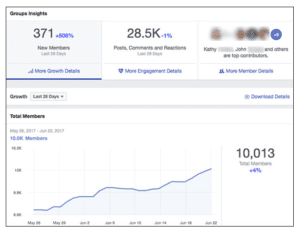
Diversify Your Strategy to Avoid the Facebook Algorithm Updates
You know the saying “don’t put all your eggs in one basket?”
Well, the same applies to digital marketing using social media. The more you rely on just one strategy, the more you stand to lose.
That’s proven especially true with brands whose strategy heavily emphasized the impact of social strategy – in particular Facebook.
According to SimilarWeb, over the past two years sites like BuzzFeed, The Huffington Post, and Mashable have suffered the most from diminishing social traffic due to the recent Facebook updates.
Why? Because they relied too heavily on the channel for traffic.
That’s not to say they were entirely wrong to do so. After all, the three sites derived about a third of their U.S. desktop traffic from social channels.
But if you look at them in comparison to sites like The New York Times and The Washington Post, you begin to see the holes in the strategy.
Those sites have lost only 10% of social media traffic, and their traffic has actually risen by 22% over the past two years.
The reason behind the relatively low traffic loss is that compared to sites like Mashable, they didn’t have that much to begin with.
The sites that stand to be hit the hardest by the latest algorithm changes from Facebook updates are the ones without a plan to diversify their traffic and revenue.
So the lesson here is this: Always have a contingency plan. Up your efforts on other social channels, and make sure you have a well-rounded strategy that includes the following:
- Email marketing
- Solid SEO
- Killer landing pages
- Webinars, videos, and gated content
- PPC
You can also use these other channels to tease content from your Facebook Page and direct user’s there.
Use Facebook Advertising to Master the Algorithm Changes from Facebook Updates
You knew this one was coming.
As much as we want a way around it, the truth remains the same: Facebook advertising works – now more than ever.
Ads and boosted content are a surefire way to put your content in front of your audience.
Even with all of the Facebook updates, the platform continues to be one of the leading advertisers in the space due to it’s incredible targeting abilities.
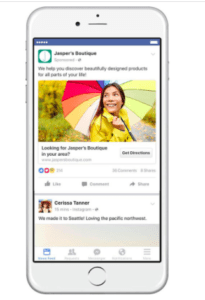
But success in digital advertising still requires very specific knowledge of your audience and what they will react to. And in many cases, you have to follow some of the new rules, even when it comes to digital advertising on this social media platform.
For example, your audience is still likely to react better to video, whether it’s an ad or an organic post. Experiment with different types – dynamic, carousel, lead ads, etc. to see which works best for your brand.
Really think about who you’re targeting (and employ the help of your Audience Insights to do so), and continue to focus on telling engaging, interactive stories.
Because the bottom line is this: organic reach is declining. But advertising reach? As effective as ever.
Wrapping Up How To Stay on Top of the Facebook Algorithm Changes
Facebook is not what it used to be.
But that’s not really such a bad thing.
An improved user experience is good and will likely increase in more users overall, and help them get more of the personal connections and interactions they signed up for.
And it’s not over for brands. It’s changed because of Facebook updates, but the best brands will adapt. The strategies above will help you do so with your own brand as well.
