

When determining whether your website is likely to appear in search engine results pages (SERPs), one key measurement to look at is domain authority (DA). This third-party metric can help you gauge your website authority online and gauge the chances of maintaining a competitive edge on search engines.
In this blog, Theresa Bass, Sr. Digital PR Strategist, will explain more about this metric, including how to check domain authority, the difference between domain authority vs. authority score, and how to increase domain authority for your site to achieve higher, long-term rankings.
What’s Covered:
- What Is Domain Authority?
- How Domain Authority Is Calculated
- Does Domain Authority Matter for SEO and Marketing?
- Topical Authority vs. Domain Authority
- Core Components of Domain Authority
- Actionable Best Practices to Improve Domain Authority
- Monitoring, Reporting, and Tools
- Common Mistakes (and What to Avoid)
- Case Examples and Benchmarks
- FAQs
My Expert Opinion on Domain Authority
There are plenty of metrics out there that can help you measure the success of your SEO strategy using tools like Google Analytics and Google Search Console, but it can help to track certain third-party metrics to supplement those core key performance indicators (KPIs).
Here is where DA could help. It’s easy to track, and it can clearly indicate whether your website authority is high enough for Google to both index and rank highly in search results.
Many factors influence DA, from the number of high domain authority websites linking back to yours to high-quality content that provides valuable information and a good user experience.
Knowing how to set clear benchmarks based on your competitors and regularly tracking your DA can help you progress and get on top of SERPs. So, let’s dig deeper into this metric and the steps you can take to maximize it.
What Is Domain Authority?
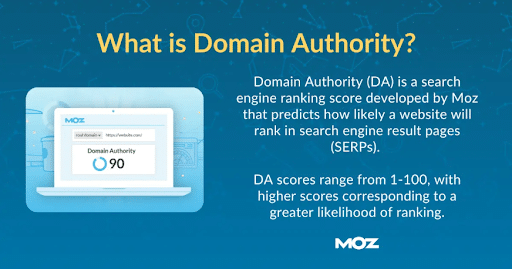
Created by Moz in 2004, DA is a specific metric that can help gauge a website’s likelihood of appearing in search results on Google and other search engines. It differs from other metrics like page authority in that it examines an entire website’s overall strength compared to competing domains, taking into account multiple key factors and other metrics.
Keep in mind that DA isn’t a direct Google ranking signal; it’s a Moz metric. However, it can serve as a clear indicator of your domain’s competitiveness and link equity.
Also, it’s important not to confuse domain authority vs. authority score, as authority score is a Semrush metric that includes factors like spam indicators and organic traffic instead of backlinks and link health.
How Domain Authority Is Calculated
Moz and other authority checkers calculate DA with a score ranging from 1 to 100. The higher the score, the more authority a domain has and the more likely it is for search engines to index and rank it.
The specific score is the result of Moz’s assessment of a domain’s backlink profile, relevance, and certain trust signals, including your site’s compliance with Google E-E-A-T guidelines establishing Experience, Expertise, Authority, and Trustworthiness.
Does Domain Authority Matter for SEO and Marketing?
DA is an integral metric for your SEO and marketing efforts in a number of ways. For example, it can help with:
- Competitor Benchmarking: DA can give you certain competitive insights that you might not get with other metrics, as it allows you to compare your site’s authority with those of your top industry competitors, helping to determine where you stand and how to gain a competitive advantage over time.
- Link-Building Prioritization: You can also use DA to help you determine which sites to target with your link building strategy based on their score, helping ensure you don’t land links on low-quality sites.
- KPI Reporting: DA functions as a good long-term performance indicator to keep an eye on as you continually optimize your website, helping measure real growth as you develop your content and SEO strategies.
- Ranking Prediction: Additionally, DA can help you project what kinds of rankings you’re able to land based on your site’s authority, especially if you want to target high-volume and highly competitive keywords.
Domain Authority And AI visibility
Domain Authority still matters significantly for AI visibility, but its role is indirect.
AI engines do not use DA as a direct ranking metric, but they overwhelmingly favor high-authority websites as sources for their answers.
Here is a breakdown of why DA and overall site authority remain critical for what is sometimes called “AI Ranking” or “AI Visibility,”
| Factor | Direct Impact on AI? | Explanation |
| Direct Metric | No | AI engines like Gemini, ChatGPT, and Perplexity do not calculate or use Moz’s Domain Authority score directly to rank sources. They generate answers by referencing information. |
| Source Credibility | Yes | AI models are trained on, and perform real-time retrieval from, vast datasets of publicly available information.
When deciding which sources to trust and cite, they prioritize sites with a strong online reputation. High DA is a proxy for this trust and reliability. |
| Mentions & Citations | Yes | Your DA is built on backlinks and citations.
When AI models encounter your brand name and content mentioned across many other reputable, high-DA websites (like the ones that influence a high DA score), it increases your “mention density.” This signals to the AI that your brand is a credible expert on a topic, making it more likely to be included in an AI-generated answer. |
| Topical Authority | Yes | Search engines prioritize Topical Authority (deep expertise in a niche).
AI models recognize niche expertise better than generic content. Building strong Topical Authority can factor into your DA over time and also directly signal expertise to AI. |
| Google Search Tie-in | Yes | Google remains the largest single data source feeding many AI models.
Pages that rank well in traditional Google Search (which often correlate with high DA) are more likely to be seen and learned from by the AI’s retrieval systems. |
In short, while DA is not a ranking factor for AI, it is a powerful indicator of the trust and credibility that AI models rely on when selecting sources to inform their output. Building a high DA via strategies like quality backlinks and strong content will result in higher visibility and mentions in AI-generated answers.
“Topical Authority” vs. “Domain Authority”
Both topical authority and DA are essential, but they apply to different elements of your SEO strategy.
While DA is a broader metric looking at your website’s authority compared to competitors based on several factors, topical authority measures your site’s demonstrated depth, expertise, and trustworthiness regarding specific topics and niches.
You can build topical authority by developing pillar pages or content clusters covering a primary topic in depth, with blog posts and other pages discussing subtopics within that pillar, with internal links between them in what is known as a “hub and spoke” strategy.
The greater your topical authority, the more it can factor into your DA over time. Think of topical authority as more of a short-term measurement that can get results within weeks to months, while DA is a long-term target that might take several years to maximize.
Core Components of Domain Authority
If you want to know how to increase domain authority, the following are some of the primary factors to optimize:
Backlinks and Link Quality
One of the main elements to work on to increase DA is your backlink profile.
To get a large number of high-quality backlinks, you need to implement an effective link acquisition strategy.
Some channels you can use to obtain quality backlinks include:
- Digital PR
- Content collaboration with other related industry blogs and publications
- Collaborations with affiliates and influencers
- Partner content
- Editorial links
On-Page SEO
You must also factor in on-page SEO and how it can optimize your DA. This aspect incorporates certain components on web pages to optimize them for better rankings, such as:
- Keyword inclusions
- Header tags
- Title tags and meta descriptions
- Alt text for images
- High-quality content covering topics extensively
- Internal links
Technical SEO
Your site’s technical SEO is equally vital, incorporating elements related to the user experience and tactics that help search engines better understand your content.
Some to cover here include:
- Logical site structure for crawlability with an HTML or XML sitemap and a robots.txt file
- Mobile-responsive designs that allow for a seamless experience across devices
- Secure HTTPS connections instead of unsecured HTTP
- User-friendly designs allowing for ease of navigation
- Structured data and schema markup give search engines context regarding content topics
- Canonical tags to mitigate the risk of duplicate content issues
UX Signals
The user experience is another key consideration.
Some UX signals to optimize for include:
- Core Web Vitals, which measure page loading performance, responsiveness, and stability
- Dwell time measures the length of time users spend on a single page
- Bounce rates, which track the rate at which people immediately go back to search results after landing on a page
Brand Mentions and Online Citations
Additionally, you should track brand mentions across the web to gauge brand authority, along with any local citations and listings.
The more positively people discuss your site and the more you gain high-quality listings on platforms like Google Business Profile and Yelp, the higher your DA can get.
Actionable Best Practices to Improve Domain Authority
To help you continually improve your DA over time, take the following key steps:
Build High-Quality Backlinks
Take the time to develop a high-quality backlink profile consisting of many links from authoritative sites. This component is one of the main factors that Moz considers when calculating DA, and it can signal to Google that your site is both authoritative and trustworthy based on E-E-A-T guidelines.
Develop a Strong Content Strategy
You also need to put together a solid content strategy that helps you connect with your target audiences through topical authority, incorporating on-page and technical SEO elements that help boost performance. Blog posts, articles, service pages, navigation pages, and other content with interlinking will significantly improve your DA over time.
Incorporate Internal Linking
Internal linking across pages can distribute link equity, especially when linking to newer pages from more established content that has already started ranking. Eventually, as your DA increases, your linked pages will feed into each other for even better performance.
Perform Technical SEO Fixes
If you experience any issues with technical SEO, such as a poor user experience, missing robots.txt, or other problems, fix them promptly. You can easily identify these issues by looking at Core Web Vitals, checking structured data using the Schema Markup Validator, and looking for any issues on platforms like Semrush and Ahrefs.
Regularly Monitor and Audit Performance
Conduct weekly, monthly, or quarterly reporting to track progress based on your specific goals and corresponding KPIs. Based on these reports, you can make any necessary adjustments before your site has the chance to suffer.
Monitoring, Reporting, and Tools
To check your Domain Authority, you must use Moz, as it is the only platform that calculates this specific proprietary metric.
However, while Moz is the exclusive source for DA, a well-rounded SEO strategy uses a combination of tools to measure different aspects of site “strength.”
Here are a few tools for monitoring Authority and Performance:
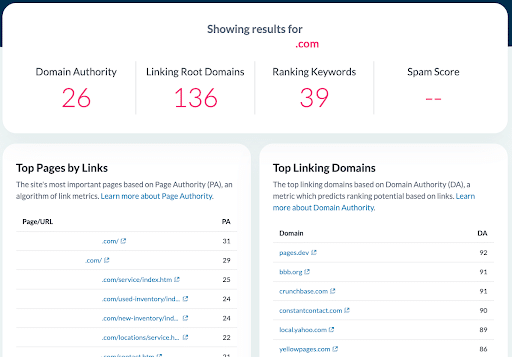
- Moz: Using the Domain Authority Checker, you can enter your domain and see where it stands, including your current DA, ranking keywords, spam score, top pages, top domains linking back to yours, trends, and top competitors.
- Ahrefs: You can also track your site’s progress using Ahrefs’s Website “Authority” Checker, which will measure your website authority based on other metrics that you can compare against your DA.
- Semrush: Measure your site’s Authority Score with Semrush’s Website Authority Checker, which will give you a breakdown of SEO performance based on organic search traffic, backlinks, traffic share, organic traffic, and many other metrics.
- Google Search Console (GSC): Within Google Search Console, you can view corresponding metrics to gauge SEO performance, like rankings, total clicks, impressions, click-through rates, queries, and page performance, including how your site appears in rich snippets.
Over time, with monthly or quarterly reports, you can see if you’re making any progress over time, but be sure to correlate your DA with rankings and traffic, which you’ll want to track more frequently in Google Analytics and GSC.
Common Mistakes (and What to Avoid)
- Overemphasis on DA: Don’t focus solely on this metric; instead, incorporate it into your overall site measurement with other metrics that apply to your specific business goals, whether you want to increase rankings, website traffic, or conversion rates.
- Black-Hat Links: While link building used to be as easy as getting as many backlinks as possible across the web, you need to ensure those links are on authoritative sites that can spread their link equity to your domain.
- Ignoring Technical SEO: Don’t overlook technical SEO elements like page load speed, HTTPS, sitemaps, and others, as the user experience plays a huge role in boosting DA.
- Siloed Teams: When marketing and sales teams are aligned on messaging, content priorities, and outreach strategy, it creates more cohesive execution across teams and supports sustained improvements in Domain Authority
Case Examples and Benchmarks
What is a good domain authority? As mentioned, it really depends.
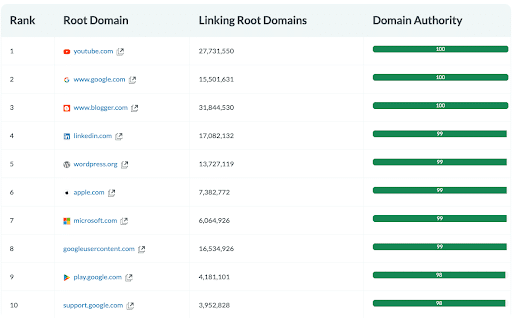
Some of the top sites out there have a DA at or near 100, including social platforms like YouTube and LinkedIn and, of course, Google. Moz’s list of the Top 500 shows what some of the biggest brands out there have been able to build.
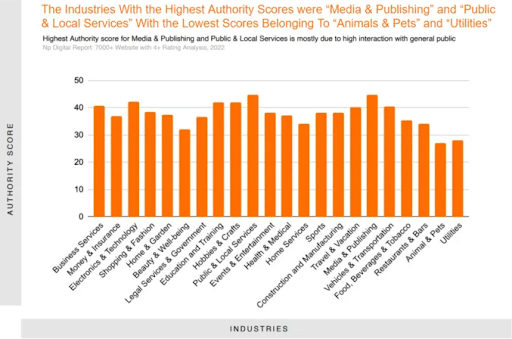
Certain industries also have higher average DAs than others, with media and publishing and public and local services among the highest, while utilities and animals and pets fall on the lower end.
However, the average was ultimately much lower than what you’d see in the Top 500, ranging from around 30 to 40.
But what is a good domain authority benchmark? The answer will largely depend on your competitors and where they are.
For example, we can see that for this particular automotive site, some direct competitors have considerably lower scores than broader ones like Yelp:
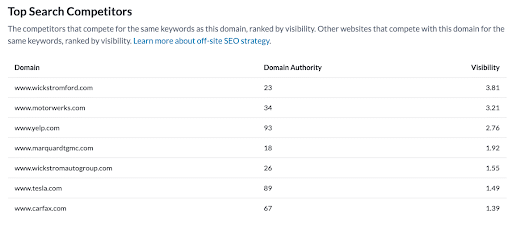
In this instance, a DA benchmark might sit somewhere between 20 and 30 based on the positions of sites like wickstromford.com, motorwerks.com, and wickstromautogroup.com.
Ultimately, it will help to get a full picture of top industry performers and calculate something of an average to help you determine what kind of DA to target.
FAQs
1. What is domain authority in SEO?
Domain authority, or DA, is a type of metric that Moz developed to help determine the likelihood a website has of appearing on search engine results pages (SERPs). This score ranges from 1 to 100, with higher scores indicating that a website has a strong chance of ranking.
2. Is domain authority a Google ranking factor?
No, DA is not a direct Google ranking factor, as Moz invented it as a third-party metric. However, DA correlates with other Google ranking signals, such as topical authority based on high-quality content, along with other elements like backlinks and user experience that contribute to Moz’s DA metric.
3. What is a good domain authority score?
High domain authority websites tend to have an authority score of over 60, but the exact measure here will largely depend on your competitors’ scores. Generally, your benchmarks should be higher than your top competitors and strive for over 30 to help you maintain authority.
4. How do you check your domain authority?
To check your Domain Authority, you primarily use tools developed by Moz, as DA is a proprietary metric they created. While other platforms offer “authority” scores, they are distinct measurements.
Quick Steps to Check Domain Authority:
- Visit Moz Link Explorer: Go to the Moz Link Explorer tool.
- Enter Your URL: Type your domain name into the search bar.
- Analyze the Score: Review the Domain Authority number (scaled from 1 to 100). Higher scores indicate a greater ability to rank.
5. How long does it take to increase domain authority?
Generally, it takes up to several months to increase your DA, but the exact amount of time it takes will depend on certain key factors, such as your starting DA, SEO technical health, and the SEO strategy you implement.
6 Does Domain Authority still matter with AI visibility?
Yes, Domain Authority still matters significantly for AI visibility, but its role is indirect.
AI models do not use DA as a direct ranking factor. Instead, high DA serves as a critical proxy for trust and credibility, signaling to the AI that your website is an authoritative, reliable source. AI engines favor sourcing their answers from and citing websites with this proven online reputation.
Build Your Website Authority With Ignite Visibility
Want to find out how to increase domain authority the right way? Ignite Visibility can develop the perfect strategy based on your goals.
You’ll have the chance to:
- Develop a roadmap for SEO
- Incorporate backlinks, on-page SEO, and other strategies
- Create and curate high-quality content, establishing topical authority
- So much more!
Get in touch with our experts today to discuss your marketing needs and start building the perfect strategy for your brand.

