

Many SEOs are under the impression that there are only two ways to rank in Google: with organic and paid links in the search engine results pages (SERPs). That’s simply not the case.
Google offers webmasters a veritable potpourri of methods that they can use to push their sites to the top of the search results. Many SEOs limit the reach of their brand because they don’t consider all the possibilities when it comes to ranking a site.
Here’s a list of all the different ways to rank in Google.
-
The Knowledge Graph
Google Knowledge Graph debuted in 2012. It’s designed as a way to get information to people quickly.
It’s called a “graph” because it shows relationships between different people, places, and things associated with a particular search term.
For example, if you Google “Jack Nicholson” right now, you’ll see exactly the types of results you expect to see in the organic SERPs. However, if you look to the right side of the page, you’ll see the Knowledge Graph. That will give you a brief overview of Nicholson, including his birth date, height, and the names of his children. You’ll also see quotations attributed to him, movies he’s starred in, and a list of celebrities that people who are Nicholson fans tend to search for. The graph also displays popular images of the actor himself.
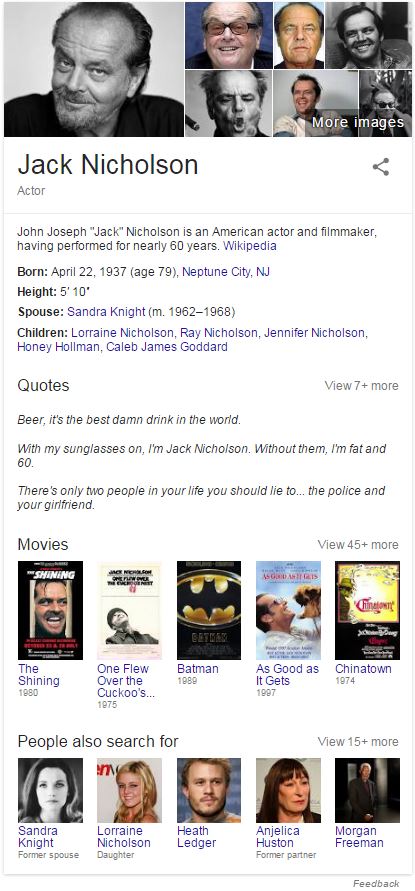
The important thing to understand about the Knowledge Graph is that it appears at the very top of the SERPs (a recurring theme as we go through the possible ways to rank). Much of the information provided in the knowledge graph is presented as a link (for example, the movies Nicholson appeared in and the names of his children).
Authority site publishers who provide relevant, factual information about a particular search term can push themselves to the very top of the SERPs by appearing in the Knowledge Graph.
-
A Normal HTML Listing
The option that’s most familiar to many SEOs is to rank a site as a “normal” HTML listing in the SERPs. Even with all of the changes that Google has made lately, there’s still a couple of great reasons to do that.
First of all, some Google power users intentionally skip over the paid ads. Those are typically the four listings that appear at the top of the SERPs and are clearly labeled as ads.
In other cases, though, some search terms don’t bring up any paid ads at all. That’s because webmasters have either determined that there’s no point in paying for ads for those search terms or they haven’t done a thorough enough job with their keyword research to understand that people are using the search term. In either case, the usual white-hat methods of ranking a page for a particular keyword pay off.
The bottom line: it’s a great idea to practice a traditional SEO strategy in connection with a solid content marketing effort. You’ll gain traffic, present your business as an authority in its space, and build brand-name awareness. At Ignite Visibility we get about 60% of our leads through ranking in this area of Google.
-
Rich Snippets
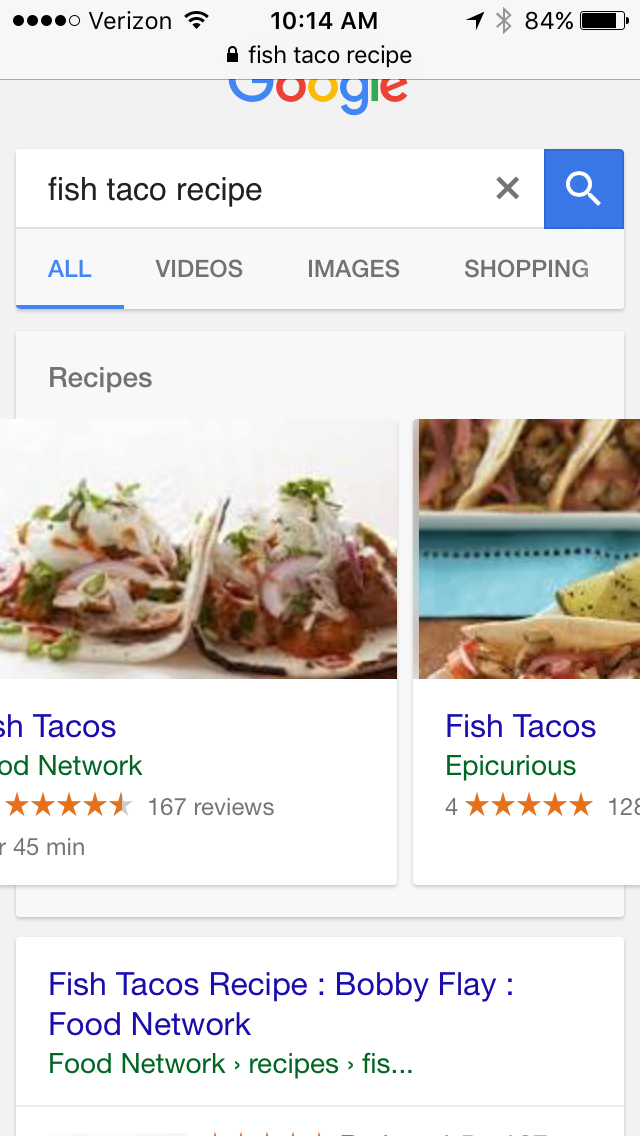
Go ahead and Google “best chicken marinade.” You should see some of the results appear with a rating in the form of stars (with five stars being the highest possible rating).
Where did those ratings come from? They’re part of rich snippets.
Rich snippets are created by additional Schema.org markup that you can add to your web pages to provide the search engines with additional information about the content of the page. In so doing, you’ll also provide people who use the search engines with that additional information as well.
If you implement rich snippets on your site by adding Schema, you’ll provide more information in your search link than your competitors who don’t. That’s likely to improve your click-through-ratio (CTR) and present an image that your site is an authority in its domain.
You add the code to your site that follows one of three markup specifications:
- Microdata
- Microformats
- RDFa
It’s beyond the scope of this article to explain each of those three specifications in detail. Suffice it to say that, of the three, Microdata is probably the most popular and follows the schema.org specification.
There’s a new flavor of rich content that’s recently been introduced, though, rich cards.
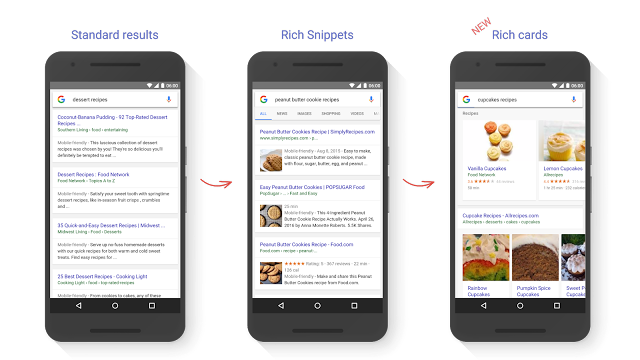
They’re only displayed on mobile search, though.
Instead of just presenting additional information in the SERPs, rich cards appear at the very top of the results list as digital cards. They’re also displayed in a carousel so users can scroll through them from left to right.
As of now, though, rich cards are only available for movies and recipes. However, Google is looking at the possibility of expanding the use of rich cards for other types of publishers.
-
Local 3-Pack
Google “Chicago plumber” and take a look at what you see right after the top four paid results. You should see a map of Chicago and below that three local listings. That’s the Local 3-Pack.
Once again, those three listings appear towards the very top of the SERPs. They’re sandwiched between the paid results and the organic results.
That’s prime digital real estate for SEOs.
Of course, there are more than just three plumbers in Chicago. Google gives users a chance to see the others with a link at the bottom to view more results.
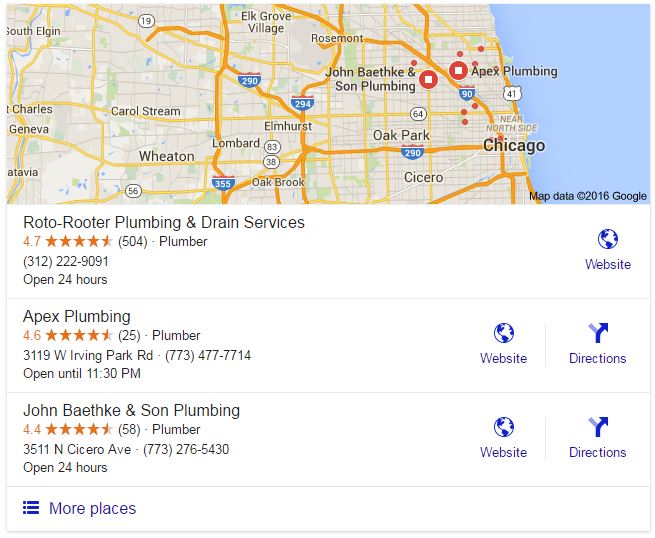
So how does a plumber in Chicago ensure that his business ranks in the top three of the Local 3-Pack every time that search is performed? In short: he can’t.
That’s because ranking in the Local 3-Pack is based on proximity. Google will, by default, show users the three closest plumbers.
What the plumber can do, though, is ensure that his website is properly marked up so that Google can determine the location of the business. To do that, he uses the aforementioned schema.org markup to inform Google about his business address.
The plumber can also use traditional off-site SEO methods to optimize his site for local search.
You can learn more about local SEO here.
-
Instant Answers
Google “how to unclog a sink.” You’ll see at least part of the answer to that question without clicking on any links.
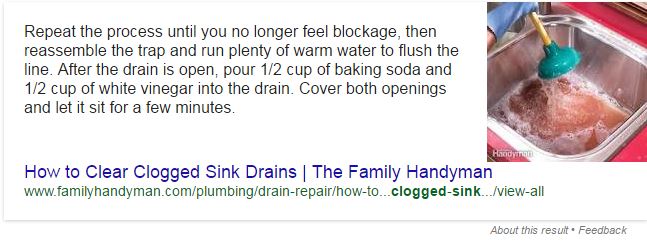
That’s Google giving you an instant answer. It’s an attempt to improve the user experience by requiring fewer clicks to provide people the information they’re looking for.
At first blush, that might seem like bad news to brands who are hoping that people will click on their links in the SERPs. That’s not really the case, though.
Look again at the instant answer. It’s only part of the answer and it does provide a link so that the user can get all the information he or she needs.
Once again: the instant answer appears at the very top of the SERPs. In this case, there aren’t even any paid ads on top of it.
Google shares instant answers to specific questions from sites that the search engine has determined are authorities in their industry. For the answer to this question, Google has determined that The Family Handy Man is an authority and probably has the right answer to the question.
It’s safe to say that The Family Handy Man gets a big brand boost for being featured as part of Google’s instant answer.
-
AMP Mobile Results
Pick up your smartphone, open the browser and Google “2016 Olympics.” You should see several results at the top that appear as cards in carousel format. If you look at the bottom of each card, you’ll probably see the acronym “AMP.”
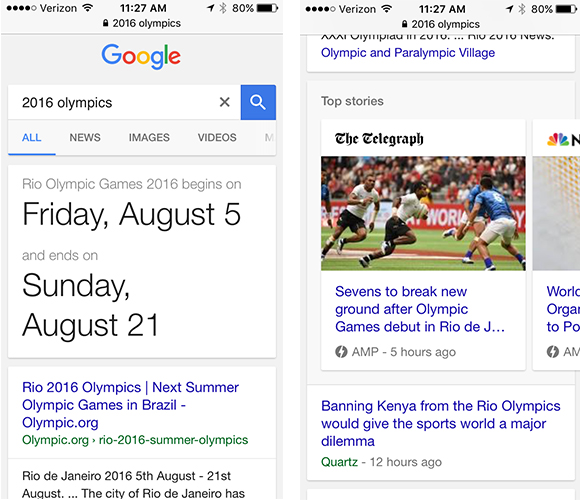
What does that mean? It stands for “Accelerated Mobile Content.” It’s a style of HTML that’s meant to display web pages in lightning-fast time on a mobile device.
Since Google loves speed, especially for mobile devices, the search giant pushes AMP results to the very top of the SERPs.
If you haven’t already converted your site to AMP, it’s a good idea to do so right away. That’s because there’s simply no doubt that people are increasingly turning to mobile technology to get answers to their questions.
If you’re using WordPress, there’s already a plugin that you can install to automatically create AMP pages for each of your blog posts. That will save you the trouble of manually creating AMP pages by hand.
-
Google Images
Who said that you have to rank only with text? You can also rank with images.
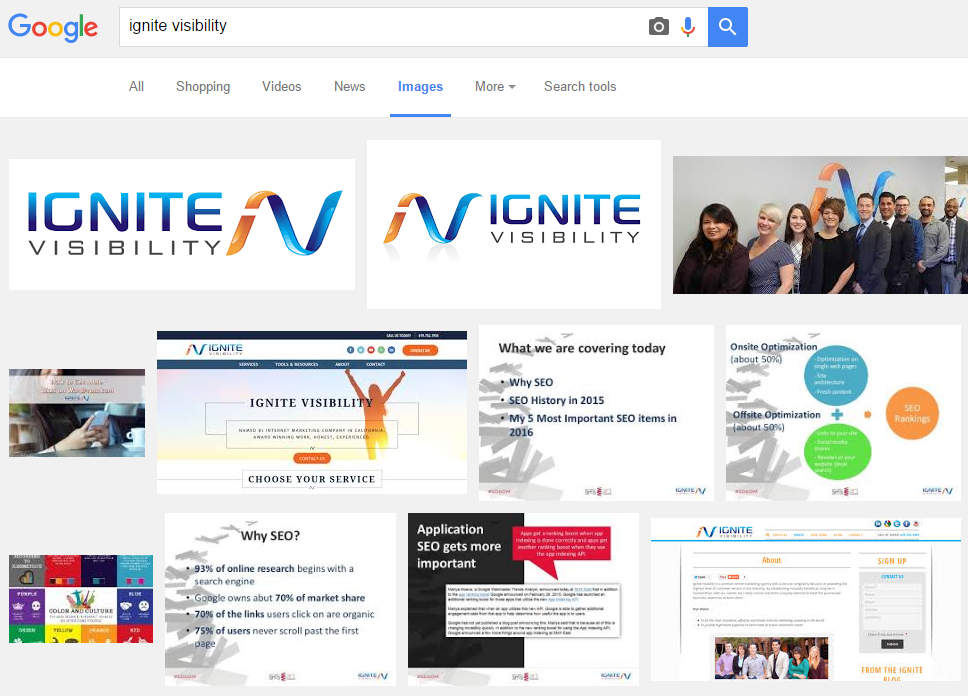
People use Google not only to search for articles but images as well. When Google presents its image search results, it also includes links to where the images originated. Users often click those links to learn more about the image and, in many cases, they’ll “borrow” the image for their own website and attribute it back to its origin. That creates a backlink to the site where the image was found, which is good for SEO.
If you’re looking to rank an image in Google Image Search, create an infographic and optimize it on your site. People frequently search for infographics related to specific subjects. You can brand your infographic with your own logo and URL so that people who “borrow” it will effectively act as brand ambassadors.
For standard images on your site, make sure that they’re optimized properly.
-
Rank for Videos
Here are a couple of important facts: 1. Google owns YouTube and 2. YouTube is the second most popular search engine in the world.
What that means is this: you can rank with video.
If you decide to create a YouTube video and rank it, here are the factors that will affect your rank:
- Watch time – How long people watch the video affects its rank. It’s effectively the “bounce rate” for videos and probably the most important metric of the bunch. If people bail on your 10-minute video after just 30 seconds, don’t expect it to rank well.
- Keyword relevance – YouTube gives video publishers the flexibility to create their own titles and descriptions. They can also add tags to their videos.
- Channel popularity – How many subscribers does your channel have? That will help determine the rank of your videos.
- Engagements – YouTube gives users the ability to like, dislike, and comment on a video.
Remember, though, Google also offers Google Video Search that’s very similar to Google Image Search. Videos embedded on websites that aren’t part of the YouTube universe are featured in the Google Video Search results list. If you want to rank there, you will need to follow these tips.
Many Ways to Rank
There are plenty of ways to rank beyond the standard organic listing. Browse through the list we’ve covered here and look for other opportunities to reach people in your target market with search results.
