
Businesses need effective content marketing to get ahead, but many don’t properly implement or measure its ROI. According to HubSpot, only 29% of marketers are actively using content marketing, and 41% measure the success of their strategy based on sales.
However, content marketing ROI is one of the most important metrics to track if you want to gauge the success of your efforts.
This guide, led by Kim Wise, Content Editor Specialist, breaks down why a tailored content strategy matters and how to measure what counts, covering keyword targeting, writing best practices, auditing, and more.
What You’ll Learn:
- What is Content Marketing ROI?
- Why Measuring Content ROI Matters
- Calculating Your Content Marketing ROI
- How to Measure Content Marketing ROI
- Content Marketing ROI Examples
- Content Marketing ROI in the AI Search Era
- Key Factors in Determining Your Content Marketing ROI
- Structuring Your Content Marketing Metrics Dashboard
- FAQs
What is Content Marketing ROI?
Content marketing ROI is a metric that measures the revenue or business value your content yields against the cost of content creation, distribution, and management. Tracking this metric will help you determine whether your content is actually profitable and the steps you need to take for continual optimization.
To calculate your content marketing ROI, take the revenue from your content, subtract your content marketing spend, and divide it by the spend.
Generally, a higher ROI indicates your content marketing investments are producing stronger business results.
Keep in mind that certain trends in the marketing industry are impacting your ability to measure the ROI of content marketing. For instance, multi-channel attribution is crucial to understand if you want to determine where your leads are coming from. AI analytics tools can also help you more effectively determine the cost-effectiveness of your campaigns and help with optimization.
Additionally, you must determine which devices are generating the most traffic, leads, and ROI, with insights into mobile and desktop users. This aspect is particularly important as around 63% of all website traffic comes from mobile devices.
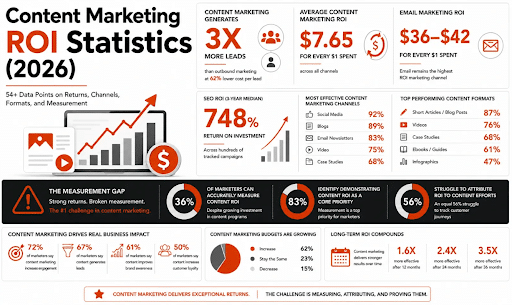
Consider other content marketing ROI statistics, too: According to a Genesys study, the average content marketing ROI is $3 for every dollar spent, which is an impressive figure. Also, content marketing generates more than three times as many leads as outbound marketing while costing 62% less.
What Is a Good Content Marketing ROI?
When you measure content ROI, you might wonder what a “good” ROI looks like. Generally, the ideal ROI of content marketing will depend on various factors unique to your strategy, including:
- Profit margin
- Sales cycle
- Industry
- Customer acquisition cost (CAC)
- Average customer value (ACV)
- Customer lifetime value (CLV)
- Time horizon, i.e., the total amount of time expected to hold an asset or process before it ends, based on your financial goals
Calculating Your Content Marketing ROI
When it comes to content marketing, calculating your ROI can be difficult. The return on marketing investment formula alone won’t be enough. However, it is necessary to make sure your efforts are growing your brand.
Here’s a brief formula to show you how to measure your content marketing ROI:
(Revenue Attributed to Content – Total Content Investment) / Total Content Investment X 100 = ROI
In this formula, “revenue attributed to content” refers to the total amount of revenue generated from your content, which you can calculate by multiplying the number of leads generated through content by your average close rate and ACV.
You would then subtract your “total content investment,” which is the amount spent on creating, distributing, and managing your content. Once you’ve subtracted this from your “revenue attributed to content,” divide the remaining sum by your “total content investment” and multiply it by 100, which will give you your content marketing return on investment.
Let’s demonstrate how to measure content marketing ROI with an example, which has a total “revenue attributed to content” of $15,000 and a “total content investment” of $3,000:
$15,000 – $3,000 ($12,000) / $3,000 X 100 = 400% ROI
This formula shows that the total ROI of content marketing efforts for this business is 400%, meaning that for every dollar spent on content marketing, the business earns $4 in profits.
By evaluating your content consistently, you’ll be able to learn a few things:
- Where you can invest more money
- Where you should cut back on spending
- Which tactics are working in your strategy
- When you need to pivot
- What content topics and formats your audience responds well to
Why Content Marketing ROI Is Hard to Measure
Content contributes to long, multi-point customer journeys, which can make it hard to measure content ROI.
For instance, the following aspects of content could obscure the actual return on investment in certain ways:
- Indirect Influence: Content might not directly lead to a buying decision, instead subtly nudging people toward one when something like word-of-mouth might finally convince them to commit.
- Long Sales Cycles: Customers also often go through long sales cycles from the top of the funnel to the bottom, making it less clear how content carried them along.
- Dark Social: Some traffic and engagement from your content might come from dark social interactions, which involve private shares that can be difficult to identify and track.
- Offline Sales: It can also be hard to connect your content to in-store or other offline sales.
- CRM Gaps: Disconnected multi-touch attribution, poor UTM tracking, missing bottom-of-funnel conversion data, and other gaps in your CRM could make the ROI of content marketing even murkier.
- Delayed Compounding Returns: Also known as the “snowball effect,” delayed compounding returns might make your initial returns appear way too small, only for them to dramatically start going up.
Identifying and addressing these potential weak areas can help you better determine how to measure your content marketing ROI.
My Expert Opinion on Franchise Content Marketing
Maintaining consistency across hundreds of pieces of franchise content takes more than good writing; it takes a system. My team creates everything from corporate blogs to locally focused pages, so we see firsthand how small differences in tone, formatting, or keyword focus can affect performance. What works best is building a framework that scales: clear brand guidelines, standardized outlines, and flexible templates that allow for local relevance without sacrificing quality.
Our content marketing efforts have yielded high ROI with effective content generation and ROI measurement. One home services franchise saw a 38% increase in organic bookings and a 16% boost in “Book Now” completions thanks largely to localized content development, including targeted location pages that connected with local leads. Another franchise in the consumer electronics industry observed a 90% increase in multi-unit franchise deals, with a key factor being content marketing targeted at investors.
It’s not about producing cookie-cutter content; it’s about giving every piece the same foundation of clarity, accuracy, and value. When that structure is in place, franchise content feels unified but still speaks directly to local audiences, and that’s where real SEO and engagement gains happen.

Why Measuring Content ROI Matters to Marketing Teams
Marketers need to know how to measure content marketing ROI to determine precisely how their content contributes to revenue, not just activity.
By tracking content marketing ROI statistics, you can drive the following:
Budget Defense
Instead of relying on vanity metrics like clicks and impressions, marketers can better defend their content budget by demonstrating improvements in pipeline impact, CAC, LTV, and other more meaningful metrics.
Executive Buy-In
Being able to connect content to ROI will also encourage executives to buy into your strategy as it demonstrates a real contribution to long-term profits. According to CMI, focusing more on impact vs. activity is essential to appeal to C-level executives today.
Channel Prioritization
By measuring the ROI of specific channels, you can better prioritize them based on performance. For example, you might find that organic content drives more profits from your SEO efforts, while email marketing and social media platforms require less prioritization due to less meaningful impact.
Content Quality
If you notice that your content is failing to convert and drive profits, you can take steps to increase quality, from optimizing on-page SEO elements for increased visibility to improving the user experience and creating more data- and expert-backed content that builds trust.
Resource Planning
Weeding out low-quality content, tools, or other components of your content strategy can also help you with resource planning, as you minimize production waste on low-performing content and figure out how to automate certain processes.
How to Measure Your Content Marketing ROI
The following are some clear steps to help you measure content marketing return on investment:
Step 1: Define the Business Goal Before Choosing Metrics
The first step involves defining your specific business goal to inform the metrics you need to track when calculating ROI.
One goal might be lead generation, in which case you would want to focus on metrics like form completions and email captures. If you want to boost sales, you’d focus more on ecommerce conversions, revenue, and average order value.
Step 2: Calculate the Full Content Investment
You also need to determine the total amount of your content investment based on all expenses.
Start by quantifying your content production efforts, accounting for costs like freelancer fees, internal team salaries, and content production tools.
Next, calculate the cost of distribution through paid promotion, sponsored social posts, and media placement fees.
Content management will also contribute to your investment, making it important to look at the cost of content management systems, design tools, SEO trackers, and other management tools.
Step 3: Assign Value to Content Outcomes
To make it easier to connect your content to ROI, assign a financial value to conversions across the customer journey.
For example, an ecommerce brand might tie revenue to content with attribution models in Google Analytics 4 or HubSpot. You could also compare SEO and PPC costs by multiplying your organic traffic by the average cost per click (CPC) you’d pay in a PPC campaign.
Step 4: Choose the Right ROI Calculation Method
Finally, you can select the right method to calculate your ROI. If you require a simple calculation, you might use the basic formula provided above.
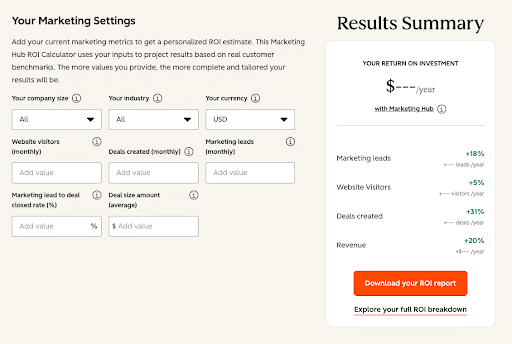
However, you can also find a content marketing ROI calculator to provide a more in-depth calculation.
For instance, HubSpot’s content ROI calculator allows you to calculate a more precise ROI based on factors like your company size, industry, and monthly visitors, deals, and leads.
Content Marketing ROI Examples by Business Model
Here are some examples of how you can calculate ROI for content marketing in various industries:
B2B SaaS
A B2B SaaS brand will need to account for long sales cycles and customer journeys that can make calculating ROI more challenging.
Let’s look at how ROI calculation might work for a brand in this industry:
- Total Spend: $20,000 on freelance writers, editors, SEO software, and content promotion
- Return Metric: $240,000 in a marketing-attributed pipeline over 6 months, yielding an average close rate of 20% and an ACV of $12,000 over 3 years (the LTV)
- Attribution Assumption: Through multi-touch attribution, marketers might credit a content piece if a user reads it within 90 days of starting a free trial.
- ROI Calculation: ([Pipeline X Win Rate] – Total Spend) / Total Spend X 100, i.e., ($240,000 X 0.20) – $20,000 / $20,000 X 100 = 140% ROI
Ecommerce
Ecommerce brands are likely to see shorter sales cycles, which could make ROI calculation look quite different from that of B2B SaaS brands.
Here’s an example to show what ecommerce ROI calculation might look like:
- Monthly Spend: $15,000 on influencer partnerships, product images, and shoppable blog content
- Return Metric: $45,000 in direct online sales attributed to discount codes and UTM codes within content
- Attribution Assumption: A combination of first- and last-click attribution, with content credited if someone made a purchase within 14 days of viewing the content piece.
- ROI Calculation: (Attributed Revenue – Content Spend) / Content Spend X 100, i.e., ($45,000 – $15,000) / $15,000 X 100 = 200% ROI
Local Service Business
Local service brands will focus heavily on conversions from locally targeted content.
The following example shows how ROI calculation might work for these businesses:
- Monthly Spend: $2,500 on locally optimized educational blogs, Google Business Profile optimization, and hyper-local FAQs
- Return Metric: $15,000 in booked jobs from organic local search leads
- Attribution Assumption: Last-touch attribution through call-tracking numbers and form submissions coming from blog posts
- ROI Calculation: (Revenue from Jobs – Content Spend) / Content Spend X 100, i.e., ($15,000 – $2,500) / $2,500 X 100 = 500% ROI
Franchise and Multi-Location Brand
Franchises and multi-location brands will also have a very local focus when it comes to content ROI measurement.
Let’s look at an example here:
- Monthly Spend: $10,000 on localized guides, local landing pages for multiple locations, and social media templates for franchisees
- Return Metric: $60,000 in collective local sales, including store visits and location-specific bookings
- Attribution Assumption: First-touch attribution assuming that local educational content introduced the brand to consumers who then converted through maps or search
- ROI Calculation: (Total Attributed Revenue – Content Spend) / Content Spend X 100, i.e., ($60,000 – $10,000) / $10,000 X 100 = 500% ROI
Publisher Brand
Publisher and media brands will look mostly at ad and affiliate revenue when calculating ROI.
This calculation might look like:
- Monthly Spend: $5,000 on in-depth editorial articles, newsletters, and infographics
- Return Metric: $16,000 in ad revenue and affiliate commissions generated from content
- Attribution Assumption: Total traffic attribution crediting content with ad and affiliate revenue if conversions came within a month after viewing a specific article page
- ROI Calculation: (Ad and Affiliate Revenue – Content Spend) / Content Spend X 100, i.e., ($16,000 – $5,000) / $5,000 X 100 = 220% ROI
Content Marketing Metrics vs. Content Marketing ROI
To pin down your ROI, you need to know the difference between metrics and ROI.
Here’s a little breakdown of the different metrics and their specific roles:
Activity Metrics
Activity metrics measure what a business has done in terms of content production and management. They won’t necessarily indicate that content is successful, only that teams have completed the necessary production tasks and used certain available resources.
Examples of activity metrics include the volume of blog posts published, turnaround time per asset, and the number of social media posts shared.
These metrics can also refer to user engagement with content, such as impressions, views, engagement rates, and follower count.
Leading Indicators
These metrics can help show how your content is building an audience that’s likely to convert, but again, they won’t connect directly to revenue.
These metrics ultimately serve to optimize your content strategy, identify drop-offs in your funnel, and indicate audience interest.
Some examples here include organic search sessions, average time on page, scroll depth, social shares, and resource downloads.
Financial Outcomes and ROI
These metrics will appeal most to executives and leadership, showing clearly how content has led to increased profits along the customer journey.
Metrics to focus on for ROI calculation include pipeline value, CAC, and direct revenue.
In short, metrics like traffic, rankings, engagement, and shares do matter, but they won’t count toward ROI unless you can tie them directly to business value.
Franchise and Multi-Location Content ROI: What Sets It Apart
Content marketing ROI is the ultimate measure of success for any business. It’s how we confirm the resources you’re spending on content are actively generating revenue and justifying future investment.
Every business needs a content strategy, but franchises must localize theirs for it to resonate with audiences. Typically, there’s a playbook from corporate, which usually focuses on the national brand story.
A franchise content marketing strategy that’s successful does two things well: stays in alignment with the national brand and incorporates the local angle. It can be a challenging thing to achieve. The balance between consistency and local relevance makes building a plan hard to navigate at times.
There’s much at stake in developing your franchise road map: SEO, lead generation, and brand authority. Here are some tips to marry these two areas:
- Lean on corporate strategies to build credibility. Corporate teams excel at developing key messaging, so use that content as a base and find meaningful ways to localize it.
- Use a corporate library of resources provided, including written content marketing and imagery. You can customize these to your locations.
- Take advantage of content templates. Corporate often provides templates for events, promotions, or social media. Adjust images, copy, or calls-to-action to reflect local audiences.
- Localize a national campaign. An example would be a holiday shopping campaign. There may be specific deals set by corporate, but you can pick and choose which to promote based on the sales data from your stores.
- Develop local landing pages. Connecting with local audiences through hyper-local content can contribute largely to conversions and sales.
- Optimize content with local content marketing keywords. Much of the time, this is adding the city, community, or neighborhood to general keywords. There may be other nuances that are specific to your customers, as well.
- Collaborate with local influencers. National brands may have well-known spokespeople, but your marketing will be stronger if you work with someone who has local credibility.
- Maintain good brand consistency. This step is key to building more trust and recognition as you work to stand apart from competitors and establish a unique brand voice.
- Track all location-level leads. Use a location-level dashboard to help attribute content to all phone calls, direction requests, form completions, and store visits that count toward revenue gains.
Keyword Targeting for Franchise SEO Success
Content marketing keywords are the foundation for franchise SEO. Getting it right is the difference between success and stagnation.
First, you’ll need to define how to do keyword research for content marketing. There are different approaches depending on the type of content: main site pages, pillar pages, or blog posts.
These content targeting keyword strategies will support your initiatives:
Choosing Scalable, Localized Keywords
Look at volume and competition for standard keywords plus a city, state, neighborhood, ZIP code, or county. “Near me” is another focus. You can use tools like Keyword Planner, SemRush, or Ahrefs.
To scale, you’ll need to think about your site structure and how it will align with these keywords. It may include micro-sites or dedicated location landing pages that have a structure of:
- Yourbrand.com/locations/san-diego
You can also write city-focused blogs (hyperlocals).
Balancing Brand vs. Local Intent
Root keywords should follow what the corporate brand optimizes for, as long as those services or products are available at your locations. To not compete with national website pages, add the local intent to create longer tail keywords. You don’t want to be vying for the same exact words as the corporate website.
Prioritizing High-Volume, Low-Difficulty Opportunities
All your content marketing keyword research will provide the volume of searches each month and keyword difficulty. The greater the keyword difficulty score is, the harder it is to rank. Find a happy medium by concentrating on those with decent volume and lower difficulty.
Depending on your industry, there may be fewer of these than others. You may be competing with more than one industry type if the keywords relate to several different types.
How to Measure Content Marketing ROI in GA4, Search Console, and Your CRM
When measuring your ROI in Google Analytics 4, Google Search Console, and your CRM platform, here’s a checklist to help with setup:
- Define key events: Identify your main conversion actions, such as gated content downloads, newsletter sign-ups, webinar registration completions, and high-intent product demo requests.
- Use UTMs: Use UTM tracking parameters with consistent syntax (e.g., all lowercase letters), including “utm_medium” to track high-level channel traffic, “utm_source” for specific platforms, and “utm_campaign” for content themes.
- Connect forms to CRMs: Include UTM code in forms, capture initial landing page URLs, validate lead routing rules, and prevent duplicate record creation.
- Tag content type, topic, and funnel stage: Connect each content format and topic to each stage of the funnel, from awareness to decision.
- Track assisted conversions: Regularly analyze multi-touch attribution reports in GA4, and identify first-touch brand discovery content, lead nurturing content, all while crediting assists to non-converting pages.
- Import offline outcomes: In your CRM, upload closed sales pipeline data, use unique IDs to match external data, and account for long sales cycles if applicable to your industry.
- Reconcile CRM revenue: Pull all actual closed-won deals, compare analytics to your financial reports, and calculate all ROI metrics that content directly influenced.
Content Marketing Writing for Consistency, Quality, and Local Relevance
You may not have a superstar content marketer on your team, but you can still implement these best practices to support consistency, quality, and local relevance.
- Maintain tone and quality across all locations: This is where corporate style guides for tone and voice come in handy. They often provide insights on how a copy should sound. This may include specific attributes, words to use or not use, and other brand-focused messaging.
- Empower “less-than-stellar” writers with frameworks: Templates with SEO guidelines are useful to any content producers, regardless of their talents. These can include headers, requirements for linking, length, main points to cover, and the type of CTA.
- Avoid thin or low-value content that hurts SEO: Content with fluff that stuffs keywords and has no originality won’t boost your search rankings. All your content should be a storyline that sets up challenges, why they exist, and the solutions you offer. If it’s not meaningful and full of examples, it won’t perform well.
Franchise Content Can Hurt Your SEO: 5 Things to Avoid
Can content marketing actually impact SEO negatively? Yes, so be aware of these five common ways it can happen.
1. Not Using the Right Keywords to Compete
Content marketing keywords are foundational to your strategy. However, you have to use the right ones that help you outrank competitors.
First, evaluate competitors using SEO tools such as Ahrefs or SEMrush to see how they are ranking. Analyze their content and identify opportunities to improve on it, whether through more in-depth coverage, higher readability, or a clearer structure and hierarchy.
Focus your content using keywords that match your goals for branding, conversions, and qualified leads.
You also need to use keywords strategically. Every piece of content should target a primary keyword while naturally incorporating related terms and phrases that support the topic. Modern search engines evaluate context, topical relevance, and user intent—not just exact-match keywords—to determine what a page is about. Cover your subject thoroughly, organize it logically, and use supporting keywords where they make sense to reinforce the themes you want both readers and search engines to recognize.
Your content will work best from an SEO perspective when you have a long, meaningful list of keywords that define what you do and who you serve and have a localization aspect.
2. Failing to Promote Your Content
Once you hit publish, you also need a distribution plan. Promoting your awesome content is at least as important as creating it. You cannot expect the search engines to do your promotional work. Even the most optimized pieces of content require active promotion. If all you do is create content, you’re engaging in “content production,” not content marketing.
Take a multi-pronged approach to content promotion:
- Create a newsletter that shares your weekly content with subscribers.
- Share your content across your social media profiles.
- Comment on posts or forums with your content link if it’s relevant.
- Pitch your content to local influencers, editors, and site owners as great material for their audiences.
3. Content Is Too Short or Too Thin
Search engines often deliver a boost to longer pieces of content. Length also allows you to use more keywords in natural ways. Would you rather slog through ten 500-word posts that each deal with a small part of your topic of interest or just read one 1,500 to 2,000-word post that includes everything you need to know?
You’ll get more value with the latter. You may see better results when tracking your content marketing success metrics with this approach. From a franchise perspective, corporate could give you an outline or key points for a topic. That’s your starting point; now you need to flesh it out and optimize for your targeted keywords.
One word of caution: remember, no padding or fluff. Your lengthier pieces should offer extensive, useful information. If they don’t, you’ll irritate your audience.
4. Content Production Is Too Low
If there’s one key to achieving content marketing ROI, it’s being consistent. If you only create content here and there without a calendar or a plan, it won’t deliver traffic or leads.
Setting up a defined plan for output and sticking to it will signal to search engines that you are regularly creating content.
There are many different formats available, and you can repurpose them. For example, take an e-book and break it down into an explainer video.
5. Content Lacks Originality
You never want to just copy and paste what your national corporation provides. It won’t be relevant to your location. Additionally, duplicate content can dilute rankings and make it harder for Google to determine which page to surface. Some ways to maintain originality include:
- Ensuring that each piece has a local story and feel by using examples that reflect your audience
- Writing with the language of your region and customers
- Expanding on angles that highlight what’s happening in your market
- Using local long-tail keywords
- Ending with a call-to-action (CTA) that makes sense for your area
Measuring What Matters: Key Franchise Content Marketing Metrics
Content metrics deliver actionable insight. They reveal what’s working and what needs improvement. Defining your key performance indicators (KPIs) is the first step to consistent tracking.
Organic traffic
This is the traffic coming to your site from search engines. In Google Analytics (GA) or SEO tools, you can view total and new organic traffic. When your SEO tactics are in place, you should witness a consistent increase.
Organic clicks are another critical metric to track. Look for overall keyword ranking, too, and how you’re either gaining or losing spots.
Conversion metrics
There are multiple things to measure under this category, including:
- Lead form completions
- CTA click-through rates (CTRs)
- New subscribers to newsletters or social media profiles
- Closed deals tied to marketing qualified leads (MQLs) that originated from content
Engagement
Engagement metrics uncover if your content is resonating. Track this by viewing:
- Time spent on site or page: Time spent on site is an excellent sign of engagement with content. The benchmark for this varies by industry, with a median value of 1 minute 31 seconds. Watch time spent for two reasons. First, you want your time spent to rise so you can get more leads. Second, you need to be sure that time spent is connected to more leads and conversions.
- Social media shares, likes, and comments: Measure your total number of social shares and how many shares each piece received. You can do this with a social share checker or the native analytics for your platforms, or with a tool like Buffer or Buzzsumo. You can also use the “content grouping” function in GA to see which types of content get more engagement.
- Page depth: This metric tells you the precise number of pages a user visits during their time on the site. Check this by looking at “page depth” in GA. You find this under “audience,” and then “behavior,” and then “engagement.” If none of your visitors look at more than two pages, you’re lacking some hardcore fans.
- Natural inbound links: When someone creates this kind of link to your content, they’re showing their entire audience something they found truly valuable.
Structuring Your Content Marketing Metrics Dashboard
To make it easy to track and measure, you can create a dashboard with all the most critical metrics. You can include the KPIs covered above.
Depending on the source of the data, you will need a platform that allows you to feed this into a centralized dashboard. One excellent option for this is Google Looker Studio.
For content marketing metrics dashboard configurations, be sure there’s data sync, so you’re not looking at stale information.
Why are metrics for content marketing so vital? Well, it helps you avoid those mistakes we discussed earlier. You’ll know the state of keyword ranking and can make adjustments. You’ll also gain clarity around distribution model success and the overall quality of your content. Measuring what matters sets your franchise up for long-term content marketing success.
How to Audit and Improve Franchise Content ROI
Franchise content marketing metrics provide you with the insights you need to make improvements. Auditing your content engine enables you to identify where to start.
How to Run a Multi-Location Content Audit
Take these steps to perform your audit:
- Create an inventory of all content across all locations.
- List performance metrics for each page (e.g., views, time on page, ranking).
- Include metadata for each page to find those with blanks or duplicative content.
- Evaluate how effective the content is based on metrics, and highlight those areas with the worst performance.
- Determine where keyword targeting gaps are and what pages you could refresh to include these.
How to Improve Content Marketing ROI
Following the audit, take these actions to improve content:
Address duplicative content.
This occurs when multiple franchise pages compete or when franchise content mirrors the corporate site. For competing pages, combine them into one. For mirrored corporate content, apply localization strategies to make it unique.
Refresh location landing pages with declining rankings.
If competitors are overtaking pages, update content and follow location SEO best practices. Adding depth or length to the content can also improve performance. Content pruning can help remove any unnecessary or unhelpful content or optimize existing content on your pages.
Fix issues with title and heading tags.
Audit pages for duplicates or missing elements, then revise them according to best practices.
Update missing or non-unique meta titles and descriptions.
Identify gaps during a meta audit and ensure each page has a unique, optimized title and description.
Embed maps and driving directions.
Local searchers often want to visit physical locations, and maps help search engines understand store locations. Display Google Business locations on the Contact Us page as well.
Consolidate content to maximize performance.
If you have two or more pages that are similar enough, and one performs better than the others or the pages tend to compete, combine them into a single high-performing piece.
Include internal links.
Encourage people to continue their content journey and distribute link equity across pages with internal links using relevant anchor text.
Implement conversion rate optimization (CRO) marketing.
Determine where people are stopping their journeys prematurely and optimize your content to move more people down the funnel toward a sale, reducing friction and bounce rates.
Test your CTAs.
With the help of A/B testing, you can experiment with two versions of a CTA with a different element changed, such as your text, image, or placement. You can then determine which drives the most conversions.
Repurpose content to get the most from it.
Save money on content production by turning existing content into new pieces, such as turning long-form videos into multiple short-form clips covering specific subtopics.
Distribute content on all relevant platforms.
Make sure your content reaches your audiences where they are, whether that’s your blog, YouTube, social media channels, or other industry-relevant sites.
Nurture email leads with automation.
Include automated email campaigns with regular engagement to keep leads traveling down the funnel, with abandoned cart reminders, newsletters, personalized offers, and other compelling email content.
Prioritize topics based on which drive more conversions.
Focus on the topics that actually get people to convert, potentially developing pillar pages that cover a particular topic in greater depth before branching off into subtopics through linked blogs.
Facilitate sales enablement.
Provide your sales teams with content designed specifically to help them connect with bottom-of-funnel audiences who are ready to convert.
Content Marketing ROI in the AI Search Era
Google states that content marketing and SEO are still relevant as generative engines take over the search experience, but you should prioritize unique and useful content along with effective technical SEO and relevant images and videos to appear in AI search results.
While you can use AI-assisted content production, you need to make sure all of your content has that human touch behind it to connect with audiences and search engines alike. Establishing strict quality control protocols can mitigate the risk of unethical use of AI-generated content.
Also, keep in mind that although AI Overviews and AI Mode are changing the way people search, you can still use these tools to your advantage to boost visibility and exposure, accounting for zero-click behavior.
Developing more branded content and boosting your reputation across all platforms can also help boost citations and mentions in branded searches.
Another consideration here is the increased reliance on first-party data to help with attribution, which may not be as easy when people find you but fail to click through in AI search results. You can engage in self-reported attribution by asking your customers directly about how they discovered your brand, such as including a “How did you hear about us?” during checkout.
FAQs
1. What is content marketing ROI?
ROI in content marketing is a metric that calculates the percentage of net revenue generated by content marketing strategies based on the total amount spent on developing and managing your content.
2. How do you calculate content marketing ROI?
You can measure content marketing ROI by using the basic formula of “(Revenue Attributed to Content – Total Content Investment) / Total Content Investment X 100.” You may also use a content marketing ROI calculator to help you determine the overall ROI percentage.
3. How long does content marketing take to show ROI?
In many cases, content marketing takes around 6 to 12 months to produce a meaningful ROI, but the length of time will ultimately vary based on the extent of your content strategy, your industry, and other factors.
4. What metrics should I track for content marketing ROI?
To effectively measure your content marketing return on investment, you should track several key metrics, such as:
- Customer acquisition cost (CAC)
- Revenue generated
- Conversion rates
- Marketing and sales qualified leads
- Organic traffic and search visibility
- Average customer value (ACV)
- Customer lifetime value (LTV)
5. How can I improve content marketing ROI?
There are many ways you can improve the ROI of content marketing, such as optimizing evergreen content for increased search visibility, repurposing existing content to fill in gaps across platforms, continuously optimizing your conversion funnels, and using clear, compelling, and relevant calls to action.
Level Up Your Franchise Content Marketing Strategies
Driving content marketing ROI for franchises requires a custom strategy and many considerations. It can be overwhelming keeping up with keyword trends, competitors, and content production.
Our team has deep expertise in franchise marketing, and we can help you with:
- Lead generation
- Creative services
- Content marketing and SEO
- Social media management
- And more!
Check out our content marketing services to see how we can help improve and measure content ROI.