Get Started
MENUMENU
  • Who We Serve
    • Who We Serve

      • Business Types
      • Multi-Location Businesses
      • B2B Marketing
      • Ecommerce
      • Lead Generation
      • Franchise Businesses
      • Franchise Marketing
      • Franchise Development
      • National to Local
      • Franchise SEO
      • Franchise Paid Media
      • Franchise Social Media
      • Franchise Email Marketing
      • Franchise Web Dev
      • Industries
      • Automotive Services
      • Dental Practices
      • Financial Services
      • Home Services
      • Healthcare Practices
      • View More Industries
  • Services
    • Services

      • Owned Media
      • Content Marketing
      • Conversion Rate Optimization
      • Creative & Branding
      • Website Development
      • WordPress Development
      • Reporting & Data Analytics
      • Email & SMS Marketing
      • Lifecycle Marketing
      • Earned Media
      • SEO
      • Local SEO
      • AI SEO
      • Digital PR
      • Social Media Managment
      • Paid Media
      • PPC
      • Paid Social Advertising
      • Display Advertising
      • Influencer Marketing
  • About Us
    • About Us

      • About Ignite
      • Our Story
      • Our Values
      • Our Team
      • Clients
      • Diversity & Inclusion
      • Hire Us
      • Contact Us - Get Started
      • Our Awards
      • Our Clients
      • Case Studies
      • Request Free Audit
      • Join Our Team
      • Become a Referral Partner
      • Career Opportunities
      • Hiring Notice
  • Free Resources
    • Free Resources

      • Free Resources
      • Our Blog
      • YouTube Channel
      • Marketing Resources
      • Franchise Marketing Resources
      • Attend Our Next Webinar
    • Ignite Free Resources
  • 619.752.1955
  • Get Started
Home / Website Development / The Top Web Developer Skills That Really Matter in This Field

The Top Web Developer Skills That Really Matter in This Field

September 24, 2025 By Lucas Dantas

Web-Developer-Skills

As technology continues to advance and development becomes increasingly crucial in the digital landscape, there will be an ever-growing demand for skilled web developers. However, there are some specific web developer skills that are more important than others, including a blend of hard and soft skills that value technical and interpersonal capabilities.

In this blog, Head of Engineering, Lucas Dantas, will take a close look at some of the most important hard and soft skills for developers to build to help them kickstart and advance their careers.

My Expert Opinion on the Web Developer Skills That Matter

The fact is that the role of web development isn’t going anywhere. The growing number of websites out there needs knowledgeable and skilled developers to keep them running and keep up with the stiffening competition.

At the same time, there are some particular skills that developers need to thrive in this industry.

Recent statistics in a Stack Overflow Developer Survey, which involved over 65,000 international developers, identified some of the many ways developers are building their skills. For example, 82% of coders use online resources primarily in learning how to code, with 90% using SDK and API documents to learn coding.

Coders are always learning in general, with 61% of respondents spending over 30 minutes searching for solutions or answers every day.

The job environment is also shifting, as 42% of developers work in a hybrid environment while only 20% work in-person.

Now, if you want to flourish as a developer, there are some critical web development skills you need to have. These include a blend of hard skills that apply to various development tasks and soft skills pertaining to communications and relationships with others to facilitate effective collaboration.
Lucas-Dantas-Web-Developer-Skills
Lucas Dantas – Web Developer Skills

Core Technical (“Hard”) Skills for Web Development

On the technical side of things, here are some of the hard web programming skills that are important to have:

1. HTML & CSS Mastery

As you learn HTML and CSS programming, there are multiple important skills for web developers to build.

One of these skills is semantic markup, which is a type of HTML markup that uses various elements to organize content on a web page. Examples of semantic markup include the following tags:
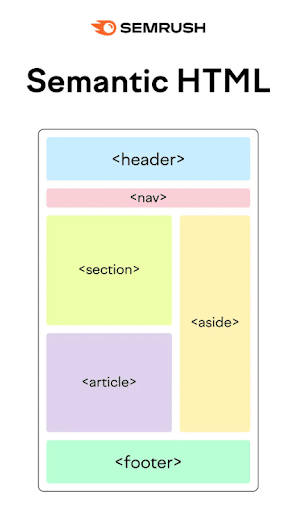
Semantic-HTML-markup-example
Semantic HTML markup example.
You can then supplement semantic markup with elements like schema markup to help with search engine optimization (SEO) and other ways to enhance your site’s performance and design.
Additionally, you need to implement a responsive design that provides users with the same seamless browsing experience across devices and browsers, as this can not only encourage engagement among mobile users but also improve mobile SEO. CSS media queries usually help achieve a responsive design, as developers apply various styles based on certain types of viewport characteristics, such as height, width, and device orientation.You also need to take into account the two types of CSS layout systems, including:

  • CSS Flexbox: This is a one-dimensional layout system that distributes space among elements on a page using either a single column or row. It can arrange components in navigation menus, forms, and card layouts, among other containers.
  • CSS Grid: Alternatively, you could use a two-dimensional system to structure content into both rows and columns, which is better for more complex layouts and potentially overlapping elements.
CSS-Flexbox-vs.-CSS-Grids
CSS Flexbox vs. CSS Grids.

2. Advanced JavaScript and Frameworks

Other hard website developer skills needed today include more advanced JavaScript knowledge and expertise around certain frameworks.

ECMAScript 2015, or ES6 for short, took JavaScript to the next level when it landed, introducing new features to optimize its performance. ES6+ has been used to refer to all releases since ES6, e.g., ES2016 and ES2017.

Some critical features to know about here include:

  • “Let” and “const” variables, the former of which you can assign, while the latter is unassignable
  • Arrow functions (=>) that make it easier to write functions with a streamlined method of working with the “this” keyword
  • Template literals (“) that enable you to embed expressions in strings for simpler string concatenation

Meanwhile, you must also familiarize yourself with the React, Vue, and Angular JavaScript frameworks and libraries to develop user interfaces. All of these platforms use a component-based model, but while React is a UI library that integrates into other tools and libraries, Vue operates with a progressive framework for incremental adoption, while Angular is a comprehensive and opinionated fixed framework.

React-vs.-Angular-vs.-Vue
React vs. Angular vs. Vue.

State management is also crucial to learn, which involves understanding the process of both maintaining and managing all data that JavaScript apps require for proper functioning. For instance, within React, you can use the React Context API to share global state while bypassing manual prop passing, while Vue’s Vuex/Pinia state management library can help manage Vue framework data.

3. Backend and API Integration

You also need these skills for web development, including knowledge of Node.js, REST and GraphQL APIs, authentication, and serverless functions.

Node.js is an open-source JavaScript runtime environment that uses Chrome’s V8 JavaScript engine as its foundation, allowing developers to run JavaScript code on servers beyond a web browser. Developers frequently use this runtime environment to build web servers, backend services, and command-line tools.

Meanwhile, two popular API architectures you can use include REST and GraphQL, which handle data in different ways. Generally, REST is simpler and subsequently better for beginners, but at the cost of potential “over-fetching” or “under-fetching” of data and less flexibility, where the GraphQL client can specify the exact data it needs with increased adaptability to meet changing needs.

REST-vs.-GraphQL-APIs
REST vs. GraphQL APIs

Also, educate yourself on the different methods of authentication to verify user identities and protect user data.

These authentication methods can include:

  • Session-based Authentication: This is a conventional method that involves storing user session data on the server and sending a cookie to the client that contains a session ID, followed by continual validation of the ID.
  • Token-based Authentication: You may also use this stateless option, which involves the server generating a token when a user logs in before sending that token to the client, where it’s stored and sent by the client.
  • OAuth: Another option is this open authorization standard that enables a third-party app to access user data through another service, such as using a Google account to log into another account, eliminating the need for the user to provide a password.

Developers can also use serverless functions to manage backend code without the need to manage servers or other infrastructure. Instead, a cloud provider scales and provisions as needed, allowing for more cost-effective and flexible development with less overhead.

4. Performance Optimization and Security

Other essential hard web development skills include code splitting and lazy loading for performance optimization and adhering to Google’s Core Web Vitals, as well as OWASP and HTML/TLS for enhanced security.

Code splitting entails breaking down application code into smaller clusters that are easier to manage, facilitating parallel and faster loading. Meanwhile, lazy loading is a specific code splitting method that only loads resources on a page when they’re needed, such as not loading images until a user scrolls to them on the page, making for faster loading times.

When it comes to optimizing security, one step to take is to gain a deep understanding of the Open Web Application Security Project (OWASP) best practices. This non-profit foundation provides guiding principles that mitigate various security risks to all types of web applications.

Here are some of the main OWASP principles:

  • Validating and sanitizing all incoming user data to prevent SQL injection and other types of injection attacks
  • Securing the authentication process through methods like one-way password hashing and multi-factor authentication (MFA)
  • Only giving authorized users access to resources with server-side enforcement
  • Consistent security monitoring and logging to proactively address potential attacks

Additionally, secure websites should use Hypertext Transfer Protocol Secure (HTTPS) instead of unsecured HTTP. A website running with HTTPS uses Transport Layer Security (TLS) to encrypt all data transferred between user browsers and web servers in a “handshake” whenever a user visits a website.

OWASP-top-10-elements-for-security
OWASP top 10 elements for security.

5. DevOps and CI/CD Pipelines

Other web developer skills pertain to DevOps and both CI and CD. DevOps applies to automated processes for integrating, delivering, and testing code changes to optimize production.

Efficient DevOps processes can automate software development through continuous integration (CI) and continuous delivery/deployment (CD).

In doing so, developers could implement the following:

  • Docker: This platform allows you to build, run, and share apps in containers to isolate them and their code, dependencies, libraries, and settings to maintain consistency across all designated environments.
  • Kubernetes: Also known as K8s, Kubernetes is an open-source automation platform that helps scale and deploy applications within containers.
  • Automated Testing: Developers should run automatic tests along the CI/CD pipeline, which helps ensure that any changes to code don’t bring with them any regressions or bugs.
  • Git Workflows: This strategy enables the structured management of code changes and effective collaboration to optimize DevOps, especially by providing a defined source of truth and allowing for parallel development.
What-a-functioning-Kubernetes-cluster-looks-like
What a functioning Kubernetes cluster looks like.

Essential Soft Skills for Developers

To complement those hard web developer skills, the following are some essential programming soft skills that can significantly help your career:

1. Communication and Stakeholder Management

One of the most important soft skills for developers to have is effective communication, including the ability to translate complex technical concepts into language that all stakeholders can understand.

Also, engage in active listening to determine what stakeholders are looking for and what they expect, with detailed documentation facilitating communication between all parties.

Keeping everyone in the project on the same page can prevent costly and frustrating rework.
2. Collaboration and Teamwork
In facilitating strong communication, you also need to practice effective collaboration and teamwork at every level.

You can keep projects moving along according to schedule using the agile methodology, which breaks up a project into sections called sprints.

Agile-methodology-in-project-management
here

One way to utilize the agile approach is pair programming, which entails two developers collaborating to write code, with one developer serving as the driver who writes the code while the other functions as the navigator who reviews the code and guides the project.

Regular code reviews through this strategic methodology will help keep the development process smooth and eliminate any errors throughout.

3. Problem-Solving and Critical Thinking

Other key programming soft skills include debugging, root-cause analysis, and innovative troubleshooting that help identify potential issues and address them before they can develop.

Debugging could entail replicating the bug, using various debugging tools, backtracking to find the point of failure, and logging.

Root-cause analysis (RCA) would involve defining the specific problem, collecting error logs and other relevant data, figuring out the root cause, and implementing solutions with documentation.

Innovative troubleshooting is equally important here, which requires developers to visualize a given problem, reverse it, prototype and experiment, and ultimately figure out the best solution.

4. Time Management and Organization

Always prioritize your tasks based on importance, carefully plan your sprints to fit them within the project schedule, and use any available project management tools to assist you in your development.

Time management skills for web developers will help prevent potential setbacks and keep clients satisfied with timely rollouts and updates.

5. Adaptability and Continuous Learning

You’re never done learning skills for web development, as education is ongoing, as with any other profession.

Stay up to date on the latest frameworks and keep an eye on emerging and continuing development trends, integrating them into your practices.

Also, participate in online communities, of which there is no shortage. You can participate in discussions on everything from GitHub and Stack Overflow to Reddit and Dev.to.

Integrating Hard and Soft Skills in Real-World Projects

Now that you know what kinds of web developer skills make for a successful professional, let’s put them into practice via a hypothetical scenario.

Imagine you need to develop a web app for a multi-location business, with a global iteration and local variants that have their own requirements.

Phase 1: Planning

To kick off this project, a developer could develop a central corporate site with either sub-sites or sub-domains for each location, working to maintain consistent branding across locations while tailoring each sub-site or domain to individual location requirements. To maintain this alignment, all site iterations could pull from a centralized asset library that includes pre-approved visuals, containers, and other content.

Using the agile methodology, the developer might collaborate with both corporate and local management to get a feel for what each site iteration will require in terms of development.

Phase 2: Development and Architecture

To put together the site, the developer could work with another to serve as either the driver or navigator, facilitating pair programming to put together a mobile-responsive platform that connects with users across all devices.

Both developers would determine the specific requirements based on stakeholder input and put them into practice with a centralized database and a single codebase that serve each location.

Meanwhile, location-specific pages with unique content could assist with local SEO, supplementing other elements like a fully developed Google Business Profile.

Using AWS or Azure, a multi-region site architecture could also use the cloud to optimize scalability with a geographically aware load balancer that minimizes latency for all users.

Phase 3: Launch and Post-Launch

Franchisees for each location could test functionality and provide feedback in a pilot program, feeding a feedback loop that enables a successful launch.

Franchisees could also receive training on how to manage and use local content.

At the same time, a CI/CD pipeline can continuously integrate and deploy global updates across all locations, with Google Analytics and other tools allowing for user tracking to gauge each site’s performance.

Consistent communication between developers and stakeholders will further enable continual improvement and updates.

Advanced Career Development Strategies

As you establish a foothold in your industry, demonstrate your web programming skills in a comprehensive portfolio.

Highlight projects indicating the website developer skills needed in complete portfolios, including a blend of hard and soft skills that you have used to complete various development tasks. Divide your projects into phases and clearly indicate the steps you took to complete each project, from planning and discovery to launch and post-launch updating and analytics.

Also, engage in networking whenever you can, taking advantage of the many opportunities out there to grow and connect with others in your industry. GitHub and other communities can allow for open-source contributions, and you can attend and speak at industry meetups in your area.

Writing technical blogs around various topics can also help you showcase your abilities and encourage a conversation among an audience, further helping extend your network.

Build Your Web Developer Skills With Ignite Visibility

Want to develop a successful career that fully utilizes and builds on your web development skills? Ignite Visibility offers plenty of opportunities.

With our expertise and support, you’ll be able to:

  • Apply your web programming skills to real-world projects
  • Build both hard and soft skills to advance your career
  • Collaborate with experienced developers and teams
  • Grow professionally with ongoing training and mentorship
  • Contribute to innovative digital solutions
  • And more!

Check out our careers page today to see how we can help you put your skills to work and set you on the path to long-term success.

Related Posts

  • Core Web Vitals for SEO - Ignite Friday

    Updated: 3/17/2021 Remember the speed report in Google Search Console? It’s gone. Don’t worry, though.…

  • Google Rolls Out WordPress Web Stories Plugin - Breaking News

    It’s here. Just this week, Google officially rolled out the Web Stories WordPress plugin. It’s…

  • Top 3 Free Alternatives to Google Analytics

    Google Analytics may be the hegemonic site analytics tool of the moment (or decade), but…

About Lucas Dantas

Lucas Dantas is the Head of Engineering at Ignite Visibility, where he leads high-performing global teams to build smart, scalable tech. With a background in product strategy, DevOps, and hands-on software development, Lucas knows what it takes to turn complex problems into clear solutions. When he shares insights, it’s from real-world experience, not theory.

About Ignite

Ignite Visibility is a premier full-service digital marketing agency. We were founded in San Diego, CA but are now a 100% remote-first company with Igniters and clients around the globe.

Ignite Visibility is one of the highest awarded digital marketing agencies in the industry, works with some of the biggest brands in the world and is a 6x Inc. 5000 company.

noun-trading

Our Services

Ignite Visibility offers Award-Winning Services including comprehensive full-funnel digital marketing strategies. Learn more about our most popular service offerings below:

  • SEO Search Engine Optimization
  • PPC Pay Per Click
  • Email Marketing
  • Social Media
  • Creative
  • View All Services

Contact Us. Let’s Chat!

  • This field is hidden when viewing the form

Marketing Guides

SEO In 2020: How To Prepare For Major Disruption

"SEO: The Movie" - Have You Seen Our Film? Watch Now

"Social Media Marketing: The Movie" - Have You Seen Our Film? Watch Now

Amazon Seller Central vs Vendor Central

Listen To The Podcast Featuring The Best Minds In Marketing

John Lincoln Interviews Global Director of Digital Marketing & Strategy at Qualcomm, Jessica Jensen

Check Out 227 Free Online Marketing Classes

The 2020 Guide To Dominating SEO With Advanced Schema

Learn More About Our Digital Marketing Agency

Learn More About Our SEO Services

Learn More About Our Paid Media Services

SELECT CATEGORY

Become A Contributor

Interested in writing for Ignite Visibility?

APPLY NOW

noun-chat

Let's Chat

Ready to grow your online visibility and sales?

Request Your Free Proposal

Work With Us

NEWSLETTER // SIGN UP NOW


noun-strategy

Free Marketing Resources

  • Digital Marketing Resources
  • Marketing Strategy Videos
  • Weekly Marketing News Recaps
noun-strategy

Most Popular Blogs

  • How Long Does SEO Take?
  • Multi-Location SEO: Top Strategies
  • Google AI Overviews: Everything You Need to Know
  • Technical SEO 101
  • 18 Google Ad Extensions You Should Use
  • Complete Guide to Google Responsive Display Ads
  • Capitalizing on Local Service Ads
  • How SEO and PPC Work Together
  • Community Management Best Practices
  • B2B Social Media Marketing Guide
  • VIEW ALL BLOGS
noun-letter

Join Our Newsletter

CONNECT WITH US

  • facebook
  • twitter
  • instagram
  • youtube
  • linkedin

Services

  • SEO
  • Local SEO
  • AI SEO
  • Paid Media
  • Social Media Marketing
  • Email Marketing
  • Conversion Rate Optimization
  • Website Design & Development
  • Digital PR
  • Analytics & Attribution

Industries

  • Consumer Franchise Marketing
  • Franchise Development
  • Multi Location
  • ECommerce
  • B2B
  • Healthcare & Medical
  • Home Services
  • Financial Services
  • View More Industries

Resources

  • About Us
  • Our Team
  • Awards
  • Clients
  • Case Studies
  • Blog
  • Marketing Resources
  • Franchise Marketing Resources
  • Contact Us

Ignite Logo

REQUEST A FREE PROPOSAL

JOIN THE NEWSLETTER

Locations

San Diego

4370 La Jolla Village Drive Suite 320,
San Diego, California 92122

Irvine

7700 Irvine Center Drive Suite 430,
Irvine, CA 92618

Orlando

100 East Pine St,
Orlando, FL 32801

New York

14 Wall Street
20th Floor New York, NY 10005

(619) 752-1955

©2026 Ignite Visibility. All Rights Reserved.
Privacy Policy and Terms of Service