
Want to increase the number of new memberships to your gym? Search engine optimization, or SEO, can be the key to connecting with your online customers.
Here at Ignite Visibility, we provide SEO for businesses across a range of industries, including SEO for gyms. We’ll help you climb to the top of search engines, targeting critical industry keywords from “when to join a gym” to “best gyms in [your city].” Ultimately, gym SEO will help you get ahead of competitors and bring in many satisfied members.
In this article, we’ll get into how SEO can elevate your online presence and the benefits of our specialized gym SEO services.
What You’ll Learn:
- The Benefits of SEO for Gyms
- How We Build Local Gym SEO Strategies
- Keyword Content Ideas for Gyms
- When to Hire an Agency for Gym SEO
The Benefits of SEO for Gyms
Here are some compelling reasons to implement SEO for fitness gyms if you want your business to excel online.
Increased Membership Enrolment
When researching businesses, many of us turn to search engines. According to a consumer survey from Capital One Shopping, 66% of people use search engines, with Google being the predominant spot.
With the help of a solid gym SEO strategy, you can connect with people in the market for gym memberships and encourage more signups.
Local Community Engagement
Using local gym SEO, you can establish a stronger connection with your community. Keep in mind that 80% of U.S. consumers search for local businesses online at least once a week.
People in your area will be able to find you more easily, and you’ll appear more credible than your competitors with high rankings for top keywords.
Targeted Reach
Connect with potential customers by targeting high-value keywords based on search intent. For instance, optimize for various keywords to reach people looking for weight loss or muscle gain advice, along with people who are ready to join a gym near your locations.

Long-Term ROI and Cost Efficiency vs. Paid Campaigns
A strong SEO gym strategy will also yield long-term ROI with a cost-effective solution. Once you gain a foothold in search engines, your business can stay there and continue to attract valuable traffic.
Paid campaigns only work when they are on, but SEO is always-on. Paid should boost SEO, not be the foundation for your marketing. You’ll have consistent ROI with SEO. Additionally, improved organic reach and traffic can improve your paid search campaign quality scores.
Steady and Growing Organic Traffic
Organic traffic is a metric that refers to people coming to your website from search engines. It’s the most valuable kind of traffic because it signals your reach and relevance to searchers.
Monitoring this is critical to determining the success of your gym search engine optimization. Should it drop, it’s a sign you need to refresh content and produce more of it.
Review Credibility
Showing up in local searches for gyms connects to your reviews. When people search, they look for reviews, as they are a top influence of decision-making. They also impact how search engines rank you. Positive reviews enhance your credibility and reputation.
On average, the top three spots in local searches have 561 Google reviews, per Semrush. Additionally, 83% of people use Google to look up reviews of local businesses. The interconnectedness of organic rankings and reviews should be part of your fitness SEO strategy.
An Overview of Strategies for Optimizing Local SEO for Gyms
To get the most from your local gym SEO strategy, it helps to implement certain key strategies, such as:
Google Business Profile Optimization
Local SEO for fitness gyms ties directly with the optimization of your Google Business Profile (GBP). Here’s a quick checklist to help:
- Start with your name, address, and phone number (NAP).
- Add keywords to your business name if possible.
- Write a detailed business description.
- Make Google Posts that include keywords and promote events and special deals.
- Add high-quality images and videos of your gym, including equipment and shots from classes.
- Encourage and manage customer reviews. Be sure to respond to positive and negative ones.
- Use attributes and special features like amenities, activities, and accessibility.
Content Marketing
You’ll also want to develop a strong content marketing strategy. Regularly producing high-quality, optimized content will drive more organic traffic. You should start with a list of keywords to target. Your content plan should include:
- Blog posts
- Dedicated location pages
- Website pages
- Social media
You can also create different types of evergreen content, repurpose your content, and leverage user-generated content from your customers. Creating a content calendar is a great way to stay organized and consistent with content.
Mobile-Responsive Design
Another critical component of gym SEO is mobile responsiveness. Your website should provide the optimal user experience for everyone, regardless of which type of device they’re using. This is imperative, as 64% of all web traffic in the U.S. alone comes from mobile devices.
Customer Reviews
Customer reviews drive credibility. Most consumers read them. As noted, they are a vital part of your GBP. Google does look at your reviews as a component of ranking. How can you solicit them easily? Here are some tips:
- Make it easy: Add the link for a review in customer newsletters and other emails.
- Incentivize members to leave one: Offer them a free piece of swag.
- Leverage QR codes: Stick them in the gym with a reminder to leave a review.
- Ask members directly: Mention it when they check in, as a friendly reminder.
Building Links
Get your gym in all relevant local directories and obtain backlinks from local businesses that have some authority in Google’s eyes. The more high-quality links you have on reputable websites, the more authority your site will have.

How We Build Local Gym SEO Strategies
As a provider of gym SEO services, we’ve learned a lot about how to develop and execute a strategy. Here are the steps we take.
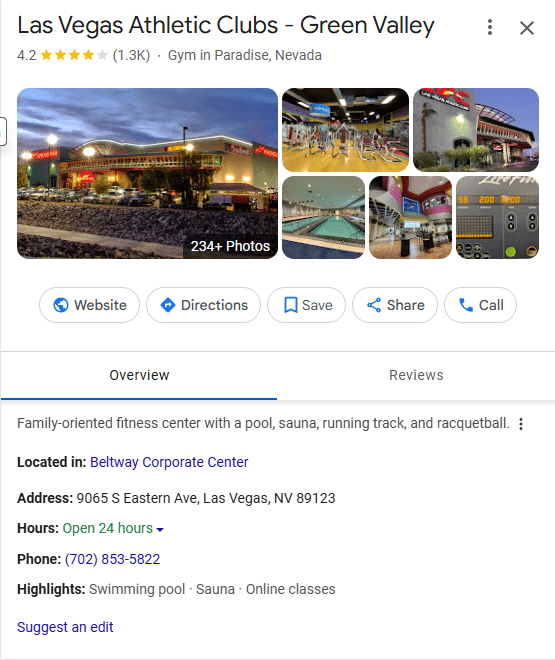
Google Business Profile
To reach local audiences, you need good local gym SEO. This process entails optimizing your company’s GBP. This is a key first step because it’s what enables local pack visibility. It builds citations to appear in local listings and gets satisfied customers to leave reviews. Together, these components can significantly help boost engagement and memberships.
Site Audit
Another key first piece is a site audit. This audit looks at all of the current SEO elements on your website. Doing so helps us determine what’s working and where there are opportunities for improvement. In the process, we analyze your site to identify technical issues, keyword opportunities, and gaps in your content that we can cover.
Some things we might find include:
- Images are too large, which impacts site speed
- Duplicative content
- Pages that don’t have proper meta titles or descriptions
Keyword Research
The next step will involve keyword research. We look for high-volume short- and long-tail keywords that apply to your industry. For instance, we might look for location-specific keywords such as “gyms in [city]” as well as service-based keywords like “gym memberships” and “fitness advice.”
On-Page SEO
Your website’s on-page SEO is extremely important to help you rank in search. These elements include your page’s content with keywords and links, headers within that content, title tags and meta descriptions that show up in search results, and images with optimized alt text.
Additionally, the readability score of content matters in terms of SEO. Higher readability scores are the result of sharper sentences, short paragraphs, and using active versus passive voice.
Content Creation
We’ll also develop top-quality, fresh content that incorporates keywords and other SEO components. Content will include landing pages where people can sign up to become members and learn more about unique membership benefits, along with blog posts covering a range of topics like workout tips and advice for first-time gym members.
Link Building
In addition to on-page SEO on gym websites, we’ll implement certain off-page SEO techniques, like link building. This service involves getting backlinks on reputable and authoritative websites that lead back to yours. For example, you can have high-ranking fitness blogs include a link to your site in a guest post, with additional offsite links on local directories and review sites.
Performance Tracking
We also monitor your website’s performance on a regular basis to ensure our gym SEO services are working. Tools we use to measure various metrics include Google Analytics and Google Search Console, which provide valuable insights that can inform future efforts.

Measuring SEO Success: Tracking Performance and ROI
To get the best results with SEO for fitness brands, it’s crucial to track campaign performance effectively and compare it to your goals.
Tracking will depend on the goals you have set and their corresponding metrics. For instance, if you have a list of keywords and optimize your website to include these, you’ll likely want to follow rankings over time. Another goal might be to bring more traffic to your website, in which case organic traffic would be a major key performance indicator (KPI).
Your Metric Framework
Measure what matters with these metrics:
- Organic traffic: Record new and total for this metric. Seeing consistent growth in new organic traffic is a good sign that your SEO strategy is working.
- Local pack visibility: Monitor if your GBP makes it to the top three. When you reach this, your local SEO efforts are paying off.
- Keyword positions: Track your rankings, specifically those in the top three, 10, and 20. You’ll be able to do this with a tool like Semrush. You can see your gains and losses. When you see losses, it may be time to refresh the page.
- Conversion actions: Determine how your SEO drives conversions, which would be someone signing up for a visit or membership. Tagging your calls to action (CTAs) properly will tell you where conversions come from organically.
- ROI compared to paid ads: Review the performance of SEO with these metrics and then compare them to the conversions from paid. SEO efforts don’t have a cost per click (CPC), but you can evaluate your investment in each.
Local Gym SEO Measurement Tools
With your goals in place and your KPIs decided, use the right tools to monitor and measure SEO for fitness gyms. Some of the top platforms to implement include:
- Google Analytics: Using Google Analytics, you can keep a consistent record of your website’s performance in real time. Metrics include organic traffic, bounce rate, session duration, pages per session, keyword rankings, and geographic data.
- Google Search Console: Another tool you can use to gauge the performance of SEO for gyms is Google Search Console. It helps you identify any technical issues with your site and provides some guidance on how to fix them.
- Semrush: Yet another option to measure performance is Semrush, which tracks rankings. It also gives you plenty of features to help with everything from keyword research to content marketing optimization.
- Moz Pro: Get detailed insights and analytical data to measure performance, conduct SEO audits, and optimize your site’s on-page SEO.
Based on the data you collect, you can determine what to optimize for improved performance, perfecting your gym SEO strategy over time.

Common SEO Mistakes Gyms Should Avoid
There are certain pitfalls with SEO for gym owners that you should avoid if you want to stay on top of your strategy.
These potential mistakes may include the following:
- Not optimizing GBP categories and attributes: You can add a primary category and one or two secondary ones. Failure to do this will impact your ability to show up in the local pack. Attributes allow you to identify specific services, amenities, and qualities.
- Missing hyper-local landing pages: If your landing pages don’t focus on the location, they are unlikely to rank for search terms. They are different from your standard website pages. They should be focused on conversion and match the user’s intent.
- Ignoring structured schema: Another SEO pitfall is not using structured schema. It’s the process of using tags to include in your HTML. It improves the way search engines “read” your content. Add schema to each web page so that search engines understand your content and boost your rankings.
- Failing to track local conversions: Are you tracking local conversions? It could be something without much visibility. You need to define the specific event or action and implement tracking within Google Analytics.
- Keyword Stuffing: After selecting target terms, be sure to keep instances natural when you optimize content. Don’t simply stuff keywords into the content, which can hurt readability and lead to SEO penalties if your content comes off as too spammy. Instead, include them where they make the most sense and include organic variants in your content.
- Ignoring Mobile Optimization: Not having a mobile-responsive website could also hurt SEO for gym owners, as the majority of people looking for local businesses tend to use their mobile devices, and Google often favors mobile results in search rankings. Fix this by ensuring you’re using a mobile-first template.
- Poor Website Navigation: A website with low navigability could not only make it harder for people to explore your website and hurt readability, but it could also make it harder for search engine bots to crawl and index for SEO for gyms. Resolve this by simplifying navigation menus.
- Neglecting Online Reviews: Fitness businesses with a lack of reviews could further hurt rankings, as Google often ranks businesses based on their reputation. Encourage people to leave reviews, and even if you get negative reviews, you can still reply thoughtfully to each review for reputation management.
Having professional gym SEO services behind your strategy could help you more easily avoid or address these issues before they become a problem.
Keyword Content Ideas for Gyms
Keyword research is one of the most important aspects of SEO for gym owners. The terms should appeal to different users at various stages of the sales funnel as you attempt to draw in new members.
Funnel stages also align with keyword intent. Keyword intent is why someone is entering a term. There are four types:
- Navigational: Someone wants to go to a specific web page.
- Informational: Someone wants to learn something, and it’s usually in the form of a question.
- Commercial: Someone is researching to make a purchase. They aren’t ready to buy but are doing their due diligence.
- Transactional: Someone is ready to buy a product or service.
Mapping out intent with your funnel stages helps you choose the best keywords, type of content, and CTAs.
Top of Funnel: Awareness
When people are at this stage of the sales funnel, they’ll want more information about certain fitness-related topics and won’t necessarily want to join a gym just yet. At this point, you can create blog posts covering certain topics around fitness tips, health advice, and ultimately recommend that people join a gym.
Some keywords to target here could include:
- Workout tips for beginners
- Should i join a gym
- First-time gym tips
- Gym advice for beginners

Middle of Funnel: Consideration
Potential customers will reach this stage of the customer journey when they’re considering joining a gym but haven’t settled on a specific company. The content you develop here could include customer testimonials and service pages convincing people to join your gym over competing businesses.
Keyword ideas for the consideration stage include:
- Best gyms in [city]
- Gym memberships near me
- Gym classes near me
- [gym brand] reviews
Bottom of Funnel: Decision
When people are ready to enroll in a gym membership, they’ll wind up here. Service pages, location pages, and testimonials will also carry people through to membership signups during this stage.
The following are some keywords to target here:
- Gym specials in [city]
- [gym brand] membership
- [gym brand] price
- [gym brand] membership deals
Keyword Intent, Content Types, and CTAs
| Keyword Intent | Content Types | CTAs |
| Navigational | Web Pages
Membership Login |
|
| Informational | Blog posts and pages that describe your services |
|
| Commercial | Blog posts, testimonial pages, comparison pages |
|
| Transactional | Conversion landing pages |
|
When to Hire an Agency for Gym SEO
To truly succeed with SEO for gym owners, consider working with professionals who can give your campaigns everything they need.
The following are some reasons for hiring a company like Ignite Visibility to handle your SEO:
- You Don’t Have Enough Time: Can’t focus enough on SEO to get the results you want? Professional SEO services will give your campaigns the attention they need while you focus on growing your business.
- You Lack SEO Expertise: Hiring a company to handle SEO can lend industry knowledge to your strategies for better results.
- Slow Traffic to Your Site: If you’re not getting more traffic fast enough, an SEO company will take steps to achieve top rankings for high-volume keywords for far faster traffic gains.
- Budget Restrictions: You may also lack the budget for an in-house team or specialist, which is where outsourcing can come in handy, giving you everything you need with a more cost-effective solution.
- You Need Scalability: SEO experts will also be able to help you scale as your business grows or demands change among your audience.
- It’s Hard to Keep Up With SEO Trends: Professionals are always staying updated with the latest SEO industry trends. We’ll integrate these trends into your strategy for continually improved performance.
- You have multiple locations: Multi-location marketing can be complex. You have many websites and content calendars to maintain. If you’re growing, an expert could be a good investment.
- Growth goals are a priority: Whether you just opened or have been in business for years, growth requires leads. If your website isn’t a content engine that attracts and converts, it will be hard to hit this.
- Your current rankings are abysmal: If you’ve tried some SEO strategies but haven’t seen any improvement, an agency could be your lifeline. They’ll help you quickly discern the issues with plans to solve them.
- You don’t have any internal resources: If your staff doesn’t have SEO expertise and is winging it, you’re probably not getting much traction. If no one is responsible for these parts of your business, you can’t improve them.
Key Questions to Ask Prospective Agencies
- When evaluating your options, include these queries:
- What deliverables will they provide?
- What’s the timeline from beginning to execution?
- How will they deliver reporting?
- Does the agency have experience in your industry?
- What success stories can they share from similar businesses?
Succeed with SEO for Gyms with Ignite Visibility
As a leading fitness marketing company, we can give you a holistic SEO solution for your gym company. We can also provide you with many other digital marketing services to help your business thrive online.
With our gym SEO services, you get:
- In-depth keyword research to cover every level of the sales funnel
- Optimized content with on-page SEO elements
- Off-page SEO strategies, including link building that builds a strong backlink profile
- Much more!
Contact us today to speak with one of our experts about a potential SEO strategy for your fitness company.