In recent years, Google has been integrating AI into its many functions, including ads and organic search results, along with dynamic ads that help optimize targeting. With AI Max, Google has effectively blended AI and dynamic responsive ads with a suite of features to build even stronger connections with target audiences.
In this blog, Ryan Cox, VP of Paid Media, National to Local, will explain how Google AI Max works, its benefits, its features, and when to use it as a supplement or alternative to traditional search ad campaigns.
What’s Covered:
- What Is AI Max for Search?
- Why AI Max Matters for Marketers and Agencies
- How AI Max Works: Core Components
- AI Max vs. Traditional Search Campaigns
- Best Practices for Implementing AI Max
- When and Where AI Max Delivers the Strongest Results
- Monitoring and Optimizing AI Max Campaigns
- FAQs
What Is AI Max for Search?
So, what is AI Max, and how does it work for Search ads?
AI Max is a suite of features that advertisers can use to fully optimize Search ads that appear in Google search results, usually at the top of search engine results pages (SERPs) above organic results.
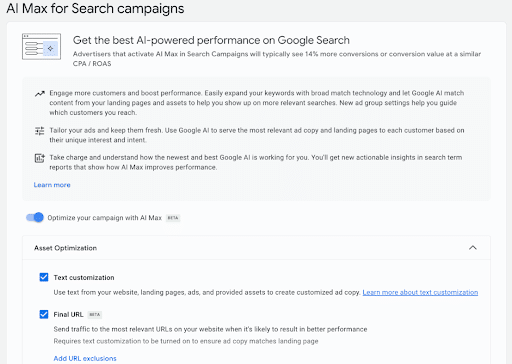
Google AI Max harnesses the power of AI solutions to improve ad targeting and enhance creative asset optimization to help advertisers reach the right audiences at the right time more effectively.
To achieve the best results, AI Max for Search incorporates a few key features, including:
- Search term matching to target the most appropriate queries more precisely
- Text customization that generates optimized headlines and descriptions
- Final URL expansion to direct viewers to the most relevant landing pages
Ultimately, this tool is essential in today’s paid media advertising environment for a number of reasons. For one, it helps take advantage of AI-driven search, and it enables advertisers to more easily scale their campaigns and maximize efficiency, helping them get the most from their available ad budget and maximize return on ad spend (ROAS).
My Expert Opinion on Google AI Max
In the past, we’ve seen Google Gemini become an increasingly integral component of Google’s core functions, with elements like Smart Bidding, Performance Max, and Responsive Search Ads.
Then, in May 2025, Google officially announced AI Max for Search campaigns, which would take ad optimization to the next level with several key features.
If you want to take your Google Search ads to the next level, you might benefit enormously from implementing AI Max in addition to other campaigns, including display ads and SEO efforts.
Why AI Max Matters for Marketers and Agencies
This particular feature is crucial for marketers and marketing agencies because of the benefits it offers over more traditional Search ad strategies.
Some of the main benefits of AI Max for Search campaigns include:
- Expanded Reach: Through search term matching and asset-based targeting, advertisers can use these campaigns to reach even more people in their target audiences when conventional campaigns might underperform.
- Improved Asset Performance: Asset optimization helps connect the right headlines and descriptions with audiences for even more precise targeting, automating this process to drive efficiency without manual inputs.
- Automation of Creative: These campaigns match creative content to each user’s specific interests and deliver ads that appear as organic as true organic results, maximizing relevance and, subsequently, conversion rates.
- Relevance to User Intent: Connect with audiences based on search intent, whether you want to reach people at the top of the sales funnel or toward the bottom when they’re ready to convert.
According to data from Google, AI Max for Search can help marketers significantly when used the right way, with advertisers using this feature experiencing up to 14% more conversions. Campaigns using phrase and exact match keywords can see an even higher lift of up to 27%.
When properly implementing this solution, you can effectively automate the advertising process to complement human expertise, using the data you collect to effectively personalize your campaigns. At the same time, you maintain complete control over your ads and campaigns to ensure they fit in with your overarching strategy.
How AI Max Works: Core Components
There are three primary features you get with Google AI Max, including:
Search Term Matching
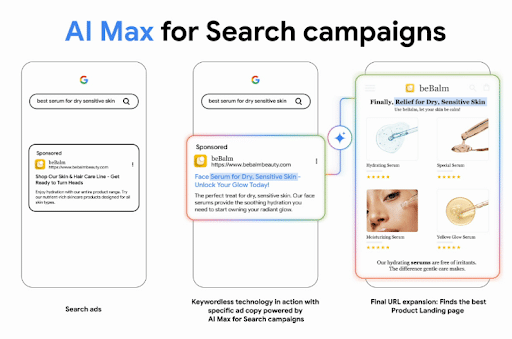
This feature enables ads to show up for queries that traditional ads might otherwise not appear for, thanks to a combination of keywordless tech and broad match keyword optimization.
In this context, “keywordless” simply means that advertisers don’t need to add keywords themselves to ensure ads reach their target audiences. Google automates keyword optimization by analyzing behavioral, contextual, and semantic data for more precise targeting, using machine learning over time to hone your targeting.
Text Customization
You also don’t need to manually create headlines and descriptions with AI Max, as the tool automatically generates new ones based on input from various sources, including keywords used, landing page content, and other ad creative.
Final URL Expansion
In addition, this feature can determine which of your site’s URLs best matches your ad content, connecting them to your ads for an even better chance of conversion.
To utilize this feature, you must activate text customization.
Comparison: AI Max vs. Traditional Search Campaigns
Wondering what the difference is between AI Max for Search and traditional campaigns? Here is a breakdown of each and their respective features:
| Feature | Standard Search Campaigns | AI Max |
| Primary Goal | Target users looking for particular products or services to drive more lead conversions and sales | Works to maximize conversions and lead value with even more precisely targeted Search ads |
| Targeting Method | Manual targeting using various keyword match types | AI-driven targeting using audience signals, user behavior analysis, and machine learning |
| Query Expansion | Use an advertiser’s keyword list and match types | Automatic expansion using “keywordless” technology to match ads to relevant queries you might otherwise overlook |
| Ad Creation | Involve manual text ad creation | Dynamically optimizes headlines and descriptions based on existing text assets |
| Landing Page | Advertisers specify the final URL | Automatically determines which URL is the most relevant for an ad with final URL expansion |
| Management Effort | Need ongoing manual management and optimization | Uses AI and machine learning to continually optimize and perfect campaigns |
| Best For | Campaigns in need of complete control over ad content and targeting, especially toward the bottom of the funnel | Businesses with a sufficient amount of conversion data, many landing pages, and a focus on broader reach and scale at every stage of the customer journey |
Best Practices for Implementing AI Max
If you want to get the most from AI Max for Search campaigns, follow these best practices:
Start Small and Test
Don’t implement AI Max for Search across your entire account from the start, only using it for high-performing or non-critical products or services to test its impact. Also, give the campaign a few weeks at least to complete the learning phase, as it captures and understands user data.
Enable Key Features
Make sure you enable all of the core functionalities to gauge their performance, including search term matching (STM), text and asset customization, and final URL expansion.
Also, be sure to include high-quality assets that can fuel your campaigns, including:
- Up to 15 headlines and four to five descriptions
- A minimum of three landscape (1200 x 628 px), three square (1200 x 1200 px), and one portrait image
- At least one YouTube video of 10 or more seconds to extend reach across Google channels
Monitor Search Term Reports
Regularly review search term reports to see which keywords are getting the most traffic to your ads. You may also be able to identify irrelevant queries this way for future exclusion.
Exclude Irrelevant Queries
Indicate to Google what search queries you don’t want to incorporate into your ads, which you can do by creating and including a list of negative keywords. This step will help further maximize relevancy across all ads.
Align Landing Pages
All landing pages connected to your ads should align with asset groups and be relevant to your offerings. As you would with keywords, you can include URL exclusions to prevent ads from going to landing pages that aren’t relevant or aren’t truly supposed to be landing pages.
Ensure Conversion Tracking
Turn on conversion tracking to help determine how well your ads are meeting your conversion goals. In the case of these campaigns, you will likely want to focus on high-value conversions like qualified leads or purchases instead of page views and other vanity metrics.
When and Where AI Max Delivers the Strongest Results
There are certain situations when Google AI Max works best, such as:
- Campaigns with exact and phrase match foundation
- Ecommerce or other types of websites with a large number of landing pages
- Multi-location and local service campaigns targeting people within specific areas
To give you a better idea of what you can achieve with these types of campaigns under the right circumstances, here are a few case studies that just might inspire you:
L’Oreal
Beauty brand L’Oreal had the goal of increasing its customer base from 1.25 billion to two billion by 2030, with Search ad campaigns at the focus of those efforts. To help the company on its way to achieving this goal, L’Oreal implemented AI Max campaigns that could quickly adapt to changing consumer behaviors.
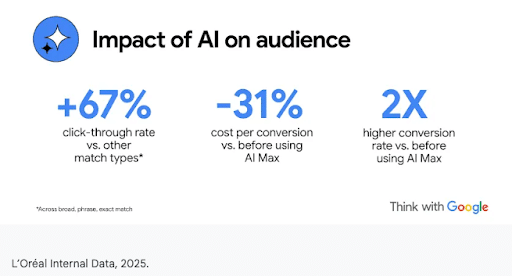
More specifically, L’Oreal used this tactic to optimize skin care and hair care ad campaigns and determine scalability. Search term matching, custom ad text, and final URL expansion helped optimize the customer journey, leading to favorable results, including a 67% increase in click-through rates, a 31% decrease in cost per conversion, and twice the conversion rate.
ClickUp
Another brand that saw success using these campaigns was the all-inclusive workspace ClickUp, which had the objective of reaching key decision-makers to increase the adoption of its app.
With Google AI Max, ClickUp was able to boost incremental conversions by 20%, reduce cost per acquisition by 22%, and increase its incremental ROAS by 16%.
Klook
Travel company and booking service Klook needed an ad campaign that could keep up with its expanding inventory and presence, along with changing consumer behaviors in the travel industry.
Using these campaigns, Klook could target a larger number of long-tail keywords and deliver more optimized content to connect with high-intent audiences.
The result? Klook saw a whopping 161% increase in overall conversion value and a 25% rise in ROAS within a single month.
While these and other case examples show the effectiveness of these campaigns, they’re not for everyone or for every situation.
For instance, you may want to avoid using AI Max for Search if you have a strict cost per acquisition or are in a brand-sensitive industry with potential compliance issues, such as finance or insurance.
Monitoring and Optimizing AI Max Campaigns
As you develop your strategies, there are some specific reports to review to inform your approach.
To begin with, you will want to look at the various reports within AI Max, including:
- Search Terms Reports: Regularly check out this report, which is segmented by match type to indicate incremental search terms, with a source column that indicates whether a term came from keywordless or broad match expansion matching. Max will appear as a new keyword match type for incremental terms.
- Asset Performance Reports: See the performance of your headlines, descriptions, and URLs to determine whether any changes to copy might improve performance.
- Landing Pages Reports: Show how your ads’ corresponding landing pages perform to help gauge relevance across ads and how well those pages drive conversions.
You can also gain certain budget allocation insights on your Insights page or Bid Strategy report, which could show where your budget goes and the factors influencing performance shifts. Using these insights, you can decide on where to allocate your budget to maximize ROAS and ROI in the long term.
FAQs
1. What is AI Max for Search campaigns?
These campaigns use AI-driven Search ad strategies to connect with audiences using the best combination of ad copy and landing page URLs with the goal of driving more conversions among high-intent leads.
2. How do I enable AI Max in Google Ads?
Once you have sufficient conversion data, you can set up these campaigns within your Google Ads account. Click “+ Create” and choose “Campaign,” which will allow you to select a campaign objective and set up other aspects before toggling the AI Max opt-in.
3. What are the benefits of using AI Max for Search ads?
Advertisers benefit in a number of ways from using these strategies, such as improved reach and ROI by driving conversions, enhanced ad relevance with dynamic ad assets, and smarter landing page matching to further connect with high-intent leads.
4. When should I use AI Max in my Search campaigns?
You should use these campaigns if you want to scale Search ad performance and discover relevant and valuable keywords to help you connect with audiences. At the same time, you can benefit from increased control over fully automated Performance Max campaigns.
5. How do I measure the performance of AI Max campaigns?
Within Google Ads analytics, you can measure the performance of these campaigns in several ways, such as search terms reports, landing page reports, and asset reports, with the ability to measure metrics like conversions, conversion values, and cost per acquisition to gauge performance.
Get the Best Results From AI Max With Ignite Visibility
Want to get the most from AI Max for Search campaigns? Ignite Visibility has ample expertise and resources to build the perfect campaign for your PPC strategy.
When you work with us, you’ll be able to:
- Determine which keywords will best connect with your audiences
- Develop ad strategies using Google AI Max and/or other approaches
- Integrate paid media advertising into other aspects of digital marketing
- Continually measure and optimize campaigns for better performance
- And more!
Get started with us today by requesting a free proposal and find out what our experts can do for you.