Video killed the radio star, but did ChatGPT kill SEO?
That’s what some people are saying, but we disagree. While AI-generated content can result in short-term gains, over the medium-to-long-run, websites that rely on generic AI content will tend to suffer large traffic losses.
So, what is AI generated content, and is AI generated content good for SEO? In this article, Jonathan Finegold, Director of SEO at Ignite Visibility, digs further into these points and concepts below, focusing on E-E-A-T and why content differentiation is key in 2026.
What We’ll Cover
- Google’s Recent Updates on AI-Generated Content
- Impacts of AI on SEO and Quality Content
- Pros and Cons of AI-Generated Content
- Ethical Considerations When It Comes to AI
- AI Tools & Strategy
- How to Detect AI-Generated Content
- FAQs on AI-Generated Content
My Expert Insights on AI-Generated Content
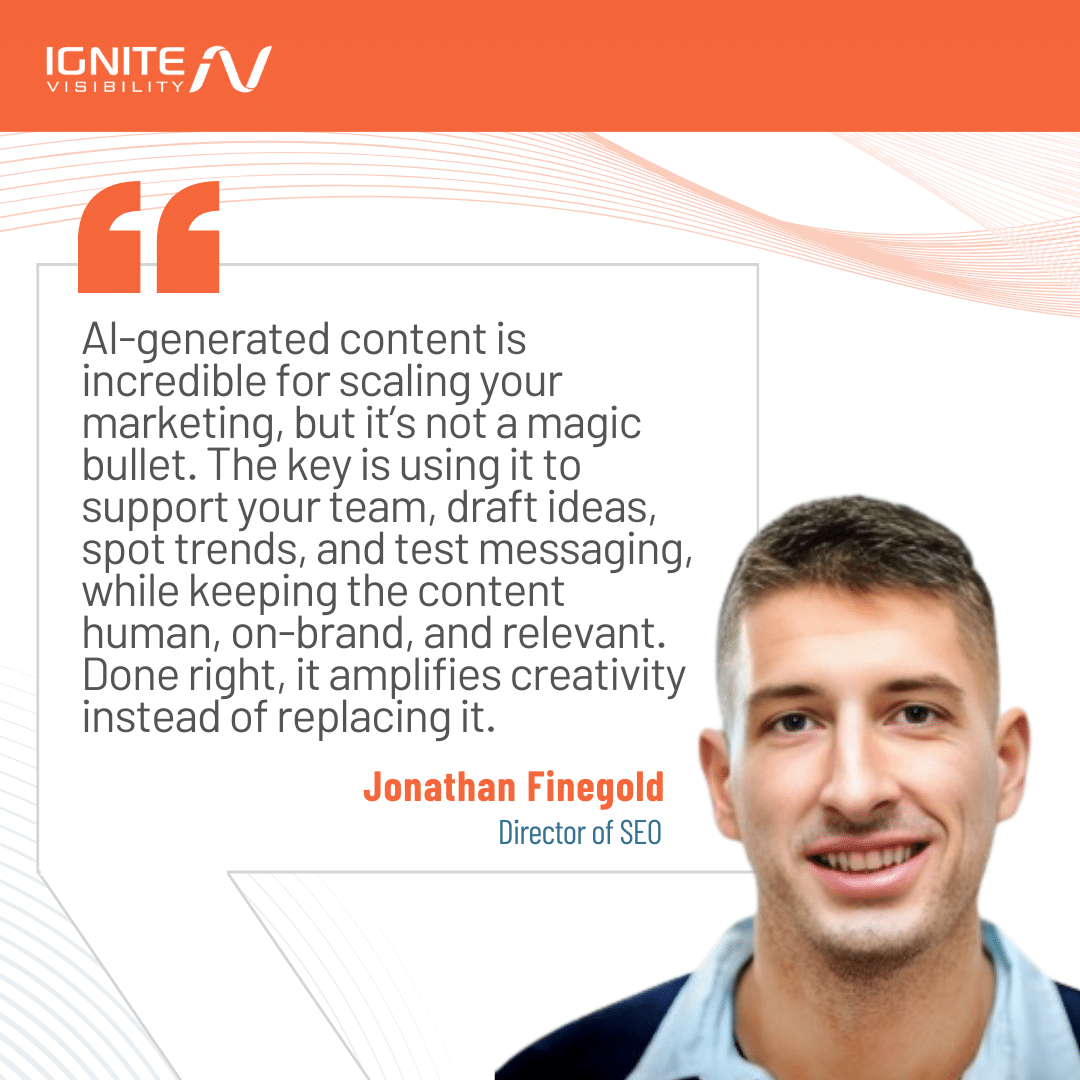
In the ever-evolving landscape of digital marketing, AI-generated content represents both a groundbreaking opportunity and a challenging frontier. As a digital strategist, I see AI-generated content as a tool that can revolutionize content creation, but it’s essential to use it wisely to maintain authenticity and relevance.
The efficiency and scalability of AI-generated content are unparalleled. AI can produce large volumes of content in a fraction of the time it takes humans. This is particularly beneficial for businesses looking to maintain a consistent online presence or to generate content for SEO purposes.
However, this efficiency shouldn’t compromise the quality and uniqueness of the content. It’s crucial to customize AI outputs to align with your brand’s voice and audience’s expectations.
AI algorithms can analyze trends, user behavior, and engagement metrics, allowing for the creation of highly targeted and relevant content. This data-centric method ensures that the content resonates with the intended audience, potentially increasing engagement and conversion rates.
Furthermore, the rise of AI-generated content necessitates a shift in SEO strategies. Search engines are becoming more sophisticated in identifying AI-generated content, and there’s a risk of being penalized for over-reliance on it. The key is to use AI as a tool to augment human creativity, not replace it.
Google’s Recent Updates on AI-Generated Content
The world’s premier search engine has an opinion or two on AI-generated content.
Technically, AI-generated content is not against Google’s guidelines. In fact, they say that right on their website: “Appropriate use of AI or automation is not against our guidelines. This means it is not used to generate content primarily to manipulate search rankings, which is against our spam policies.”
However, Google’s main objective is to provide the best experience for users by delivering quality search results, based on search intent.
In May 2025, Google released new guidance on AI generated content, including how to use AI content generation for SEO the right way. More specifically, Google’s guidance on using AI-generated content discusses the importance of helpfulness, accuracy, human review, and metadata to ethically and properly use this content: “When creating content for the web, focus on accuracy, quality, and relevance, especially when automatically generating the content.”
So, if a high position on Google’s SERP is what you’re after, it’s okay if you get a little bit of help from AI. But remember, AI-generated content isn’t always accurate. It’s not guaranteed to be original either. And if Google loves anything, it’s accurate and original content.
Here’s an example: say two companies use the same prompt to ask ChatGPT to create an article on the best email marketing tools. Chances are, ChatGPT could produce very similar content for both queries. Since Google values unique and helpful content, these companies can expect lower rankings in search engine results.
Summarizing:
- Google’s main objective is to reward high-quality content, regardless of the production process.
- Quality content demonstrates experience, expertise, authority, and trust, also known as E-E-A-T.
- Google has dealt with mass-produced low-quality content for a long time
- It can recognize spam, including AI-generated spam
Rule of thumb: produce people-first content that showcases your experience and expertise on a topic.
Impact of AI on SEO and Content Quality
Knowing what Google thinks about AI-generated content is great, especially when you’re in the business of content creation. However, if you want to use AI as an SEO content creation tool, you also need to look at the impact these tools have on SEO and content quality.
AI’s Impact on Google’s Search Algorithm
Website performance on Google search is algorithmically determined. While there is a certain irony in that Google also vets the performance of its search algorithm against human input.
It does this by hiring teams of humans to rate content across the web against the Search Quality Rater Guidelines. In case you’re not keen on reading a 170+ page PDF, there is a shorter overview document, it’s only 36 pages long. Keep in mind that when it comes to AI content for SEO, Google’s raters don’t directly impact rankings; they only inform changes based on the guidelines present.
These guidelines tell us what the ideal piece of content looks like (and what it doesn’t look like).
And although the guidelines don’t have a direct impact on search rankings, they often tell us what will. Updates to the guidelines tend to precede updates to the algorithm.
Google is taking steps to combat misinformation and unoriginal AI-generated content. In its recent Helpful Content update, the popular search engine is aiming to “better reward content where visitors feel they’ve had a satisfying experience, while content that doesn’t meet a visitor’s expectations won’t perform as well.”
So, it seems that Google is trying to stay ahead of this AI-generated content trend by staying realistic about the fact that people are going to use AI to produce content but that someone still has the responsibility to ensure this content is accurate and original.
Key Takeaways
- Deceptive and/or harmful content will receive the lowest rating.
- Your-Money, Your-Life (YMYL) topics — e.g. finance, healthcare, politics, etc. — will be more strictly graded against the criteria.
- Content quality takes into consideration the amount of effort put into making sure the content satisfies the searcher, the originality of the content, the talent and skill of the creator, and its accuracy.
- The reputation of the content creator matters and for best performance, the creator must show thought leadership across different platforms: their website, LinkedIn, guest blogs, etc. It’s also beneficial to have relevant credentials and training.
- Content quality is shown through E-E-A-T: experience, expertise, authority, and trust. Does the creator have first-hand knowledge and experience? Is the information accurate? And does the creator have a broader recognition as an authority on the subject?
The highest quality content shares these characteristics:
- The purpose of the page is beneficial and has no potential for causing harm.
- The accuracy of the information is carefully scrutinized and of the highest possible standard.
- The content shows originality, talent, and skill, and conveys first-hand and/or trained experiences.
- The author and website domain are associated with a very positive reputation.
- The page title (title tag and H1) accurately summarizes and reflects the content.
- There is adequate information about the content creator.
- There are no ads or other elements (e.g. interstitials and pop-ups) that significantly interfere with the consumer’s experience.
Does Google Matter Less Now? What About Bing?
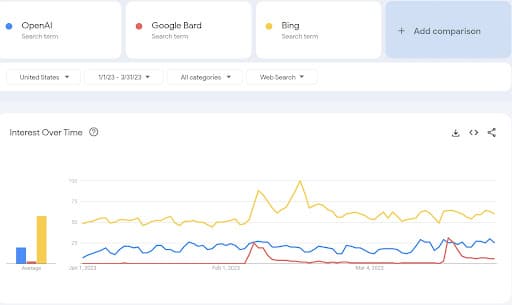
As ChatGPT and other AI bots emerge as content generators, something else is popping up: ChatGPT spurred competitors to push their own products to market, initiating the “AI Wars.”
Microsoft invested heavily in Open AI, making Microsoft Open AI’s exclusive cloud computing provider. In exchange, Microsoft is extending Open AI’s technology across its own platforms, including Bing.
Google launched Bard in response. Then in February 2024, Google Bard was rebranded as Gemini. As of 2026, Gemini is Google’s primary generative AI platform and virtual assistant.
While I’m sure that both technologies will continue to see development and that more alternatives will pop up, the truth is that, to date, Bing’s OpenAI tech is a step above Google’s.
Interest in Google Gemini has seemed to have dropped off after very short spurts in press coverage.
Does this matter? Does this have any implications for SEO?
Big picture: no.
The purpose of a search engine is to show a human the highest quality result.
Google has invested a lot of resources into defining and measuring what high-quality content is, and so it’s one of the best guides available on how to create content that will rank well regardless of the search engine.
The main thing to look out for is the diversification of search engine usage. Per Statcounter, Google is still the top dog and has in fact seen a slight growth in the share of search since the beginning of 2023:
This is worth keeping an eye on as Bing hits new user milestones, anyway.
Getting back to the main point: Google’s definitions of quality are still the most important.
Pros and Cons of AI-Generated Content
AI-generated content is not the SEO-killing murderer a lot of people are making it out to be.
Positives to AI-Content Generation
Using AI in marketing does have some advantages, including:
- It improves writer efficiency and speed. When a writer is experiencing writer’s block, AI bots are a good place to go to shake them out of it.
- It improves consistency. Different writers have different voices. If they are all using similar tools, it can be easier to match all of your pieces of content to one brand voice.
- It enhances language and grammar. Once properly programmed, AI bots can remember advanced grammar and syntax issues, reducing the number of errors in your writing.
- It can spark ideas and drive inspiration. Some days, it’s hard to think of new ideas. AI can help by searching the web for new ideas and perspectives.
- It can enhance SEO strategies. AI can make hashtag and keyword research much easier. It can also help writers improve the readability of their content.
- It is highly scalable. AI generated content allows for bulk content creation and multilingual support, keeping your business scalable.
- It saves more money. You can also benefit from cost savings with AI generated content marketing through reduced production costs. For example, ChatGPT can help outline content pieces to simplify the content creation process, saving time and money while maximizing productivity.
- It allows for better personalization. When paired with the right data, AI-generated content can improve personalization capabilities. An example here might include using Copy.ai to help create templates for personalized emails that you can then use to target specific audience segments and individuals.
Possible Cons
Even with the number of benefits of AI, there are still some downsides to producing content this way. Some of these cons include:
- It isn’t unique. Since AI pulls content from all over the web, your chances of plagiarism are pretty high.
- It may not be factual. AI finds you content. It doesn’t fact-check it. If the content it fits is untrue, it’s up to the writer or editor to figure that out before publishing the content. Keep in mind that studies have found that around 45% of AI news queries produce erroneous results.
- It can’t create content from a human perspective. AI is great, but it doesn’t have the personal touch that an actual writer has. It can’t bring in life experiences or prior research knowledge, and it can’t write for your specific audience.
- It can create biased content. Again, since it is just pulling information from the internet, the user has to do their own research to ensure that the content came from accurate and unbiased sources.
- It creates intellectual property law and ethical issues. Since AI is still fairly new, so are the laws and ethical standards around it. If you’re not careful, you could end up in the middle of a legal or ethical issue surrounding someone else’s work.
- It can increase the risk of Google penalties. If you don’t carefully implement AI content generation for SEO, it might come across as spam and fail to pass Google’s low-quality content filters.
- It may result in brand voice dilution. Over-reliance on AI content for SEO can keep your content from standing apart and prevent you from developing a unique and memorable voice.
- It could present legal and compliance risks. AI generated content for SEO might put you at risk of noncompliance with FTC guidelines and copyright violations, depending on whether the content comes from copyrighted material or if it makes controversial claims.
A Sea of AI-Generated Content
One thing is for sure: AI has lowered the average cost of generating content, more of it will flood the market than ever, and AI-generated content will become increasingly saturated and devalued.
With more content out there, the more important it is to differentiate your content. Let’s talk about how to do that from an E-E-A-T perspective.
If you want your content to be received well by Google and your readers, it’s important to follow the E-E-A-T criteria, regardless of how the content is generated.
And, of course, if your goal is to boost your ranking on SERPs, you want to make sure that your content is coming from an area of authority, expertise, and trustworthiness.
Although people tend to think of AI-generated content as being robotic, as long as the prompt is crafted well, tools like ChatGPT can produce content in a way that mimics an expert or authority.
It mirrors this voice through what it can take from its database and predictive analysis. The output can be good — certainly impressive for a non-human content generator and even better than a lot of the generic human-generated content out there.
Again, content spam isn’t new and humans were never very good at it, anyway. It’s not surprising that ChatGPT can produce decent generic, predictable content.
Excellent content — content that stands out — isn’t predictable.
Your experience and expertise, mixed with creative thinking, give your content an advantage over the AI competition. Only a human with experience and expertise on a topic can:
- Share recent, diverse, and previously unpublished examples, case studies, and data that are true. AI, of course, can make anything up. But content that’s factually incorrect doesn’t tend to rank well.
- Push the envelope on what is known about a topic, including the provision of analysis versus regurgitating known facts.
- Analyze a topic from a unique, fresh perspective.
- Relate the content to what their readers truly care about.
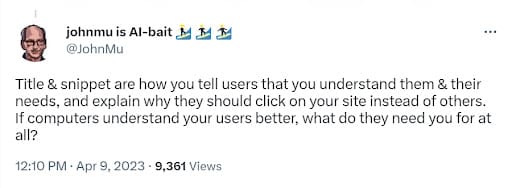
Further, as AI-generated content becomes more of a mainstream event, it has been proven that sites that rely heavily on AI, instead of human writers, to create their content pay for that convenience in their SERP rankings.
When it comes to producing high-quality and authoritative content, AI isn’t truly there yet. They can’t truly achieve the excellence in quality that Google is looking for. But that hasn’t stopped people from trying. When brands lean on AI-generated content to rank for keywords or acquire organic traffic, the proof is in the pudding.
Caveat: the following data is often anecdotal and is not a systemic analysis of all web properties that rank on Google. These examples are often also devoid of context to protect the domain’s and brand’s identity. There is certainly more data to collect and a larger picture still coming together as our experience with ChatGPT- and other AI-generated content grows.
All of that being said, there is certainly a lot of evidence against the use of AI-generated content for SEO.
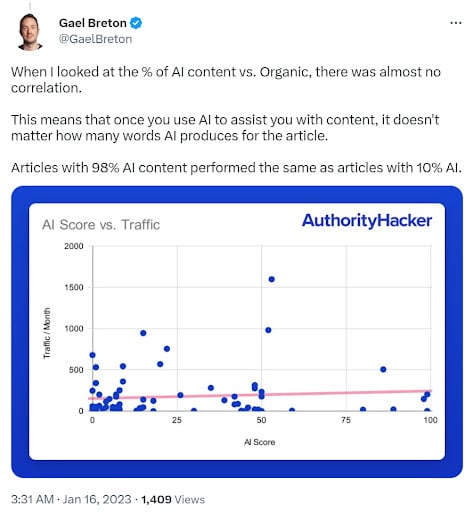
Gael Breton, the founder of Authority Hacker, analyzed Bankrate and Cnet AI-generated content against their expert-written content and found that human content outperformed its AI-generated counterpart by a very, very significant margin — up to 776%.
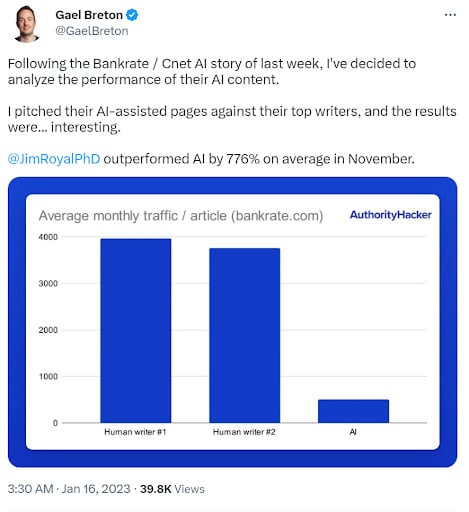
The length of the AI-generated content didn’t make a difference:
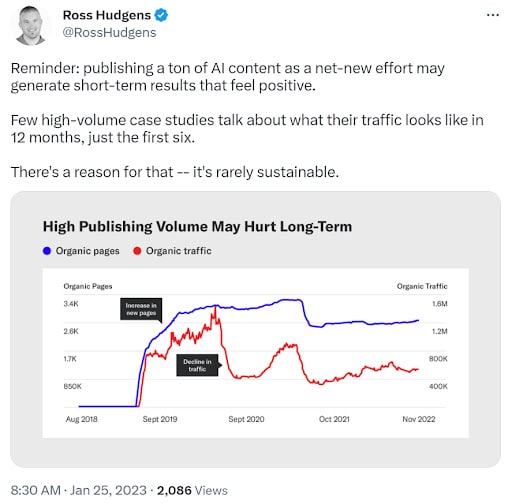
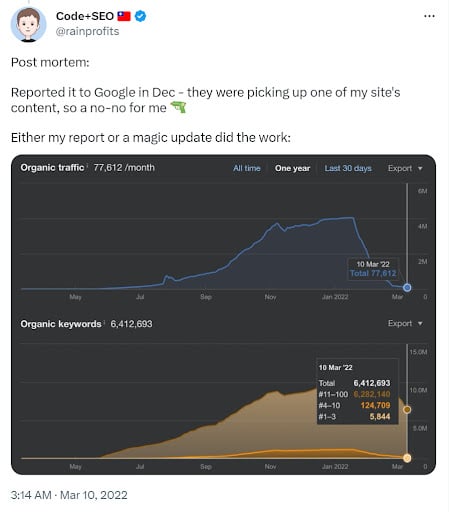
Furthermore, even when AI-generated content earns organic positioning and traffic, the effects are often short-term and then drop back precipitously. Consider these examples:
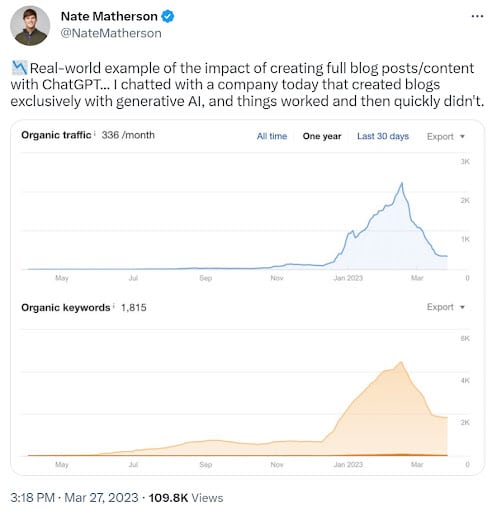
The evidence suggests that AI-generated content does not typically outperform content written by a human expert.
Even when AI-generated content ranks and drives organic traffic to a domain, the benefits are very short-lived and disappear almost entirely.
Relying on AI-generated content is simply not a sustainable or dynamic SEO strategy.
Evolving Accuracy and Ethical Considerations of AI Content
Factual Accuracy
Another issue with AI-generated AI is factual accuracy. AI pulls its information from a large database, but who is fact-checking that information?
When that database doesn’t have the answer to a question, the AI’s language model has to predict what the answer is. This is where things can go awry.
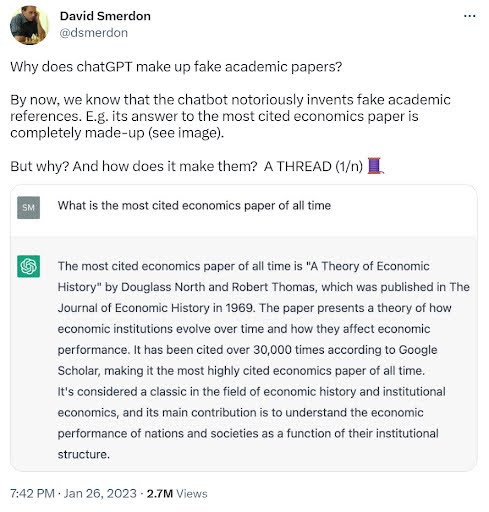
The example that always comes to my mind is when ChatGPT was asked for the most cited economics paper of all time.
Its answer was pretty credible at first glance: “A Theory of Economic History” by Douglass North and Robert Thomas. “Economic” and “theory” are the two most cited words in popular economics papers, and the most likely word to follow from those two is “history.”
Who is the most cited economic historian? Douglass North. The average economics paper has two authors, too. At first glance, it looks like ChatGPT’s answer was pretty smart.
It was also blatantly wrong — that paper doesn’t exist.
Getting basic facts wrong has been a major, documented problem with ChatGPT. ChatGPT has even fabricated entire news events. Google Bard famously erred on its first public demo.
These confidently outputted, but factually incorrect responses to basic questions are known as AI hallucinations.
Getting basic, known facts right is just part of accuracy, truth, and credibility. What has set humans apart is our ability to explore the unknown and provide new information.
What the above examples show is that when AI is needed to cover gaps in knowledge, it tends to provide inaccurate answers.
Pushing the envelope, providing new insights and examples with a dedication to the facts, and doing a better job at engaging your readers are what defines excellent content — and AI like ChatGPT or Bard can’t do these things for you.
Plagiarism
Besides factual inaccuracies, there is also the ethical issue of plagiarism.
AI-generated content has to come from somewhere, meaning someone had to put it out into the world. Using someone else’s words and passing them off as your own is the literal definition of plagiarism. And how ethical is it to pass off someone else’s work under the assumption that you’re the expert who wrote it?
Besides being unethical, it could also end up being very illegal. There are a number of active lawsuits involving how AI-generated content gets the information it needs to produce results. It will be interesting to see how those lawsuits play out, both in terms of revenue but also in terms of ethical responsibility in the business of content creation.
Licensing, Copyright and Trademarks
The rise of AI-generated content in Wikipedia and many other online resources has continued to raise questions regarding accuracy and ethical use.
For instance, there are concerns regarding the use of IP in the data used to train AI models, with cases like Disney v. Midjourney working to determine whether AI-generated content truly infringes on existing copyright by recreating characters and other IP.
To avoid potential legal issues with image licensing, copyrighted text, and other issues, follow this legal checklist:
- Data sourcing: Audit all training data and verify if it came from an existing licensed property or if it’s in the public domain.
- Contractual safeguards: Make sure vendor agreements discuss representations and warranties to ensure they legally obtain all training data.
- Output vetting: Develop and integrate procedures that make sure AI generated content marketing materials are not “substantially similar” to copyrighted materials in training data.
- Disclosure protocols: Clearly indicate when you use AI generated content, whether using an AI content generator for social media or any other content.
- Governance framework: Put together an AI ethics committee to perform risk assessments on bias, IP, and privacy permissions, ideally on a quarterly basis.
Whenever you use AI content generation for SEO, include an AI disclosure in a location that can be easily seen, potentially at the end of AI-written or -assisted content pieces. For example, a blog post might have a disclosure right before the author bio stating: “This article was written with the assistance of AI. The final content has been reviewed, fact-checked, and edited by a human.”
In your disclosures, be clear, understandable, and conspicuous to maintain compliance with FTC requirements, the California AI Transparency Act, and other industry standards.
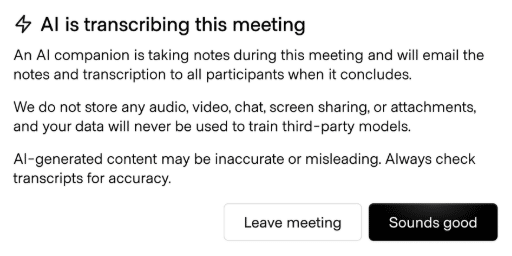
Ways to Leverage AI as a Tool for Ideation and Strategy
The quality of a specific piece of content is only one piece of the puzzle. The bigger picture is how the piece fits in with the overall content strategy. There might be a place for AI within the overall strategy, but AI can’t replace the strategy (or the strategist).
AI can also disincentivize good strategy. It could, for example, lead to content overproduction and dilute the average quality of your content, the trustworthiness and authority of your domain, and your website’s perceived relevance to the search query.
None of this means that AI, like ChatGPT, doesn’t have a place. That place is under the supervision of a human who is curating the content, keeping it faithful to an overall strategy, and giving it the E-E-A-T elements that only a human can offer.
Although ChatGPT and tools like it can’t outperform expert human writers, that doesn’t mean that these tools don’t have a place in our SEO workflows. There are some pretty creative ways of using ChatGPT and like-tools to assist in research, editing, and directional guidance.
Which AI tool you use is really up to personal preference, but some tools to consider besides ChatGPT, include:
- Semrush’s AI Writing Assistant – This tool not only creates AI-generated content but it also provides you with an SEO score and suggestions for improvement.
- Jasper – Jasper breaks down its content creation process into different workflows so you can tell the tool whether you’re writing copy for a sales page or an email marketing campaign. It also allows you to program in your brand’s voice.
- GrowthBar – This tool helps you write everything from content briefs to press releases and everything in between. It also has a separate idea generator and a blog outline tool.
- Magai – Magai is an AI-generated content tool that allows you to create different personas, save prompts, revisit previous chats, attach PDFs, and generate content using different AI models.
Some ways that you can use paid and free generative AI tools in your content marketing include:
1. Blog Topic Recommendations
Always check against keyword data from a reliable tool such as SEMrush and make sure you’re not cannibalizing keywords from an existing piece of content.
2. Content Gaps
Ask ChatGPT to find semantically related topics that are missing from a specific piece of content. As always, double-check against the resource for accuracy. In the example below, ChatGPT recommends including content on email automation when the analyzed page clearly already discusses that topic.
3. Internal Linking Recommendations
ChatGPT is great at recommending related articles to link to. An expert can help you determine which internal links would drive the most value and what the optimal anchor text should be.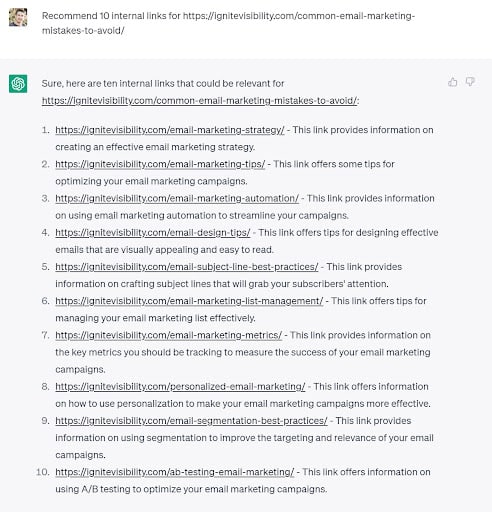
4. Keyword Recommendations
AIs can’t give you actual keyword search volume data unless they are pulling it from a third-party database. The recommendations are directional and can give you ideas to fuel your research when you pull search volume data from tools like SEMrush. If you use the right prompt, you can also leverage AI to help find synonymous and semantically related keywords for further inspiration.
5. Cluster Keywords Based on Semantic Relevance and Search Intent
AI can help you group relevant keywords when you’re researching for your content strategy. There will be some manual clean-up and reorganization, but AI can help at least get you started.
6. Create Unique Headlines
You only have a few seconds to capture your reader’s attention and get them to click on your webpage. Use AI to help you generate a set of headlines that are both relevant and attention-grabbing. 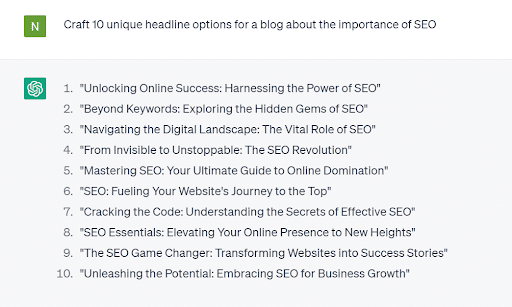
7. Generate FAQs
AI can generate good FAQs to answer. As an expert, you will need to clean up the recommendations and add your own, as you know your audience and what they care about best.
8. Email Marketing Copy
AI tools can help you speed up your email marketing process altogether. While it’s clear you should not rely on AI-generated content, it’s a great place to start gathering some ideas. You’ll need to revise and edit to make sure the copy is consistent with your brand voice and tone.
9. Social Media Copy
When prompted correctly, AI can generate catchy sentences that will drive your audience to click on your content over competitors. Use AI to help you craft your captions, but beware of spelling and grammar issues and always be sure to fact-check. 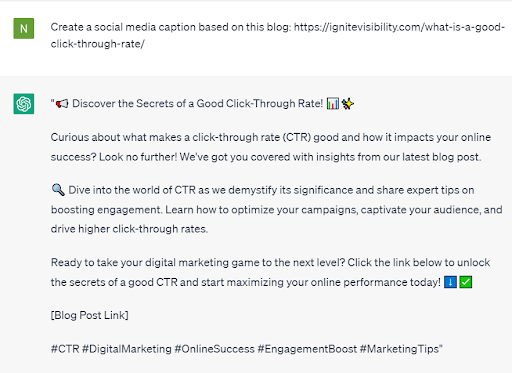
10. Paid Ads Copy
If you have a difficult time summarizing the value behind your deal, AI can help you. As a marketer, relying on AI to do the hard work will give you more time to ensure creative is up to standard.
A common theme in every case is that the recommendations need to be reviewed and turned into actionable insight by an expert. AI cannot replace the expert, it can only help automate some of the more routine tasks and help make the process faster.
These recommendations are just a handful of ways you can leverage AI as an SEO assistant. While I focused on ChatGPT, there are so many other AI-powered tools available to you.
11. Creative Audience Personas Should Guide Your Content Strategy
AI can help you create user personas based on your audience data. Personas give your content strategy more direction because you have a better idea of who you’re talking to. User persona creation can be time-consuming and it’s oftentimes difficult to know where to start.
AI can help you create these personas much more quickly or, at least, give you a strong baseline to build on. This is a use case for AI that we practice internally here at Ignite Visibility.
12. Audit Content for CRO
SEO content can come off as wordy. You can use AI to analyze your content against CRO best practices. It’s a quick, effective way to make sure your content doesn’t just rank but also persuades the reader to take action.
Using AI for SEO Content: Additional Tips
If you want to use AI to write your content, especially a first draft, there are some best practices to keep in mind:
- Always create content for the user, not for the search engine.
- Be transparent about the use of AI.
- Have an editor, ideally a subject matter expert, thoroughly comb through the AI content to ensure factual correctness.
- Add unique insights and original thought to the content to differentiate it from everything else on the internet. This will help meet E-E-A-T criteria. Examples of unique insights include specific examples, proprietary data, and insights based on your personal experience.
- Edit for your voice. Pro-tip: you can create a private GPT to which you can upload existing content with your brand voice for training. This will get the first draft of the content closer to your brand voice.
- Have your SEO team edit for keyword optimization.
- Add custom creative, including both static graphics and video. These elements help elevate the content with multimedia.
- Make sure you are promoting content through digital PR efforts.
Detecting AI-Generated Content
If you are concerned about using AI-generated content in your digital marketing or want to see how Google could figure out that you used AI to write your content, there are a few tools that can help.
Some of those tools include:
It is worth noting, however, that just as AI-generated content is a fairly recent development, so are these AI detectors.
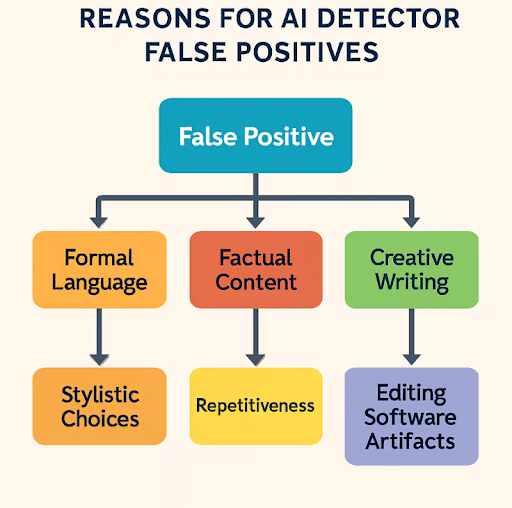
A lot of the time, they will produce false flags, especially if your content contains a lot of general statements such as “contact us for more information!” or super technical writing.
Many digital marketing industry experts are hopeful that, over time, as AI improves and evolves, these AI detection tools will, too.
Be Careful With What You Expose to AI
Everything that’s available to you through AI like ChatGPT, Bard, and any other tool is available to its other users. It’s important to be very selective about what data you feed into it to condition the results. Never upload proprietary data or information unless you’re ready for that to be accessible to the broader public.
Pro-tip: You can block plugins that leverage ChatGPT to crawl your site by disallowing the ChatGPT-User agent on your robots.txt file:

Think About the Larger Conversation Around the Topic You’re Writing On
Traditionally, we’ve thought about SEO and marketing in terms of stages of the marketing funnel: awareness, consideration, and conversion. And a comprehensive SEO strategy will create content for each of these stages within specific verticals of your industry and market.
If you sell gas grills, for example, you’ll want how-to content to establish expertise in your space, draw high-funnel visitors, and make them aware of your brand.
You can then use mid-funnel content, like an industry study, best-of guide, or infographic, to segment users who are in the consideration stage.
You’ll drive users in this segment to your transactional content. This still matters, AI might just change how users move through these stages.
The entire conversation around a purchase might now happen through an AI assistant on Bing or Google.
Conversations are fluid and can jump around. Asking Bing AI to recommend a good gas grill between the $500 and $1,500 range might prompt it to recommend the Weber Summit S-670 6-Burner Natural Gas Grill. You might then ask if Weber grills are hard to maintain if they are warranted, and which vendor has the best shipping and return policies.
As of the middle of 2023, AI search assistants don’t seem good enough to have productive conversations around these questions in a way that saves the consumer time by aggregating data from multiple websites.
For example, asking Bing AI about who has the best return policy only gives me information from the Weber website. I can’t get Bing AI to compare the return policies of the top 10 online gas grill sellers.
The experience is bound to improve, and quickly, if there is demand for this type of search assistant.
Keep in Mind the Limitations of Detectors
Although AI content detectors are getting better and better and can effectively identify a lot of patterns that AI uses, they aren’t without their limits.
For example, many detectors might identify content that uses certain writing techniques like em dashes and “it’s not this, but that” language, along with a consistent voice, as AI-generated, even when it’s entirely human-written.
As a result of these limits, some detectors will even avoid showing what percentage of content is likely written by AI if it falls under a certain percentage. One such tool is Turnitin, which will omit the percentage if it detects less than 20% of AI-written content. This helps prevent false positives.
To avoid potential false positives from AI detectors, run your content through multiple detectors; results might vary from platform to platform. Other strategies could include avoiding the overuse of formal writing tones, cliches, and repetitive transitions or passive voice.
In short, write naturally, and AI detectors might be less likely to falsely flag your content as AI-generated.
FAQs on AI-Generated Content
1. Should you use AI to write all your blogs and website copy?
No. Rely on AI to get you started on the creative process, help you build content outlines, and write enticing titles. You can use AI to help you brainstorm, however, you should get into the habit of fact-checking AI-generated results.
2. Can Google detect AI content?
Yes, Google can detect AI-generated content through its machine-learning algorithm. If your content is created for people first, it won’t affect your rankings. However, Google has been detecting low-quality content and spam for years. So make sure the intent behind your content is to deliver high-quality, valuable information.
3. Is all AI-generated content bad?
No. But if you’re not fact-checking AI-generated content or making edits, you could be in trouble. The bottom line is to stay away from poorly written content, so edit, fact-check everything, and follow E-E-A-T guidelines.
4. How does AI-generated content affect user engagement and bounce rates?
If your content is written by a robot for a robot, your readers are going to notice. If they aren’t engaged with your content, you’re going to see an increase in bounce rates which will, in turn, negatively affect your site’s performance. That’s why it’s important to review all AI-generated content and edit it to put a human touch to it before hitting publish.
5. Are there legal issues with using AI to write articles?
There sure are. There are many active lawsuits right now involving how AI gathers information from the internet and whether or not it should have access to people’s work. It will be interesting to see how these legal and ethical issues play out in the courts over the next year or so.
6. Will AI content work for voice searches and new SEO trends?
Yes. Voice searches and other trends are rising in popularity. The people designing and creating new AI capabilities are doing so with these trends in mind. However, it is still important that you, as the marketer, stay on top of upcoming trends, get to know your audience, and keep a pulse on your industry without relying on AI to do all of the hard work for you.
7. Can AI help us write content for audiences in different countries?
Yes. AI can write in different languages. However, it may not always pick up on the nuances and intricacies of different cultures.
8. Is AI good at writing about complex topics like science or finance?
AI is a great starting point for complex topics. However, it cannot replace a true expert’s knowledge and experience. AI-generated content should always be fact-checked, especially if it is written about topics like science or finance.
9. What is AI generated content?
This content is produced, at least in part, by AI content tools, such as an AI content generator for social media platforms. It could include text, image, audio, or video content that comes from tools like ChatGPT and the data used to train their models.
10. Is generated content good for SEO?
If you want to use AI generated content for SEO, it is possible to use this content to boost your rankings when used carefully. Make sure content benefits from human oversight and natural keyword integration, along with generally natural writing and helpful content, to potentially improve SEO efforts.
11. How many marketers use AI for content generation?
A growing number of marketers are using AI to produce or help produce their content, with a recent SurveyMonkey survey finding that 56% of marketers are taking an active role in using AI.
12. What could make AI generated content ineligible for copyright?
Generally, AI-generated content becomes ineligible for copyright if it doesn’t involve significant human authorship or direct creative input, such as content using works that AI produces without much human control over the output.
Final Thoughts on AI-Generated Content
We could go on for days about AI-generated content, the ethical implications, and how it will change digital marketing, but for now, here are my final thoughts on the topic:
- AI-generated SEO content can be decent, but it can often be factually incorrect and it’s quite generic. AI-generated content is not excellent.
- Excellent content is what it takes to own the top positioning on Google and other search engines over the long term and in a sustainable way.
- Excellent content is written by experts and contains unique insights, data, and interpretations. It shows the author’s experience and expertise.
- AI can be leveraged as a research and assistance tool in the content-production process.
- As AI evolves so will Google’s algorithms and the tools to detect it.
- Content produced by a human for a human is still the best type of content you can create.
As AI continues to evolve and improve, we can’t ignore the impact it will make. Not only can you use AI to improve your writing, but it can also help scale your other marketing strategies through AI-driven personalization.
Whether you’re looking to improve your email content marketing strategy, learn how to use AI for paid media, or just work with a digital marketing agency that stays up to date on all of the latest trends and tools, Ignite Visibility can help!
If you’re looking for content created with a human touch, schedule your consultation today!