In today’s SEO, there’s a fragmentation of search taking place, as users conduct searches via a combination of AI, social media, and search engines. While Google remains the primary tool for many of these users, Bing is the backbone of the AI layer, making Bing SEO an essential part of a search strategy in 2026.
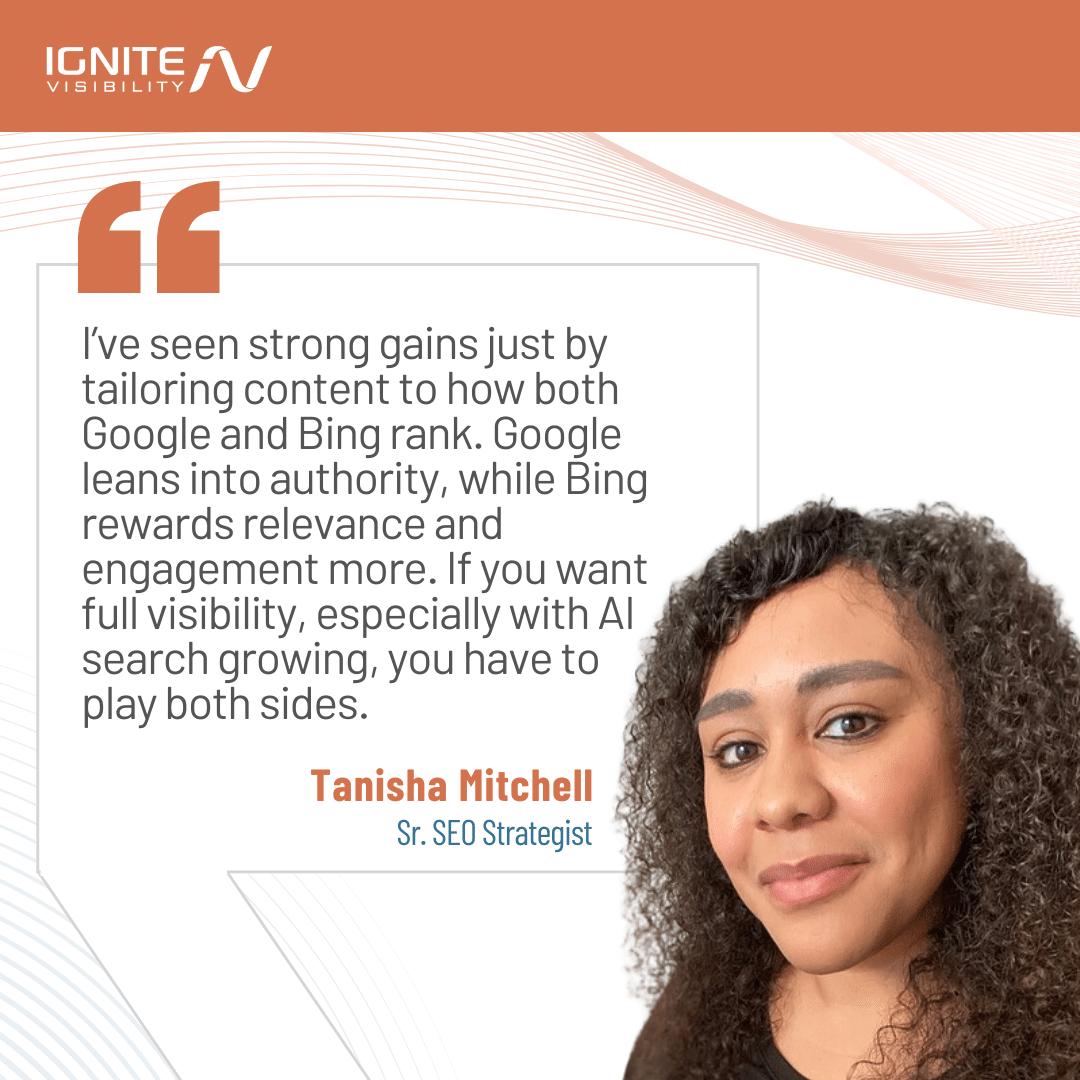
In this blog, Tanisha Mitchell, Sr. SEO Strategist, explores the key differences and how to leverage both search engines for maximum visibility.
TL;DR
In this guide to Bing SEO, we’ll cover the following:
Expert Insights on Bing vs Google
Understanding the differences between Bing vs Google SEO allows you to create a well-rounded optimization strategy that maximizes your website’s reach and performance across both search engines. Not only will this lead to higher visibility and increased traffic, but it will also boost your website’s overall competitiveness in the online market.
Effectively reaching your online audience requires a strategic approach that encompasses the preferences of both Google and Bing users.
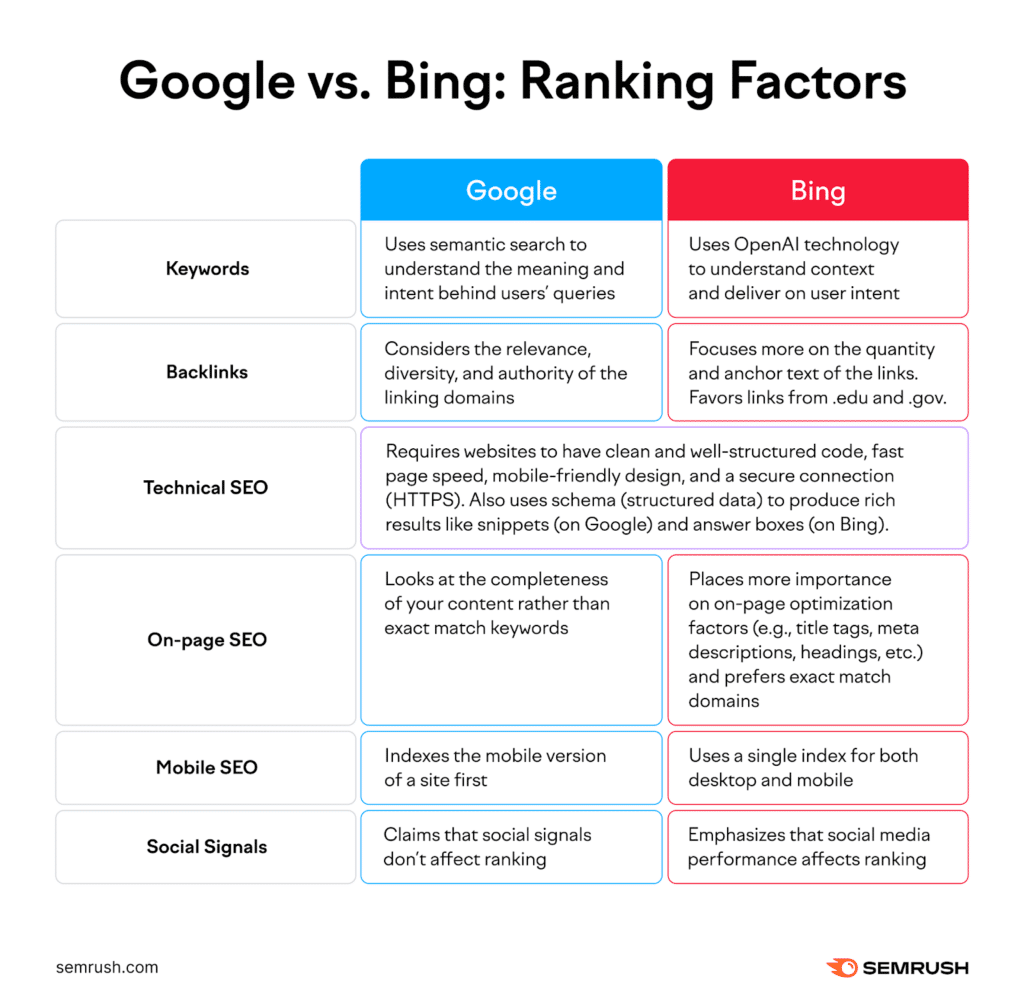
While Google places great emphasis on high-quality content and reputable backlinks, Bing leans towards relevant information with strong social engagement.
To maintain a well-rounded digital presence, it’s crucial to tailor your website to satisfy both search engines’ requirements.
Bing currently accounts for 5.13% of all search engine traffic, and while this is considerably less than Google (89.85%), it trumps all others, including Yahoo! (1.48%), Yandex (1.3%), and DuckDuckGo (0.75%). It’s also much more AI-centric, with 34% of Bing searches being AI-driven, whereas AI-powered search only makes up 19% of all searches on Google. So, if you want to maximize AI visibility in search, Bing SEO is potentially better than Google in this respect.
Conduct in-depth research on how Google and Bing operate, and optimize your website to accommodate the unique preferences of each platform. By doing so, you’ll unlock the full potential of your online visibility and effectively broaden your reach.
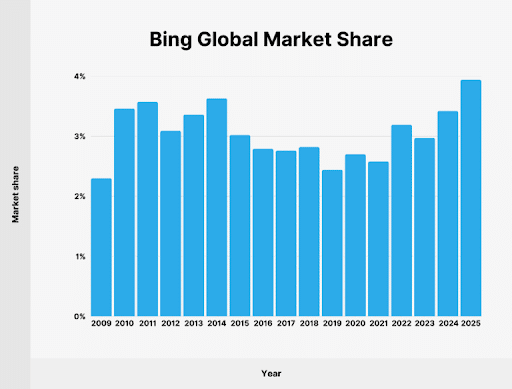
Bing vs. Google Market Share
Although Google still dominates with more than 90%, Bing’s share remains significant with more than 500 million unique monthly visitors, especially among users in North America and Europe. Google continues to lead mobile search, but Bing is gaining ground due to its integration with Windows devices.
Bing’s global market share has been steadily increasing since a small dip in 2023.
In terms of desktop market share, Bing is also growing. In 2023, it held only 8.58%. In 2025, that number jumped to 11.96%.
This could be thanks to Bing stepping into the AI chatbot game. After the release of Bing Chat (now Microsoft CoPilot), the search engine started seeing over 100 million users a day. Within 48 hours of the launch announcement for Bing Chat, over 1 million people joined the waitlist. How’s that for the search engine everyone forgot about?
Why is Bing SEO Important?
While Google is clearly the more dominant search engine, you really shouldn’t rule out optimizing your site for Bing, too. Here’s why:
1. There’s Less Competition – With Bing, you’ll still get a decent amount of traffic without fighting through all of the competition on Google. When comparing Google to Bing, it might seem like the small portion of the global market share isn’t all that important, but it’s still millions of people that you could better position yourself to get in front of.
2. Certain Demographics Use Bing More – Bing has a strong presence among white-collar professionals, who are likely to use it during the workweek due to its integration with Windows desktops and the Microsoft Office Suite. This audience represents a more mature and educated demographic, with an average age of 45 and half of them holding a college degree. Bing users earn over $100k annually and tend to spend 35% more online than Google searchers. They also tend to lead settled lives, with 46% being married and 30% having children at home.
3. You Can Optimize for Apple Maps Users – Another benefit of SEO for Bing is the ability to appear in Apple Maps results, as the platform tends to use this Maps app to display some local business information. As a result, you can benefit from better mobile SEO among Apple users, in particular, on Bing vs. Google.
Google vs Bing: Which Search Engine is Better?
The landscape of search engines is more varied than you might initially think, with Bing and Google standing out as distinct platforms with unique features.
Take it from Eli Schwartz, Growth Advisor with his company of the same name, “Google might be the world’s largest search engine in the world, but it is by no means the only one.”
Simplicity and convenience have made Google the search behemoth it is today, and it commands a major portion of search traffic. But Bing especially shines on desktop platforms and in markets like the United States.
The functionality of both search engines might be similar; however, Google offers more core features overall. The contrast also extends to their index size and crawling, with Google boasting an index of hundreds of billions of web pages.
Bing is estimated to have an index of between 8 to 14 billion web pages. This is significantly less than the hundreds of billions Google claims to have indexed. The handling of image and video searches further distinguishes Bing, with many users finding it more dynamic and informative.
So, is Bing better than Google? Like most things in digital marketing, it depends. With their individual strengths, optimizing for both Bing and Google is a smart move for reaching a wider audience online.
Let’s take a closer look at the ranking factors you should take into account when it comes to your Bing search optimization efforts.
Brand Preferences and Website Type
When it comes to performing well on Bing, the search engine’s algorithm looks for factors such as quality, credibility, user engagement, page load time, location, and relevance. It also puts a lot of stock in a site’s sitemap, backlinks, and redirects.
In addition, Bing’s algorithm is dynamic, meaning that if the search engine detects that a certain ranking criterion seems to be more important than another, it will start to assign more weight to that specific criterion.
Bing also prefers content that is properly cited and relevant. If they’re going to push your content to their users, they want it to be credible. They also want your content to be easily accessible to the reader. This means if you’re forcing readers to scroll through pages of content before they can find the answer they’re looking for, Bing isn’t going to like it.
Bottom Line: Keep your content relevant, user-friendly, and accurate to find success with Bing SEO.
User Engagement Metrics
User engagement plays a pivotal role in how search engines evaluate and rank content. Both Bing and Google monitor signals such as click-through rate (CTR) and dwell time, but they weigh them differently in their algorithms.
Bing’s Emphasis on CTR and Dwell Time
Bing places a stronger emphasis on click-through rate (CTR) and dwell time as direct indicators of relevance and user satisfaction. If users consistently click on a result and spend time engaging with the content, Bing interprets this as a positive signal. Pages with high CTR and longer dwell times are more likely to climb in rankings, especially for competitive keywords.
- Click-Through Rate (CTR): Bing uses CTR to gauge how compelling a result is based on its title and meta description. A high CTR suggests the result matches user intent. According to data from Marketing LTB, clicks from Bing users on desktop devices are 21% more likely to convert, further illustrating the benefit of SEO for Bing.
- Dwell Time: Bing tracks how long users stay on a page before returning to the search results. Longer dwell times imply the content was useful and engaging.
How Google and Bing Differ
While Google also considers CTR and dwell time, these metrics are part of a broader, more complex evaluation system. Google’s algorithm relies heavily on semantic relevance, content quality, and user intent modeling, which means engagement metrics are just one piece of the puzzle.
Google may use engagement data more indirectly, focusing on patterns across large datasets rather than individual page performance.
It prioritizes E-E-A-T (Experience, Expertise, Authoritativeness, Trustworthiness) and alignment with search intent over raw engagement metrics.
Social Signals
When it comes to incorporating social signals into its SEO, Bing presents a rather distinct approach compared to other search engines.
Social signals, including likes, shares, retweets, and upvotes on platforms like Facebook, Instagram, TikTok, X, LinkedIn, and Pinterest, are considered crucial ranking factors by the Bing algorithm.
Imagine you own a local bakery and continuously create engaging content about your goods on your various social media pages. Your cupcake post on Facebook gains thousands of likes and hundreds of shares, while your X thread about the baking process racks up countless retweets.
On Bing, these social signals – the likes, shares, and retweets – are noticed by its algorithm and used as indicators of your site’s relevance and quality. By accounting for the positive public response to your content, Bing is more likely to rank your website higher on its search engine result pages, thus driving increased organic traffic your way.
So, businesses with significant social engagement can potentially achieve greater SEO success in Bing’s search results, thanks to its unique approach to observing and weighing social signals.
Backlinks
Backlinks remain essential for both search engines, but Bing places greater emphasis on social engagement.
Bing prioritizes social signals such as shares, likes, and comments across platforms like Facebook, X, and LinkedIn.
While Google places more weight on high-quality content and relevant backlinks, Bing rewards exact-match domains and continues to focus on user engagement metrics like click-through rates .
While Bing tends to put less emphasis on backlinks than Google, backlinks are still important to Bing’s SEO rankings.
Sites with more backlinks tend to rank higher with Bing, just as they do with Google. However, the quality of those backlinks is increasingly more important than the quantity.
Bing even offers a helpful link explorer tool, the Site Explorer, to better understand the value of the links on any given page.
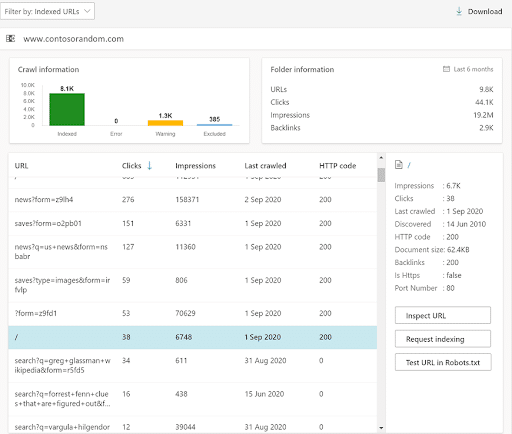
Additionally, Bing reports can allow you to see up to 10,000 pages that refer to your site, supplementing its Bing rank checker tool.
Instead of indexing every piece of content on a domain, as Google does, Bing actively removes pages from its index if it finds they lack sufficient link authority or value to rank in its search results.
What this usually means is that for a page to maintain a place in Bing’s index, it must have at least one external website link to it. This critical Bing ranking factor can hurt your company’s ranking if ignored.
Some backlinks that you should be interested in are:
- Editorial backlinks
- Guest blogging backlinks
- Business profiles
- Guest posts
- Sponsored links
Understanding Page Authority
Page Authority is a predictive score used to determine a single web page’s ability to rank within search engine results pages (SERPs). Not to be confused with Domain Authority, each individual page measure is derived from a proprietary algorithm and incorporates several factors, including the number, quality, and relevance of inbound links and overall site quality.
Both Bing and Google utilize some form of Page Authority in their own way.
Google’s Interpretation
Google does not publicly acknowledge a specific “Page Authority” metric. However, it has a similar concept known as “PageRank.” This algorithm evaluates the quality and quantity of links to a webpage to determine its importance. Google’s understanding of Page Authority, then, is indirectly indicated through PageRank.
Bing’s Interpretation
Bing’s ranking algorithm generally places importance on social signals and user engagement, in addition to the relevance and quality of external links, which indirectly influence a page’s authority in Bing’s SERP.
While Page Authority isn’t a term specifically utilized by Bing or Google in their official guidelines, it is a conceptually vital part of SEO terminology and practice. Both search engines, although having different algorithms, do share some functional overlap about Page Authority, i.e., they use several factors to determine a page’s eligibility to rank on their SERPs.
Content and Location
Relevant and quality content correlates strongly with good Bing SEO ranking, just as it does with Google.
Like Google, you’ll want to focus on including related keywords in the content. As always, write your content for your reader – not the search engine. Google’s sophisticated algorithm focuses on the contextual understanding of the keywords rather than their mere presence or absence. However, with Bing, you can gain some ground by strategically placing exact-match keywords in your meta descriptions. Bing seems to give more weight to this metadata than Google.
Bing also seems to be more likely to reward pictures, videos, and audio due to what is known as “entity understanding”, while Google relies much more on text-based content. This means that having a more dynamic website that incorporates high-quality content with original media may help to better position your site for high rankings on both search engines.
When it comes to local searches, Bing also tends to showcase small businesses, assuming the searcher wants the most proximal results. Whereas, Google tends to sway in favor of larger, more established companies, giving preference to what it sees as the most credible results.
Marketing LTB has found that around 43% of all Bing queries are local.
For local businesses, this aspect should be an important consideration for optimal SEO.
Technical SEO Considerations
Optimizing for search engines isn’t just about keywords and content. It also requires attention to the technical infrastructure that enables discoverability. While Google and Bing share many foundational SEO principles, they diverge in how they crawl, index, and update content.
Crawling and Indexing: Google vs. Bing
Understanding the differences between Bing v. Google’s approaches to crawling and indexing is a critical key to the SEO puzzle.
| Feature | Bing | |
| Crawling Frequency | Uses complex algorithms to prioritize crawl budget | More conservative crawl budget; favors stable sites |
| Indexing Speed | Fast, but selective; relies on signals like backlinks and freshness | Can be slower unless aided by proactive submission |
| Sitemaps | Supports XML sitemaps and auto-discovery | Supports XML sitemaps; encourages manual submission |
| JavaScript Rendering | Advanced rendering capabilities | Limited support; prefers static HTML |
| Canonical Tags | Strongly respected | Respected, but less strict than Google |
Bing’s IndexNow Protocol
One of Bing’s standout innovations is IndexNow, a tool that allows websites to instantly notify search engines when content is added, updated, or deleted. This dramatically reduces the time it takes for changes to appear in search results.
To get started with IndexNow, all you have to do is send a simple HTTP request to Bing (and other participating engines) with the URL of the updated content. This will alert the search engines to reindex the page.
Using IndexNow enables faster indexing of new or updated pages, reduces reliance on traditional crawling, and improves visibility for time-sensitive content.
IndexNow is a clear differentiator for Bing, since Google has experimented with it but not adopted it widely, yet.
Technical SEO Optimization Tips for Bing
Here are some tips to help you improve your technical SEO for Bing:
- Enable IndexNow: Use supported plugins or server-side integration to push updates directly to Bing.
- Simplify Site Architecture: Bing prefers clean, crawlable HTML with minimal reliance on JavaScript.
- Submit URLs Manually: Bing Webmaster Tools lets you submit URLs directly for faster indexing.
- Use Clear Canonicals: While Bing is more forgiving, clear canonical tags help avoid duplicate content issues.
User Interface
While both Bing and Google exist to serve a similar purpose—providing users with relevant search results—they do so in their unique ways that are apparent in their differing user interfaces.
Bing’s user interface leans towards a more visual experience, complete with dynamic daily images and a richer presentation of results. While Google emphasizes relevance, user experience, and frequently updated content, Bing offers credit to older, well-established websites, optimizing its search towards a different user demographic.
It’s fair to say Bing provides higher-quality image search results compared to Google, a compelling edge for visually-centric searches.
Search optimization isn’t a one-size-fits-all. While Google persists as an essential platform for SEO efforts, Bing’s unique SEO attributes position it as a valuable player in the game of search engine optimization.
Understanding these nuances in their user interfaces and SEO preferences can help you make an informed decision and develop a balanced strategy that brings out the best in both search engines.
Image and Video Search
When it comes to images and videos, we see another divergence in the approaches that Bing SEO and Google SEO take.
Google’s focus leans towards data relevance and an immersive narrative of information, whereas Bing amplifies its user interface with vibrant visuals and eye-catching imagery.
Google searches, for example, tend to be more textually rigorous, prioritizing a wealth of information and options that often make it a top choice for those seeking depth on a topic.
In contrast, Bing continues to stand out for its visual search capabilities. Bing’s image and video search are enhanced by AI-driven algorithms, allowing users to find visually similar images with more accuracy.
According to Marketing LTB, search results with images get 18% more engagement, making it important to see how your business performs in image searches and others with a Bing rank checker.
Bing’s video search also shines, offering a thumbnail preview of videos when hovering over, an engaging feature that encourages interaction.
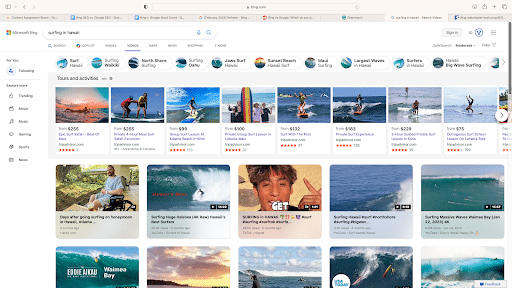
In essence, your choice between Bing SEO and Google SEO in terms of image and video search could be influenced by whether you prioritize a data-rich environment or a visually engaging one.
Optimizing image and video content can lead to better visibility on Bing, especially for industries that rely heavily on visual content .
Local Maps
Google Maps is renowned for its detailed accuracy, a rich repository of business information, and familiarity for most internet users. Its robust features, such as Street View and user-generated content in the form of photos and reviews, provide a comprehensive view of local businesses.
Bing Maps, on the other hand, treads a unique path. While it may not be as popular as Google Maps, it impresses with its visually immersive and user-friendly interface. Currently, around 3,910 live websites appear on Bing Maps.
However, for local businesses planning their SEO, it’s crucial to maintain a presence on both platforms since Bing and Google cater to different demographics. Catering to both ensures broader visibility and reaches a wider audience.
Regardless of your preference, both Bing Maps and Google Maps provide valuable local search results. It ultimately comes down to the distinct features each offers and where your SEO strategy aligns.
AI and Search Evolution
With the rise of generative AI transforming how users interact with search engines, it’s important to understand how the two are connected. This shift is redefining not only the user experience but also how content is indexed, ranked, and surfaced.
Bing’s Partnership with ChatGPT
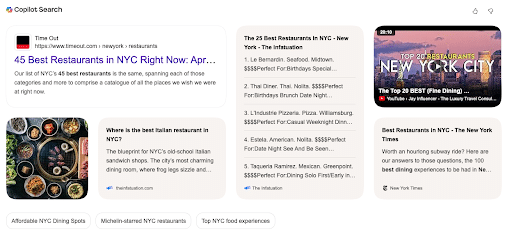
Microsoft was one of the first tech giants to partner with OpenAI by embedding ChatGPT directly into Bing’s search experience. Thanks to this integration, users can now receive AI-generated answers that summarize web content in a conversational format, often appearing above traditional search results. These answers cite sources, making visibility in Bing’s index more valuable than ever.
Why Bing Rankings Influence AI Visibility
Since ChatGPT relies on Bing’s index to source information, ranking well on Bing directly impacts whether your content appears in AI-generated answers. This is especially critical for commercial queries like product comparisons, brand recommendations, and how-to guides.
Keep in mind that the difference between Google and Bing AI also comes down to popularity, with people preferring Bing’s AI summary cards over Google’s AI Overviews 58% of the time when tested side by side.
To improve your Bing ranking, be sure to produce structured, authoritative, and clearly written content. This will increase your chances of being selected by AI when bots are searching for answers.
Local Bing SEO Optimization
Local search optimization is essential for businesses that rely on geographic visibility, such as restaurants, service providers, and brick-and-mortar shops. While Google dominates local search with Google Business Profile, Bing offers its own platform: Bing Places for Business.
With Bing Places for Business, businesses get help improving local search visibility with:
- Free Listing Management: Businesses can claim and verify their listing for free.
- Integration with Microsoft: Listings appear not only in Bing search, but across the Microsoft ecosystem, including on services like Cortana and Windows Maps
- Bulk Uploads: Ideal for multi-location businesses, Bing Places supports bulk listing management
When it comes to improving your local reach, here are some Bing SEO optimization tips:
- Claim your Bing Places listing
- Add rich media such as high-quality photos and videos
- Encourage reviews from consumers
- Maintain NAP consistency
All of these options will improve your local SEO and, hopefully, send more traffic your way!
Google vs Bing: Ranking Factors Overview
While both Bing and Google aim to deliver the most relevant search results, their ranking algorithms differ in subtle but important ways. Understanding these distinctions can help marketers and SEOs tailor their strategies for each platform.
Key Differences in Ranking Signals
Here are the key differences between Google vs Bing and each of its ranking signals.
| Ranking Factor | Bing | |
| Keywords | Prioritizes semantic search and keyword context | Favors exact-match keywords in titles and URLs |
| Backlinks | Strong emphasis on high-quality backlinks | Values backlinks but less aggressively than Google |
| Content Quality | Focuses on E-E-A-T (Experience, Expertise, Authoritativeness, Trustworthiness) | Prefers clear, well-structured content with direct answers |
| Mobile Optimization | Mobile-first indexing is critical | Mobile-friendliness matters, but less dominant |
| Page Load Speed | Important for both SEO and user experience | Considered, but not as heavily weighted |
| Social Signals | Minimal direct impact | Uses social media engagement as a ranking signal |
| Multimedia Content | Understands and ranks video/audio context well | Prefers pages with rich media like images and videos |
| Domain Age & Authority | Important, especially for competitive queries | Also valued, with a slight preference for older domains |
| User Engagement | Click-through rate, dwell time, bounce rate | Similar metrics used, but less transparently |
| Source Attribution | Favors giant brands optimizing for E-E-A-T | Much more likely to link to small, niche blogs answering “how-to” queries |
Bing-Specific Insights
Something to really understand is how Bing values certain ranking factors, including:
- Exact-Match Keywords: Bing places more weight on exact keyword matches in page titles, meta descriptions, and URLs. Unlike Google’s semantic approach, Bing rewards precision.
- Social Signals: Bing incorporates signals from platforms like Facebook and Twitter to assess content popularity and credibility. While not dominant, these can tip the scales in competitive niches. Also, consider the entire Microsoft, OpenAI, and Reddit ecosystem, as Bing is the sole search engine effectively indexing “Human Consensus” using Reddit at scale, including for AI results.
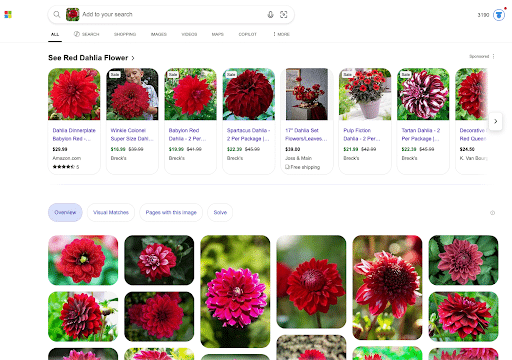
- Multimedia Optimization: Bing favors content that includes images, videos, and other rich media formats, especially when paired with descriptive alt text and metadata. Bing also favors visual search optimization through Bing Visual Search, which uses “Object Detection” in images to identify items more effectively than Google. In turn, it’s best to optimize image metadata for “shoppable” AI results to better optimize for Bing vs. Google.
Bing vs Google: Webmaster Tools
Google Search Console Tools and Bing Webmaster Tools share several similarities, and each offers unique features that can be beneficial to SEO practitioners.
Google Search Console
- Data and Reports: It provides detailed reports on your website’s performance, mobile usability, and search traffic. External and internal links, along with the most significant keywords, also form part of the reports.
- Coverage and Enhancement Tools: Google Search Console aids in site improvements, focusing especially on mobile-first indexing and Core Web Vitals.
- URL Inspection Tool: Offers insights into how Google views a specific page by examining the indexing status and viewing the crawl report.
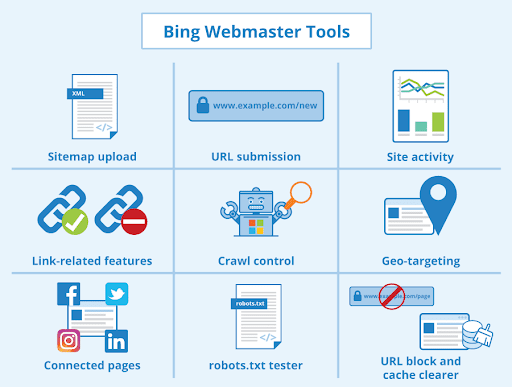
Bing Webmaster Tools
- Data and Reports: Just like Google, Bing provides detailed reports about your website’s performance, clicks, impressions, and more. However, it also includes a unique SEO analysis tool that identifies optimization opportunities.
- Site Scan: A feature that Google lacks; Bing’s site scan allows you to examine and understand the SEO issues present on your website.
- Keyword Research Tool: While Google has phased out its keyword tool in the Search Console, Bing continues to offer the Keyword Research tool as part of its suite, helping with content strategy and optimization.
Similarities
- Both Google Search Console and Bing Webmaster Tools offer XML sitemap submission, helping search engines better understand your site’s structure.
- Both platforms offer disavow links tools. This can be pivotal if you wish to inform Bing or Google that certain links to your site should not be taken into account for your site’s ranking.
- Both provide detailed data on how their respective crawlers view your website, and whether they encounter any issues when crawling and indexing your content.
The choice between the two often depends on an individual’s preference, one’s marketing objectives, and where a large chunk of your audience comes from. It can be beneficial, however, to use both to get a holistic view of your website’s performance and potential optimization opportunities.
Bing vs Google: FAQs
1. Does Bing SEO affect ChatGPT’s Browse feature?
Yes, SEO on Bing does impact ChatGPT’s Browse feature, seeing as ChatGPT pulls information from Bing when relaying results to users. As such, a high Bing SERP ranking can help increase your chances of having ChatGPT cite your page over others.
2. What is the most important Bing ranking factor in 2026?
Today, the most important factors for Bing SEO optimization are relevance and search intent. When optimizing SEO for Bing, you’ll want to make sure Bing, especially its AI system, and its users perceive your content as the most relevant while matching people’s specific intent with the right short- and long-tail keywords.
3. Is IndexNow mandatory?
While IndexNow is not required for SEO on Bing, it’s ideal to use to expedite Bing SERP ranking and indexing, as well as rankings on Yandex, Naver, and other search engines outside of Google.
4. How does Bing handle Reddit and forum content?
Today, Bing is the only search engine that offers “Human Consensus” results using Reddit at scale. However, results from other forums are also among the many regularly used sources that can help you appear in Bing search engine results.
5. Do I need a separate strategy for Bing?
When considering optimizing for Bing vs. Google, you don’t need to create an entirely separate strategy. However, you should make sure your Google-optimized content and pages also optimize for Bing, which places more emphasis on keyword matching, social signals, and backlink quality.
Meet Your Business Goals With Ignite Visibility
As AI-powered search reshapes the SEO landscape, both Google and Bing offer valuable opportunities for businesses in 2025.
Google’s massive reach is unmatched, but Bing’s focus on social signals, AI integration, and user engagement presents new avenues for growth.
Optimizing for both ensures a balanced and effective strategy.
By understanding the difference between Google and Bing search engines and leveraging them to your advantage, you can boost your visibility and performance across diverse markets. Staying agile and informed will help you thrive in this evolving SEO environment.
Ignite Visibility can help you:
- Optimize your website for Bing and Google
- Create an effective SEO strategy with a holistic approach
- Create dynamic content for a more engaging user experience
- Handle all the technical aspects of SEO for Google and Bing
- And more!
To get started with Bing SEO optimization, learn more about our SEO services and how they can achieve the highest Bing SERP rankings.