To many marketers, Generative AI is a new concept. In a short period of time, it’s gone from being a new term to now something we hear almost daily. However, many still don’t fully understand what it means.
In this comprehensive guide, Ignite Visibility’s SVP of Marketing, Danny Conlon, will walk you through what generative AI is and what marketers need to know.
What You’ll Learn
- What is Generative AI?
- Potential Applications of Generative AI
- Benefits of Using Generative AI
- Risks and Challenges That Come with Using Generative AI
- Generative AI vs Generative Engines
What is Generative AI?
Generative AI is a type of artificial intelligence that creates entirely new content, such as text, images, or even music, by learning from vast datasets. Unlike traditional AI, which focuses on making predictions or recognizing patterns from existing data, generative AI goes a step further by producing original outputs.
What makes generative AI unique is its ability to continuously learn and adapt. Over time, it refines its understanding of user input, improving the quality and relevance of its generated content.
Examples of Generative AI include:
- Chatbots and Language Models: These can generate human-like text, answer questions, write essays, or even compose poetry. Conversational AI, such as virtual assistants (e.g., Siri, Alexa), is a subset of generative AI specifically designed to engage in real-time dialogue, providing responses that mimic natural human conversation.
- Image Generation: Tools like DALL-E and MidJourney can create original images based on text prompts (e.g., “create a futuristic city skyline”).
- Music Composition: AI models like OpenAI’s Jukedeck or Google’s Magenta can generate new pieces of music in various styles.
- Code Generation: Tools like GitHub Copilot can write code snippets based on natural language instructions.
- Video Creation: AI tools like Runway ML, Synthesia, and Pictory allow users to generate or enhance video content. These platforms can create videos from text prompts, synthesize human avatars, or turn written content into engaging video summaries, making video production more accessible and efficient.
It’s important to note that many AI powered platforms combine more than one type of AI. ChatGPT for example uses both conversational and generative AI.

My Expert Insight into Generative AI
My biggest advice is to not get lost in the weeds when researching how Generative AI works.
As marketers, we don’t necessarily need to dive deep into the technical details of how generative AI, like ChatGPT, is built or how it works on the backend. The key focus should be on understanding how to use it effectively for our own marketing and, more importantly, how it’s impacting the customers and users we’re trying to reach.
For instance, users are increasingly turning to generative AI tools to conduct research and search for information about products and services. As marketers, it’s crucial that we recognize this shift in user behavior and learn how to be present where users are now searching—through AI-powered tools.
That doesn’t mean we need to become AI coding experts or master the underlying algorithms of ChatGPT. What matters is how we adapt our strategies to meet users in these new digital spaces. By understanding these changes, we can ensure that our marketing efforts stay relevant and are optimized for how people are engaging with information today.

Applications of Generative AI For Marketers
We have already explored several examples of Generative AI; now, let’s delve into additional ways marketers are leveraging this technology.
Content Creation
Marketers are increasingly using generative AI for content creation due to its speed and cost-effectiveness. This technology proves highly beneficial for generating various forms of content, such as social media captions, ad copy variations, and email content. However, it’s crucial to exercise caution when using AI-generated content for SEO purposes, as it may come with limitations that could impact search engine performance. It’s also important to remember Generative AI outputs are only as good as their inputs. Using Gen AI to create content still requires strategy.

Image Generation
Marketers can use generative AI tools, like DALL-E or MidJourney, to quickly create high-quality, customized images for their campaigns. These AI-powered platforms allow marketers to generate visuals based on specific text prompts, sometimes eliminating the need for expensive photoshoots or lengthy design processes. The images produced can be used across various marketing channels, including social media posts, email newsletters, blog articles, paid ads, and even website design.
However, it’s important to remember that while generative AI can speed up the image creation process, strategy is still key. Some images may require human editing to fine-tune details, ensure they align with brand identity, or enhance their quality before they’re finalized for use. By leveraging generative AI thoughtfully, marketers can maintain a consistent visual identity, experiment with fresh content, and scale their marketing efforts with greater efficiency, all while reducing the time and cost typically associated with traditional image sourcing.
Music and Audio
Programs like ElevenLabs and PlayHT are revolutionizing how marketers can integrate audio into their content strategies. These tools allow users to generate realistic audio in various forms, offering new possibilities for content creation. For example, AI voiceovers produced by these programs can mimic natural speech, allowing for the creation of engaging and professional-sounding narrations for videos, podcasts, and advertisements. The voiceovers are highly customizable, enabling marketers to select specific tones, accents, and styles to match their brand voice or message.
Additionally, programs like Soundraw can generate new music tracks based on text prompts or preferences, giving marketers the ability to create original background music for videos, social media posts, or even ads without needing to hire musicians or purchase licenses. This opens up opportunities for marketers to tailor the auditory experience of their content to evoke the right emotions or reinforce branding.
Data Analysis & Automation
Marketers can use generative AI for data analysis and automation to boost efficiency. For data analysis, AI can quickly process large amounts of customer and market data, uncovering patterns and trends to help marketers make smarter decisions and target the right audience. In terms of automation, AI can handle repetitive tasks like generating personalized emails, creating social media posts, and optimizing ad copy. It can also automate customer responses and analyze feedback in real time, freeing up marketers to focus on more strategic work.
The Benefits of Generative AI
As mentioned earlier, marketers don’t need to understand the technical details of generative AI, but rather focus on how to leverage it effectively. Here are the top ways generative AI benefits marketers.
Increased Efficiency and Productivity
Using generative AI tools, it’s possible for individuals and businesses alike to optimize efficiency and productivity.
An example: Rather than waiting on a content team to craft every social media post, a marketer can use AI to generate multiple caption drafts in minutes, freeing up time to focus on strategy, creative direction, or community engagement.
This not only speeds up content workflows, but also helps maintain brand consistency and responsiveness to trends. AI-powered caption generators can cut content‐creation time by up to 50%, allowing teams to publish more often without increasing headcount.
Enhanced Creativity
Using image generators and other tools, people can augment their creativity through improved creative expression, often by finding more inspiration with the help of these programs. Certain programs could also inspire innovative ideas.
An example of generative AI for creativity: To ethically implement generative AI for creative inspiration, a company could use a tool like ChatGPT to give them ideas for storyboarding a video ad, which could help guide the process of developing the actual ad.
Reduced Costs
Certain industries may also be able to use generative AI to lower costs associated with various operations. Data analytics and generative AI, for example, could help predict how certain changes in processes might positively impact ROI, helping business leaders make more profitable informed decisions.
An example: One example of a company benefiting from generative AI models through higher ROI is Swedish fintech firm Klarna, which used a generative AI assistant to improve cost-effectiveness and efficiency, resulting in an 85% reduction in customer issue resolution time and over $40 million in increased profits.
The Risks and Challenges of Generative AI
While there are many advantages of using generative AI, it isn’t without its potential issues. You might wonder, “What challenge does generative AI face with respect to data?” or “Why is controlling the output of generative AI systems important?”
The following are some challenges that could affect the implementation of these solutions:
1. Inaccuracy Bias
One of the main problems around generative AI is the development of potentially biased or erroneous results. For instance, Google’s recently implemented AI Overviews have been known to produce some questionable results with inaccurate information, while biased data sources could influence generated results and, in turn, make them biased in different ways.
2. Ethical Concerns
Another potential issue relates to the ethics of using generative AI and the content it produces. One example includes the possible copyright infringement of artists, writers, and others whose content contributes to generated content, leading to legal troubles involving certain platforms.
3. Security Risks
The use of generative AI also ties into some security concerns, as people and entities could easily use some programs for malicious purposes.
An example: Hackers and others could use generative AI tools to help conduct cyber attacks, while others could produce deep fakes of real people in an attempt to scandalize them with fake content.
Mitigation Strategies for Reducing the Risks of Issues With Generative AI Software
The following are some ways to overcome the challenges related to generative AI models:
- Clean Your Data: Prior to using data with generative AI, protect privacy by removing any personally identifiable information.
- Perform Due Diligence: Whether using generative AI models for language or any other application, vet all third-party vendors to select one that complies with privacy regulations and has sufficient security.
- Establish Clear Guidelines for Employees: Make sure your employees implement generative AI the right way with guidelines covering proper use and human oversight.
- Check Sources: When conducting an AI search on a platform like ChatGPT or Google’s AI Overviews or AI Mode, be sure to check the sources of all information to ensure accuracy.
- Clearly Identify AI Content: If you ever use AI-generated content, always include a transparent notice in some form to indicate to audiences that content is AI-generated.
In helping further overcome the various issues with generative AI, organizations behind these systems must identify and prevent data biases and promote non-discrimination and equity.
Organizations will also need to adhere to all intellectual property laws to prevent potential infringement.
Generative AI and Generative Engines: How Do They Connect?
If you do want to get into the technical details, then this part is for you.
Generative engines power generative AI applications by using various algorithms and models to produce content. These engines enable generative AI programs to create text, images, music, and other types of content based on the data they have been trained on.
There are several generative AI examples out there that perform the work behind generative AI tools, such as:
Generative Adversarial Networks (GANs)
These are made up of two neural networks, a discriminator and a generator. First, these systems work by having the generator develop new data. Then, the discriminator validates this data against the original source to improve its accuracy.
A GAN system may generate realistic images of faces by relying on the generator to create new images and the discriminator to assess their authenticity against the real photos, improving the generated images with the goal of making them indistinguishable from the real human face.
Transformers
Using input data, transformers produce text that’s contextually relevant, making them effective for understanding natural language and producing it for certain platforms.
One popular platform that uses transformers for text generation is ChatGPT, with GPT standing for Generative Pretrained Transformer.
Variational Autoencoders (VAEs)
These engines take existing data to distribute it strategically in new content using an encoder and a decoder. The encoder takes input data and converts it into a latent representation that the decoder then reconstructs, resulting in new output data that’s similar to the input.
An example of the use of these engines is image generation, which uses VAEs to place portions of previous images into new configurations to generate entirely new images. They can also produce other types of high-dimensional data like music and text content.
The Different Generative AI Engines: Platforms and Tools
The following are a few of the biggest generative AI tools that people can use. Marketers should be aware of these engines as users increasingly turn to them to do research on your business or services:
- ChatGPT: This platform uses transformers to understand and produce natural language based on input data, usually in the form of sequential text. The platform can use the data that users input to generate all types of data, including new text, translations, and summaries, with the help of predictive text generation.
- Microsoft Copilot: Many Microsoft products use this engine to produce all kinds of content. Generative AI tools like Microsoft 365 Copilot and GitHub Copilot can produce text content, code, and more with the help of OpenAI’s Codex and other GPT-3 models.
- Midjourney: This platform transforms text prompts into high-quality images, ranging from photorealistic to surrealistic styles. Founded in 2022 by David Holz, co-founder of Leap Motion, Midjourney operates as an independent research lab based in San Francisco. Accessible primarily through Discord, users can generate images using the /imagine command, receiving a set of four variations to refine or upscale. In 2025, Midjourney expanded its capabilities to include AI-generated video creation, enabling users to animate images into short clips, further enhancing its utility for marketers and content creators.
- Google Gemini: Like ChatGPT, users can input data to have Gemini’s transformer engines develop new text, such as translations and summaries. It’s one of several generative AI tools Google continues to roll out, with integrations into major Google platforms like Google Search and Google Assistant. For instance, Search users can input search queries, and Google Gemini will bring back results compiled from previous sources in AI Overviews at the top of the page.

Future Trends of Generative AI Models
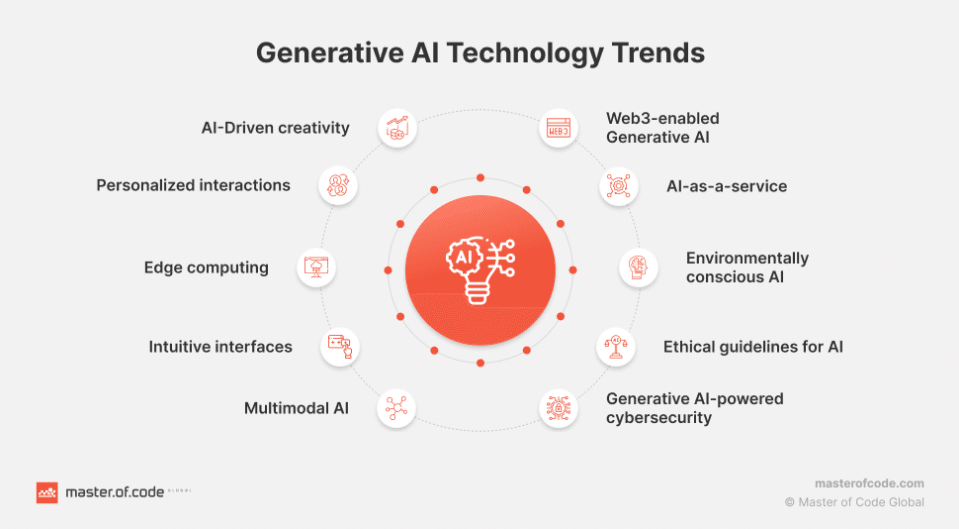
How will generative AI work in the future, and what businesses might AI impact over the next decade? Also, why is controlling the output of generative AI systems important looking ahead?
According to the experts today, there will be numerous shifts in the industry that will change how these AI models work for users and the organizations behind them.
For instance, you’ll see the following:
Multimodal AI
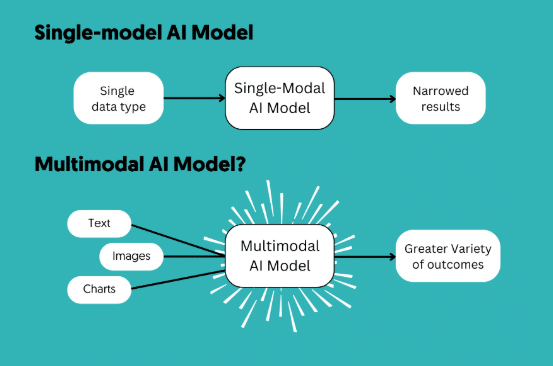
One of the biggest trends among the different types of generative AI is the increased development of multimodal AI models, enabling generative AI software to process and produce a wide range of content, from text and images to audio and video.
This is different from single-model or unimodal AI in that it allows for a broader range of results based on many types of data.
Specialized Models
Another trend we’re seeing is the development of small language models (SLMs) that perform more specialized tasks, which will be essential for many industries.
Examples of generative AI using SLMs include customer service chatbots, recruitment support, content generation specifically for marketing, and analysis of specific types of datasets, such as crop growth in the agricultural industry.
Web3-Enabled Generative AI
This type of AI uses the principles of Web3 to maintain transparent, user-centric, and decentralized platforms to mitigate the risk of issues related to trust, data privacy, and ownership. These platforms would implement decentralized machine learning (DML) and federated learning to allow the tool to train and run across multiple computers on a network instead of a single corporate server.
Optimize for Generative AI with Ignite Visibility
With the increased use of generative AI, it’s now more important than ever for marketers to keep up. Generative engine optimization (GEO) is an essential tool in boosting SEO efforts to optimize for generative AI and the engines powering them.
If you would like some help with GEO and connecting with generative AI users, Ignite Visibility is here for you.
With our help, you can:
- Develop high-quality content that appears in generative AI results
- Supplement GEO efforts with reliable SEO strategies that further increase visibility in search engines
- Stay up-to-date with the latest generative AI trends to inform future strategies
- Measure the results of your efforts with in-depth analytics and reporting
To get started on your next strategy, get in touch with our experts today.