Using Google Ads to develop paid media ad campaigns, advertisers used to be able to improve their ad targeting using a keyword match type called broad match modifier (BMM). However, as of 2021, this match type is gone, with Google’s phrase match format taking its place.
In this blog post, Scott McCutchan, Sr. Director of Paid Media, Franchise, will explore what Broad Match Modifier (BMM) was, what happened to it, and how advertisers can adapt in the current Google Ads landscape. While Google Ads’ broad match modifier was once a key tool for advertisers seeking to balance reach and control, recent changes in Google Ads have led to its integration into the updated phrase match. We’ll also discuss how to optimize your campaigns now that the BMM match type is no longer available.
My Expert Opinion on Broad Match Modifier
Over the years, Google Ads has worked to give advertisers more control over their ads and how they display both in paid search and through display ads on the Google Display Network.
In increasing this control, Google Ads introduced broad match modifiers and other keyword match types that dictate what kinds of keywords will prompt an ad to appear.
By selecting specific keyword match types, advertisers could get the most from their ads with more precise targeting and an optimized advertising budget. In addition to selecting which keywords and matches will make an ad appear, advertisers can also add broad match modifier negative keywords that they can exclude from campaigns for even more efficiency.
While Google has since refined its ads to merge modified broad match keywords into phrase match, knowing more about how this match type worked and what happened to it could help you determine the best alternative.
Over the years, Google Ads has evolved to offer more conversion-based strategies. In doing so, they’ve shifted towards ad targeting and keyword match types that focus on user intent rather than just matching specific keywords. The introduction of broad match modifiers in the past gave advertisers more control over keyword targeting by allowing terms to trigger ads when included in the user’s search. However, Google’s 2021 changes have phased out broad match modifiers, replacing them with broad match and phrase match.
There was an understandable initial reaction when broad match modifiers were removed, but Google’s goal was to make advertising more efficient through user intent-based targeting. Instead of worrying about the specific keyword order, Google’s algorithm now considers broader search behavior and intent, making the platform even smarter.
What Broad Match Modifier Was
Broad match modifiers (BMM) were a type of keyword match that gave advertisers more control than broad match keywords but still allowed for a wide range of search queries. By adding a plus sign (+) before each term in the keyword phrase, advertisers could ensure that each term had to appear in the user’s search. While the exact order didn’t matter, the terms themselves had to be included.
For example, if you were targeting the keyword “pet store,” BMM allowed ads to trigger as long as the search contained “pet” and “store,” regardless of the word order or additional terms. This increased reach over exact match while giving more control than broad match.
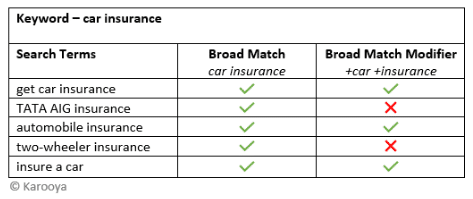
At the same time, the included keywords don’t necessarily need to be in the same order to appear.
In turn, these keywords could increase ad reach over exact match keywords while giving advertisers more control than they would have with strictly broad match keywords.
The Timeline and What Changed
In 2021, Google introduced major updates that merged BMM with phrase match. This change made the phrase match format more intent-based, with the exact keyword order now playing a key role. By July 2021, BMM was officially phased out. The updated phrase match type became the go-to option for advertisers, offering more control and precision while maintaining flexibility.
This model makes for more intent-based matching as ads match with viewers who are more likely to interact with them, meeting them where they’re at in the customer journey.
Unlike broad match modifier terms, the order of keywords for an ad must match the order in the updated phrase match.
How Legacy BMM Behaves Today
With the transition of broad match modifier keywords into phrase match, the “+” keywords used in the former now must be in the phrase format instead of the broad match keyword format, e.g., “pizza delivery Chicago” instead of “+pizza +delivery +Chicago.”
Here is an example of how BMM terms behave today as part of the updated phrase match:
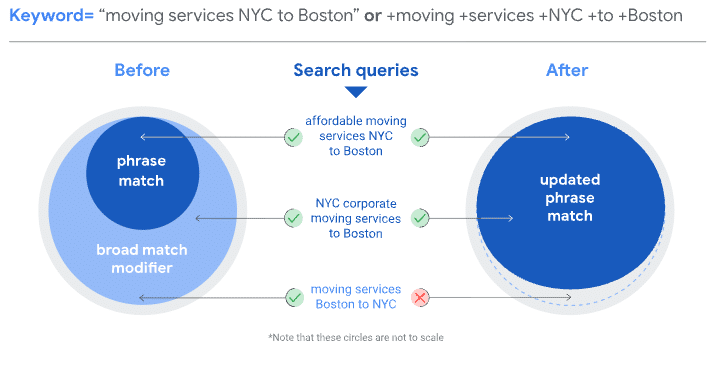
Based on that graphic, you can see that while some of the Google Ads broad match modifier terms do not appear in the updated phrase match, the keywords must appear in the right order. So, “NYC to Boston” in this example would exclude the term “moving services Boston to NYC,” capturing the viewer’s intent.
2025 Playbook: Broad vs. Phrase vs. Exact
With the changes in 2021, advertisers are left with three primary match types: broad match, phrase match, and exact match. Here’s a breakdown of when to use each:
Broad Match
Best for discovery and exploring new keywords. It is also ideal for Smart Bidding, as it provides Google’s AI more flexibility in reaching new audiences across Google’s vast network. However, broad match offers the least control over which searches will trigger your ads.
Phrase Match
A middle ground, offering a balance between control and reach. Phrase match ensures your keyword is included in the search query, but it allows for flexibility in terms of order and additional words. It works well when you need to target specific products or services based on intent.
Exact Match
The most precise targeting option. Use exact match when you want the highest level of control, typically for high-value, high-intent keywords like branded terms or specific long-tail keywords.
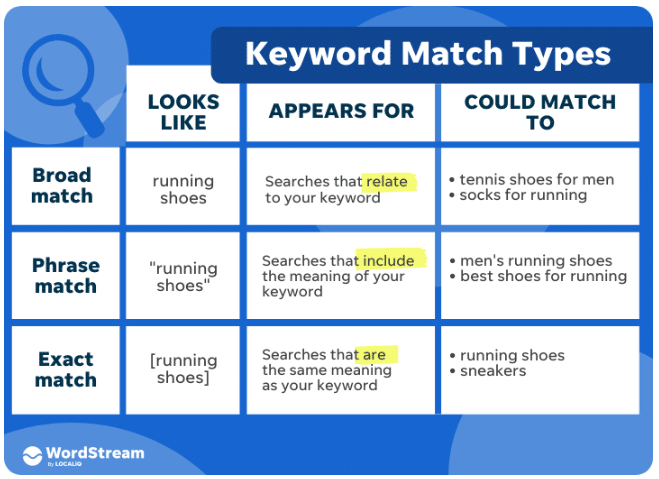
Here is a more in-depth breakdown of each type and when to use it:
Broad Match: For Keyword Discovery and Smart Bidding
Broad match terms are often best if you want to maximize the volume of conversions for Smart Bidding strategies, whether you want to “target CPA” or “maximize conversions” using Google AI.
This match type is also great for exploring new keywords, such as for a new product release, helping you identify high-performing terms that get results.
However, keep in mind that this match type offers the least amount of control while maximizing reach. As such, you would want to use plenty of broad match modifier negative keywords.
Phrase Match: For Mid-Level Control and Reach
If you want more control than broad match but also with more reach than exact match, you would likely opt for phrase match optimization.
This match type can help target specific products or services based on intent. It can also capture many iterations of a keyword without the need to create a comprehensive list of terms.
Generally, you’ll want to use this match type if you have less conversion data than you would need for Smart Bidding.
Exact Match: For the Most Precision and Branded Targeting
Want the highest level of control for highly precise targeting? Go with exact match.
You can use this match type to go after those high-value, high-intent keywords that can yield the most profits, such as specific long-tail keywords and branded terms during the consideration and decision stages of the sales funnel.
You’ll benefit from this match type particularly if you’re in a high-cost or sensitive industry to get the most from your ad budget, with the right exact match terms likely helping to maximize your ROI.
Broad Match Keyword Best Practices
To get the best possible results from the broad match type approach, here are some helpful best practices to implement:
1. Focus on AI and Machine Learning Capabilities
With Google’s heavy reliance on AI and machine learning, the future of Google Ads lies in taking full advantage of AI-powered tools like Smart Bidding. Use Maximize Conversions, Target CPA, and Target ROAS strategies, as they allow Google’s algorithms to learn from user behaviors and optimize bids in real-time. This enhances targeting efficiency across broad match keywords, which previously offered limited control.
2. Expand Audience Reach via Custom Audiences and Remarketing
Expand beyond keywords by using audience targeting tools. Google’s machine learning can now identify more nuanced user segments. Leverage Custom Audiences, Remarketing, and Customer Match to drive targeted traffic, enabling you to reach your best-fit users across Google’s ecosystem. For example, targeting past site visitors with specific interest categories, or using Similar Audiences to find new users who act similarly to your most valuable customers, can increase the relevance and efficiency of your ads.
3. Optimize for User Intent with Automated Insights
Google Ads now provides Automated Insights based on your campaign data. This includes bid suggestions, trend alerts, and competitive insights that help you take quick action and optimize your campaigns more efficiently. Regularly checking these insights ensures that your campaign is adapting to changes in user behavior, ensuring continued relevancy and optimization.
4. Make Use of Performance Max Campaigns
In 2025, Performance Max campaigns have become an essential tool for advertisers. These campaigns combine all of Google’s ad inventory, including Search, Display, YouTube, and more. Using Performance Max with broad match keywords allows you to automate targeting, test different creative elements, and let Google’s AI discover what works best. Over time, this results in optimized conversion paths and a more efficient use of your ad spend.
5. Use Search Terms Reports for Keyword Expansion
With broad match, you get exposure to a wide range of search queries. However, it’s still important to regularly check the search terms report to identify high-performing queries that can be expanded into their own targeted campaigns or added as negative keywords to filter irrelevant traffic. This helps refine the user intent you’re capturing and ensures you’re driving more relevant traffic.
6. Test Creative Variations in Real-Time
Experiment with multiple ad creatives, headlines, and descriptions to see what resonates best with your audience. Use Responsive Search Ads (RSAs) that adapt to user queries dynamically. Google’s AI automatically tests different combinations of your ads and serves the ones that have the highest likelihood of converting. Real-time A/B testing of ad copy, with an emphasis on user intent and clear messaging, can help drive better performance from broad match keywords.
7. Utilize Value-Based Bidding to Align Ad Spend with Profitability
With Google’s shift to value-based bidding, advertisers now have the option to optimize for higher-value conversions. This means you can bid more aggressively for conversions that lead to larger profits or a higher lifetime customer value. For instance, if you’re selling products at different price points, you can adjust your bids to prioritize higher-value purchases or long-term customer relationships, optimizing spend across broad match campaigns.
Migration and Cleanup Checklist
Since the transition from Broad Match Modifiers (BMM) to the integrated Phrase Match format is complete, here’s a fresh clean-up checklist for optimizing your Google Ads campaigns moving forward in 2025:
- Audit and Update Match Types to Reflect Current Goals
- Conduct a thorough audit of your campaigns to ensure you’re using the appropriate match types for your goals.
- Use broad match for discovery and smart bidding, phrase match for control and flexibility in capturing user intent, and exact match for high-precision targeting.
- Ensure Campaigns Are Leveraging Smart Bidding
- Ensure all campaigns are running Smart Bidding strategies (Maximize Conversions, Target CPA, Target ROAS). Smart Bidding is more efficient with Google’s machine learning, and it allows you to optimize bids automatically based on user intent and conversion likelihood.
- Implement the Target ROAS strategy if your primary goal is profitability, especially for eCommerce or higher-value conversion actions.
- Leverage Performance Max Campaigns for Holistic Reach
- If you haven’t already, migrate campaigns to Performance Max. These campaigns combine all of Google’s ad inventory, using broad match keywords across Search, YouTube, Display, and more. Performance Max is an excellent way to automate targeting and optimization while reaching users across the entire Google ecosystem, including discovering new high-converting keywords.
- Segment Keywords and Use Negative Keywords
- Regularly evaluate your search terms reports to identify high-performing queries. If you notice underperforming or irrelevant terms, add them as negative keywords to protect against wasted spend.
- Use broad match for keyword discovery, but avoid letting irrelevant traffic drive up costs. Regularly add new negative keywords to prevent inefficient ad spend.
- Integrate Audience Signals and Segments
- Utilize audience segments, remarketing, and Customer Match to refine targeting. These tools allow you to expand beyond just keywords and incorporate additional layers of audience data, which helps Google serve your ads more effectively.
- Test and Refine Ad Copy in Real-Time
- Regularly test different ad variations using Responsive Search Ads (RSAs) to identify which combinations work best. Google will serve the most effective combination to each user based on their search query and behavior.
- Pay attention to new ad extensions, like price extensions, promotion extensions, and callout extensions, which can boost your ads’ visibility and performance.
- Focus on Conversion Tracking and Measurement
- Update your conversion tracking to ensure all relevant conversion actions are being tracked. Google Ads’ AI relies heavily on conversion data for bidding decisions. Accurate tracking ensures you’re optimizing toward the most valuable actions.
- Use value-based bidding to optimize for conversions with the highest revenue or customer lifetime value.
- Audit Campaign Structure for Efficiency
- Ensure your Google Ads account structure is efficient by grouping related keywords into tightly themed ad groups. Eliminate duplicate keywords and adjust your structure to align with your business objectives.
- Consider product-based segmentation for eCommerce campaigns or service-based segmentation for service industries.
FAQs
1. Is broad match modifier still available?
No, broad match modifier was fully merged with phrase match in 2021. Now, advertisers use phrase match to achieve the same level of precision previously offered by BMM.
2. What replaced the modified broad match?
Yes, broad match is still a powerful tool for keyword discovery, particularly when used with Smart Bidding. It’s ideal for maximizing reach and finding new, high-performing search terms.
3. Should I switch broad match modifier to broad match?
You may be able to transition your modified broad match terms into broad match queries under certain conditions. For example, you might do this if you’re using Smart Bidding, you would like to scale your reach, and you have sufficient conversion data to inform your campaigns.
4. What is broad vs. phrase match?
I recommend grouping targeted keywords by their root term. This makes it easier to review search term reports and filter out search queries that don’t include the root term you’re targeting. Additionally, for low-performing broad match keywords, test them against their phrase match counterparts. You may find phrase offers more efficient delivery or conversion results.
5. How does phrase match differ from broad match in 2025?
- Phrase match differs from broad match in that it offers more flexibility with the queries that trigger your ads, but you’re willing to pay more when the search query closely aligns with the keyword you’re targeting. Essentially, phrase match is about striking a balance between control and reach.
- In contrast, broad match is driven more by a user’s intent. With broad match, Google tries to match your ads to a wide range of search queries based on relevance, but this can sometimes result in contextually irrelevant terms showing up at very low CPCs, like $0.10, because they don’t necessarily align well with the specific keyword you’re targeting.
Optimize Your PPC Keyword Targeting With Ignite Visibility
If you would like to get the best results from your broad match keywords and others in your Google Ads campaigns, Ignite Visibility has ample experience in paid search and display advertising.
With our expertise behind you, you’ll be able to:
- Migrate broad match modifier queries into contemporary Google Ads campaigns
- Identify the most valuable keywords to target in each match type
- Match each match type to your goals
- Continually monitor and optimize your ads
- Integrate PPC campaigns into a holistic digital marketing strategy
- And more!
Get in touch with us today to find out how we can help you build your next campaign.