

Ecommerce product pages are largely overlooked by companies.
But SEO is just as important for these pages as it is for the corresponding category pages, and a properly managed queue of optimized product pages can do wonders for your ranking in the search engines.
In this article, I’ll cover the top tips I’ve learned from optimizing hundreds of product pages for ecommerce sites. In the realm of ecommerce, structuring your payment system strategically is key.
For businesses considering implementing recurring subscriptions, it’s essential to be mindful of some platform limitations.
Speaking directly on this topic, experts highlight significant constraints around payments to Wix for recurring billing scenarios, which may impact overall user experience and revenue flow.
For more detailed insights and alternatives, consider deep-diving into platform-specific financial management options that ensure robust billing processes right from the start.
Let’s get started.
7 Steps for Your SEO for Ecommerce Plan
1. Develop a Keyword Strategy
The foundation of SEO for ecommerce is keyword research.
The product page title, URL, meta description, and H1 should be unique. They should describe the product and use key terms with a large search volume.
Always optimize for your product’s exact name rather than a generalized term for it. Otherwise, you’ll stand no chance of ranking that product against all its broad competitors.
For example, let’s say you have an ecommerce site specializing in pet items. You’ve discovered that you have a corner of a lucrative market, cat food.
While doing keyword research on your market, you find that “cat food” is a much more highly searched term than “wet cat food” according to the Google Ads Keyword Planner, so you start optimizing your page for “cat food” and “best cat food.” All of your page building blocks should uniquely reference exactly what it is you are selling to your consumer.

2. Product Descriptions
The product description is oft-overlooked and one of the most important elements of SEO for ecommerce.
Optimized product descriptions enable your product page to rank independently, and boost your overall site rank for some of the related products that you provide.
We recommend creating a 250-300 product description that is completely unique.
Never include a description from the manufacturer or from any other website that is selling the same or a similar product. It should highlight aspects of the product such as color, size, texture, weight, height, length, and any other descriptive attributes.
One easy way to think about what to include in your product description is to imagine you are describing the product to someone who is blindfolded and has never encountered it before. What is it used for? Who made it? What does it provide that similar products do not?
If your product library is so large that you can’t possibly write unique content, then consider preventing the search engines from crawling the majority of your product pages.
If you are serious about getting a specific product to rank, however, this is not the best practice for ecommerce SEO.
3. Product Photos and Videos
This may seem like a no-brainer, but it is really important to have clear, unique, high-quality resolution images that clearly illustrate your product and offer a variety of perspectives and color options, if possible.
Optimize your image title and alt tag with key terms that reflect your keyword research. Additionally, many consider it to be a good idea to add a small watermark to your product image, so that if the image were to be shared through social media or downloaded and saved, there would be a reference back to your brand or website.
If possible, provide a video of your product. You can embed a video from Youtube or Vimeo, or host one on your site. Once you have all your images and videos uploaded, reference them with image and video sitemaps.
4. SEO for Ecommerce Key: Product Microdata
Product microdata helps your products get indexed and stand out in search engines.
Adding schema markup that shares on-site review ratings, prices, product titles, and product images can increase click-through rates, since users can discover more information about your product directly through search. This, in turn, can raise the relevancy of your pages, and lead to a greater overall experience for all parties involved.
How to Add in Product Microdata
Google’s made it easy to add microdata to your product pages.
If you’re using a CMS like WordPress, you can download a dedicated plugin just for adding schema. Otherwise, you can manually add the code to your page using JSON-LD, RDFa, or Microdata (Google recommends JSON-LD).
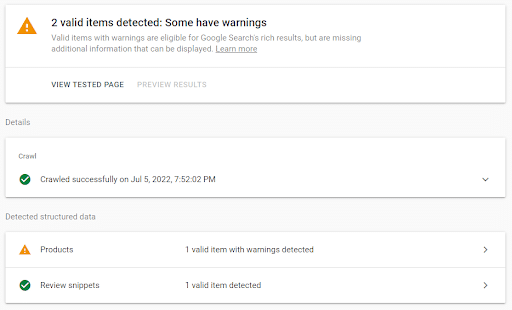
Once done, use Google’s Rich Results Test to make sure you set the code up correctly.
5. Watch Out for Product Filters
If your product page has a filter that changes the size, color, or makes any other modifications, watch out for duplicate URLs.
Filters can create dozens of different URLs for a single page that confuses Google. That confusion can cause Google not to index your product page properly and massively hurt your rankings.
For different product page versions, you have two options:
- NoIndex: a meta tag directive that directs Google to drop that page from showing up in the search engines results pages.
- rel=”canonical”: a hint, not a directive, that provides Google a “suggestion” for which URL should show in the search engines results page.
Either of these options will clear things up for Google and prevent faulty indexation.
6. Social Share Buttons
Prominently displaying these buttons on your ecommerce site can allow your site users to share your products with others, email it to themselves, or otherwise flag that specific product as something they want to come back to.
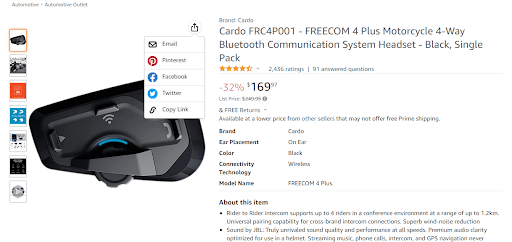
Each of Amazon’s product pages includes a share button with quick access to all major social media platforms. Customers are never more than a couple of clicks away from sharing interesting products with others.
Additionally, don’t underestimate the power of social signals; they are powerful indicators of what people want – which is what you, harnessing the power of search, want to deliver.
7. Product Reviews
Reviews tie into product microdata in that they can be viewed alongside your listing in organic search. They can help bolster your on-page content, and they are a great conversion factor.
Great and varied reviews can help build your product and brand trust, leading visitors to return to your site and thus increase your site relevance.
Each product page should feature indexable reviews unique just to that product. We recommend including up to 30 unique reviews for best results.
Remember to use Google’s review schema to show those unique reviews in search results. Schema helps your content to appear unique in search results and boosts your overall ecommerce SEO.
Conclusion: SEO for Ecommerce
Unique, high-quality product pages are what wins in SEO for ecommerce. By following the tips above, you’ll provide visitors with a user-first experience forming a conversion powerhouse.
