
Optimizing your franchise sales process and aligning it with marketing is critical to driving franchise development success. This is where a well-executed sales enablement strategy plays a pivotal role. Sales enablement is particularly essential in today’s sales strategies, as it provides sales teams with the most effective content, tools, and training to maximize win rates and shorten sales cycles in increasingly competitive markets.
In the following blog post, Rachael Wachstein, Director of Franchise Client Success, will give you an in-depth look into sales enablement and explore the ways you can use it to close more deals and grow your franchise brand.
What You’ll Learn:
- Key Components of an Enterprise Sales Enablement Strategy
- Overcoming Sales Enablement Challenges in Franchise Development
- 6 Steps For Franchise Sales Enablement
- Content Strategy for Sales Enhancement
- Measuring Sales Enablement Success
- FAQs
An Introduction to Sales Enablement For Franchise Development
Franchise brands need to empower their sales teams as much as possible to help them do their job. Without the tools needed to help them succeed, sales teams will flounder, and subsequently, the growth of the franchise system will suffer from that inefficiency.
Enter sales enablement solutions, which are an essential ingredient for your sales team’s success.
What Is Sales Enablement?
Sales enablement involves giving sales teams everything they need to maximize their efficiency and velocity of sales, including optimized processes, innovative technologies, and relevant content that resonates with prospects.
Sales enablement is the strategic process of equipping your sales teams with the proper content, training, technology and insights that they’ll need to win even more deals.
Recent statistics show how important sales enablement is today, with 49% of salespeople meeting their quota more frequently with a sales enablement strategy in place.
Some of the recent trends making sales enablement easier than ever include AI integrations that analyze buyer behavior for better personalization. AI helps with predictive analytics for sales projections, microlearning that educates prospects with concise and focused content, and digital sales rooms (DSRs). such as Showpad or Highspot, that allow for even more effective collaboration between buyers and sellers.
Organizations using AI in their enterprise sales enablement strategies see around 29% higher sales growth than peers who fail to leverage this technology.
In a sales enablement strategy, sales and marketing teams must work cohesively and closely to align their processes and data.
One case study highlighting the effectiveness of sales enablement content and platforms involves developing sales enablement for a financial services provider that hired professionals right out of college, using a combination of training materials and tools to train reps on how to reel in more prospects. The result was the ability for newly trained reps to outperform multiple 5-year reps by around 21%.
This is simply one instance demonstrating how the right approach to sales enablement could help you get the most from your development efforts.
What Does Sales Enablement Do for Franchise Development?
Sales enablement helps franchises meet the unique needs of potential buyers by ensuring the sales team can effectively communicate value. The process enhances franchise sales by:
- Aligning Sales and Marketing: Create a cohesive strategy to reduce miscommunication and streamline lead acquisition.
- Providing Data-Driven Insights: Equip sales teams with market research and performance data, allowing them to make informed decisions tailored to each prospect.
- Improving Lead Management: Defining clear criteria for Marketing Qualified Leads (MQLs) and Sales Qualified Leads (SQLs) for a focused approach.
- Streamlining The Franchise Buyer Journey: Deliver content and interactions that match the buyer’s unique needs throughout the sales pipeline. Creating high-quality gated content and maintaining responsive communications are a couple of the keys to more efficient franchisee journeys.
- Showcase Franchisee Benefits: Create clear messaging about what the franchisee gets for buying one of your franchises. High-quality, engaging content and an equally engaging sales team can establish what sets you apart from competitors’ opportunities.
If you’re not yet convinced of the importance of sales enablement, consider the fact that enterprises with a sales enablement strategy in place saw a 49% higher win rate for predicted deals. Additionally, sales enablement shortens onboarding time by as much as 40-50%, helping franchises meet or even exceed their growth goals!
In short, you need effective enterprise sales enablement to fully realize your franchise’s success.
The Role of Sales Enablement Content in Closing More Deals
The right content will fuel your sales enablement marketing efforts as you work to move your prospects through the sales funnel.
There are many types of sales enablement content you can use for your brand, including:
- Overview decks
- Sales playbooks
- Scripted introductory videos
- Educational webinars
- Palm cards for brokers
- Case studies and testimonials showcasing the success of other franchisees
- Email templates with personalized messaging for various investor segments
- Franchise development SMS texts that connect with
- prospects on mobile devices
- Training materials
One sales enablement strategy example is Two Men and a Truck, which uses data-driven information with tailored resources and efficient communications to optimize franchise development.

Another sales enablement content example is KFC, which also offers franchisees access to case studies, performance analytics, and business plans, among others.

My Expert Opinion on Enterprise Sales Enablement
Enablement is all about giving sales professionals the resources to thrive with their strategies. A strong sales enablement strategy will help align marketing and sales efforts to keep everyone on the same page, ultimately helping your franchise brand stand apart from competitors and move more people to the bottom of the funnel.
I’ve found that the right combination of sales enablement tools, content, training, and measurement is key to helping you get the most from your sales efforts and empowering them to exceed sales goals. Building a strong connection between sales and marketing will ultimately fuel sustained success and execute a more cohesive overarching strategy.
Now, let’s get into it: What is sales enablement, and what kinds of sales enablement software and other resources go into an effective strategy?
Key Components of an Enterprise Sales Enablement Strategy
When putting together your sales enablement strategies, you’ll need to include and utilize the following elements:
Content Strategy
What is sales enablement without a highly effective sales enablement content strategy? Let’s look at some of the main pieces of content to include in yours:
A Navigable, User-Friendly Website
Consider the ease of use of your website, where all of your content will appear. Prospective franchise buyers should easily find the most important information about your franchise opportunity.
In addition to developing a dedicated franchise website or subdomain on your existing site, you should make it easy to find.
For example, 1-800-GOT-JUNK? Includes a “Start a Franchise” link in the top navigation, which could get people to see your opportunity right away.

But it’s not enough to just have franchising information in your header anymore. It should also be in the footer of your website.

Testimonials
The goal and objective of testimonials is to give your ideal prospects someone to identify with. One of the easiest ways for your prospects to connect with current clients is through videos. If you’re looking for multi-unit or multi-brand operators, that’s who you’ll want to feature in your testimonial videos.
Here is a sample format of interview questions for franchisees:
- What is your name?
- How many brand locations do you own? Where are you located?
- When did you become a franchisee?
- What led you to look at [INSERT BRAND NAME]?
- Why should someone consider [INSERT BRAND NAME] as a business investment?
- Why did you choose [INSERT BRAND NAME] over other opportunities?
- What was the biggest differentiator about [INSERT BRAND NAME] that led to you becoming a franchisee?
- What motivated your investment in [INSERT BRAND NAME]?
- Tell us about your family, life, and professional goals.
- Biggest successes so far in the business? Biggest challenges?
- Why did you continue investing in [INSERT BRAND NAME] after opening your first location?
- Do you own other franchise brands? If so, which ones?
- What’s the best part of being an [INSERT BRAND NAME] franchise owner?
- Tell us about your growth goals for the next 3- 5 years? How many more units would you like to open?
- What does corporate do to support your success?
BatteriesPlus has some good sales enablement examples of testimonials that focus on different touchpoints, such as franchisees’ ability to develop a family-based business and generate millions in sales.
One clear differentiator is Batteries Plus prioritizes videos featuring the types of investors they want to address, specifically multi-unit and multi-brand, interviewing multi-branded portfolio managers or multi-concept investors.

Gated Content
Do you have anything you can use as gated content? I’m talking about ebooks, whitepapers, or guides to educate prospects. Use these pieces of content for top of funnel outreach. Once a prospect fills out your form, they become a “soft lead” and you’ll move them into a long term nurture campaign.
Additionally, the more your potential franchise buyers know about what to expect with your opportunities, the more ready they’ll be to make a decision when it comes to engaging with your sales team. Ultimately, good gated content will help you identify the right buyers from the beginning, leading to more SQLs and sales in the long run.
One example of good educational content is the McDonald’s playbook, which goes over the details of how to get started as a McDonald’s franchisee for new prospects.

Other Educational Content
In addition to gated content, your website should include other important information including:
- Financial requirements
- Investment requirements
- Value propositions
- Industry stats
- Consumer demand for products or services
- Profitability
- And more
Don’t forget to share profitability including EBITDA, AUV, average gross revenue, etc. from your Franchise Disclosure Document.
Franchise-Focused Social Media Posts
Appeal to new prospective franchisees with your social media, especially on LinkedIn, where you can connect more easily with eager professionals. At the same time, appeal to consumers and prospects with posts that connect with both audiences.
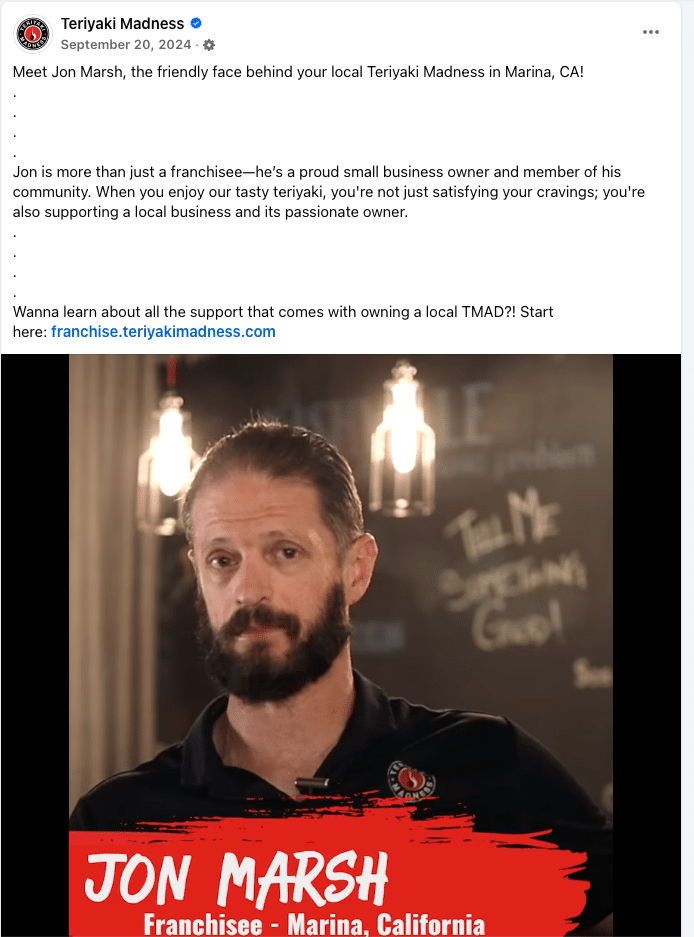
For instance, Teriyaki Madness posts about grand openings on LinkedIn and other platforms, showcasing the introduction of new locations to customers while also indicating to prospects that they could own their own locations.

Teriyaki Madness also posts about individual franchisees on Meta and other consumer-facing platforms, giving faces to their brand to draw customers to specific locations while simultaneously showing how they value franchise owners.
Convenient Contact Forms
Shorten the sales cycle and get more people to connect with your sales teams through clear, simple contact forms.
These forms should be quick to fill out and only request important information, with compelling calls-to-action (CTAs) that effectively convert.
The Pickle Pad has a good example of how a franchise contact form should look, appearing right at the top of the homepage with a simple three-step process.
Notice how they qualify prospects immediately, by asking about their liquidity and share financial obligations.

Sales Training
You also need sales enablement tools to support your sales teams and supplement your sales enablement content, helping them perform at their best. Here are some ways to go about this:
Sales Training Software
Essential sales enablement software could include sales training applications that help ease the training process and encourage ongoing education among sales teams.
Some of the most popular tools include:
- Highspot: This solution blends training and coaching with content management and analytics using SmartPage technology to develop the best selling experience for customer acquisition.
- Mindtickle: As an AI-powered tool, Mindtickle allows for role-playing scenarios with conversation intelligence to help improve and measure sales staff skills.
- Allego: Like Mindtickle, Allego uses AI components to enable dialogue simulations for sales coaching and practice, with additional educational and content management capabilities.
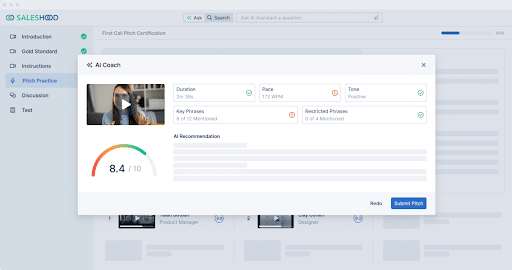
- SalesHood: For a more collaborative tool, you might go with SalesHood, which facilitates just-in-time learning and video-based peer reviews, along with AI coaches to help with conversational practice.
Sales Training Programs
To get the most from the above sales enablement platforms, you need a solid sales training program in place. There are multiple components that will go into a sales training program, such as:
- Clear goals that put you in the right direction
- A needs analysis that identifies existing skills and potential gaps to fill
- A detailed curriculum that covers multiple skillsets
- Using in-person, virtual, or both approaches to maximize the effectiveness and accessibility of training
- Enforcing ongoing coaching with consistent feedback and measurement
Technology Integration
There are plenty of sales enablement tools you could use as part of your technology stack, such as:
Customer Relationship Management (CRM) Platforms
One of the main tools to use is a franchise sales CRM system, which helps your sales teams manage workflows, from tracking leads and managing contacts to mapping out the entire sales pipeline.
There are plenty of CRMs to choose from, some of the best being Salesforce CRM and HubSpot Smart CRM.
Others that are great for franchise sales enablement include:
- Zoho: Automate sales, workflows, reporting, and sales pipeline management, with the ability to create email templates and collaborate across teams using a customizable dashboard.
- FranConnect: This platform includes lead capture and automation, in-depth analytics, task management, and the ability to help streamline the process of developing new locations for your franchise.
- ClientTether: Visualize sales pipelines, facilitate comprehensive task management, utilize click-to-dial functionality, automate call scheduling, and customize your sales cycles using this CRM.
- Pipeline CRM: Take advantage of many features with this CRM, such as management for pipelines, teams, and leads, along with sales automation, automated email marketing, tracking, and reporting.

Content Management Systems (CMSs)
CMSs are also essential sales enablement tools, allowing you to easily create, manage, and publish content on various platforms. Website hosts like WordPress include easy-to-use CMSs that can help you manage all of your content in a central hub.
Sales Enablement Automation
To keep all processes smooth, use sales enablement automation. Tools like CRMs can help you automate lead management and other processes, while automated follow-up emails and other correspondence can keep prospects engaged and moving along the buyer’s journey.
The more automation you have in place, the more your marketing and sales teams can focus on converting high-quality leads.
Performance Metrics
To determine the overall performance of your sales enablement efforts, you must track several key metrics based on your goals.
Some examples may include:
Revenue-Based Metrics
Here are some critical revenue-based metrics to measure:
- Quota Attainment: The percentage of sales staff who meet or exceed their individual quotas.
- Win Rate: The percentage of closed deals vs. the total number of opened deals.
- Average Deal Size: The average number of units each deal generates.
- Sales Growth: The rate of increase in sales revenue over a set period.
- Customer Acquisition Cost (CAC): The total cost of marketing and sales combined to acquire a new customer.
Productivity Metrics
Additionally, you should track various metrics gauging your team’s productivity, such as:
- Sales Cycle Length: The average time needed to close a deal.
- Time to Productivity: The amount of time required for newly onboarded sales reps to reach their full potential and close deals with efficiency.
- Lead-to-Opportunity Conversion Rate: The percentage of leads that transition into marketing- and sales-qualified opportunities.
- Pipeline Velocity: The speed with which deals travel down the sales funnel.
- Sales Process Adherence: The ability of sales reps to adhere to a strict sales process.
Content and Tool Metrics
You may also want to track these content metrics to measure the effectiveness of your sales enablement content strategy:
- Content Usage Rate: Measures the effectiveness and frequency of use of content among sales reps.
- Sales Tool Adoption Rate: The percentage of sales reps actively implementing your sales enablement tools.
- Content Engagement: The way prospects engage with the provided sales content.
- Sales Forecast Accuracy: The alignment of sales forecasts with results.
Sales Enablement Best Practices for Franchise Development
If you want to get the most from your strategy, the following are some additional sales enablement best practices to implement:
- Align Sales and Marketing: These teams should work together towards common goals, along with all other teams, to keep your strategy cohesive with consistent messaging and lead generation. In doing so, Martech.do recommends connecting both teams’ goals, processes, and messaging to maximize the efficiency of the customer journey.
- Tailor Content to Speak to Each Prospect: Your content should speak directly to each potential franchisee, with case studies, training materials, projections, and guides that speak to their unique concerns, wants, and needs.
- Make Full Use of Software: To supercharge your efforts, use and integrate the right platforms to help you automate and generally streamline sales and other processes.
- Make Informed Data-Driven Decisions: Use data to determine performance and trends that might steer your strategy in a smarter direction. Over time, you can perfect your efforts for improved conversion rates and revenue.
- Use the SMART Goals Framework: To guide your sales enablement strategy, set goals that meet the SMART criteria: Specific, Measurable, Achievable, Realistic, and Timely. Highspot recommends setting aligned goals that help you achieve your overall business objectives.
Overcoming Sales Enablement Challenges in Franchise Development
There are inevitably some sales enablement challenges your franchise will encounter along the way to success, but there are plenty of solutions to ensure they don’t hinder your performance.
Some of these challenges include the following:
Inconsistent Messaging
One of the main issues that franchises can struggle with is inconsistent messaging, especially between marketing and sales teams.
Create a unified language that best represents your brand, its mission, and its values. Marketing and sales teams should then use this language across all content and communications, giving your franchise a unique, recognizable, and trusted personality.
The more consistent your messaging, the more stable your franchise will appear to potential buyers as you establish a clear brand identity with which they can connect.
Lack of Data Integration
All of your marketing and sales data should be aligned in addition to your messaging. Sales teams must have access to meaningful data from the marketing team, with fully integrated tools like CRMs that make data collection and analysis simple across the entire organization.
AI schedulers are very helpful in connecting leads with sales teams. According to the digital director of the UK-based We Make Footballers franchise, which trains children to play football, “We are beginning to use [AI] to analyze large data sets across our organization and provide insights and analysis that would not be possible (or at least be extremely time intensive) by human observation.”
Overcomplicated Journey to Qualification
It’s also a mistake to overcomplicate a prospect’s transition from lead to franchisee. Know what kind of journey your audiences take and eliminate any potential bottlenecks keeping them from converting.
Tools like FranConnect can help streamline the journey from MQL to SQL and, ultimately, sales. For instance, Firehouse Subs used this tool to decrease its entire sales cycle by nearly 50% through improved lead flow management.
The HubSpot CRM platform has also helped franchises like Smash My Trash, a mobile dumpster compactor service, use automation to optimize workflows for leads and contracts, allowing for easier contracting and an overall smoother lead management process.
Insufficient Content Creation
A lack of content can hurt your marketing and sales efforts, as prospects might not know what exactly they’re getting by becoming franchise owners.
Include as much information about your franchise as possible and the opportunities you offer, from investment requirements and other expectations to differentiators that show what you offer that competitors don’t.
This content should appear on your website, social media platforms, emails, and other platforms where you can reach your prospects.
Batteries Plus, for example, discusses its multi-unit opportunities, enabling franchisees to own several locations while many franchises limit them to one. It also advertises non-traditional locations that can reach people in areas where there’s less competition.

Inadequate Sales Training and Onboarding
You also need to sufficiently train and onboard sales employees to ensure they can give your franchise and buyers everything they need. Sales staff should know what kind of messaging to use, how to use all of the tools available to them, and how to connect with all teams to maintain cohesive and efficient processes.
To achieve this, develop strong training and onboarding processes with helpful courses and hands-on training.
Content Overload
While too little content can be a huge hindrance, having too much content could also present some problems in a sales enablement content strategy. Overwhelming your sales teams with content might make it harder for them to find what they need at the right time, leading to inefficiency and subsequently reduced productivity.
Be sure to organize your content and make it easy for your teams to access precisely what they need based on topics.
Sales and Marketing Misalignment
Another critical issue that can hurt enterprise sales enablement efforts is simply misaligning sales and marketing efforts.
To get both teams to work together most effectively, make sure marketing efforts inform sales, and vice versa, with both working toward the broader business objectives.
Connecting both teams will improve cohesion as they work toward acquiring leads at the top of the funnel and efficiently bringing them down to the bottom.
6 Steps For Franchise Sales Enablement
- Create a Universal Goal: All of your teams should align around a specific unified goal based on the franchise’s vision. This goal will also establish the kind of budget each team will need to help achieve it.
- Develop a Lead Qualification Framework: With your universal goal in place, you need to figure out which targets to set specifically for marketing and sales teams by establishing what counts as a sales-qualified lead (SQL) or a marketing-qualified lead (MQL). Both will include certain characteristics that define the ideal customer profile.
- Draft a Service-Level Agreement (SLA): You can hold your sales and marketing teams accountable with the help of an SLA based on yearly franchise deal goals, including the number of qualified leads your team generated and how many of them ultimately became SQLs and led to a sale.
- Target the Best Prospects: You must also know how to reach the right potential franchisees at the right time with high-quality content that resonates. Creating buyer personas profiling different types of franchise buyers, defining your audience’s specific needs and the values they want from a franchise, and establishing your franchise as a “hero” to your audiences can help you build better connections.
- Use Sales Enablement Content: Consider what kinds of content your franchise buyers want to see, such as details about how to start a franchise, the potential profits they can generate, and what sets your opportunity apart from other similar franchises. Blog posts, videos, testimonial pages, financial requirement details, and other content can help lead more qualified leads down the sales pipeline.
- Automate Processes With Innovative Technologies: While most brands already have a CRM, it’s important to automate other communication tools like SMS and email marketing, and make sure they all work together properly.
Content Strategy for Sales Enhancement
To develop a highly effective sales enablement content strategy, take the following steps:
1. Conduct a Content Audit
To begin, audit your current sales enablement content to determine what you can actually use based on relevance. Assess performance and usage of different content assets, and identify any gaps in your content strategy.
2. Segment Your Audiences
Segment your audiences into different groups based on demographics, psychographics, lifestyle, income, and other characteristics, creating an audience persona for each segment. You can then use this segmentation to paint a picture of the customer journey and develop content to connect with each stage.
3. Create High-Quality Content
Develop new relevant content that resonates with audiences at every step of their journey, gathering feedback from your sales team regarding usage and effectiveness to determine how to approach future content generation efforts. Also, optimize content with good SEO to maximize visibility on search engines and reach the right audiences at the right time.
4. Decide on Distribution Channels
Figure out which channels are best for your content, and organize content with a content management system or a sales enablement platform. Sales teams should also have access to all relevant tools and training to make full use of your content. Analytics could then help measure the performance of content and distribution, informing future optimization.
Measuring Sales Enablement Success
Here are some of the best key performance indicators (KPIs) to measure the success of your sales enablement efforts:
- Time to Revenue (TTR): This KPI measures the time it takes for a prospect to move from initial discovery to the moment of investment. It’s essential in assessing the efficiency of overall sales and conversions.
- Win Rates: Measures the percentage of won sales opportunities, using the formula: (Total Closed-Won Deals / Total Opportunities) X 100. It effectively details how many deals are successfully closed to gauge productivity.
- Content Utilization Rates: Tracks the rate at which sales teams use marketing and sales, measuring metrics like page engagement, sessions, and views. The higher these metrics, the better the content behind them.
FAQs
1. What is the difference between sales enablement and sales training?
Enterprise sales enablement refers to the larger strategy of empowering sales teams and aligning them with marketing, while sales training is a key component of these strategies in developing sales reps’ skills and knowledge.
2. How do I implement a sales enablement strategy?
There are several steps you must take to develop a strong strategy, including setting clear and realistic goals that align with broader business objectives, creating high-quality and organized content, and implementing CRM and CMS integrations, along with other tools.
3. What are the best tools for sales enablement?
There are many types of sales enablement tools you could use to get the most from your strategy, including content management systems, customer relationship management tools, sales training and coaching platforms, and sales engagement software.
4. How can I measure the success of my sales enablement strategy?
Regular measurement of relevant KPIs based on your goals could help you determine the effectiveness of your strategy. For instance, you might track various content, productivity, and sales engagement metrics that indicate what’s working and what needs additional optimization.
Take Full Advantage of Sales Enablement With Ignite Visibility
At Ignite Visibility, we develop strategies that optimize franchise development processes at every level. With our sales enablement services behind you, you’ll be able to maximize your success in the long term.
We provide custom solutions for sales enablement as part of franchise development. We learn the individual needs of each client to determine the best approach, putting together tailored sales enablement solutions that work for them.
Need some help with enterprise sales enablement? With our campaigns, you’ll benefit from:
- Cohesiveness between marketing and sales
- High-quality content on a navigable, converting website
- Social media, PPC, and other marketing strategies to generate more leads
- Saving money by getting more out of the leads you’re already paying to generate
- And more!
Get in touch with us and get started on your next strategy today!