
A single ad rarely closes the sale on its own. Usually, several marketing touchpoints work together to get there. With proper credit allocation, marketers can identify which interactions actually drive conversions and which ones stall the journey, sharpening the campaign decisions that follow.
In this blog, Rochelle O’Neil, Paid Media Strategist, breaks down what multi-touch attribution is, how it works, and the different models you can use to put it into practice.
What’s Covered:
- What Is Multi-Touch Attribution?
- How Does Multi-Touch Attribution Work?
- How to Choose the Right Model for Your Business
- Multi Touch Attribution vs. Marketing Mix Modeling
- Turn Attribution Insights Into Revenue and Budget Decisions
- Multi Touch Attribution FAQs
TL;DR
- Most conversions result from multiple touchpoints, not a single interaction, making single-touch models too narrow to capture the full picture.
- Different attribution models (linear, time-decay, position-based, and more) weight touchpoints differently, so the model you choose shapes which channels get credit.
- Effective attribution depends on reliable data such as campaign tags, identity matching, and CRM relationships, among others
- No attribution model is perfect. Understanding its blind spots is part of using it well.
- Connecting credited touchpoints to revenue (and continually testing your approach) is what turns attribution data into smarter budget decisions.
What Is Multi-Touch Attribution?
To kick things off, what is marketing attribution, and what is an attribution model with a multi-touch methodology?
Attribution in marketing is an umbrella term referring to the process of assigning credit to particular touchpoints along the customer journey. Multi-touch is a specific type of attribution model giving credit to several key points as an allocation method.
Multi-touch differs from other attribution models in that it takes a cross-channel approach, which looks at how touchpoints work together in lead generation strategies to influence each other and lead to a sale. This is unique from models like first-touch attribution, which credits 100% of conversions to the first interaction with a customer, and last-touch attribution, which gives all the credit to the final interaction before a sale.
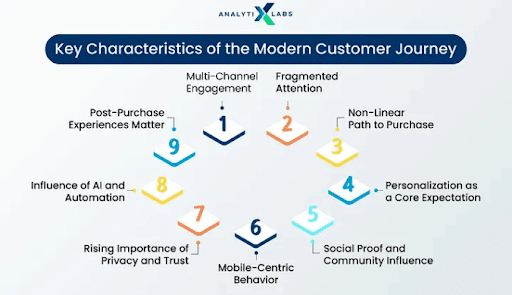
Cross-channel attribution is especially important with today’s complex customer journeys, where buyers often interact with a brand across multiple devices, platforms, and touchpoints before ever converting. Next, we’ll take a look at what that complexity actually looks like.
How Does Multi-Touch Attribution Work?
Multi touch attribution marketing entails four primary stages:
- Data Collection: The marketing attribution process begins with collecting raw interaction data from all marketing channels, including UTM tags and other click-level parameters, email tracking tokens, and behavioral tracking data, e.g., page views and conversion events like form completions.
- Journey Matching: The leading multi-touch attribution platforms can organize all of that collected data into a cohesive customer journey for each user, with cross-device and -session behavior using various first-party identifiers, such as customer IDs, hashed email logins, and server-side cookies.
- Credit Allocation: Following a defined conversion event and journey mapping, platforms will then use a specific type of attribution modeling to distribute conversion credit across all relevant touchpoints, adhering to rule-based logic (e.g., linear or U-shaped models) or data-driven algorithmic logic.
- Reporting: Finally, marketing attribution tools will organize all of the allocation metrics into a high-level dashboard to provide marketers with a comprehensive visualization, detailing performance metrics across the customer journey to help with profit calculation and budget allocation.
A couple of key elements to consider when using marketing attribution tools include:
- Touchpoints: A touchpoint is any single interaction or exposure point between brand assets and their prospective customers, such as clicking on an ad, opening a newsletter, viewing a video, or reading a blog post, all of which contribute to the journey and, ultimately, a conversion.
- Lookback Windows: This marketing attribution concept refers to a set period of time counting backward from the moment of conversion, helping determine how far back a system can search for previous interactions along the journey. Any interaction outside of this window receives zero credit toward a conversion.
A specific journey for a user might look something like:
- Sees and clicks on a paid ad, serving as the first touchpoint in the lookback window.
- Conducts an organic search for a related term on Google, taking the user to a blog post.
- Signs up for and receives an email newsletter before eventually clicking a link in an email.
- Clicks on a paid search ad that takes them to a specific product or service, where they finally convert.
Just remember that display views and offline activity require accessible, linkable data. For instance, if direct mail is part of your marketing mix, include a QR code or trackable link on each piece that sends recipients to a corresponding landing page.
My Expert Opinion on Multi Touch Attribution
In my experience, the biggest mistake I see businesses make is defaulting to last-click attribution simply because it’s the easiest to set up, not because it reflects reality. That approach consistently undervalues the upper-funnel touchpoints that actually get people into the funnel in the first place.
When trying to convert audiences into loyal customers, you need a complete look at the path from that first interaction to the final conversion event. Tracking every stage along the way lets businesses see not only which paths people are taking to convert, but also which bottlenecks cause them to slow their journeys or drop off entirely.
While one touchpoint might look like the key interaction leading to conversions, the journey could be more complex and involve a lot of factors influencing a customer’s decision, making single-touch approaches too nearsighted to give you the insight you need.
If you’re still relying on a single-touch attribution model, you’re likely behind your competitors, as around 75% of companies have made the switch to multi-touch. More and more businesses are understanding how even some of the earliest exposure and interactions in a long journey could be deserving of most of the credit for a conversion, with those down-funnel touchpoints simply solidifying and helping people follow through with a buying decision.
To get the most from your marketing attribution tools and strategy, you need to choose the right approach, collect the data that matters, and understand both what attribution can tell you and where it falls short.

Five Multi-Touch Attribution Models Compared
Let’s look at and compare the different cross-channel attribution models you might use:
1. Linear
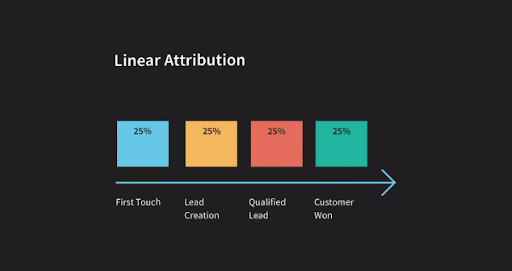
This specific attribution model assigns the same credit to every touchpoint along the journey. For instance, if a customer makes a purchase after clicking on an ad, reading a blog post, receiving an email, and engaging with a social media post, each touchpoint would get 25% credit for the conversion.
Best for: This model is often ideal if customers go through a long sales cycle, and it isn’t clear exactly which touchpoint led to a sale.
Limitations: Linear multi touch attribution marketing comes with certain limitations to keep in mind. It treats top-of-funnel interactions the same as bottom-of-funnel touchpoints, which can obscure which interactions actually carry the most weight. It can also miss those critical decision-making interactions that truly lead to a close.
2. Time Decay
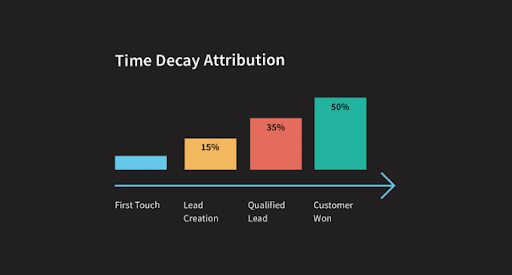
Time decay attribution modeling assigns more credit to touchpoints near the bottom of the funnel where customers convert, with earlier interactions receiving progressively less weight.
An example here could include a journey that begins with a click on an ad that gets 0% credit, followed by an email signup (15%), which leads to a click on an email link (35%), and ends with a direct search and product checkout (50%).
Best for: This model works best when launching campaigns that entail long decision-making processes or multiple touchpoints over time, e.g., campaigns that involve a lot of retargeting or ecommerce sales.
Limitations: This attribution model can undervalue top-of-funnel and brand awareness strategies, and it assumes recent interactions caused the sale when the buyer may have already made their decision earlier in the journey.
3. Position-based / U-shaped
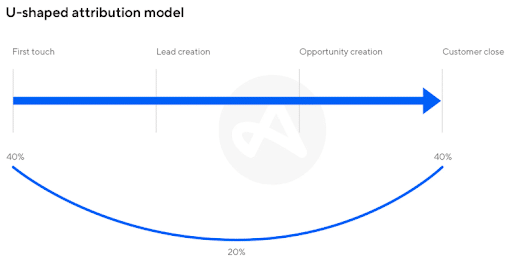
Known as the position-based or U-shaped model, this type of attribution gives the bulk of the credit to both the first and last touchpoints, distributing the rest throughout the middle of the journey.
Here, a U-shaped model might look something like:
- An initial paid search for a SaaS brand ad gets a click (40%).
- The person then follows the brand on social media (10%).
- The user signs up for a free product demo (10%).
- The customer pays for a full subscription (40%).
Best for: You’ll want to use this model if you have a user acquisition campaign that focuses more on building initial interest and leading to a final conversion, especially for products like software that depend heavily on the first ad and the final install.
Limitations: This model can be too rigid for some campaigns, as it follows a fixed 40-20-40 rule in which it assigns 40% of credit to the first and last interactions, distributing the remaining 20% across the middle regardless of how the journey actually unfolded. As a result, campaigns could overlook essential lead nurturing moments that fall between those points, especially on longer journeys where that 20% gets split across several touchpoints This model also depends on clearly identifying the true first and last interaction, which can be difficult if parts of the journey (such as offline touchpoints or cross-device activity) aren’t fully tracked.
4. W-shaped
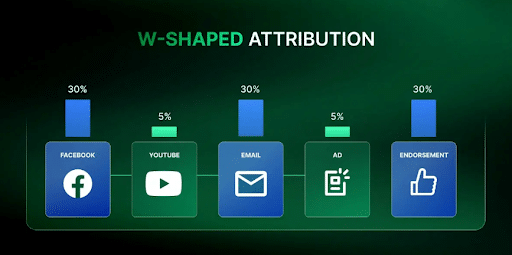
This model builds on the U-shaped approach by adding a third high-credit touchpoint: lead creation, the moment a prospect converts into a lead (e.g., filling out a form or requesting a demo). Rather than crediting just the first and last interactions, W-shaped attribution assigns equal weight to three milestones (first touch, lead creation and conversion), recognizing that all three play a critical role in the journey.
For example, a journey might start with a social media post view (30%), followed by an email signup that creates the lead (30%), and end with a purchase (30%), with any additional touchpoints in between splitting the remaining 10%.
Best for: This approach is suitable for businesses with long marketing-to-sales handoffs that need teams to track pipeline contribution over lead volume, often in B2B sales cycles. It also works for campaigns emphasizing the transition from marketing-qualified to sales-qualified leads, since lead creation is treated as its own distinct milestone rather than being folded into the middle.
Limitations: W-shaped attribution requires syncing data to your CRM to properly identify and track the lead-creation milestone across the pipeline, which is something leading multi-touch attribution platforms can help with. It also depends on clearly defining what counts as “lead creation” for your business, which can vary across teams. And like the U-shaped model, it can still oversimplify everything that happens between those three key milestones.
5. Data-driven / Algorithmic
Another option is the data-driven or algorithmic approach, which uses data collection and machine learning to assign credit to touchpoints based on their actual impact on conversions, rather than applying a fixed rule like the models above.
For example, through machine learning, leading multi-touch attribution platforms could develop a more nuanced journey that looks like:
- Discovery through a blog post (20%)
- Learning about a product via a case study (25%)
- Deeper product engagement with a webinar (20%)
- Click-through and purchase with a retargeting ad (35%)
Best for: You may want to implement this model if traditional rules-based systems oversimplify your business’s journey. This often applies to campaigns with long, complex sales cycles spanning weeks or months, or those with high enough conversion volume to properly train the algorithm. This model tends to work best for larger accounts or businesses with strong existing traffic, since the algorithm needs a steady volume of recent conversion data to generate reliable results. .
Limitations: Relying too heavily on complex machine learning could reduce transparency, and outputs become entirely dependent on clean, helpful data you feed into the algorithm. Also, while the best tools can help establish correlation, they can’t necessarily show causation from touchpoint to touchpoint.
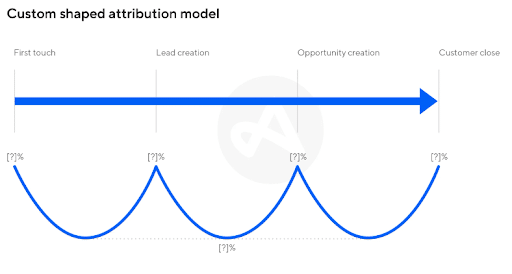
Keep in mind that fixed weights in any of these attribution models reflect assumptions and may not accurately determine the value of each touchpoint.
Also, linear, time decay, and position-based attribution models are no longer available in Google Analytics 4 (GA4) as of November 2023. As such, you will need to use other marketing attribution tools to measure the performance of these models.
How to Choose the Right Model for Your Business
To help you make the right choice for your campaigns, consider the following:
- The initial business question and desired conversion outcome. Are you trying to understand what drives awareness, what closes deals, or the full picture in between? This shapes which model fits your goals.
- Data quality and volume. Some models, like data-driven attribution, need a steady volume of clean conversion data to produce reliable results, while simpler models like linear or time-decay work with less
- Your unique sales cycle and CRM milestones. Longer, multi-stage sales cycles (especially in B2B) often benefit from models like W-shaped attribution that credit specific pipeline milestones, such as lead or opportunity creation.
- Explainability. Consider how easily you and your stakeholders need to understand why credit was assigned the way it was. Rules-based models are more transparent while algorithmic models can feel like a black box.
Consistent comparison. When testing multiple models, use the same lookback window and the same set of eligible touchpoints so you’re comparing results on equal footing rather than skewing outcomes based on setup differences.
What Data Do You Need to Make Attribution Useful?
You’ll need multiple key data points to help you get the most from attribution efforts, including:
- Campaign Tags / Click IDs: These elements help identify individual user interactions across channels.
- Timestamps: Keep track of precisely when each event occurred along the customer journey timeline.
- First-Party Identity Matching: First-party data that people consent to provide can help identify specific users without relying on third-party cookies.
- Conversion Definitions: Define exactly what counts as a conversion, which will give your campaigns a clear goal.
- CRM Relationships: Track each touchpoint’s connection to pipeline stages and revenue outcomes using tools like Salesforce or HubSpot.
- Revenue: Track revenue resulting from closed transactions.
Spend: Measure marketing and ad spend data to track return on ad spend (ROAS) and your customer acquisition cost (CAC). - Location IDs: Regional and location-based businesses need to add these components to connect digital campaigns to physical location interactions.
Keep your data clean by eliminating duplicates and unmatched outcomes, accounting for refunds, and flagging administrative events so they’re separated from genuine customer activity.
What Multi Touch Attribution Can and Cannot Tell You
While these models can tell you a lot about what’s driving or preventing conversions, they can’t tell you everything.
Here are some factors that your models might miss:
- Missing Interactions: While cross-channel attribution can track digital touchpoints with ease, it’s largely blind to offline, “dark social,” and other non-click actions without effective integrations.
- Cross-Device Gaps: These models can only track multi-device journeys if users create a centralized login or provide another key identifier across devices.
- Platform Silos: Certain platforms act as “walled gardens” that don’t share any user-level data outside of their own ecosystems, or CRMs might be isolated from other attribution tools, creating disconnects in your data.
- Model Bias: Your platforms will only assign credit based on the rules of the model you have in place, which may not reflect the reality of the entire journey.
- Correlation, Not Causation: Even the most sophisticated models can show which touchpoints correlate with conversions, but they can’t fully prove that those touchpoints actually caused the customer to convert. Outside factors like word-of-mouth, brand reputation, or timing may still play a role.
- Incrementality: Attribution shows you which touchpoints were present in the journey, but not whether that interaction actually influenced the outcome. A customer who saw a retargeting ad might have converted anyway, even without it.
Multi Touch Attribution vs. Marketing Mix Modeling
Here is how multi-touch is different from a marketing mix model.
| Factor | Multi-Touch Modeling | Marketing Mix Modeling |
| Measurement Level | User-level | Aggregate-level covering business trends and top-down statistical modeling |
| Data Requirements | User identities, timestamps, pipeline data, click IDs, and web event tags | Historical sales data, economic indicators, media channel spend, promotions, and seasonality |
| Granularity | Very high down to specific keywords, assets, and ad variants | Low to medium to the channel, region, or campaign level |
| Speed and Refresh Rate | Real-time or daily | Delayed, often run monthly or quarterly |
| Offline Coverage | Poor, blind to most offline interactions | Excellent, incorporating all offline media and in-store experiences |
| Primary Use Cases | Intra-channel keyword bidding, real-time campaign optimization, and ad creative tuning | Strategic board-level budget allocation, ROI forecasting, and media mix optimization |
| Core Limitations | Privacy regulations, platform silos, offline blindspots, and model bias | Needs deep historical data and doesn’t allow for real-time creative optimization |
Both of these models can work with each other despite their differences. While multi-touch approaches might help with micro-level tracking, your marketing mix model can help illustrate the bigger picture.
Turn Attribution Insights Into Revenue and Budget Decisions
With your model and tools in place, you can take those insights and turn them into actions to boost revenue.
Connect attribution credit all the way through to qualified leads, customers, and revenue – not just conversions This means accounting for sales lag (the time between a lead and a closed deal), margins (since not all revenue is equally profitable), and market differences (since a touchpoint’s value can vary by region or segment).
Turning these insights into action requires the right infrastructure to connect the dots. This is exactly where a platform like our proprietary RevIntel platform comes in, making it easy to optimize your paid media campaigns for revenue.
The right software can be helpful if you need to transition from GA4 and other limited platforms to more capable multi-touch solutions, especially if you work with complex sales cycles, multi-stake buying committees, or heavy programmatic and paid spend.
Some key capabilities to look for include:
- Identity resolution and stitching – connecting a single customer’s activity across devices and sessions
- CRM and pipeline milestone mapping – linking touchpoints to lead, opportunity, and revenue stages
- Dynamic model comparisons and custom modeling – testing multiple attribution approaches side by side
- Automated cost data collection and budget simulation – forecasting how budget shifts could affect results
- Data feeds and ad network feedback loops – feeding attribution insights back into platforms to improve optimization
With the right model, data, and platform working together, you can move beyond last-click guesswork and start making budget decisions based on where your revenue is actually coming from.
Multi Touch Attribution FAQs
1. What’s the difference between single-touch and multi-touch attribution?
While single-touch attribution assigns 100% of conversion credit to a single event in the buyer’s journey, its multi-touch counterpart distributes credit across multiple touchpoints based on their influence on a buying decision.
2. Which multi-touch attribution model is best for my business?
The specific type of multi-touch model you use for your campaigns will depend on factors like your industry and offerings and the overall complexity of your sales cycle. The different types of models include linear, time-decay, U-shaped, W-shaped, and algorithmic, each of which can help track the most effective interactions and exposure points.
3. What data do you need for multi-touch attribution?
You need different types of data to effectively assign credit in your multi-touch model, including:
- UTM tracking parameters for each touchpoint
- Timestamps marking when people reach each touchpoint
- Identity matching strings
- Milestone definitions
- Pipeline status
- Revenue and spend
- Location IDs
4. Does Google Analytics 4 support multi-touch attribution?
Yes, but with real limitations . GA4 uses a native “Data-Driven Attribution” model with machine learning to assign credit to various channels across web and app activity. However, it doesn’t automatically capture offline conversions or full cross-device journeys. Offline data requires custom import and cross-device accuracy depends on users being logged into Google. It also won’t reflect activity happening entirely outside Google’s ecosystem, such as on other ad platforms.
5. Can multi-touch attribution track phone calls and offline sales?
Yes, but you will only be able to do so with specialized software integrations, such as dynamic number insertion (DNI) software for tracking phone calls, or trackable landing pages and QR codes for tying offline materials like direct mail back to digital data
6. How does multi-touch attribution differ from marketing mix modeling?
Multi-touch models work by tracking granular user-level data, including click paths, cookies, and digital IDs to help optimize keyword bidding and creative assets in real time, while marketing mix modeling looks at high-level campaign data to analyze historical data on a weekly or monthly basis.
Make Full Use of Multi-Touch Attribution With Ignite Visibility
With multi-touch attribution, you can find out what kind of journey people take to convert with in-depth data and effective channel tracking.
To get the most from your attribution efforts, our team at Ignite Visibility can help you build and execute a strategy that connects every touchpoint to revenue.
Our team will be able to assist with:
- Setting up tracking data to monitor every touchpoint
- Selecting the right model based on your business and sales cycle
- Integrating CRMs and other solutions into a holistic system
- Continually measuring results for improved performance
- And more!
For more information about how we can help you with attribution to boost conversions and revenue, check out our paid media services today.