Bringing in new customers is like fishing with a really good lure, you need the right bait and the perfect cast. That’s where lifecycle marketing comes in. Lifecycle marketing encompasses five key phases: awareness, acquisition, activation, retention, and loyalty.
Looking forward to 2026 and beyond, effective customer acquisition is more important than ever as consumer behaviors change and the digital landscape continues to evolve. From the development of AI search solutions to the need for more personalization across marketing channels, there are some tactics that will work better than others today when attracting high-value customers.
In this article, Chief Client Officer, Jeff MacGurn, will break down the art and science of customer acquisition, landing those first-time buyers.
What You’ll Learn
- What is the Acquisition Phase?
- Key Strategies for Effective Customer Acquisition
- Measure Your Progress: Keep Score and Improve Your Game
- Challenges in Customer Acquisition
- Tools and Technologies
- Case Studies
- FAQs
My Expert Insight on Building a Winning Customer Acquisition Strategy
Landing new customers isn’t just about luck; it’s about creating a fool-proof customer acquisition strategy. It starts with understanding who you’re trying to reach and giving them what they want. What makes them tick? What are the problems they are trying to solve? Once you have a good handle on that, you can craft content that truly speaks to them.
Remember, building trust is everything. Show your audience you care about their needs, and they’ll be more likely to become loyal customers.
What is the Acquisition Phase?
The acquisition phase is like the front door of your business. It’s where you make that all-important first impression and invite potential customers inside. This is the stage where you introduce your brand to a new audience and convince them to become customers.
To measure how much you’re spending to bring in each new customer, you can use the customer acquisition cost formula, or CAC. It’s pretty simple:
CAC = Total cost of acquiring new customers / Total number of new customers acquired
For example, if you spent $10,000 on marketing and gained 500 new customers, your CAC would be $20 per customer.
The customer acquisition phase fits into the broader customer lifecycle like the first domino in a row. It’s where the customer journey begins. After you’ve caught their attention, you move on to activating them as customers, then retaining their business, and finally, building loyalty. It’s a continuous cycle, but without strong acquisition, the rest of the process crumbles.

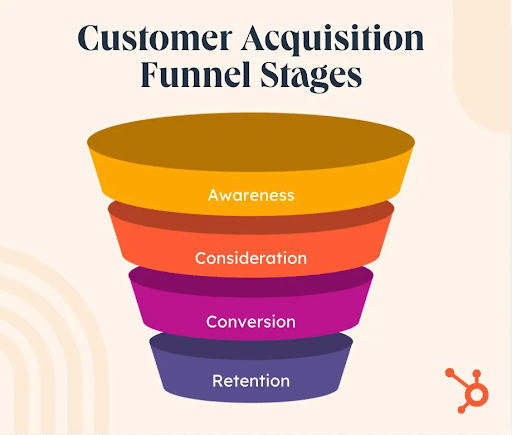
Client acquisition ultimately encompasses a funnel that brings people from the top of the funnel to the bottom via the following stages:
- Awareness: Here, customers first learn about your brand and offerings to kick off their journey.
- Consideration: Moving down to the next level, prospects conduct more research into your company and products or services to determine if you’re a good fit, comparing you to other options on the market.
- Conversion: Once you’ve convinced your audience to turn into customers, they will convert with a sale. The length of time this stage requires will largely depend on your industry, as companies like ecommerce businesses will have an easier time making a sale than B2B lead generation strategies that are more involved.
- Retention: Finally, customer retention is the end goal as you work to keep people coming back to you over competitors for repeat business. Discounts, exclusive offers, personalized product recommendations, and other tactics could maximize retention.
Importance of Customer Acquisition
The ultimate goal of the acquisition phase is to turn potential customers into paying customers. It’s about growing your customer base and laying the foundation for future revenue. If you don’t have new customers coming in, your business will eventually hit a wall. That’s why understanding and mastering the acquisition phase is so crucial. It’s the lifeblood of any business.
Think of it like building a house. You need a strong foundation before you can add walls, a roof, and interior design. In this case, your foundation is acquiring new customers. Without it, the rest of your marketing efforts won’t be as effective.
Keep in mind that customer acquisition also comes with much higher costs than retention, with acquisition costs being up to five times higher than retaining existing customers. This illustrates the need to connect with high-intent, high-value customers who are most likely to remain loyal and maximize profitability.
There are plenty of businesses out there that have managed to effectively target their audiences with the right customer acquisition tactics.
For example, Sephora’s Beauty Insider loyalty program encourages new customers to join to gain access to some of the best deals available on all kinds of beauty products, with reports finding that the program is responsible for around 80% of sales.
Meanwhile, eyewear retailer Warby Parker offers a unique try-before-buying customer acquisition model that enables new customers to get a feel for its products, along with personalized recommendations based on answers to a style quiz. These and other customer acquisition strategies have helped the company increase its active customers by 9% within a 12-month period and average revenue per customer by 4.6% year over year.
Key Strategies for Effective Customer Acquisition
Landing new customers is a mix of art and science. Let’s dive into some popular strategies to help you grow your customer base.
SEM/Paid Search
SEM, or Search Engine Marketing, is basically paying to show up higher in search results. It’s like buying a prime spot on a busy street for your business. The big benefit? You can reach people actively looking for what you offer.
If you’ve got a decent budget, paid search is a great way to quickly get in front of potential customers. But even if your wallet isn’t bursting, it can still work. Focus on super targeted keywords and create ads that really stand out.
For businesses with a unique product or service, paid search can be a game-changer. You can showcase your special sauce to people who might not find you otherwise.
To make the most of your paid search campaigns, focus on clear and compelling ad copy, strong landing pages, and ongoing optimization. Keep an eye on your keywords, bids, and ad extensions to maximize your return on investment.
Paid Social
Paid social advertising is like hosting a targeted party on platforms like Facebook, Instagram, or TikTok. Unlike organic posts, you pay to get your content in front of specific people. The key is knowing your audience inside and out. Who are you trying to reach? What do they like? What keeps them up at night?
Successful paid social campaigns often involve a mix of stunning visuals, compelling copy, and a strong call to action. For example, a fashion brand might use Instagram to target young professionals interested in sustainable fashion with visually appealing ads featuring their eco-friendly clothing.

Email & SMS Marketing
Email and SMS marketing are like having a direct line to your customers. It’s a personal touch in a digital world. The trick is to keep it interesting and relevant. Nobody likes spam, so make sure your messages are valuable and engaging.
Personalization is key. Use people’s names, reference their past purchases, or offer tailored recommendations. Automation is also critical, helping you send the right message at the right time.
For businesses with a range of products, email and SMS are perfect for cross-selling and upselling. You can also use them to announce new product launches and exclusive offers to your existing customers.
AI-Driven Personalization
The use of AI in marketing is expanding in many ways, from simplifying content creation to enabling more effective personalization in emails, ads, and other types of marketing materials.
AI can glean insights into your audience’s preferences and behaviors to tailor messaging and visuals to speak to each segment, with dynamic content helping to optimize every piece of content.
For instance, AI could help personalize email pieces to connect with each audience segment using the right language and offers, with machine learning helping figure out what works and what doesn’t to further hone your strategies.
Recent data has found that AI personalization is capable of boosting revenue by as much as 40% over impersonal, generic marketing efforts. At the same time, businesses can cut down on customer acquisition costs by up to 50% with these solutions.
Omnichannel Marketing
Connecting with your audiences at every touchpoint is essential in moving them from the top of the funnel to the bottom.
With the help of omnichannel campaigns, you can figure out where your audiences are and regularly engage them on each relevant platform. As you map the customer journey, you can identify the specific locations where your audiences spend their time both online and offline.
In turn, you can develop a supercharged campaign that takes advantage of all critical channels, such as:
- Social media
- Advertising
- SMS text messaging
- Websites and apps
- Chatbots
- Print ads
- Streaming ads
- TV commercials
In the process, you’ll be able to eliminate any bottlenecks to maximize efficiency and profitability across the journey.
The latest stats show that omnichannel strategies can increase customer retention by up to 89% while reducing their cost per contact by as much as 7.5% year over year.
Influencer Collaborations
A growing number of audiences on social media channels are following influencers they trust to give them product and service recommendations, making influencer marketing a great option when looking to stand out and attract more customers.
Building relationships with influencers can connect you with audiences who might otherwise fail to establish a strong connection with your brand on other channels, and you can benefit from user-generated content that enhances your marketing efforts.
For instance, a micro-influencer with a loyal following on YouTube could create an unboxing video of one of your products, showing how it works and giving a review, with a promotional link directly to your site in the video description or even the video itself, which can build more trust among new audiences and lead to more conversions and sales.
If you’re not taking advantage of influencer marketing, you’re losing out on a crucial opportunity, with 86% of U.S. marketers expected to partner with influencers in 2025.
Remember, building a loyal customer base is a marathon, not a sprint. By combining these strategies and continuously testing and refining your approach, you’ll be well on your way to growing your business.
Affiliate Marketing: Your Secret Sales Army
Affiliate marketing is like hiring a bunch of enthusiastic fans to sell your stuff. You find people who love your product and give them a special code or link. Every time someone buys using their code, they get a cut. It’s a win-win, right?
Setting up an affiliate program isn’t rocket science, but it does take some planning. You need to make it clear what’s in it for your affiliates, give them the tools they need to succeed, and find a way to track everything.
The biggest perk of affiliate marketing is that you only pay when someone actually buys. Plus, it can turn your fans into loyal promoters. But, it’s not all sunshine and rainbows. Managing a bunch of people can be a headache, and you need to keep a close eye on things to make sure everything’s on the up-and-up.
CRO and Landing Pages
Conversion Rate Optimization (CRO) is all about turning website visitors into paying customers. It’s like perfecting your sales pitch to get more people to hit that “buy now” button.
Your website is your digital storefront, so make sure it looks good and is easy to navigate. People are impatient, so don’t make them hunt for what they want.
Landing pages are like mini-websites focused on one goal. They should be clear, catchy, and convince people to take the next step. A strong headline, a beautiful picture, and a big, shiny button are your best friends.
To make your landing pages work their magic, put yourself in your customer’s shoes. What do they want to know? What will make them click? Test different things—headlines, images, button colors—and see what gets the best results.
Remember, there’s always room for improvement. Keep tweaking and testing to get the most out of your CRO efforts.
Measure Your Progress: Keep Score and Improve Your Game
Okay, so you’ve got your fishing rods out and you’re casting your line, but how do you know if you’re catching any fish? That’s where tracking your progress comes in. You need to keep an eye on some key numbers to see what’s working and what’s not.
Two big ones to watch are your conversion rate, that’s how many people who see your stuff actually become customers, and your cost per acquisition (CPA), which tells you how much you’re spending to get each new customer. It’s like calculating the cost of each fish you catch.
Here are some other critical metrics to measure the effectiveness of your customer acquisition marketing strategy:
- Customer Acquisition Cost (CAC): This metric tracks the total overall cost of acquiring each customer. You can measure this metric using the following formula: Marketing Cost / Number of Customers = CAC. For instance, a company might spend $20,000 on a marketing campaign, which generates 500 new customers. Dividing $20,000 by 500 would equal a CAC of $40 per customer.
- Customer Lifetime Value (LTV): Refers to the overall value of a customer in their relationship with a brand. Here’s the formula for this metric: Customer Contribution Margin (m) X Customer Lifetime (T) = LTV. The Customer Contribution Margin refers to the revenue that the average customer generates with the annual cost of providing a service or product subtracted, while Customer Lifetime represents the average number of years a customer remains a loyal customer. An example here could include a company with a total contribution margin of $200 with an average customer subscription lasting two years. $200 X two years would mean the LTV is $400.
In addition to measuring each of these separately, you should measure the LTV/CAC ratio to determine the total value that customers bring vs. the cost of acquiring one, which is critical in gauging profitability.
To get your LTV/CAC, you would simply divide your LTV by your CAC. Using the above examples, let’s calculate the LTV of $400 by the $40 CAC, which would lead to a ratio of 10, meaning that the overall value of a retained customer is 10 times the cost of acquiring a new customer.
Now, here’s the fun part: A/B testing. Imagine you have two different fishing lures. You try one out for a while, then switch to the other. Whichever one catches more fish is the winner! That’s basically A/B testing. You’re constantly experimenting to see what works best.
To help you keep track of all this, there are some pretty cool tools out there. Google Analytics is a classic, but there are also specialized marketing platforms that can help you dive deep into your data.
Remember, it’s not just about the numbers. Use your data to tell a story. What’s working? What’s not? Where should you focus your energy next? Keep experimenting, keep learning, and keep improving your fishing game.
Challenges in Customer Acquisition
As you put together your strategy, there are some potential challenges that might come along, including:
- Market Saturation: One common problem that many businesses face is market saturation, as they need to stand apart from many competitors with the same offerings. To resolve this issue, find ways to differentiate your brand, whether you can market around specific pain points that your competitors are ignoring or highlight features unique to your products or services. You can also get creative with your marketing to make your brand stick out with ads and other marketing content.
- Ad Fatigue: People are becoming increasingly inundated with ads, leading potentially to a degree of ad fatigue as more and more brands become nothing but background noise. One solution here is to implement user-generated content (UGC) in your ads that make your campaigns more personable and real to audiences.
- Data Privacy Concerns: People are also growing increasingly concerned with how companies use their data, making them reluctant to do business with brands that don’t clearly establish data usage and respect users’ privacy. To alleviate these concerns, consider putting your privacy policy front and center, and request people’s permission to use their data, including third-party cookies, as they navigate your site.
Tools and Technologies
To help you put together your customer acquisition marketing strategy, there are plenty of tools out there you can add to your roster.
For example, you could use Contentsquare to gain more insights into how users navigate your site, mapping out funnels to determine precisely where people bounce and neglect to convert into customers.
Meanwhile, Google Analytics can help with tracking metrics, including website analytics like traffic and traffic sources, which can further help determine whether your efforts are driving engagement and conversions.
HubSpot is another effective tool you can use to develop and manage your entire sales funnel, with automations and user behavior tracking to help you streamline the customer journey from beginning to end.
As you look for the right solutions to assist with client acquisition, you can check out review sites like G2 to see what people are saying about the latest software and platforms.
Case Studies
To give you a good idea of what you can achieve with a strong customer acquisition strategy, let’s take a look at some successful case studies of effective campaigns that got real results.
Lululemon: Community Events
One way to increase awareness and appeal to new customers is to connect with audiences through events in their communities. For instance, Lululemon is always putting on events across the country to engage new customers, spreading awareness for its brand while also integrating into the cities where its customers live.
Lululemon, in keeping with the theme of its athletic brand, promotes its athletic wear while supporting women athletes and hosting various runs, yoga events, and other types of events that encourage an active lifestyle.
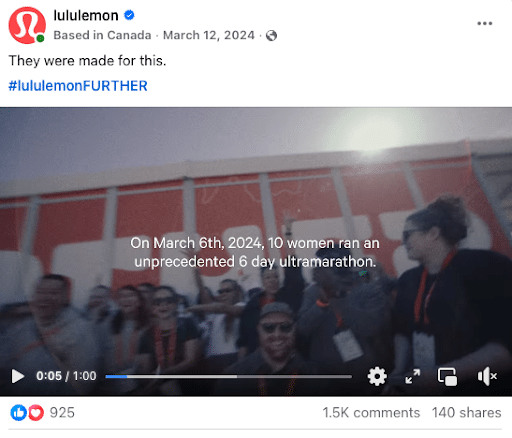
Lululemon’s client acquisition efforts contributed to a 10% year-over-year increase in revenue from 2024 to 2025, reaching around $10.6 billion.
By hosting or participating in community events, you can also build relationships with more valuable audiences.
Airbnb: Omnichannel Marketing Via Craigslist
When starting out in 2008, Airbnb began as a struggling startup like any other, trying to get its brand out there where its audience was.
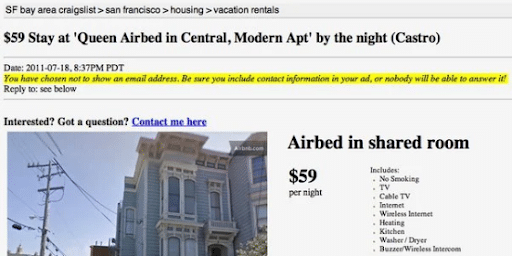
One of the key strategies the company implemented was omnichannel marketing, namely targeting Craigslist, one of the company’s largest competitors at the time as many users utilized the platform for advertising short-term rentals.
To do so, the company automated Craigslist form fills to make it easy for Airbnb hosts to cross-post listings on Craigslist, which drew more traffic to the Airbnb site through Craigslist listings.
Once they clicked through to the Airbnb site, visitors could learn more about the benefits of Airbnb. In turn, Airbnb benefited from significantly more exposure and awareness while holding its own against Craigslist and other top competitors.
Over the years since, the company has also worked to engage new customers in various ways, including an I’m Flexible search feature that’s ideal for people with more flexible travel schedules, along with its premium service, Airbnb Luxe, which gives customers access to more premium services and luxury rentals.
Blue Apron: Personalized Email Marketing
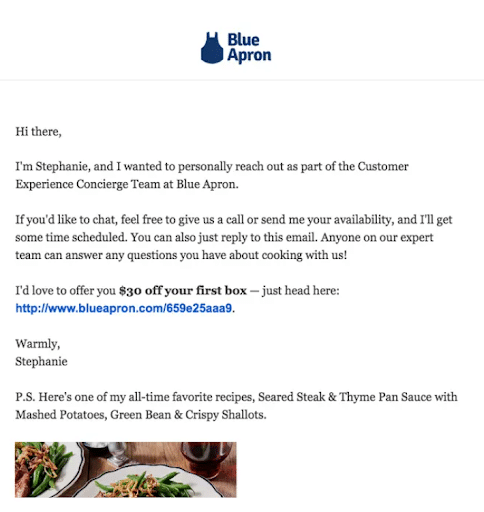
AI and personalization can help deliver more direct messages to target audiences. Meal delivery service Blue Apron recognized the value of personalized email in connecting with new customers and driving more conversions, given that people have a clear preference for their food.
Using the platform Amplitude, Blue Apron developed highly targeted email campaigns with a deep understanding of user preferences and behaviors, encouraging more people to try the subscription service based on their unique tastes.
As a result of the company’s personalization efforts, segmentation alone led to a 5.5% increase in conversions on the company’s recipe pages, and Blue Apron on the whole saw a 7% boost in conversions.
FAQs
1. Why is customer acquisition important?
A strong customer acquisition marketing strategy is critical for attracting target audiences and turning them into long-term customers. Without these tactics, you’ll struggle to establish a connection with your audiences and move people down the sales funnel.
2. How does customer acquisition differ from customer retention?
While the ultimate goal is to retain customers long after conversion, customer acquisition applies to reeling in high-value customers, specifically the ones who are more likely to stay loyal and make repeat purchases. A good customer acquisition strategy will lead to increased overall retention.
3. How do you calculate Customer Acquisition Cost (CAC)?
You can calculate this metric using the following formula: Total Marketing Cost / Number of Customers Acquired = CAC.
4. What are effective customer acquisition strategies in 2026?
In today’s marketing environment, there are multiple customer acquisition tactics that are particularly effective, including AI-driven personalization, influencer marketing, and omnichannel campaigns that take advantage of all relevant channels where your customers spend their time.
Turn Insights into Action with Ignite Visibility
Mastering customer acquisition is the first step to building a thriving business. By understanding your target audience, crafting compelling campaigns, and measuring your results, you can significantly boost your customer base.
Ignite Visibility can help you streamline this process and achieve your business goals. Whether you’re looking to attract new customers, enhance your brand reputation, or increase your ROI, we’ve got you covered. Our experts can help you:
- Monitor and manage your online reputation
- Attract and retain customers through effective marketing
- Leverage the power of social media
Ready to take your customer acquisition approach to the next level? Contact us today!