

Most informational searches today are “zero-click” because of developments like AI Overviews (AIOs) and AI Mode, along with the development of other generative engines. In fact, close to 100% of keywords that trigger Overviews alone are informational, making it important to reach people at the top of the funnel with good AI SEO practices.
In this blog, Karen Devlin, VP of AI-SEO, will review the differences between AI search tactics, including SEO to gain traffic, generative engine optimization (GEO) via citations, and answer engine optimization (AEO) using direct answers, detailing how to improve brand visibility in AI search engines.
What’s Covered:
- What Is AI Visibility?
- Why Should I Track AI Brand Visibility?
- AI Visibility vs. Traditional SEO: Key Differences
- How AI Engines Choose You (And Why SEO Alone Isn’t Enough)
- Proven Strategies to Improve Brand Visibility in AI Search
- Measuring Success: The New KPIs
- Common Mistakes Brands Make
- The Future of AI Search and Brand Visibility
- AI Visibility FAQs
Expert Opinion on AI Visibility
In today’s SEO industry, we’re seeing an increasing prevalence of AI-powered search results, which are dominating search engine results pages (SERPs) at the top of the page, often culminating in little to no clicks.
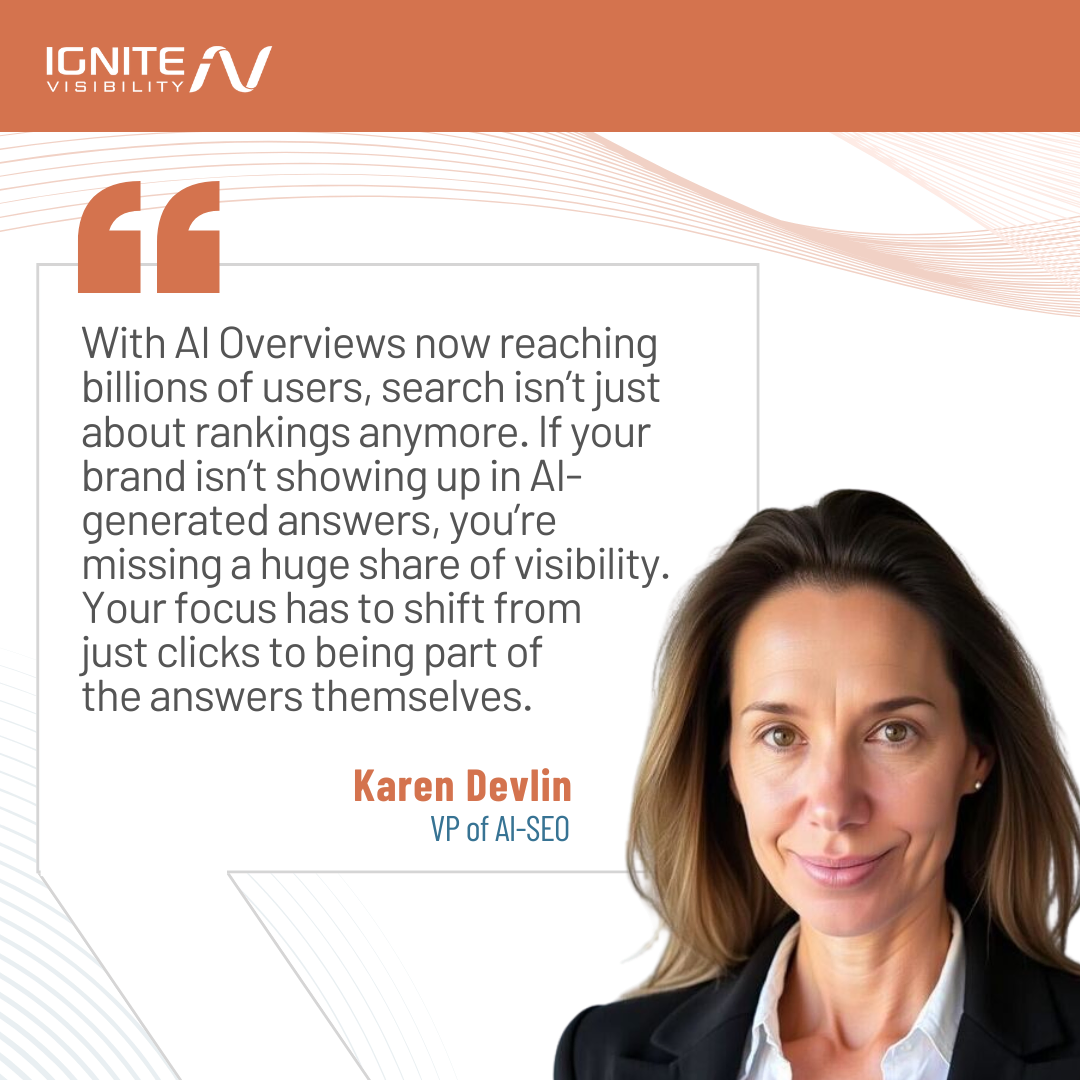
Consider the fact that Google’s AI Overviews alone reach about two billion monthly Google users, and 60% of searches today yield zero clicks. And while these types of results have historically suffered from some inaccuracies due to AI hallucinations, they are becoming increasingly reliable and trusted among users.
The popularity of AI search results is making it increasingly crucial to know how to improve brand visibility in AI searches, learn how to track brand mentions in AI search, and use the best AI visibility platforms.
Here, we’ll review what strategies improve brand visibility in AI search engines, how to track brand mentions in AI search results, and which AI visibility tool to use for keeping track of your brand’s performance.
What Is AI Visibility?
AI visibility is a kind of metric that can keep track of how often AI-driven search engines cite, summarize, or recommend your brand or content to users.
Keep in mind that, unlike with conventional SEO, AI search engines don’t rank pages. Instead, they receive content and synthesize answers based on the most relevant sources to align with users’ search queries, including their specific search intent.
Try to look at visibility here as a kind of inclusion, not simply ranking. You want engines like Google and ChatGPT to choose your content over competitors’ as the most relevant and helpful.

Why Should I Track AI Brand Visibility?
You should use the best AI visibility tracker available to help you monitor brand visibility based on mentions and citations, which will help you identify the best techniques for boosting visibility in AI search algorithms.
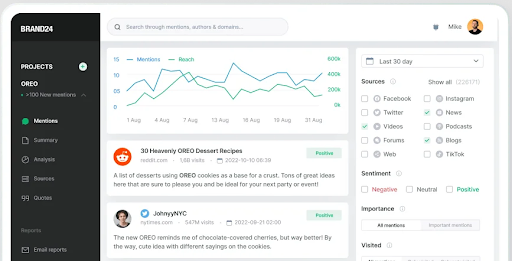
Is it possible to track brand mentions in AI search? Absolutely. In fact, using the right AI brand visibility tracking solutions, you can easily see how often your brand appears and the sentiment behind those mentions.
AI Visibility vs. Traditional SEO: Key Differences
There are several differences to keep in mind when implementing traditional and AI SEO. Let’s take a closer look at each:
- SEO: These strategies are all about achieving top rankings, picking the right keywords and placing them within your content, gathering plenty of high-quality backlinks, and boosting traffic from SERPs.
- AI Visibility: This approach entails maximizing inclusion in answers to people’s questions for generative engines, matching content with intent and providing context, building mentions and authority, and gaining citations and authority to encourage AI platforms to get you seen.
The Mechanics of AI Selection: How AI Engines Choose You (And Why SEO Alone Isn’t Enough)
Although good SEO can help you appear in AI search results, there is a lot more to maximizing AI visibility.
The following are some specific components that influence how AI engines select content, going beyond basic SEO:
Semantic Proximity
Large language models (LLMs) use an element called vector distance to find content that matches a user’s intent when conducting a search.
Specifically, LLMs convert words, sentences, or entire documents into vectors comprising lists of numbers, linking similar items together to determine intent, such as connecting “dog” and “puppy” vs. “dog” and “office.”
The Power of Co-Citation
Building brand authority through third-party mentions is now just as valuable as backlinks to your content. Try to get positive brand mentions on platforms like Reddit, Wikipedia, and industry forums, which will increase your chances of staying visible in AI search results.

Topical Depth vs. Keyword Volume
Traditional SEO has relied a lot on targeting broader topical keywords like “How to do X,” but AI SEO tends to involve more nuanced targeting, e.g., “how to do X in [specific industry]” and other intent-driven long-tail searches.
Ultimately, topical authority is essential here, as you want to cover core topics and related subtopics with greater depth than competitors to maximize visibility. For example, you might develop a pillar page that covers a base topic while briefly covering subtopics, with “spoke” pages branching from that “hub” to explore each subtopic from there. These pages can then link to each other to improve link equity, which can also improve the likelihood of AI citations.
The Core Ranking Factors for AI Visibility
Let’s go over some effective techniques for boosting visibility in AI search algorithms:
The Answer Nugget
One of the best ways to get your content seen in AI search results is to include an “answer nugget” at the top of your pages. This strategy would involve writing mini-FAQs or “Quick Answers” above the fold, which could summarize page content.
For instance, before getting into how to find a financial advisor, a blog post covering this topic might include a bulleted list of “key takeaways,” like “When choosing a financial advisor, consider your specific values and personal requirements,” and “Look for fiduciary financial advisors instead of simply credentials as your starting point.”
These answers should be short and succinct, being no longer than 40 to 80 words.
Data-Driven Authority
Original research and “proprietary metrics” are among the primary triggers for AI citations, as algorithms tend to look for the most authoritative sources that aren’t doing what all of their competitors are when it comes to answering questions or providing information and stats.
Take the time to put together original reports, testimonials, case studies, and other content that can help you stand apart from others in your industry.
Human-First E-E-A-T
“AI slop” filters want content that appeals to guidelines like Google E-E-A-T (Experience, Expertise, Authority, Trustworthiness) to prioritize content that’s truly helpful to users.
You can optimize for E-E-A-T by writing people-centric content with first-person experiences and verified author bios that put a specific face behind your content, demonstrating certifiable authority in your industry.
Freshness and Updates
Also, keep in mind that AI citations drop as content ages and becomes less relevant. Give your content a fighting chance at staying on top by making updates as needed, such as incorporating new subtopics or statistics into existing blog posts.
Proven Strategies to Improve Brand Visibility in AI Search
To get the best results with your AI SEO efforts, it’s crucial to know what strategies improve brand visibility in AI search engines.
You can take the following approaches to keep your brand in the loop:
- Create “AI-Extractable” Content: Short and helpful answer boxes, bullet lists, subheaders with brief content, and other similar content will make it easier to show up for AI searches.
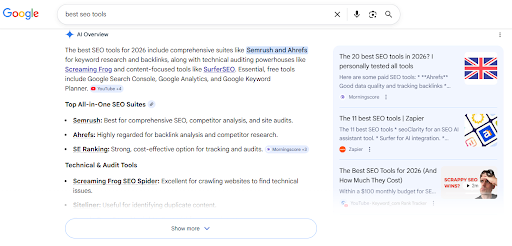
- Reverse-Engineer AI Answers: Before answering a question for a target query, enter that query into an AI search engine yourself and see which kinds of answers appear, which can instruct your content strategy.
- Get Featured on Trusted Third-Party Sites: Acquire brand mentions on trusted sites in your industry, whether they’re within Reddit threads, Quora answers, guest posts on industry blogs, or other sources beyond your site.
- Build Entity-Level Authority: Instead of keywords, use entity-based SEO strategies to target specific entities (concepts, things, places, etc.) and their relationships with each other, which is what AI algorithms look for when determining which content matches a query’s intent.
- Optimize for Conversational Queries: Be sure to optimize for voice search and target more conversational phrases that people are likely to search using smartphones, virtual assistants, and other platforms outside of conventional search.
Building a Digital Footprint
Boosting AI visibility happens off-page as much as it does on-page, as the more your brand reaches across the web, the more reputable you will look in the “eyes” of AI search engines.
To expand your digital footprint, focus on co-occurrences by getting brand mentions in the same paragraph as top-tier competitors, including mentions on authoritative sites like Reddit and G2. This strategy works by appealing to AI models’ ability to learn brand relationships via “proximity,” as your brand being mentioned beside a top competitor will make AI algorithms perceive you as an industry leader in certain contexts.
Technical Infrastructure for AI Agents
Using the right AI visibility platform, you can optimize for AI crawlers with the following strategies:
The llms.txt File
Similar to a robots.txt file, an llms.txt file sits in a site’s root directory to help AI agents find and understand content. Including this file in your site’s code can help maximize accuracy, reduce the risk of hallucinations, and optimize token usage to get the most from AI search.
Advanced Schema
Go beyond article schema with your structured data. Use a variety of schema markups, including Product, FAQ, and Organization JSON-LD formats to feed the Knowledge Graph, which can subsequently give search engines more context and help you gain more inclusions in AI results.
Optimized Performance
In appealing to Google’s Core Web Vitals, you’ll want to develop fast-loading content that’s user-friendly.
Load times must be less than 2.5 seconds, something that is non-negotiable for AI “query fan-out” indexing in addition to traditional indexing.
Optimized images and well-structured content will help shorten load times and optimize other Core Web Vitals metrics.
Measuring Success: The New KPIs
With the help of the best AI visibility trackers, you can measure the success of your efforts with these key performance indicators (KPIs) and metrics:
- Share of AI Voice (SOAV): This metric measures mentions across ChatGPT, Perplexity, and Gemini to determine your prominence compared to competitors.
- Citation Velocity: Use this KPI to track how often AI responses link to your URLs as “Sources.”
- Sentiment Benchmarking: Measures how AI describes your brand compared to top competitors based on the number of “positive,” “negative,” or “neutral” brand mentions.
An AI brand visibility tracker like Brand24 can provide you with these insights, combined with platforms like Google Analytics.
Common Mistakes Brands Make
Here are some critical mistakes to avoid with AI brand visibility tracking and optimization efforts:
- Treating AI SEO Like SEO: One big error that marketers make is focusing too heavily on keyword- and link-based SEO and not enough on AI SEO, which involves developing content that attempts to appear for short answers with more intent-based optimization.
- Ignoring Third-Party Mentions: It’s also important for brands to get mentions on third-party platforms, from social media channels to forums like Reddit and other sites that could increase the chance of AI citations.
- Writing Fluff Instead of Clear Answers: The answers to various questions should be short and to the point; remember, AI SEO isn’t about writing a lot of content as much as it is about helpful and relevant content.
- Not Updating Content: Neglecting to curate existing content could make your content increasingly irrelevant, making it crucial to update your content as needed to maintain relevance and competitiveness, such as updating blog posts with recent stats and other information.
The Future of AI Search and Brand Visibility
AI search continues to evolve, shifting from “finding links” to “explaining answers,” as people look for information in a convenient and organized summary as opposed to sites to visit.
Ultimately, zero-click dominance will continue to increase, as people can find all of the information they need within AI Overviews and other generative answers, often without any need for external exploration.
Additionally, AI is likely to grow and remain as the “first touchpoint” for users because of its prominence and convenience, even replacing other SERP features like rich snippets.
Also, with AI likely to synthesize brand-related answers based on that brand’s reputation among users, brand narrative control matters more than ever. Online reputation management will contribute considerably to your brand sentiment, while developing high-quality content telling your brand’s story will be just as important.
FAQs
1. What is AI visibility in search engines?
AI visibility refers to brands’ ability to show up for AI-generated search features on platforms like Google, ChatGPT, and other generative engines.
2. How do AI search engines choose sources?
AI search engines, including Google AI Overviews and AI Mode, choose sources based on factors like credibility, authority, and relevance, often based on Google’s E-E-A-T guidelines for content that demonstrates Experience, Expertise, Authority, and Trustworthiness.
3. How can I get my brand mentioned in ChatGPT?
If you want to know what strategies improve brand visibility in AI search engines like ChatGPT, the key is to develop high-quality, relevant, up-to-date, and helpful content that boosts your brand authority across the web, along with citations from other reputable sites in your industry.
4. What content performs best in AI search?
If you want to know how to improve brand visibility in AI search engines, you can do so by developing structured, informational, concise, and helpful content that answers people’s questions directly, often through lists, FAQs, and other scannable content formats.
Learn How to Improve AI Visibility With Ignite Visibility
Knowing the techniques for boosting visibility in AI search algorithms can help you maximize visibility on these platforms, but it helps to work with experts who understand how AI SEO is evolving and can get the best results.
With the help of our team here at Ignite Visibility, you’ll have the chance to:
- Develop a comprehensive SEO strategy that implements GEO tactics
- Implement the best AI search visibility tracking tools
- Discover how to track brand mentions in AI search to monitor performance
- Continually monitor campaign KPIs based on your goals
- Optimize accordingly for even better performance over time
Contact us today to schedule a free proposal, and find out what we can do for your brand with a solid AI SEO strategy.

