Brands post millions of videos to social profiles every day. It’s become a vital component in content for socials, helping them explain ideas, promote products, and have conversations. A critical metric for the success of these videos is watch time.
Watch time simply means the total minutes users spend viewing your videos. When it’s high, platforms treat your content as relevant and high-quality, which can impact how it shows up in feeds and algorithms.
There are many factors that go into this social media success metric. Every platform is unique. In this post, Katya Manoukian, Social Media Manager, will be breaking down why it matters, how each social site defines it, its impact, setting realistic goals, and more!
What’s Covered:
- Why Watch Time Matters (The Big Picture)
- How Platforms Define and Measure Watch Time
- Watch Time vs. Other Video Metrics
- How Watch Time Affects Discovery, Ranking, and Ad Performance
- Benchmarks and How to Set Realistic Watch Time Goals
- 10 Tactical Ways to Improve Watch Time
My Expert Insight on Watch Time
Social media videos have become an absolute must for your content creation. No matter your brand or industry, you can create videos across many topics. What’s so crucial about measuring watch time is that it literally equals attention!
Determining what to produce and ensuring it’s meaningful to your audience can set you up for greater engagement. However, there are lots of factors that determine if people see it and watch it through. That’s why watch time is such an essential metric. Measuring video performance metrics like watch time is well worth it. It can deliver a lot of helpful insights about why one video clicked and others didn’t, so that you can improve.
For example, maybe you’re testing out two styles of video on the same topic. One’s an animated explainer while the other is an actual person answering questions. You can compare the times and determine which type of video audiences prefer and move in that direction. Little experiments like this give your content strategy real data to then pivot to what works.
It’s a great metric that adds context with another one—views. Views could be high, but watch time low. So, that means people were initially curious about the topic but lost interest quickly.
Another thing to consider is that not all watch time is equal. It depends on the length of the video. High watch times on short-form video indicate authentic engagement, but that same amount of time watching on a long-form video isn’t so exciting. It suggests that the hook was great, but you fell short of holding their attention.
Improving watch time has real benefits. Sites like TikTok and Instagram prioritize videos that have the best watch times. As a result, those videos are more likely to end up in the feeds of followers and non-followers.
Each platform has nuances of watch time and how it impacts your discoverability and algorithm placement. You need this knowledge and strategies to increase average view duration and get more eyes on your content for longer!
Why Watch Time Matters (The Big Picture)
Simply put, watch time, when it’s consistent and growing, indicates your audience finds your content interesting and relevant. It’s also a signal to the platforms that your videos resonate with their users.
When you think about how to measure social media success, this metric should be on your list.
There are five key areas where watch time benefits you:
- Algorithm Boosts: TikTok, Instagram, and YouTube all consider this metric in their prioritization of videos. They want people on their sites, and when your content receives lots of watches, they’ll reward you and present your videos in feeds more often. These algorithm boosts expand your audience and can lead to more followers, as well.
- Audience Insights: Once you’ve been measuring watch time for a while, you have a lot of valuable data. You can see trends and patterns about what’s resonating with people and then produce more content that mimics the style or expands on a topic.
- True Engagement: This point on how to measure social media success looks at genuine engagement. It’s likes, clicks, and comments. But watching videos is, too, and when people are viewing all the way through, it’s a clear indication they are genuinely engaged.
- Video ROI: You’re investing in video content, from software to design to content marketing. A metric like watch time reveals if you’re getting a return on your investments.
- Brand Credibility: If people are watching your videos all the way through, it’s a trust sign. Those viewing are forming opinions about your company, typically positively. They’d tune out if you weren’t creating this kind of connection.
How Platforms Define and Measure Watch Time
Let’s review how this metric works across the major social media sites.
Watch time on Facebook is the amount of time users spend watching your videos. It includes all devices and organic and paid videos.
Video has become the go-to content format. A survey found that nearly 80% of companies said video gets the most engagement.
To find the metric, go to Insights. Then go to Content. Filter by media type: videos. Then, you’ll see the watch time for each video. You can export the data.
Watch time for Instagram represents the total time viewers consume your videos. It encompasses all videos. Instagram does break this down into these categories:
- Total Watch Time: The sum of all viewing across all videos within a specified timeframe (e.g., last 7 days, last 30 days). It’s a high-level overview.
- Average Watch Time: This is total watch time divided by views. It lets you understand the stickiness of content and audience engagement.
- Average Percentage Viewed: It’s the average percentage of each video that users view. It can help you determine why people drop off.
- Views with at least X seconds watched: Instagram also tracks the number of viewings over a specific duration, usually 3 or 10 seconds.
How to see average watch time on Instagram Reels and all other watch time numbers:
- Go to your profile page.
- Click Insights.
- Select a timeframe.
- Go to Videos or Reels to see all the watch time metrics.
TikTok
The site provides average watch time data, which is how long, on average, someone views the video. The calculation by TikTok takes the total watch duration divided by the number of views. It includes multiple replays, partial views, and drop-offs after the first few seconds.
To see the metric, go to Creator Tools and select Analytics. Navigate to Content, and open any video to see average watch time, total play time, and other metrics.
On LinkedIn, you can track total and average watch time. To view video analytics, go to Posts & Activity. Then click on the Videos tab. You can then view these metrics for each video.
X
Watch time on X is the total number of minutes or seconds that users watch each video. To calculate the total across videos, you’ll have to do some manual work.
To access this information, you’ll need a premium subscription. Also, you can only see the complete information on a desktop, as there are limitations on mobile.
To locate watch time on X, access the analytics for each video. You’ll then see average watch time for each piece of content.
Once you have this, you can add up all the data to find the total watch time.
YouTube
For YouTube, it’s the total amount of minutes or hours viewers spend watching your videos. Here’s how the site measures it:
If 300 users watch your 10-minute video for five minutes, the watch time is 500 minutes.
You can find this information by going to YouTube Studio and clicking on Analytics. Then go to the Overview tab, and check Watch Time (Hours). You can filter by date range, video, or traffic source.
It’s not an average or a percentage; it’s the complete time.
If you’re wondering what is a good average view duration on YouTube? It’s a different metric, AVD, which calculates how long the average viewer is watching your content.
Watch Time vs. Other Video Metrics
Here’s a breakdown of all social media video metrics.
| Metric | What It Measures | When to Use It | Pros and Cons |
| Watch time | The total amount of time users watch video content. | To measure content quality and stickiness. | Measuring watch time is different across sites; some give you more information than others, so it’s best to use it as one point in reviewing engagement, rather than as a sole metric. It provides deep insight that can guide how you structure videos and what the optimal length is. |
| View count | How many times a video was played | To understand consistency across content, as it indicates that your videos are reaching people and resonating. | The counts vary by platform, so understand the nuances. In many cases, a few seconds count as a view, so that inflates numbers. |
| Engagement rate | How often users interacted with likes, comments, or shares | To understand the entire dynamic of how and why users interact with your content | Don’t use the metric in a silo. It’s good context across all video metrics. Some social media scheduling tools provide benchmarks for this so that you can compare. |
| Video completion rate | How many people watched the video in its entirety | To determine if the pacing of your video works and if your content resonates | Short-form videos have higher completion rates. Longer ones see this decrease. Consider these differences when using it. |
| Average view duration | The average amount of time users watch your videos before dropping off | To gain intelligence around how engaging your content is | This is a fundamental metric that tells you about the relevance of your content. It works better for longer videos than short-form. |
| Click-through rate (CTR) | The percentage of video impressions that lead to a click | To gauge how effective thumbnails and titles are | Short-form content tends to have better CTRs, as do trending ones. A good approach is to compare CTRs by video to determine what’s working. |
| User/subscriber growth rate | The number of new followers or subscriptions as a result of video content | To decipher if your video content is good enough to get users coming back | It’s most relevant on YouTube, and not all platforms provide this metric. |
How Watch Time Affects Discovery, Ranking, and Ad Performance
Each platform considers watch time differently in terms of its algorithm. Let’s look at some highlights.
Overall Algorithm Signals and Watch Time
While every platform is unique, there are some overall signals that algorithms consider for boosting content. Those include:
- User engagement (e.g., likes, shares, comments)
- Relevance (e.g., keywords or hashtags)
- Timing and frequency (e.g, consistent posting and doing so at the right time)
- User interaction (e.g., follows and CTRs)
- Profile authority based on follower count and engagement
- Virality
All these signals, plus watch time, describe the inner workings of algorithms. Since platforms keep these top secret, we can only make inferences.
YouTube Watch Time
Experts say watch time is the leading factor for having a successful YouTube channel. When it improves, it drives up your ranking. On the platform, this metric influences the algorithm in these ways:
- If you have a higher watch time, YouTube will recommend your content more in the Suggested and Home feeds.
- A low watch time triggers YouTube to stop promoting your content.
- Those videos with the highest session watch time get priority when users search.
- The YouTube algorithm ranking signals look at total watch time, audience retention, and session watch time.
Instagram Algorithm Treats Watch Time with Importance
The Chief of Instagram, Adam Mosseri, offered some great insights on how it all works. He said the system calculates relative watch time based on the completion rate of a clip, and in isolation.
“We don’t want to penalize longer videos, which is why we look at not only the percentage of a video that was watched, but also the number of seconds. If you watched 10 seconds of a minute long video, that is just as many seconds as if it was 10 seconds of a 10 second video, so you won’t be penalized.”
He didn’t give too much away about algorithmic weighting. It’s hard to say if completion rate or watch time provides the content with a boost to be more discoverable.
TikTok Algorithm and Watch Time
TikTok rewards accounts that have high engagement. The longer people watch your content, the more they’ll push it to others in the “For You” page.
Your brand becomes more discoverable, which can lead to more likes, comments, shares, and follows.
Overall SEO Implications
Search engines within social media platforms or outside of them may consider watch time as a factor. As noted above, that’s a major consideration on YouTube. Watch times indicate quality, and every search engine rewards this.
Ad Performance Effects
If videos are part of your social media ads, you can use watch time to determine the potential effects of them. You could take a video with strong organic metrics and use that in your advertising. This could give you a boost.
Benchmarks and How to Set Realistic Watch Time Goals
What is a good watch time? It depends on the length and the platform. Here are some benchmarks.
Generally, a good benchmark on Facebook is 1 minute. A survey of brands found that most achieved a 21-50% watch time. Depending on where you’re starting, a reasonable goal is to hit 25%. There are several factors that influence goal-setting. The length of videos and the total volume are two things.
You may want to increase your overall video posts on Facebook to receive more data and then plan accordingly.
YouTube
What is a good average view duration on YouTube?
- 3–5 minutes long: 40%+ (1:30–2:30 mins)
- 6–10 minutes long: 50%+ (3–5 mins)
- 10–15 minutes long: 55–65%+ (5.5–10 mins)
YouTube videos tend to be longer than those on other sites. As a result, you’ll need content that hooks them and keeps them. Whether trying to explain a concept or demonstrating how a product works, set your goals based on the length of the video, but a good starting point is getting to the 40-50% threshold.
What is the average watch time for Instagram Reels? It’s 3 seconds. It’s a pretty short amount of time, but whether or not this benchmark is a baseline for you depends on the length of your videos.
Important to note on benchmarking is that Instagram treats watching 20 seconds of a 1-minute video the same as 20 seconds of a 20-second clip. Since the platform has multiple watch time metrics, you can set goals based on each one. Start small with an objective to increase all these measurements by 10%.
TikTok
An average watch time per video on TikTok is 15 to 30 seconds. There are also benchmarks around percentages. The most successful TikTokkers are usually at 70-80%. The shorter the video, the more likely someone will watch it through, adding to the time. They may also rewatch it many times. Those over a minute tend to be 50-70%.
Fun fact: If someone makes it through the first 3 seconds of your TikTok, they are more likely to watch the entire thing.
When setting a goal for how to increase TikTok watch time, start at the midpoint, 50%.
A study from 2024 revealed that the average video watch time on LinkedIn was between 13 and 15 seconds.
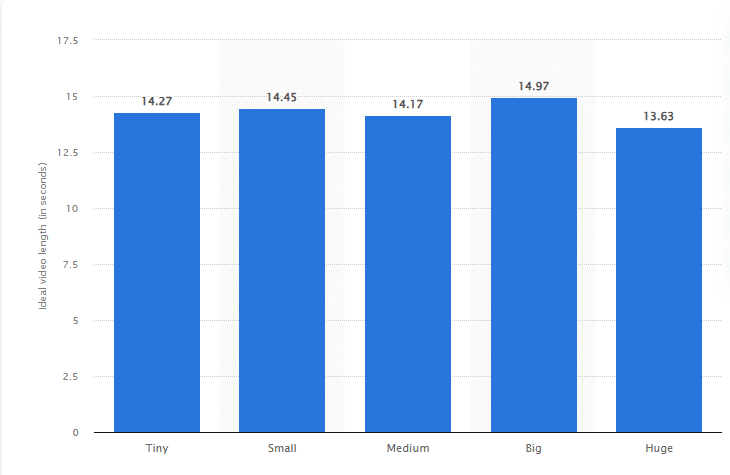
This is a very short amount of time, considering LinkedIn tends to have longer videos. You could begin by setting a target of at least 15 seconds, regardless of duration.
X
When considering what goals to set for X, remember that data insights are not completely accessible. Video content is not as abundant on this platform, so you may only decide to place short-form content on X.
So if videos are under 30 seconds, make a goal of 5 seconds of that 30 to begin with.
10 Tactical Ways to Improve Watch Time
Did you know that 93% of marketers said video marketing delivered ROI? That’s a high number, which proves your social video content can provide more than just views.
To increase this social media success metric, here are 10 actionable things you can add to your social media video strategy.
1. Use an “infotainment” angle.
Videos should be informational and entertaining. Even if the subject matter isn’t flashy, there’s always the chance to tell a great story. The origins of “infotainment” were programs that mixed news and current events using humor and storytelling techniques.
Here’s an example. Say, you work for a SaaS company with a platform for small businesses to manage their accounting. You’re releasing a new feature that allows for uploading receipts directly from phones. Instead of just showing how it works, design a video around someone who’s on the go and needs to submit these back to accounting ASAP. Stylize it as a race to get those receipts in before the end of the month.
2. Optimize the length of your video.
As your watch time data builds, you can identify how length compares to performance. It will vary across platforms. On TikTok, it may be under a minute, but for LinkedIn, the ideal length could be 3 minutes.
Narrow in on the sweet spot for each platform and make sure the content fits that.
3. Come up with catchy titles for Facebook Reels.
Facebook allows you to include a title for each video. You may not be using the feature now, or figure it’s not worth it. However, this could be a way to grab attention and make it clear what the content is about.
These titles draw people in and can impact watch time because they have an idea from the start about the topic. Otherwise, people may bounce from your videos in the first few seconds.
4. Add captions or subtitles.
Many social media users mute videos, or they may not be in an environment where they can turn up the volume. Additionally, sometimes dialogue can be hard to understand. If you add captions or subtitles, people can read if they can’t listen.
It makes it accessible for someone to enjoy, regardless of whether they have the volume up. Doing this could increase how long people watch your videos.
5. Post at the best time.
Many social media platforms will provide you with optimal times to post based on engagement data. If that’s an option, you can schedule videos for that time period when folks are most active.
You should consider this for all your content. There are times when this won’t be relevant. There may be videos that are timely and breaking news or are specifically for an event.
6. Make sure the thumbnail is high-quality.
Videos all have a static thumbnail, and when it’s visually appealing and highlights the topic of the content, it can drive more folks to click who are interested in this. It’s another way to pre-engage someone who will be more likely to stick around for the entire viewing.
7. Try the three S’s: short, sharp, and structured.
The three Ss work best for short-form video like TikTok and Reels. Short means under 30 seconds, so it’s bite-sized. Get to the point and trim the fat. This is a great strategy for how to increase TikTok watch time.
Sharp means the action, voiceover, or copy is concise. There’s no room for lots of adjectives or fluff.
Structure refers to telling a story in those 30 seconds. It may seem hard to do, but you’re only focusing on a specific topic, feature, or concept.
8. Enhance visuals.
Static shots in videos can work, but they may not hold the attention of watchers. There are some easy adjustments you can make with visuals that could make the difference, including:
- Switching camera angles mid-video
- Zooming in on the speaker’s face or an important graphic, like a chart or map
- Moving the camera slightly
9. Build videos for on-the-go mobile viewing.
How many of your video views are on mobile versus desktop? It’s likely that mobile dominates here, so any video content you produce should be mobile-first. The key to this is shooting them vertically or using a template that’s vertical.
10. Employ guided cues.
Another way to improve watch time is by using end screens and cards on videos. They nudge people to either watch more content or take an action like clicking on your website.
An example would be a fitness brand that has a series of videos on how to work certain muscles. After someone finishes watching a video on biceps, the following video suggestion would be a video on triceps.
Measurement and Reporting: Dashboards, KPIs, and Cadence
When strategizing about how to measure social media success, you’ll want to define measurement and reporting around video watches.
Ideally, you’ll be able to configure a dashboard of your video KPIs to include total watch time, average view duration, percent average viewed, and retention curves at 10/30/50/90%. You’ll need special social media, video, or marketing software to build a custom dashboard.
The cadence of measuring video performance metrics should be at least monthly so you can determine year-over-year and month-over-month differences.
For the specific KPIs, first decide on what your goals are, such as increasing overall watch time or percentages. Then define what metrics will help you determine if you are meeting them. Additionally, you may include secondary measurements that allow for more context.
Also crucial is avoiding these video metric errors:
- Focusing on vanity metrics
- Forgetting to set a baseline to start, so you have a way to determine growth.
- Ignoring platform-specific metrics like those available on Instagram
- Over-analyzing short-term data
- Failing to connect metrics to your business goals
When Watch Time Can Be Misleading
Is watch time always clear and useful? As with any metric, there are caveats to its importance. Keep these things in mind:
- All watches may not be verifiable, so filter out invalid or bot traffic if possible.
- Autoplay inflation could be skewing your numbers. You can disable this.
- Some watch times can look long, but actually be irrelevant because your audience is so small.
- High watch times without audience retention are a possible red flag.
- User intent across platforms matters. Some platforms are more for awareness, while others deliver conversions.
FAQs
1. What is watch time?
Watch time refers to the total amount of time people spend watching your video content.
2. Why is watch time an essential social media success metric?
It has an impact on algorithms, so when it is high, it can influence them to boost your content to be more discoverable and rank higher.
3. How do you calculate watch time?
It varies across platforms but is typically the total number of minutes or hours users watch videos on a platform.
4. What’s the difference between watch time and average view duration?
Watch time measures the total number of minutes viewers spend watching content. Average view duration is how long, on average, each person watches a single video.
5. How do you increase watch time on social media?
Focus on quality content, high-quality visuals, optimal length, and posting at the best time.
Get Social Media Success Strategies with Ignite Visibility
The concept of watch time on social media and its many implications can accelerate your social media success. We can help any brand up its social performance to meet the goals of more traffic, engagement, and conversions.
We’re a full-service social media strategy and management agency with expertise across all platforms.
Ready to get started? Contact us today to learn more.