
What is a Net Promoter Score? You’ve probably heard the term, often shortened to NPS, but you may not know precisely what it is or why it matters.
In this article, Lauren Roberts, Digital PR Strategist, will cover everything you ever wanted to know about NPS and how to use the metric to understand the satisfaction of customers better.
What You’ll Learn:
- What Is a Net Promoter Score?
- Why It Matters for Marketers and Leaders
- How to Measure NPS: Surveys, Sampling, and Timing
- What Is a Good Net Promoter Score? Benchmarks by Industry
- NPS Survey Pitfalls and How to Avoid Them
What Is a Net Promoter Score (NPS)?
Net Promoter Score defined: It’s a popular metric for gauging customer experience and satisfaction. It asks one question:
How likely are you to recommend (company/product/service) to a friend or colleague?
The respondent can provide a rating from zero (not at all likely) to 10 (extremely likely).
Bain & Company first introduced NPS in 2003. Since then, it’s become a hallmark of measuring, benchmarking, and tracking how customers feel about brands. It’s a snapshot of their experience, and since it’s only one question, responses are more likely.
Most businesses use these for customers or clients. Another option is employee Net Promoter Scores to gauge their satisfaction.
Three Categories of Respondents Based on Scores
Depending on the score provided, people fall into one of these segments:
- Promoters: They rate you as nine or 10 and are your most loyal and enthusiastic customers.
- Passives: They respond with a seven or eight. They’re not unhappy, but not enough to be a promoter.
- Detractors: These folks are unsatisfied, rating you zero to six. They are most likely to churn and may even discourage others from doing business with you.
How to Calculate Net Promoter Scores
Your total score can range from -100 to 100. To determine your score, simply subtract the percentage of detractors from the percentage of promoters. Leave the percentage of passives alone.
Net Promoter Score example:
- 65% of those answering are promoters, and 24% are detractors.
- 65-24 = 41
My Expert Opinion on Net Promoter Scores
Getting feedback from customers and employees isn’t easy, even if they’re happy. If surveys are too long, customers are likely to abandon them.
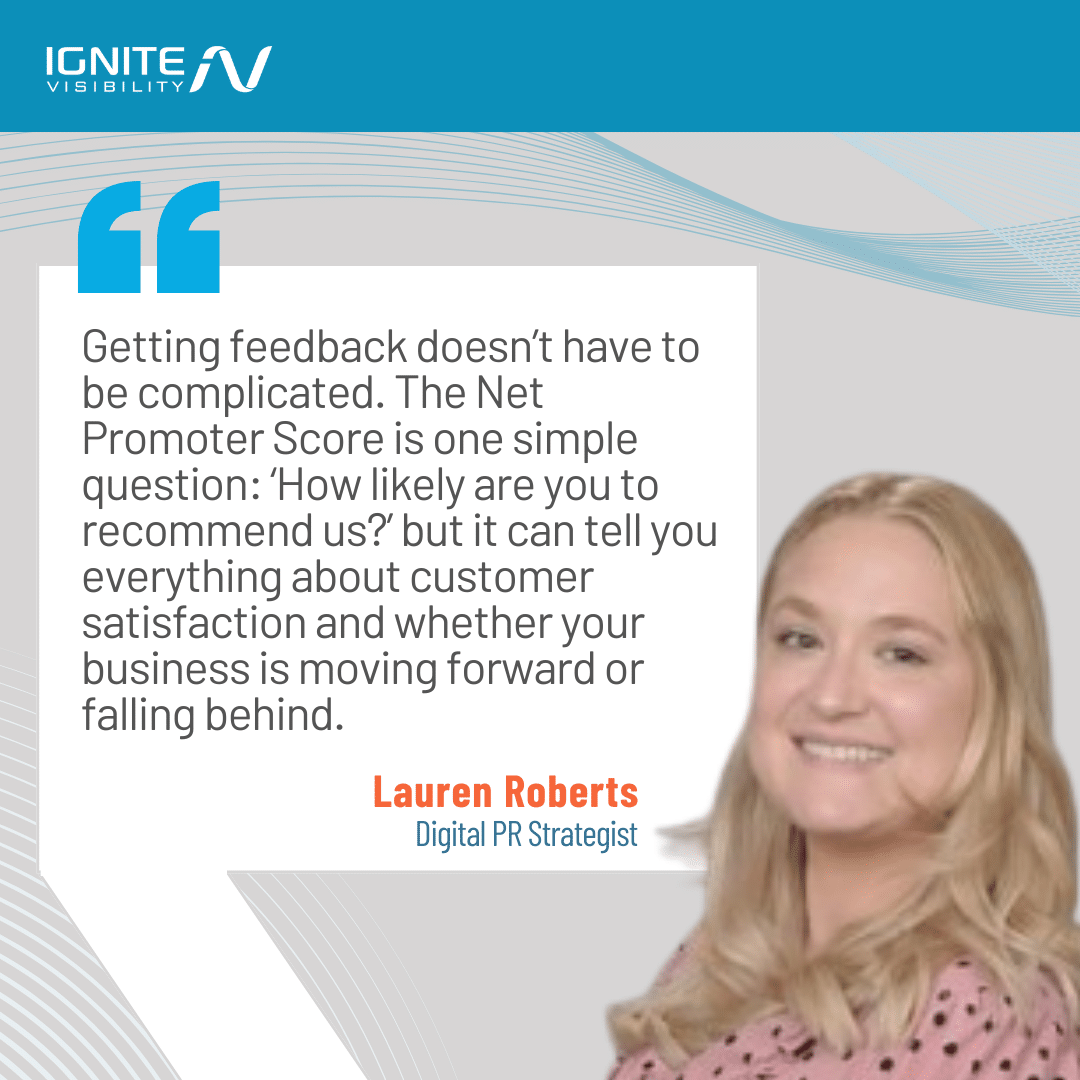
If you want a quick temperature on how folks feel about your business, resort to the Net Promoter Score. There’s only one question: How likely are you to recommend this company?
You can glean a lot from the rating they give. You can immediately know if they are satisfied or dissatisfied. Tracking this over time also provides insight into whether you’re improving or moving backward.
It’s a simple metric, but one worth measuring and understanding.
Why NPS Matters for Marketers and Leaders
So, why should you care about NPS? By measuring it and monitoring it, you can see trends in customer satisfaction and loyalty. If you start out with a relatively low score and establish new strategies for customer service and interactions, NPS is a good way to know if it’s working.
A Net Promoter Score with likely results gives you a broad view of how you’re performing. An NPS survey can also have an explanation box of “Why did you give this rating?” Those answers give you more context.
So, it does have limitations, but there are other metrics you can combine with it to understand customer sentiment better, including:
- Customer Satisfaction Score (CSAT): Measures satisfaction with a company, product, or service.
- Customer Effort Score (CES): Evaluates the ease of customer interactions.
- Churn: The rate at which you are losing customers
- Star ratings
Think of the NPS as a signal with other information filling out the reasons why you’re receiving high or low scores. Also consider that customer experiences cover many different touchpoints. The larger and more complex your company is, the more interactions people may have.
- Prediction of churn: Low scores indicate dissatisfaction. For those who rate you this way, you can trigger additional communications via Net Promoter Score software to find out why and provide them with an incentive.
- Identifying loyal customers: Those who are highly satisfied could be great targets for testimonials, referrals, and case studies.
- Simplicity makes it easy to scale: Longer surveys or ways to urge feedback can be hard to manage. One question surveys may be sent to any type of customer.
- Finding areas of improvement: Patterns in scoring can help you identify processes, products, or services that need reworking or refreshing.
- Growth correlation: As your business expands, you’ll see differences in your NPS score, and you can compare scores against how many new customers you’ve acquired.
- Improving customer lifetime value (CLV): Improving your NPS scores by consistently measuring and adjusting can increase CLV.
- Product-market fit: If NPS scores stay low with little change, you may discern that the product-market fit isn’t working. It may be time to go back to your go-to-market strategy.
How to Measure NPS: Surveys, Sampling, and Timing
When deciding on Net Promoter Score questions, you do have options in phrasing. There are two main types of questions: relational and transactional.
Relational NPS
This type of NPS rates how customers feel about their relationship with your brand. The response would have the person reflect on all their interactions with you. Typically, you’d ask it at specific intervals: annually, biannually, or quarterly.
Question examples:
- On a scale of 0 to 10, how likely are you to recommend [company/product/service] to a friend or colleague?
- On a scale of 0-10, how likely are you to recommend our services to people like you?
- Based on your experiences so far, how likely are you to recommend the company to others?
Transactional NPS
This category of Net Promoter Score questions comes after a specific interaction, usually a support call, product install, post-onboarding, or purchase. The feedback someone gives is just about that contact.
Question examples:
- Based on your (product install, onboarding), how likely are you to recommend (product/service) to a friend or colleague?
- Based on your recent purchase, how likely are you to recommend our business to a friend or colleague?
- Based on your recent (purchase, store visit), how likely are you to recommend our business to a friend or colleague?
Response Rate Expectations
Response rates vary. Research defined that the average for email is 12.4%. This is the typical channel used for NPS. However, there are Net Promoter Score tools that enable other ways, including via text, phone (as a survey at the end of a support call), or web and app pop-ups.
It could even occur in person. For example, field service companies may ask the customer after they complete a job. An analysis of response rates determined that in-person, apps, and phone have the highest numbers.
Response rates also have variations in B2B vs B2C. On average, B2B is 12.4% (range included 4.5%-39%). B2C was higher at 40%.
There’s a big difference between the two. B2B customers may have less time. They also may not receive emails if their company has a robust filtering, meaning it could land in a junk folder. B2B buyers may be more selective in the surveys they respond to, and sometimes, company policy may prohibit them from doing so.
Closed vs. Open Follow-up Questions
You can include a follow-up question in your NPS survey. Those could include:
- A text box for the customer to explain their rating (open)
- A question asking what specifically the business can do to improve their experience (open)
- Asking if the company can follow up with the customer for a negative or positive response (closed)
- Inquiring if the customer would be a promoter for your company (closed)
What Is a Good Net Promoter Score? Benchmarks by Industry
The question of what is a good net promoter score depends on your industry. There are Net Promoter Score benchmarks across verticals.
Overall, Bain & Company has developed this scoring framework:
- Over zero is good.
- Above 20 is favorable.
- More than 50 is excellent.
- 80+ is world-class.
While everyone wants to be world-class, it may be an aspiration that’s not feasible. Staying above zero is good. As noted, Net Promoter Score benchmarks vary by industry.
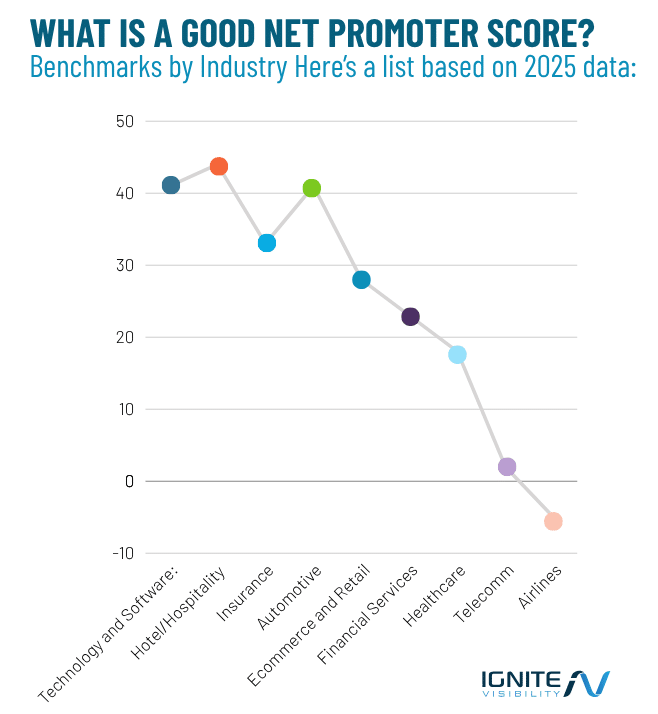
Here’s a list based on 2025 data:
- Technology and Software: +41 – Tech companies tend to have high marks if they deliver a great product, user experience, and support.
- Hotel/Hospitality: +44 – Most NPS surveys for this industry will most-often be transactional (e.g., after check-in, using the spa, or post-visit).
- Insurance: +33 – Scoring here depends a lot on whether rates go up as well as experiences when someone filed a claim.
- Automotive: +41 – Brand loyalty tends to be strong in auto, creating high scores. Dealers may also send transactional NPS surveys after a service visit.
- Ecommerce and Retail: +28 – Customer experiences vary widely when making purchases. Things like shipping speed, return policies, and value impact rankings.
- Financial Services: +23 – Banking can be complex, and it involves a customer’s money. This can make scoring volatile, as people will often have huge emotional reactions to things that go wrong.
- Healthcare: +18 – Patients will rate hospitals and providers based on many experience types. They’ll consider how long they waited, the provider’s empathy, and transparency around costs.
- Telecomm: +2 – This industry may have many detractors because of fine print in contracts, rate increases, and reliability of the service.
- Airlines: -5 – Airlines get a lot of disgruntled customers when delays occur, or their luggage is lost. Overbooking is another pain point.
Interpreting NPS Scores: Analyze and Act on NPS Data
What does your score mean? In reviewing the numbers and combining them with other customer satisfaction data points, you can make lots of assumptions. Your industry and things you have no control over also add another dynamic.
Use these strategies:
- Segment the data by customer type if information is available (e.g., demographics, location, new vs. long-time customers, higher spend). By doing this, you can get more granular on why certain groups are scoring you differently.
- Conduct root cause analysis. Dig into the detractor scores to see what went wrong in their eyes. You may find repetition of dissatisfaction around a specific touchpoint. Use what you learn to improve it.
- Activate promoters. When people give you high marks, get in touch with them about providing a testimonial or case study.
- Escalate high churn possibilities. If a high-spending, long-time customer gives you a bad rating, you should tag it and send it for immediate response to the person with the relationship or someone in leadership.
- Track NPS scores over time. If relational, choose a cadence of quarterly, biannually, or annually. If transactional, use Net Promoter Score software to trigger emails after interactions. You’ll be able to determine if you’re improving or not.
- Close the loop with follow-up questions to gain more context. You can integrate NPS scores with your CRM, which could then trigger emails to send for more information about the score and possible incentives to retain them as a customer.
- Use AI tools to analyze big data sets. In doing so, you can more easily identify trends and act on them.
- Keep monitoring your industry benchmark to see how you compare to competitors. If you remain lower, investigate the reasons others are scoring better (e.g., easier ways to contact support, better policies for returns, etc.).
NPS Survey Pitfalls and How to Avoid Them
NPS surveys give you quick and simple ratings. However, they do have limitations, and you can unintentionally err.
- Biased Sampling: Are you only sending surveys to certain groups because you believe they’ll provide the best scores? This skews the findings.
- Vanity Metric: Maybe you measure it and track its performance, but don’t actually do anything with the information. It’s not worth much if it’s just something you put in a report now and then.
- Misinterpreting Passives: They are in the middle but likely not going to churn immediately. You can create specific NPS follow-ups to passives to provide more information. Consider that some folks will never give you a 10 because no one’s perfect.
- Over-surveying Customers: Your response rates will most likely drop, and they may get annoyed. Instead, pick a cadence for overall NPS surveys. If doing transactional ones, put limits on these. For example, if a customer responded recently and then visits your store a week later, don’t ask them about their experience again. Put limits on how often you survey them.
NPS Quick-Start Checklist
- Choose Net Promoter Score software or tools.
- Craft an overall strategy of NPS survey objectives and how you’ll use the data.
- Consider having staff earn a Net Promoter Score certification in strategy.
- Determine what variation of the Net Promoter Score question to ask and follow-ups.
- Define how often to send relational and transactional NPS surveys.
- Ensure you have a data repository and that you can integrate it with other applications or data sets.
- Outline how to respond to promoters, passives, and detractors.
- Build a working group to analyze responses and recommend changes and improvements.
Meet Your Customer Experience Goals with Ignite Visibility
Now that I’ve answered What Is a Net Promoter Score, you’re ready to use this metric to drive better customer experiences. NPS helps you prevent churn and get valuable feedback.
There are many other aspects to customer experience dynamics, and we can help with:
- Lifecycle marketing
- Content marketing
- SEO
- And more!
Get started today by contacting our team.