

Not all leads exist equally. While all pose some value to your company, assuming each is equally likely to convert is naïve.Consequently, you need a system for deciding which leads to dedicate time to. That’s why marketers invented the Marketing Qualified Lead (MQL) and Sales Qualified Lead (SQL) metrics.
In this guide, Sebastian Turner, VP of Business Development, breaks down the core definitions of MQL vs. SQL, provides a modern lead scoring framework, and outlines the ‘Revenue Operations’ approach to alignment.
What’s Covered:
- What’s an MQL?
- Why Are MQLs Important?
- What’s an SQL?
- Why Do SQLs Matter?
- MQL vs SQL: Key Differences
- How Differences Between MQLs and SQLs Affect Funnel Transitions
- Where SAL Fits
- The Rise of the PQL
- Qualification Criteria Frameworks
- How Lead Scoring Can Help Qualify Leads
- SLAs and Routing Rules
- What to Measure
- Common Mistakes and How to Fix Them
- FAQs
My Expert Opinion on MQL vs SQL Marketing
When generating leads and qualifying them for marketing or sales, you need to know the differences between marketing qualified leads and a sales qualified lead. Each has different needs and objectives in the marketing funnel, which is why you need to develop content tailored to both at various stages to get the most from your marketing efforts.
While marketing qualified leads are toward the top of the funnel and seek more educational information, sales qualified leads sit toward the bottom of the funnel with more buying intent.
The key is to align both MQL and SQL marketing efforts to facilitate a smooth transition from MQL to SQL. Doing so can pass more qualified leads to sales based on their interactions with your brand and website.
This guide will review the differences between an MQL vs SQL vs SAL in marketing to help you build a winning strategy that drives sustained conversions.
What’s an MQL?
MQL, or marketing qualified leads, are leads with an expressed interest in becoming customers. They’re typically generated through marketing campaigns and activities and move on to the sales team for further qualification.
MQLs immediately proceed SQLs in the sales funnel. They haven’t revealed in-depth information, but the information they’ve already expressed indicates clear interest in your product or service.
In other words, MQLs have raised their hand.
They’ve signed up for something, whether that’s a piece of content, a webinar, or a newsletter. Your marketing has intrigued them, and they want to know more.
MQLs have a need your product or service can address. They wouldn’t be interested in learning more about your business if they didn’t believe you could help them somehow.
Common MQL Signals
There are some signals to watch for to identify an MQL in marketing, specifically involving high-fit and mid-intent interactions with your business, such as:
- Webinar Attendance: Joining an educational session to learn about a trend.
- Repeated site visits
- Social Engagement: Consistent interaction with your brand on “Dark Social” channels like LinkedIn or Slack communities.
- Content subscriptions, e.g., newsletter signups
- Content Consumption: Downloads of top-of-funnel content like ebooks and whitepapers
At the same time, there are some indicators when audiences aren’t marketing qualified leads, including:
- People who don’t fit within your target customer profile
- Visitors on your site who visit a single page and don’t return
- Leads failing to include accurate or critical information, such as valid email addresses
- Leads who don’t hit the desired score based on your metrics
Why Are MQLs Important?
Today, around 80% of all B2B content is gated primarily to attract MQLs in marketing.
Why? Because every MQL is a serious potential customer.
The ultimate sales outcome is far from certain. Still, your systems have determined they deserve the time and attention necessary to move them forward.
Differentiating MQLs from lower-quality leads lets sales teams use their scarce time effectively. This removes the bad apples from your basket, leaving sales with a tasty basket of Granny Smiths (SQLs, in this case) to enjoy.
MQLs are crucial for helping with routing efficiency by moving more qualified leads toward the sales end of the funnel, developing an effective nurturing strategy that facilitates smoother conversions, and cleaning up your data for better forecast hygiene to allow for more accurate predictions around revenue.
What’s an SQL?
SQLs are leads your marketing team has fully vetted.
They contacted them, asked questions, explored their needs, and determined their budget. The need and requirements are there, and it’s time to send them to sales.
Some common triggers to indicate when someone has become an SQL in marketing include:
- High-Value Page Visits: Repeated visits to the Pricing page or a “Competitor Comparison” page.
- Requesting and engaging with demos and trials
- Direct Inquiries: Using a “Talk to Sales” or “Request a Quote” button.
- Product Usage (PQL): For SaaS companies, hitting a “pro” feature limit within a free trial.
- High-intent sequences involving multiple personalized interactions
- Rep validation to confirm an SQL vs MQL
Why Do SQLs Matter?
Most marketers define generating more SQLs as their top priority.
That’s not surprising—an SQL is the fruit apple in the basket. They’re interested and ready to buy, and your marketing and sales teams have done the necessary work to get them there.
An SQL is the finish line for companies with an effective lead management strategy. But for others, it may only be the beginning.
Even if a lead is “ready” to buy, it may not be the right time for them.
They may need to consult with other decision-makers. Perhaps their budget is tight this quarter.
The point is, an SQL isn’t always a sure sale. But if you’ve done your job well, they’re far closer to becoming a customer than any other lead in your system.
You can measure SQL conversion efforts with the following metrics:
- SQL to Opportunity Conversion Rate: Measures the percentage of SQLs that qualify as actual sales opportunities with Account Executives.
- Speed-to-Lead: Tracks the amount of time needed for sales reps to contact leads after SQLs have engaged with marketing content or requested contact.
- Acceptance Rate: Measures the rate at which sales accepted leads (SALs) become SQLs worthy of pursuing, demonstrating how well marketing and sales efforts are aligned
MQL vs SQL: Key Differences
Let’s take a closer look at some of the main differences between an MQL vs SQL:
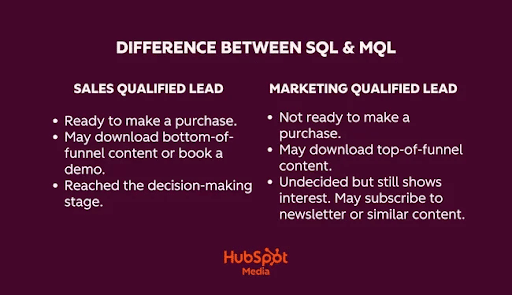
| Aspect | Marketing Qualified Leads (MQLs) | Sales Qualified Leads (SQLs) |
| Intent | Seeking information, eager to learn more about a particular problem or industry | Seeking solutions, often through brand investigation and comparison to help make a buying decision |
| Signals | Engagement with top-of-funnel content like blog posts, main pages, downloads, and webinars | Asks about pricing or requests a demo or trial, or fits your ideal customer profile (ICP) perfectly |
| Typical Actions | Downloads ToFu gated content, subscribes to a newsletter, or clicks on ads | Completes a contact form, makes direct requests for pricing or demos, or engages in discovery calls |
| Owner | Marketing teams | Sales teams |
| Next Step | Lead nurturing through automated sequences and retargeting to drive engagement | Discovery calls and demos involving one-on-one conversations with reps |
| Example Lead Behavior | Leads download “Top 10” ebook | Leads reach out to sales reps with a “Talk to an Expert” button |
Let’s take another example of an MQL vs SQL in the automotive industry, engaging with a dealership.
An MQL could include someone who downloads a “Top 10 Electric Vehicles” ebook from your website in exchange for submitting an email and other critical data. Another MQL could use a “build your own car” tool to put together their dream vehicle.
An SQL, on the other hand, could include someone who fills out an online contact form to request a price quote or actually visits the dealership to speak with a sales rep.
How Differences Between MQLs and SQLs Affect Funnel Transitions
Moving a lead from MQL to SQL is easier said than done. The vast majority of MQL sales never move forward, in large part because of misclassification.
Your marketing team may believe a lead is further down the funnel than they really are. Or perhaps your sales team is too eager to get their hands on a “hot” lead and pounces too early.
Handoff failure modes, whether engaging too late or too early, can lead to an ineffective transition between MQL and SQL. You might also experience “definition drift” as the line between SQL vs MQL becomes unclear, leading your teams to consider MQLs as SQLs or vice versa.
To avoid these mistakes, you need to understand the exact differences between MQLs and SQLs. Service level agreements (SLAs) and other sales enablement techniques can help you make handoffs more efficient by providing clear guidelines and effectively convert more MQLs into SQLs.
Where SAL Fits
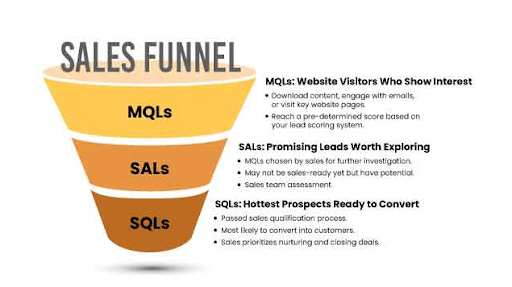
You also need to know the difference between MQL vs SQL vs SAL, as sales accepted leads (SALs) fit right in the middle of the sales funnel.
SALs come after MQLs, representing leads who are a bit more capable of becoming SQLs through further qualification. At this stage, sales teams will “accept” MQLs to turn them into SALs.
Teams can determine whether leads are SALs based on fit check with customer profiles and proper timing based on engagement.
The Rise of the PQL
The traditional MQL-to-SQL funnel is no longer the only path. In a Product-Led Growth (PLG) world, we must account for the Product Qualified Lead (PQL).
What is a PQL?
A PQL is a lead who has already experienced “value” by using your product (usually through a free trial or freemium model).
Expert Tip: A PQL is often more valuable than an MQL because their “intent” is backed by actual usage data rather than just an email submission. If a user invites three teammates to their trial account, they are likely an SQL in disguise.
Qualification Criteria Frameworks
When qualifying leads, there are some criteria you can use to separate MQLs and SQLs. Here’s how they’re different:
Lead Behavior
The primary difference between MQLs and SQLs is lead behavior. MQLs have expressed varying interest in your product, while SQLs are ready to buy.
The easiest way to understand the difference is with an analogy. Imagine you’re at a party and see someone you’d like to meet.
You introduce yourself, shake their hand, start talking to them, and the conversation goes well. Now imagine you’re at that same party, but that same person comes up to you and says, “I want to talk to you about your product.”
In the first scenario, the person showed enough interest for you to want to talk to them. In the second, they showed up and immediately started discussing a sale.
The same’s true of leads. An MQL expresses interest in your product, while an SQL is ready to buy.
Conversion Rate
The second difference between MQLs and SQLs is the conversion rate. MQLs have a lower conversion rate than SQLs because they’re at the top of the funnel.
They may be interested in your product, but your team hasn’t vetted them. MQLs may not have the budget, the need, or the authority to make a purchase despite their expressed interest.
On the other hand, SQLs are fully vetted. Your marketing and sales teams have done the work to ensure they’re a good fit for your product.
They’re fully qualified for your product and have a clear intent in making the sale. As a result, their conversion rate is much higher.
Referral Channel Difference
The third difference between MQLs and SQLs is the lead source. MQLs come from a range of sources, while SQLs come from narrower, higher-quality sources.
MQLs come from low-effort sources like:
- Content downloads
- Sign-ups for webinars or other events
- Form submissions
- Newsletter signups
- PPC campaigns
- Inbound calls
SQLs, on the other hand, come from narrower, higher-quality sources.
Your marketing team has already vetted these leads, and they’re ready for your sales team to close the deal.
SQLs may come from:
- Referrals from current customers
- Inbound calls from marketing-generated leads
- Form submissions from targeted landing pages
- Purchase intent research
This isn’t an exhaustive list, but it shows how the referral channel frames dramatic differences in intent.
Contact Requests
Generally speaking, the most obvious difference between the two is how they meet with your sales team.
If your sales team asks to set up a call or demo with a lead, they’re an MQL. But if the lead requests the meeting, they’re an SQL, just like the party analogy mentioned above.
You’ll only need to pay attention to who’s requesting the meeting. The meeting-maker might not have the authority to make a buying decision.
For instance, your sales teams might receive a demo request from a marketing team employee without a management title.
Before committing to the demo, your team should ensure they’re the appropriate person to meet with.
The “LinkedIn DM” Analogy
To understand the difference, think of LinkedIn:
- The MQL: Someone who “Likes” your post. They enjoy your content and know your name, but if you sent them a sales pitch right now, it would be awkward. They need more value first.
- The SQL: Someone who sends you a DM saying, “Hey, I saw your post about [Problem]. Do you have time for a call Thursday to discuss how you solve that?” They are ready for a meeting.
Lead Demographics
MQLs and SQLs may have different demographics, but that’s not necessarily a good indicator of a lead’s stage in the buyer’s journey.
There are cases where a company may have a particular target market. In this scenario, it’s likely your leads will fit this mold.
For example, say a marketing agency specializes in customer acquisition for legal SEO firms. In this case, their target market is pretty well-defined, and a lead’s demographic is a good indicator of whether they’re an MQL or SQL.
At the same time, in some industries, there are other qualities like job title, geographic region, or even the topics they’re searching for that are better indicators of readiness.
The point is, demographic information can be useful (or not useful) in determining which leads should be moved to your sales team. Work with your sales and marketing teams to determine the characteristics that matter most.
Likelihood to Buy
Last but not least, MQLs are less likely to buy than SQLs. That’s not to say MQLs never buy, but they’re less likely to do so.
For instance, a lead who fills out a form to download a piece of content is an MQL.
They’re interested in your product but are not ready to buy. They may have only wanted whatever you gated behind the download form.
In contrast, SQLs are highly likely to buy. It’s not guaranteed, but it’s the marketing equivalent of standing on third base—all you need to do is hit a single.
After all, it takes an SQL to make a sale. They’ve discussed their needs and budget, and they’re ready to purchase.
Online retailers, for instance, can’t make a sale without someone adding an item to their cart, entering a shipping address, and paying for the product.
The BANT System and Alternatives
The BANT (Budget, Authority, Need, and Timeline) system is a lead management process used by sales teams to qualify leads. You can use it to precisely decide how qualified, and thus likely to buy, a lead is.
Leads meeting all the criteria below are fully qualified and ready for a meeting with sales:
- Budget: Do they have the budget to make the purchase?
- Authority: Do they have the authority to make the purchase?
- Need: Do they have a clear need for your product?
- Timeline: Do they have a timeline for making the purchase?
The main benefit of the BANT system is that it helps your sales team prioritize their time.
Your sales team could request a demo from three prospects this week.
Unfortunately, they can’t meet with all three. So, the sales team uses BANT to choose the most qualified leads.
Depending on your ideal customer profile (ICP) and sales cycle, you may also use either the CHAMP (Challenges, Authority, Money, Prioritization) or MEDDIC (Metrics, Economic Buyer, Decision Criteria, Decision Process, Identifying Pain, Champion) system.
CHAMP tends to be faster and focuses on more immediate prioritization and challenges, while MEDDIC is more in-depth and allows for more detailed forecasting.
Ultimately, use the system that matches your motion to qualify an MQL vs SQL.
How Lead Scoring Can Help Qualify Leads
Qualifying your leads with a hunch is a losing process. While your instinct still plays a huge role in valuing leads, failing to quantify them as precisely as possible makes massive inefficiencies inevitable.
That’s where leading scoring comes in.
What is Lead Scoring?
Lead scoring is the process of assigning a numerical value to your leads. This allows you to determine how qualified a lead is and how likely they are to convert with infinitely higher precision than your gut feeling.
In other words, it’s a system that takes the guesswork out of lead management by breaking down leads into two groups: those who are ready to buy and those who are not.
Why is Lead Scoring Important?
Lead scoring comes with its own set of benefits. It allows sales and marketing teams to:
- Align on the criteria used to determine whether a lead is ready to buy
- Justify the budget for marketing campaigns to executives and stakeholders
- Have measurable goals to achieve with their campaigns
- Prioritize their time efficiently with those measurable goals
- More precisely utilize their marketing efforts and budget
The takeaway is that while lead scoring seems like a lot of work upfront, it pays off.
How Does Lead Scoring Work?
Lead scoring is a complex process, but you can break it down into three main phases:
- Create buyer profiles
- Score Leads according to Activity
- Assign Lead Scores manually
Create Buyer Profiles
The first step is to create buyer profiles. These are semi-fictional representations of your target customers.
Each buyer profile should include the following:
- Demographics: Who is your target buyer, and what do they look like?
- Value Driver: What common problem do they have?
- Decision Stage: What does their decision stage look like?
A buyer profile helps you understand who your lead is. This is the foundational step in determining their quality.
Score Leads According to Activity
After deciding on criteria, you can start assigning lead scores according to their completed activities.
For instance, you might assign a higher lead score to a lead based on the following criteria:
- Document downloaded: +5
- Created an account: +5
- Subscribed to a blog post: +7
- Signs up for newsletter: +3
- Signs up for email course: +5
- Purchased a product: +35
Lead scoring is about quantifying what you know about a lead and using that information to determine how likely they are to convert.
The goal is to use activity to understand a lead’s “interest” in your company. The more qualified a lead is, the higher their lead score should be.
Assign Lead Scores Manually
Even though you can automate the process of assigning lead scores, it’s best to start by scoring leads manually. Then, once you’ve manually scored a few hundred leads, you can begin to automate the process using specialized software.
The benefit you get from starting with a manual process is having something to compare your automated results to. This makes it massively easier to fine-tune your system.
Look at Explicit vs. Implicit Signals
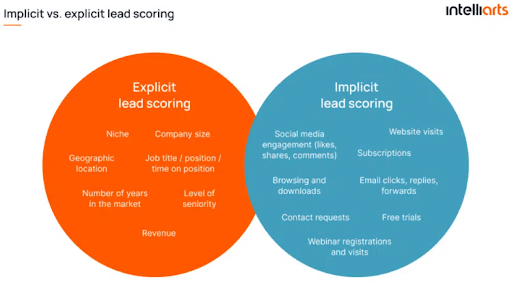
To qualify an SQL vs MQL in marketing, you should also consider explicit vs. implicit signals.
Explicit signals may include data that leads provide directly to help gauge whether they’re the right fit according to your ICP. Meanwhile, implicit signals include interest via page visits, clicks, content downloads, and the amount of time leads spend on your site.
Weigh Engagement
Another strategy is to weight the different types of engagement to better score leads, assigning more points to interactions like high-intent pages and fewer to top-of-funnel downloads like ebooks.
Use Negative Scoring
In addition to positive scores, you can use negative scoring to take away points for interactions indicating disinterest or a poor fit with your ICP.
For instance, you might remove points if a lead unsubscribes from your emails or produces high bounce rates, or if a lead provides information like a job title that falls outside of your ideal profile.
Consider Score Decay
As people disengage over time, you could implement a score decay system that removes points, such as deducting points after 30 days of inactivity.
Determine Thresholds Tied to Sales Capacity
Set specific thresholds based on the capacity of your sales team. For instance, you might use the following structure:
- Low thresholds with high capacity and low lead volume to funnel more sales qualified leads
- Higher thresholds when capacity is low and lead volume is high to narrow down SQLs more effectively
Establish Routing Rules
Depending on where leads fall, put some routing rules in place to move high-scoring leads along while nurturing lower-scoring leads.
For instance, Account Executives could receive an instant alert about “hot” leads with a high score through a CRM, while “warm” leads go through an automated nurturing sequence and “cold” leads result in automatic unsubscribes or “recycling” bucket placement.
SLAs and Routing Rules
To maintain efficient qualification, scoring, and routing for leads, your team should use SLAs that provide clear guidance.
Some key elements of an SLA include:
- Response Time: Details the maximum amount of time allowed for your teams to acknowledge or initiate action based on requests or actions, e.g., 5 minutes for contact requests and 15 minutes for support tickets
- Acceptance Criteria: Defines standards that leads must meet for teams to accept them, such as a specific budget, contact information, or authority
- Recycling Rules: Guides teams on how to determine when an issue or lead that doesn’t meet acceptance criteria needs to go to the original sender for added troubleshooting or nurturing
- Attribution Rules: Provides definitions confirming which actions or touchpoints receive any credit for converting leads or resolving certain issues
- Required Fields: Data points that either leads or team members must enter before moving leads or tickets to the next stage
- Feedback Cadence: The scheduled frequency of reviews to discuss performance, optimize processes, and review any exceptions
What to Measure
Through regular weekly, monthly, or quarterly reports, you should measure the following key performance indicators (KPIs) to gauge the effectiveness of lead qualification efforts:
- MQL to SAL Rate: Tracks the rate of MQLs becoming sales accepted leads toward the middle of the funnel
- SAL to SQL Rate: Gauges the rate at which SALs move to the bottom of the funnel to become SQLs
- SQL to Opportunity Rate: Measures the percentage of SQLs who become qualified opportunities requiring engagement from sales
- Speed-to-Lead: The amount of time it takes for sales teams to reach out to viable prospects
- Acceptance Rate: The rate of acquisition for SALs in the sales funnel
- Recycle Rate: The rate at which teams need to recycle leads for more nurturing or unsubscribing
- Pipeline Influenced: Identifies how marketing and sales affect lead progression down the funnel throughout the marketing lifecycle
- Customer Acquisition Cost (CAC) by Channel: Measures the total cost of acquiring new customers through each marketing and sales channel
Common Mistakes and How to Fix Them
When qualifying MQL vs SQL leads, here are some critical mistakes to avoid:
Treating Every Download as an MQL
Not every download will count toward an MQL acquisition.
Be sure to separate top-of-funnel and bottom-of-funnel downloads, like ToFu ebooks vs BoFu demos. Also, consider the engagement with your brand after that download, as some leads might quickly disengage after that initial download.
No Negative Scoring
Neglecting to account for score decay and negative scoring due to disengagement could lead you to qualify leads that aren’t actively interested in making a purchase or otherwise engaging with your brand.
Set up a negative scoring system to deduct points when unsubscribes or other forms of disengagement occur, or if there’s a period of inactivity.
No SLA
Not implementing an SLA could also be detrimental to your efforts, preventing your marketing and sales strategies from aligning and optimizing for better lead qualification.
Develop a clear SLA with strict guidelines to help with everything from lead scoring and qualification to process optimization and engagement with leads.
A Lack of Recycling
Your strategy should also help recycle leads as needed if they become “cold,” preventing you from wasting time trying to convert low-intent leads and clean up your contact lists to focus on leads who are more likely to make a buying decision. At the same time, recycling could nurture those colder leads over time to turn them into high-intent SQLs.
Broken Attribution
Your strategies should clearly indicate which aspects of sales or marketing strategies contribute to conversions at various stages. Metrics like CAC by channel can help you determine which efforts are maximizing ROI and which require more work to drive conversions and sales.
FAQs
1. What is the difference between an MQL and an SQL?
Marketing qualified leads (MQLs) are leads who qualify for additional nurturing and marketing to turn them into sales qualified leads (SQLs), who have higher buying intent and are ready for engagement from sales teams.
2. What is a Sales Accepted Lead (SAL) and do you need one?
SALs are MQLs making the transition to SQLs as they move down the funnel. They can indicate MQLs that show more promise and can move from marketing to sales before converting into official SQLs.
3. When should a lead move from MQL to SQL?
An MQL will move to an SQL in marketing when they show high buying intent, align with your ICP, and engage more consistently with pricing pages and other bottom-of-funnel content.
4. How does lead scoring determine MQL vs SQL?
Lead scoring helps gauge whether a lead is an SQL or an MQL in marketing based on certain criteria, such as engagement behaviors, content downloads, and the amount of time they spend on your website.
5. How do you measure MQL to SQL performance?
You can measure your ability to convert MQLs to SQLs using certain key metrics, such as MQL to SQL rates, speed-to-lead, and acceptance rates that determine how much time and effort it takes for these leads to make that transition.
Qualify and Convert More Leads With Ignite Visibility
With a better understanding of the difference between MQL and SQL lead types, you can develop stronger lead qualification and scoring strategies that drive meaningful conversions. Ignite Visibility is here to help with some of the best digital marketing solutions available, from lifecycle marketing to conversion rate optimization.
Our experts can help you:
- Identify MQLs and SQLs based on a specific ideal customer profile
- Develop clear personas for each of your ICPs
- Establish top-of-funnel marketing tactics to attract qualified MQLs
- Set up high-quality bottom-of-funnel content to connect with SQLs
- Measure the results of your campaigns to gauge performance
- Adjust strategies to better align sales and marketing
- And much more!
Contact us today to request a free proposal from our team, and find out what we can do for you.

