

Ready to learn how to select search terms?
I’m going to teach you…
In this article you will learn
What are search terms
How to select search terms
How to do research
What are the right keywords
What are some of the best tools
Subtle information to select keywords that convert

You want to learn how to select search terms?
Fortunately, there are plenty of tools to help you do just that. Additionally, you can use common sense and knowledge about your market to optimize your site for keywords that tools often won’t uncover.
Once you’ve gathered a portfolio of search terms, you can include them in your content marketing efforts. You should also add them to some of your important pages, such as the homepage and the “About” page.
In this article, we’ll cover what you need to know about finding the right search terms for your business model.
1. Finding the Best Search Terms All Starts With Basic Research
As with just about everything else in marketing, it’s always a good idea to go back to the basics. In this case, you’ll want to get your team together and brainstorm up a number of keywords related to your niche.
Let’s say you’re trying to appeal to people who are searching for marketing tools. You’d probably come up with a number of keywords similar to the phrase “marketing tools,” such as:
- Digital marketing tools
- Marketing automation
- SEO tools
- Marketing utilities
- Marketing software
Those are your basic search terms. They’re the ones that people will likely plug into a search bar when looking for information about marketing tools.
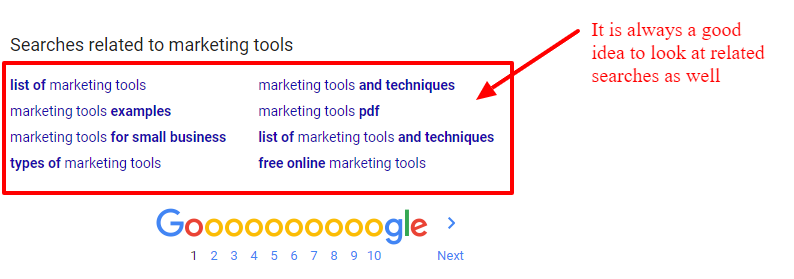
2. Expand Your Horizon to Longer-Tail Search Terms
One of the hardest things to determine, is exactly what page you want to optimize, for what term.
Watch this video to learn how to set up your site structure.
3. Get Some Help with Keyword Tools
Speaking of tools, you’re going to need some.
Although you might have generated several dozen search terms from your brainstorming efforts, your research effort is still far from over.
Why? Because now you need to uncover those hidden nuggets of gold that the wonders of modern technology can reveal.
Start with a tool like SEMRush. Head over there and plug in “SEO tools” into the main search bar. Then click “Start Now.”
After a few seconds, your screen will fill up with a report that’s packed with useful information about that keyword.
Start by clicking on the “Phrase Match” tab at the top. That will show you a number of keywords that include your basic search term.

You’ll see keywords like:
- Best SEO tools
- Small SEO tools
- Google SEO tools
- SEO keyword tool
…and many others.
From that list, you’ll likely get ideas about additional keywords that you hadn’t thought about before.
But which ones should you use? Or should you try to optimize for all of them?
4. Deciding Which Search Terms to Use
When it comes to deciding which search terms you should include in your optimization efforts, you should pay attention to two metrics in particular: volume and keyword difficulty. Fortunately, SEMRush gives you both of those stats.
Take a look at volume for starters. As you can see from the table, the search term “best SEO tools” gets about 1,300 searches every month. That’s a decent amount of traffic that you’d like to bring to your site.
However, if you look at the KD column you’ll see that the keyword difficulty is 63.13. That’s on a scale of 1 – 100 with 100 being the most difficult.
In other words, it’s pretty difficult (but not impossible) to get on Page 1 of the search results if you optimize a page for “best SEO tools.”
Click on the SERP icon on the far, right-hand side of the table. That will bring up the actual search results for that keyword in another tab.
Scroll through the search results. You’ll see some fairly high-profile domain names like moz.com, bufferapp.com, searchenginewatch.com, hootsuite.com, and ahrefs.com.
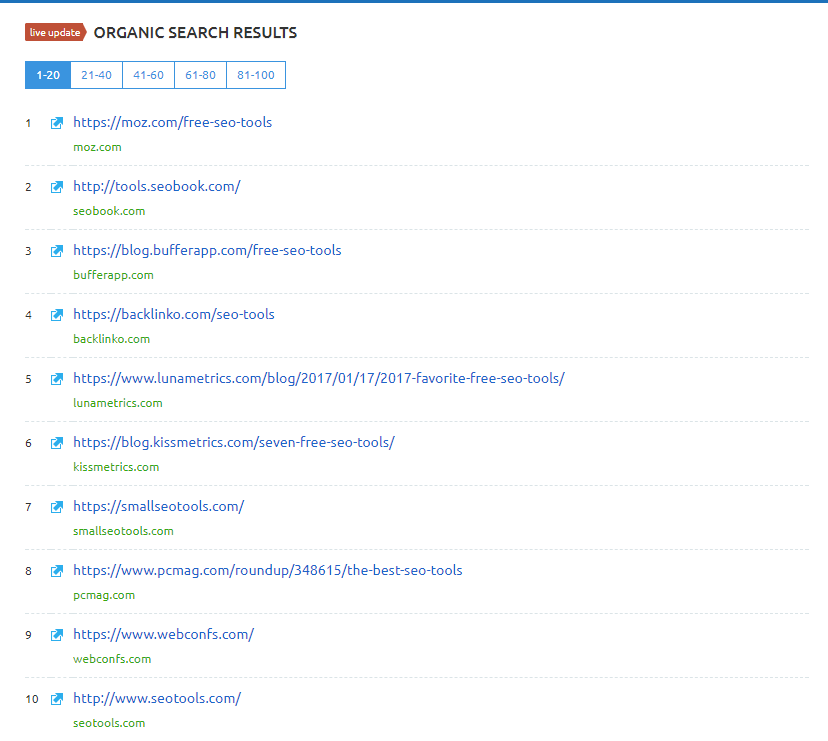
Those are all ranking very well for that search term. If you’re running a new website with little to no authority at this point, it will be difficult to rank for that search term.
Pro-tip: if you see a few YouTube videos on Page 1 of the search results, that’s usually a good indicator that there aren’t a whole lot of high-profile websites ranking for that search term. You have a shot with that one!
5. Finding the Perfect Search Terms
You want search terms that are high in volume and low in difficulty.
As a rule of thumb, “high” in terms of volume is usually at least 1,000 searches per month. However, your mileage may vary based on your own business model.
In terms of keyword difficulty, look for something below 20. That’s usually an easy term to rank for.
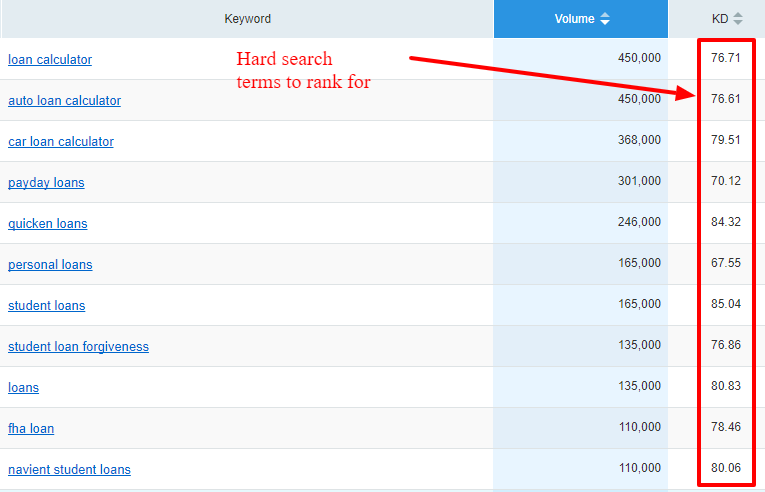
Of course, at this point in the Information Age, digital strategists all over the world are doing exactly what you’re doing. In other words, they’re using SEMRush and similar tools to find those keywords that are low-hanging fruit.
So don’t get discouraged if you can’t find a bunch of keywords that match the criteria identified above.
You might have to settle for search terms with only 500 searches per month and a difficulty level of 50. Still, you can land on Page 1.
How? By providing 10x content.
In a nutshell, create content that’s 10 times better than anything else on Page 1. Put more research into it, add more detail, use more images, embed more videos, and make the page much more user-friendly than competing pages.
Also, include on-page optimization for that specific keyword.
For example, in the “best SEO tools” search results, you can see an article entitled “24 Most Effective Free SEO Tools for Google, Bing, & More.” That doesn’t include the search term “best SEO tools,” does it?
In fact, that keyword doesn’t even occur in the search snippet.
If you see something like that on Page 1 of the SERPs for one of your search terms, then you’ve got an opportunity to rank. That’s because the page isn’t optimized for the specific keyword you’re targeting.
In other words: you can move ahead of that page in the search results!
6. Related Keywords and Search Terms
Let’s get back to SEMRush for a moment. We looked at the “Phrase Match” tab already, but there’s another useful tab to check out: “Related Keywords.”
Click on that and you will not be surprised to see a list of keywords related to “SEO tools.”
Go through the list and look for golden nuggets. Follow the same criteria identified above.
Pro-tip: Use the advanced filter option at the top of the table to only show keywords with a minimum volume count and maximum keyword difficulty.
Another pro-tip: Export your keyword reports as Excel spreadsheets. Then, copy and paste the exported reports into one master spreadsheet. Finally, sort the spreadsheet by volume in descending order so you see the most popular keywords at the top. There’s your keyword list, prioritized by volume.
7. Keyword Planner
Another tool you can use for research purposes is Google’s Keyword Planner. Unlike SEMRush, though, it’s free.
You will, however, need a Google AdWords account to use the Keyword Planner. Fortunately, that’s free, too.
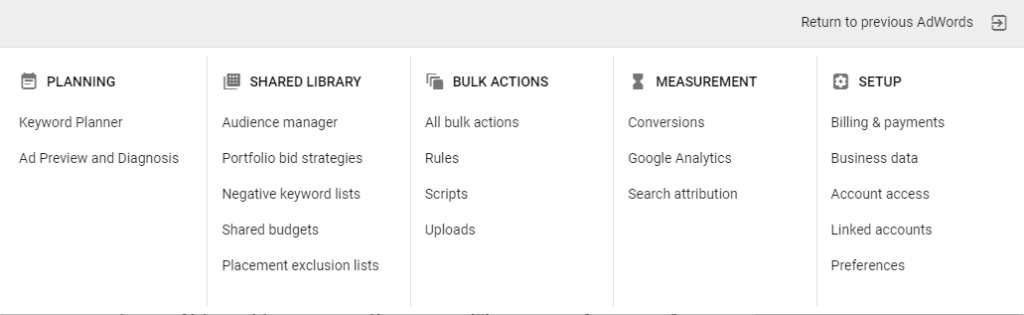
In the Keyword Planner tool, select “Search for new keywords using a phrase, website, or category” towards the top, left-hand side of the page.
In the “Your product or service” field, plug in the keyword of choice. In this case, just enter “SEO tools.”
Finally, click the “Get Ideas” button at the bottom of the page.
On the report that appears, you’ll see the average monthly searches for that keyword. Unfortunately, if you’re not an active AdWords advertiser, that average number will fall in a wide range. In this case, it’s “1K – 10K” or 1,000 to 10,000 searches every month.
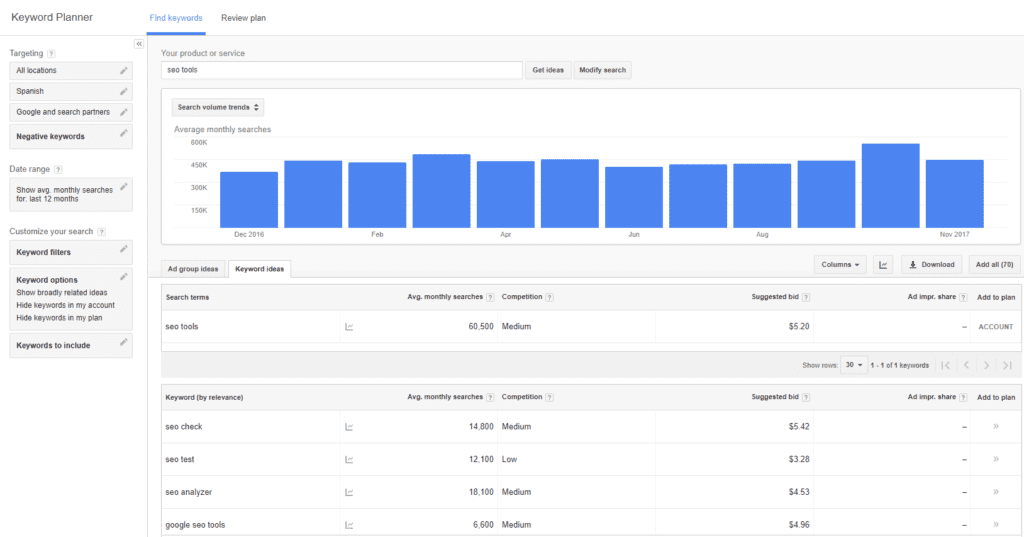
If you are an active advertiser, you’ll see a more specific number.
In the table below, you’ll see a list of related keywords. Go through that table to once again look for some golden nuggets you hadn’t discovered before.
Keep in mind, though, that Keyword Planner won’t show you keyword difficulty like SEMRush. The “Competition” value is used to describe advertising competition and not necessarily keyword difficulty.
So you should still run any search terms you find in Keyword Planner through SEMRush.
8. Look for Search Term Intent
Some search terms include purchase intent. They’re your very best friends.
For example, if someone is searching for “best keyword research tool,” it’s very likely that the person is interested in buying a keyword research tool and wants the best one.
Other keywords with purchase intent include: “cheap running shoes,” “discount luggage,” and “laptops on sale.”
Those are the types of keywords that you should optimize for. That’s because you’re more likely to land a sale when people visit your site after using them in a search.
Keep in mind, though, that other digital marketers know that. Your competitors will optimize for those search terms as well.
That’s why you should also appeal to people a little higher up in the sales funnel.
9. Search Terms With Less Intent
It’s likely that you’ll find plenty of search terms with little to no intent but have high search volume. You should optimize for those search terms as well.
Why? Because you’re also interested in boosting your brand among people who are in your target market.
Even if they don’t make an immediate purchase, they might someday. It’s a good idea to get your name in front of them so that they know you’re a viable contender for their business.
Important: you must have a great sales funnel in place when targeting people at that level.
For example, you should show your visitors a popup that offers them a freebie in exchange for providing an email address. Then, you can send them periodic emails about your product or service in an effort to get them to make a purchase.
Also, don’t forget that people who visit your site are prime candidates for retargeting.
10. Advertise With Those Keywords
It’s also a great idea to advertise with popular keywords in addition to optimizing content for them.
That’s an especially great investment if the keyword you’re targeting is popular and doesn’t have a whole lot of competition. That way, you’ll pay just a few pennies or a few dollars for a single click.
Once again, tools like SEMRush and Keyword Planner are invaluable when it comes to determining which keywords you should use and the types of ads you should run.
SEMRush is particularly helpful because it will show you ads run by competitors who are using those keywords. You might even get some ideas for your own ads by looking at them.
Keyword Planner will show you the current CPC and level of competitiveness for the keyword. Although SEMRush will show you similar info, it’s more authoritative coming from a tool that’s owned by Google.
Search Terms FAQ
What Are the Best Tools to Find Search Terms?
If you’re looking for a tool that will help you find the hottest search terms related to your niche, you’ll be happy to learn that there are plenty of options available.
Here are some of the most popular keyword research tools:
What Are Negative Search Terms?
A negative search term or negative keyword is a keyword you specify in your advertising campaign that prevents your ad from appearing.
For example, if you’re selling cuckoo clocks online, you probably don’t want your ad to show if somebody searches for “free cuckoo clocks.” That’s because people who search with that phrase are looking for a free clock and not interested in paying for one.
In that case, you’d set up an ad campaign with “free” as the negative search term.
What Are Boolean Search Terms?
Boolean search terms enable users to combine different keywords.
For example, let’s say someone is searching for cuckoo clocks in Lansing, Michigan. The person would use the search phrase “cuckoo clocks AND Lansing.”
That will return a list of results that match for “cuckoo clock” and “Lansing.”
In addition to the AND operator, people can also use OR in a search. For example, the boolean expression “cuckoo clock OR grandfather clock” will return results that match on either “cuckoo clock” or “grandfather clock.”
Wrapping Up How to Find Search Terms
Keyword research is an important part of SEO. If you haven’t yet started investing the necessary resources into finding the right search terms for your business, why not begin today?
