

Competitive analyses are essential for any brand that wants to improve their SEO efforts.
In this article, I’ll walk you through the process of reverse engineering SEO from competitor content to keywords and links.
What We’ll Cover:
- Identifying target keywords
- Finding your competitors
- Reverse engineering competitors content strategy
- How to evaluate their content
- Evaluating their site code, structure, and usability
- How to improve on their strategy
- Checking competitor backlinks
- Checking social signals
- Looking for demographic insights
- Monitoring performance
A competitive analysis serves as a way to see how you measure up against your competitors, reveal strengths and weaknesses, and highlight potential opportunities to step up your game.
There are several ways to run a competitive SEO analysis, but the main goal is to identify what’s working for your top competitors and use that intel to inform your own strategy.
Identify Target Keywords
SEO reverse engineering begins with some choice keywords.
You’ll want to kick-off the process by making a list of the keywords your target user would type in to resolve a specific challenge that your product or service solves.
Look for keyword ideas in Google’s suggested results, Google Keyword Planner, or your paid SEO tool of choice.
Find Your Competitors
All great SEO campaigns begin with an understanding of the competitive search landscape.
You’ll, of course, want to beat out the brands with similar audiences and the same target audience—your literal competitors.
Check the SERPs for Competitors
The most basic way to identify the SEO competition is to Google the keywords you’re targeting and see which companies show up in the top spots.
Keep in mind, it’s worth checking the results on Bing and Yahoo, as well for additional intel and potential ranking opportunities.
You might try doing this for your top, say 10 or 20 keywords, and create a spreadsheet that tracks which domains rank most often, and in what position.
But, you’ll also need to think about your SEO competitors. These brands might not always be literal competitors, but they might be competing for the same keywords, regardless of intent.
Use a Tool to Uncover More Insights
While searching for keywords manually is a good place to start, it won’t tell you a whole lot about the strength of the domains you’re coming up against.
Using a tool like SEMRush or Ahrefs (among countless others) will give you a deeper understanding of keywords that are worth pursuing, and which demand more resources than they’re worth.
You’ll want to use a competitive analysis tool to identify the following information about the brands competing for front-page space:
- Domain authority
- Domain age
- Traffic volume
- Backlinks
- Social signals
- Alexa rank
- Catalog listings
- SERP indexing
SEO Reverse Engineering Your Content Strategy
After you’ve identified some keywords and competitors, you’ll want to look at the links that appear in the search results.
Start with these three key components: title tag, meta description, and URL.
For example, if I type in “top SEO tools,” this is what comes up.
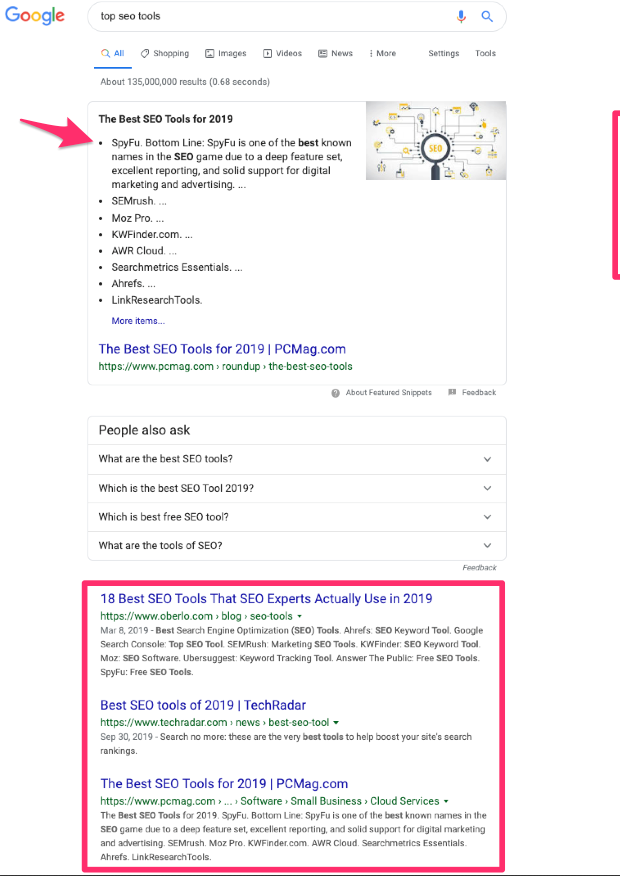
Next, you’ll want to click each of these results for a closer look at the content.
While it’s worth noting that the top results may not match the intent that you’re targeting, you’ll want to assess the following elements to see what’s working for competitors like PC Mag, so you’ll have a shot at position zero yourself.
- Content formatting
- Content length
- Keyword density
- Anchor text and links
- Internal links
- Images and alt text
- Types of content
- Topical relevance
- Level of detail
What Makes Your SEO Competition Unique? And Where Are the Gaps?
As you perform your SEO competitive analysis, you’ll want to look at how these top performers talk about their brands.
What language do they use to describe features, benefits, and pain points? What kind of media do they use? What is the brand’s aesthetic? Tone of voice? Writing style?
Keep in mind, you don’t want to copy your competitors’ unique value proposition—one of Google’s ranking signals is uniqueness, after all. However, getting a read on what’s working for other websites can help you come up with a better strategy.
Ask yourself the following questions:
- Do your competitors have more content?
- What makes it engaging?
- How are they optimizing for keywords?
- What elements do top sites have in common?
- What about quality? Do you want to read it? Will it teach you something new?
- Is content data-driven?
The other thing you’ll want to do here is look for content gaps.
For the uninitiated, content gaps are keywords that your competitors rank for that you don’t. You can use a tool like Ahrefs to identify those terms and later, use them to inform your content strategy.
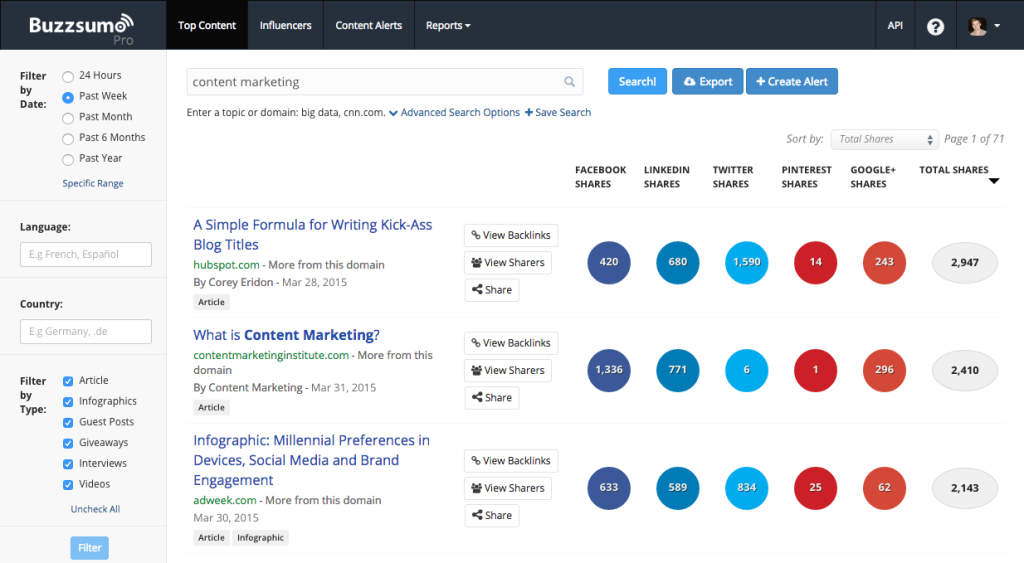
Is their Content Ranking High in BuzzSumo?
Find and analyze your competitor’s content and ranking on BuzzSumo.
You’re able to research and track their relationships and engagement to determine if they are being cultivated as influencers across the web. If they are ranking well, use this information to discover their secret to success, then put your customized spin on it.
Site Code, Structure, & Usability
If you haven’t been keeping up with the myriad changes shaking up the SERPs lately, most of Google’s updates have been about improving the experience for its users.
Faster load times, better mobile experiences, and an emphasis on intent have all brought major improvements to the end-user.
What that means for marketers is, if your website is confusing, slow, or unresponsive, your competitors will take your place on the front page.
I recommend using Screaming Frog to analyze, crawl, and audit competitor sites for onsite SEO aspects, such as URLs, canonicals, page titles, meta descriptions, and headings. The tools also uncovers more technical issues like redirects, and can help you generate XML sitemaps.
https://www.youtube.com/watch?v=AOzOffh9HIE
Look at your competitors’ home page, landing pages, and product pages and identify the following elements:
- Navigation: Is it functional, and does it promote design, usability?
- Internal Linking Structure: Do internal links make sense based on the context? Do they follow a natural progression, or link to email signup sheets or an unrelated topic?
- Calls-to-Action: Are there clear CTAs? Do they make sense based on the stage in the buyer’s journey? Do they represent a logical next step?
- Intent: Make sure all content is written (and structured) with user intent in mind.
Your competitor’s categories will help you determine how their website is organized, such as the tags they use, retail categories, and the overall segmentation of their site’s content. If the site is content-heavy on ecommerce, the categories will help you understand their organization and user navigation.
Additionally, you’ll want to take a look at the tags that competitors use to categorize their posts, as this can give you an idea of the phrases they use to rank.
All of these factors influence how a website is crawled, indexed, and ultimately, ranked.
Make Improvements to Reverse Engineer SEO
Your structure will determine how search engines view your site. A good technical structure will promote the flow of link juice and distribute link equity to give your site authority, while a straightforward navigation makes things easier on users and sets the stage for conversions.
First, go for the low-hanging fruit and take care of the following tasks:
- Optimize Page Speed
- Make Sure Your Site is Secure
- Set Up Breadcrumb Navigation
- Optimize for Mobile
- Get Rid of Excessive Redirects
For best results, I recommend following the guidelines laid out on the Google Search Console Help section—they’ll go over the full range of technical dos and don’ts right here.
Chrome Extensions Aiyima and Redirect Path also provide a quick way to spot technical SEO issues on your site, as well as your competitors’.
Once your site’s structure is in place, don’t be too quick to launch your site. You need to establish your keyword, content, social media, and link-building strategies before you can expect to see any results.
Dig into Your Competitors’ Backlink Profiles
Taking a deep dive into your competitors’ backlink profiles is one of the best ways to find linking opportunities, content ideas, and forecasting information that can help you reverse engineer your SEO strategy successfully.
Majestic SEO gives a detailed analysis of competitor links and the size of their index. Quickly compare sites to see external links, anchor texts, and dive deep into links for specific pages.
Also, analyze both backlink and domain link counts to understand what your competition is doing to track performance.
Here we see backlinks and anchor text for Coca Cola.
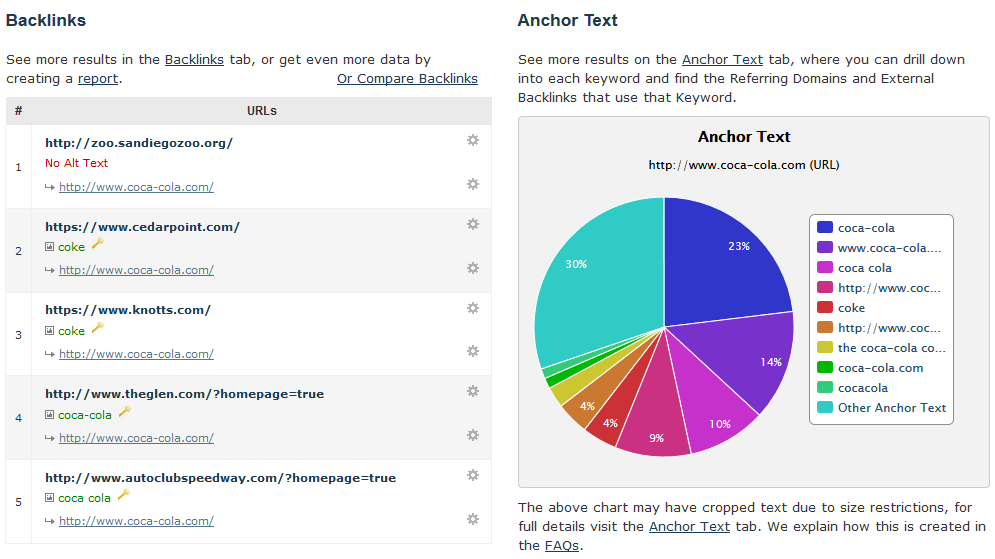
You might also use Ahrefs backlink checker, which provides a wide range of backlink metrics including:
- Most Linked URLs
- Domain rating
- Referring Domains
- URL ratings
- Estimated Organic Traffic
- Outbound Links
- Most Shared Pages
- Anchor Text Distribution
- Follow to Nofollow Link Ratio
- Natural to Unnatural Link Ratio
Implement a link building strategy that follows Google’s guidelines and is supported by high-quality content. Content and outreach make up approximately 91 percent of link-building efforts, while paid links are only about 19 percent.
The higher the quality of the content published, the more backlinks you’ll generate. Don’t use the exact same link building strategy as your competitors. Instead, carve out your own path to earn links from influential sites by syndicating your content with major industry websites.
Check Social Signals to Reverse Engineer SEO
While there’s some debate over whether or not all of your likes, shares, and retweets impact your SERP rankings, social media does help you increase visibility, drive traffic, and help you build more backlinks.
Check top social media sites, like Facebook, Instagram, and Twitter, to find out which channels competitors use, as well as which platforms drive the most engagement.
Analyze the type of content that’s generating the highest return and their posting frequency to help you develop your own social media campaign.
Investing in a social listening tool like Sprout Social or Mention will can help you find valuable insights vital to reengineering competitors’ SEO including:
- Linkless mentions
- User sentiment
- How often competitors publish content
- How often they promote content
- What types of content work best
- How brands communicate with their followers
- Media mentions
All of these elements allow you to learn more about what your competitors’ customers like about their brand, as well as where they’re earning links—allowing you to identify potential link-building opportunities for your own site.
Look Toward Alexa and QuantCast for Demographic Insights
Use Alexa and QuantCast to discover important demographic, geographic, and lifestyle information about the audience your competitors are targeting and who they are actually pulling in.
You’ll find out the gender, age, income, education level, browsing location, and more, which you then use to further customize your own target audience—or even reach new groups you haven’t targeted before.
Do they have hreflang Tags?
Hreflang tags tell search engines about specific languages content is written in and can specify location.
If your competitors are using these tags, you may want to consider expanding the reach of your campaign to include other languages and regions. Or, you may find that the regions they are targeting aren’t the same as yours, leveling the playing field.
Monitor Performance as You Reverse Engineer SEO
After you’ve identified your top competitors, continue to monitor their top 3 pages for any change. Keep tabs on what they are doing and the performance of the pages to make adjustments to your own strategies to accommodate the changes.
A tool like ChangeDetection.com is perfect for this, as it allows you to see what changes they’ve made by creating a change log for specific pages. You’ll be alerted by email or text to view change reports for text changes, such as updated metas or keywords on specific pages.
Wrapping Up Reverse Engineering Competitor SEO
Reverse engineering your SEO strategy is a process, you’ll need to keep analyzing top competitors and scanning for new rivals—but at the same time, keep a tight focus on keeping up with the latest best practices and tracking your efforts.
Use analytic tools like Google Analytics, Webmaster Tools, SEM Rush, Crazy Egg, Google Website Optimizer, and Optimizely to monitor your site’s performance. You’ll see what’s working and what isn’t to make necessary adjustments.
