
Content marketing metrics are essential for driving meaningful ROI. They must be accessible, accurate, and actionable. Because franchises operate under unique constraints and goals, understanding these metrics within the context of the franchise model is critical.
This guide, led by Kim Wise, Content Editor Specialist, breaks down why a tailored content strategy matters and how to measure what counts—covering keyword targeting, writing best practices, auditing, and more.
What You’ll Learn:
- What is Content Marketing ROI?
- Calculating Your Content Marketing ROI
- Key Factors in Determining Your Content Marketing ROI
- Structuring Your Content Marketing Metrics Dashboard
What is Content Marketing ROI?
ROI is the return on investment, a ratio between your company’s income and investments. So, it makes sense that content marketing ROI is the revenue gained from content marketing as a percentage of the amount spent.
To calculate your content marketing ROI, take the revenue from your content, subtract your content marketing spend, and divide it by the spend.
The higher your ROI, the better.
Keep in mind that certain trends in the marketing industry are impacting your ability to measure the ROI of content marketing. For instance, multi-channel attribution is crucial to understand if you want to determine where your leads are coming from. AI analytics tools can also help you more effectively determine the cost-effectiveness of your campaigns and help with optimization.
Additionally, you must determine which devices are generating the most traffic, leads, and ROI, with insights into mobile and desktop users. This aspect is particularly important as around 63% of all website traffic comes from mobile devices.
Consider other content marketing ROI statistics, too: According to a CMI study, the average content marketing ROI is $2.77 for every dollar spent, which is an impressive figure. Also, content marketing generates more than three times as many leads as outbound marketing while costing 62% less.
Calculating Your Content Marketing ROI
When it comes to content marketing, calculating your ROI can be difficult. The return on marketing investment formula alone won’t be enough. However, it is necessary to make sure your efforts are growing your brand.
By evaluating your content consistently, you’ll be able to learn a few things:
- Where you can invest more money
- Where you should cut back on spending
- Which tactics are working in your strategy
- When you need to pivot
- What content topics and formats your audience responds well to
My Expert Opinion on Franchise Content Marketing
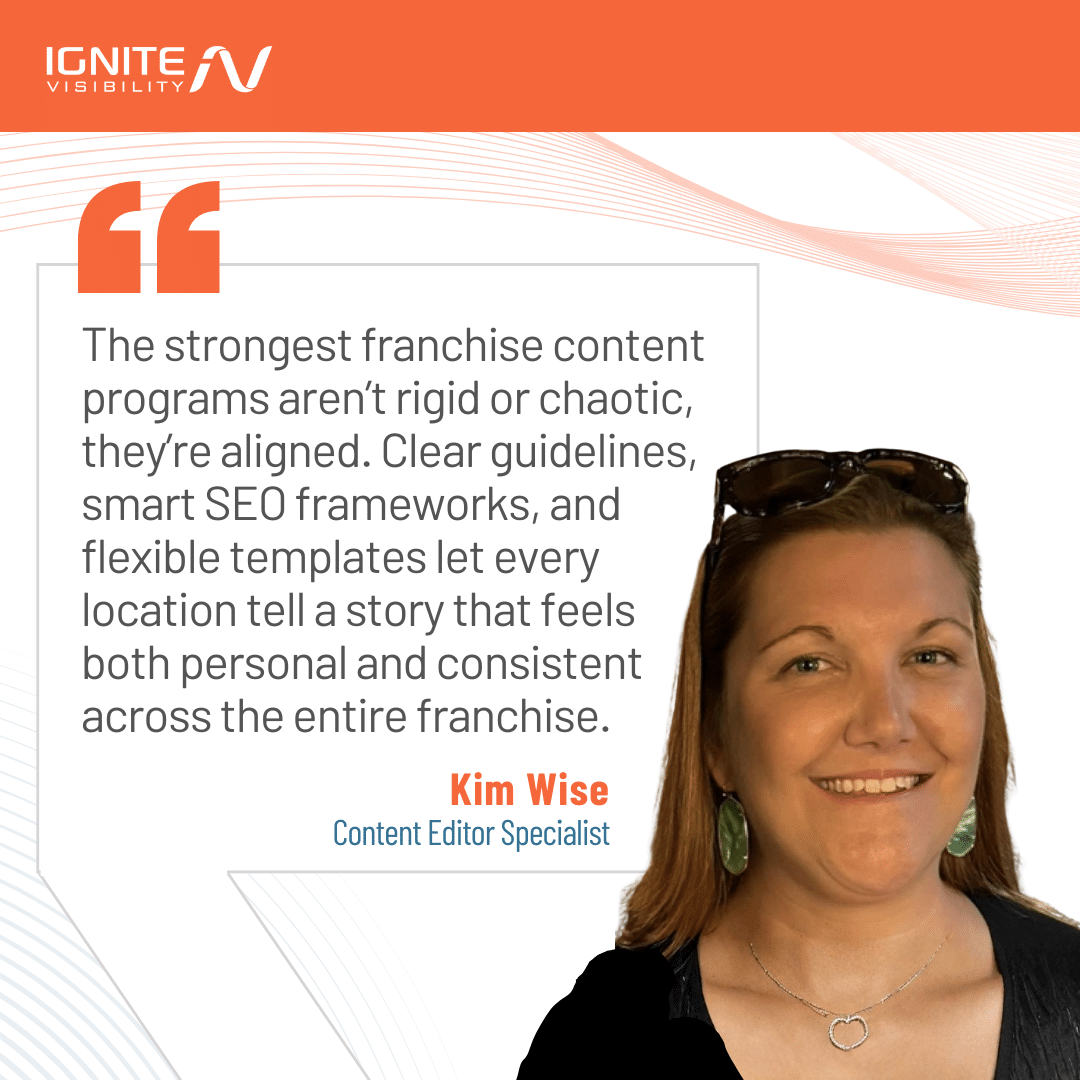
Maintaining consistency across hundreds of pieces of franchise content takes more than good writing; it takes a system. My team creates everything from corporate blogs to locally focused pages, so we see firsthand how small differences in tone, formatting, or keyword focus can affect performance. What works best is building a framework that scales: clear brand guidelines, standardized outlines, and flexible templates that allow for local relevance without sacrificing quality.
It’s not about producing cookie-cutter content; it’s about giving every piece the same foundation of clarity, accuracy, and value. When that structure is in place, franchise content feels unified but still speaks directly to local audiences, and that’s where real SEO and engagement gains happen.
Why Franchise Content Marketing Requires a Different Strategy
Content marketing ROI is the ultimate measure of success for any business. It’s how we confirm the resources you’re spending on content are actively generating revenue and justifying future investment.
Every business needs a content strategy, but franchises must localize theirs for it to resonate with audiences. Typically, there’s a playbook from corporate, which usually focuses on the national brand story.
A franchise content marketing strategy that’s successful does two things well: stays in alignment with the national brand and incorporates the local angle. It can be a challenging thing to achieve. The balance between consistency and local relevance makes building a plan hard to navigate at times.
There’s much at stake in developing your franchise road map: SEO, lead generation, and brand authority. Here are some tips to marry these two areas:
- Lean on corporate strategies to build credibility. Corporate teams excel at developing key messaging, so use that content as a base and find meaningful ways to localize it.
- Use a corporate library of resources provided, including written content marketing and imagery. You can customize these to your locations.
- Take advantage of content templates. Corporate often provides templates for events, promotions, or social media. Adjust images, copy, or calls-to-action to reflect local audiences.
- Localize a national campaign. An example would be a holiday shopping campaign. There may be specific deals set by corporate, but you can pick and choose which to promote based on the sales data from your stores.
- Optimize content with local content marketing keywords. Much of the time, this is adding the city, community, or neighborhood to general keywords. There may be other nuances that are specific to your customers, as well.
- Collaborate with local influencers. National brands may have well-known spokespeople, but your marketing will be stronger if you work with someone who has local credibility.
Keyword Targeting for Franchise SEO Success
Content marketing keywords are the foundation for SEO. Getting it right is the difference between success and stagnation.
First, you’ll need to define how to do keyword research for content marketing. There are different approaches depending on the type of content—main site pages, pillar pages, or blog posts.
These content targeting keyword strategies will support your initiatives:
Choosing Scalable, Localized Keywords
Look at volume and competition for standard keywords plus a city, state, neighborhood, ZIP code, or county. “Near me” is another focus. You can use tools like Keyword Planner, SemRush, or Ahrefs.
To scale, you’ll need to think about your site structure and how it will align with these keywords. It may include micro-sites or dedicated location landing pages that have a structure of:
- Yourbrand.com/locations/san-diego
You can also write city-focused blogs (hyperlocals).
Balancing Brand vs. Local Intent
Root keywords should follow what the corporate brand optimizes for, as long as those services or products are available at your locations. To not compete with national website pages, add the local intent to create longer tail keywords. You don’t want to be vying for the same exact words as the corporate website.
Prioritizing High-Volume, Low-Difficulty Opportunities
All your content marketing keyword research will provide the volume of searches each month and keyword difficulty. The greater the keyword difficulty score is, the harder it is to rank. Find a happy medium by concentrating on those with decent volume and lower difficulty.
Depending on your industry, there may be fewer of these than others. You may be competing with more than one industry type if the keywords relate to several different types.
Content Marketing Writing for Consistency, Quality, and Local Relevance
You may not have a superstar content marketer on your team, but you can still implement these best practices to support consistency, quality, and local relevance.
- Maintain tone and quality across all locations: This is where corporate style guides for tone and voice come in handy. They often provide insights on how a copy should sound. This may include specific attributes, words to use or not use, and other brand-focused messaging.
- Empower “less-than-stellar” writers with frameworks: Templates with SEO guidelines are useful to any content producers, regardless of their talents. These can include headers, requirements for linking, length, main points to cover, and the type of CTA.
- Avoid thin or low-value content that hurts SEO: Content with fluff that stuffs keywords and has no originality won’t boost your search rankings. All your content should be a storyline that sets up challenges, why they exist, and the solutions you offer. If it’s not meaningful and full of examples, it won’t perform well.
Franchise Content Can Hurt Your SEO: 5 Things to Avoid
Can content marketing actually impact SEO negatively? Yes, so be aware of these five common ways it can happen.
1. Not Using the Right Keywords to Compete
Content marketing keywords are foundational to your strategy. However, you have to use the right ones that help you outrank competitors.
First, evaluate competitors using SEO tools such as Ahrefs or SEMrush to see how they are ranking. Analyze their content and identify opportunities to improve on it, whether through more in-depth coverage, higher readability, or a clearer structure and hierarchy.
Focus your content using keywords that match your goals for branding, conversions, and qualified leads.
You also need to use these keywords correctly. Each piece of content should focus on multiple high-power keywords, not just one. Search engines use a process called “latent semantic indexing,” which means that they can see how various keywords in a piece of your content relate to other terms on that page and on other pages. This is how they decide what the most important themes of each piece of your content are, so make sure these are the takeaways you’ve intended with your content.
Your content will work best from an SEO perspective when you have a long, meaningful list of keywords that define what you do and who you serve and have a localization aspect.
2. Failing to Promote Your Content
Once you hit publish, you also need a distribution plan. Promoting your awesome content is at least as important as creating it. You cannot expect the search engines to do your promotional work. Even the most optimized pieces of content require active promotion. If all you do is create content, you’re engaging in “content production,” not content marketing.
Take a multi-pronged approach to content promotion:
- Create a newsletter that shares your weekly content with subscribers.
- Share your content across your social media profiles.
- Comment on posts or forums with your content link if it’s relevant.
- Pitch your content to local influencers, editors, and site owners as great material for their audiences.
3. Content Is Too Short or Too Thin
Search engines often deliver a boost to longer pieces of content. Length also allows you to use more keywords in natural ways. Would you rather slog through ten 500-word posts that each deal with a small part of your topic of interest or just read one 1,500 to 2,000-word post that includes everything you need to know?
You’ll get more value with the latter. You may see better results when tracking your content marketing success metrics with this approach. From a franchise perspective, corporate could give you an outline or key points for a topic. That’s your starting point; now you need to flesh it out and optimize for your targeted keywords.
One word of caution: remember, no padding or fluff. Your lengthier pieces should offer extensive, useful information. If they don’t, you’ll irritate your audience.
4. Content Production Is Too Low
If there’s one key to achieving content marketing ROI, it’s being consistent. If you only create content here and there without a calendar or a plan, it won’t deliver traffic or leads.
Setting up a defined plan for output and sticking to it will signal to search engines that you are regularly creating content.
There are many different formats available, and you can repurpose them. For example, take an e-book and break it down into an explainer video.
5. Content Lacks Originality
You never want to just copy and paste what your national corporation provides. It won’t be relevant to your location. Additionally, it will be duplicate content, which search engines penalize. Some ways to maintain originality include:
- Ensuring that each piece has a local story and feel by using examples that reflect your audience
- Writing with the language of your region and customers
- Expanding on angles that highlight what’s happening in your market
- Using local long-tail keywords
- Ending with a call-to-action (CTA) that makes sense for your area
Measuring What Matters: Key Franchise Content Marketing Metrics
Content metrics deliver actionable insight. They reveal what’s working and what needs improvement. Defining your key performance indicators (KPIs) is the first step to consistent tracking.
Organic traffic
This is the traffic coming to your site from search engines. In Google Analytics (GA) or SEO tools, you can view total and new organic traffic. When your SEO tactics are in place, you should witness a consistent increase.
Organic clicks are another critical metric to track. Look for overall keyword ranking, too, and how you’re either gaining or losing spots.
Conversion metrics
There are multiple things to measure under this category, including:
- Lead form completions
- CTA click-through rates (CTRs)
- New subscribers to newsletters or social media profiles
- Closed deals tied to marketing qualified leads (MQLs) that originated from content
Engagement
Engagement metrics uncover if your content is resonating. Track this by viewing:
- Time spent on site or page: Time spent on site is an excellent sign of engagement with content. The benchmark for this varies by industry, with a median value of 1 minute 31 seconds. Watch time spent for two reasons. First, you want your time spent to rise so you can get more leads. Second, you need to be sure that time spent is connected to more leads and conversions.
- Social media shares, likes, and comments: Measure your total number of social shares and how many shares each piece received. You can do this with a social share checker or the native analytics for your platforms, or with a tool like Buffer or Buzzsumo. You can also use the “content grouping” function in GA to see which types of content get more engagement.
- Page depth: This metric tells you the precise number of pages a user visits during their time on the site. Check this by looking at “page depth” in GA. You find this under “audience,” and then “behavior,” and then “engagement.” If none of your visitors look at more than two pages, you’re lacking some hardcore fans.
- Natural inbound links: When someone creates this kind of link to your content, they’re showing their entire audience something they found truly valuable.
Structuring Your Content Marketing Metrics Dashboard
To make it easy to track and measure, you can create a dashboard with all the most critical metrics. You can include the KPIs covered above.
Depending on the source of the data, you will need a platform that allows you to feed this into a centralized dashboard. One excellent option for this is Google Data Studio.
For content marketing metrics dashboard configurations, be sure there’s data sync, so you’re not looking at stale information.
Why are metrics for content marketing so vital? Well, it helps you avoid those mistakes we discussed earlier. You’ll know the state of keyword ranking and can make adjustments. You’ll also gain clarity around distribution model success and the overall quality of your content. Measuring what matters sets your franchise up for long-term content marketing success.
How to Audit and Improve Franchise Content ROI
Franchise content marketing metrics provide you with the insights you need to make improvements. Auditing your content engine enables you to identify where to start.
How to Run a Multi-Location Content Audit
Take these steps to perform your audit:
- Create an inventory of all content across all locations.
- List performance metrics for each page (e.g., views, time on page, ranking).
- Include metadata for each page to find those with blanks or duplicative content.
- Evaluate how effective the content is based on metrics, and highlight those areas with the worst performance.
- Determine where keyword targeting gaps are and what pages you could refresh to include these.
How to Implement Improvements
Following the audit, take these actions to improve content:
- Address duplicative content. This occurs when multiple franchise pages compete or when franchise content mirrors the corporate site. For competing pages, combine them into one. For mirrored corporate content, apply localization strategies to make it unique.
- Refresh location landing pages with declining rankings. If competitors are overtaking pages, update content and follow location SEO best practices. Adding depth or length to the content can also improve performance.
- Fix issues with title and heading tags. Audit pages for duplicates or missing elements, then revise them according to best practices.
- Update missing or non-unique meta titles and descriptions. Identify gaps during a meta audit and ensure each page has a unique, optimized title and description.
- Embed maps and driving directions. Local searchers often want to visit physical locations, and maps help search engines understand store locations. Display Google Business locations on the Contact Us page as well.
Level Up Your Franchise Content Marketing Strategies
Driving content marketing ROI for franchises requires a custom strategy and many considerations. It can be overwhelming keeping up with keyword trends, competitors, and content production.
Our team has deep expertise in franchise marketing, and we can help you with:
- Lead generation
- Creative services
- Content marketing and SEO
- Social media management
- And more!
Let’s work together. Get started by booking a consultation with us today.