Whether you’re a marketer, an advertiser, or just someone trying to squeeze a little bit more ROI out of your content campaigns, understanding how to improve your click-through rate can make a serious difference.
Even though some reports claim that classic organic search has lost 11-23% of its click share since 2025, it still has a higher click-through rate than paid ads. WordStream reports that an average of 6% of clicks on Google come from paid results, compared to a striking 94% from organic listings. This contrast can significantly shape how you define a “good” CTR across different channels.
In this blog, Jason Carleton, Sr. Director of SEO, dives into all things CTR. Whether you’re working on SEO, paid media, email marketing or social media, understanding and optimizing your CTR can significantly impact your digital marketing performance.
What We’ll Cover:
- What Is A Good Click-Through Rate
- Benefits Of Keeping Your CTR High
- When Should You Calculate Your Click-Through Rate
- Actionable Tips To Improve Your CTR
- What Factors Might Be Influencing Your CTR?
- CTR Benchmarks: How Does Your Click-Through Rate Measure Up?
- What Is A Good Click-Through Rate For Each Service?
- Frequently Asked Questions About CTRs
My Expert Insight On Click-Through Rates
Creating outstanding content is just the starting point; getting people to engage is where click-through rates (CTR) become critical. CTR acts as a powerful measurement tool for all of your content, determining how well your headlines, meta descriptions, copy, and visuals capture attention and drive action.
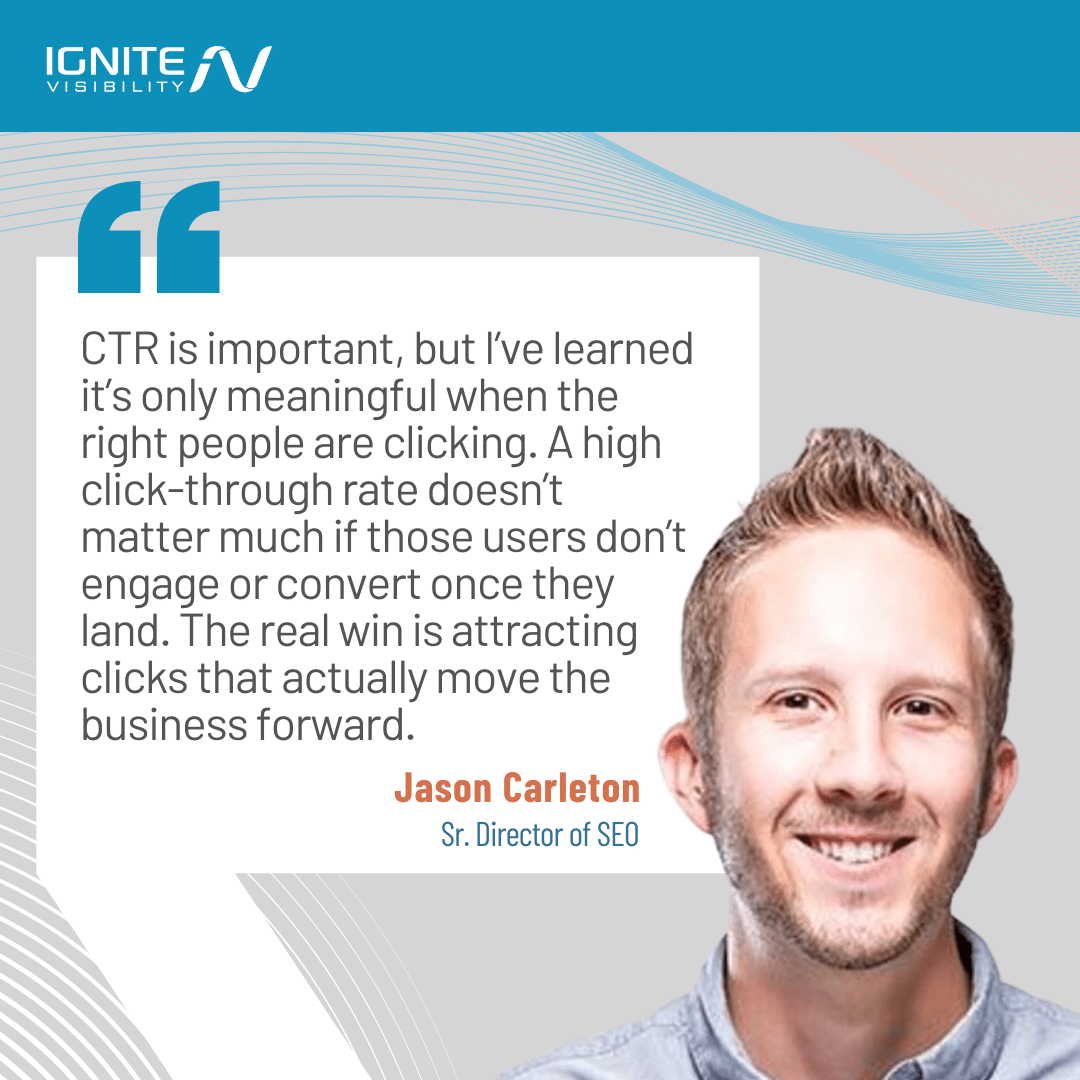
It’s important to note, though, that not all clicks are worthwhile. In 2026, marketers should stop chasing the highest possible CTR and start asking themselves better questions about the numbers they’re hitting, such as:
- Did the right audience click on my content?
- Did the click come from a high-internet query or a curiosity-driven headline?
- Did the user engage after landing on my page?
- Did the click contribute to pipeline, revenue, or retention?
Even the highest CTR is worthless if it isn’t coming from clicks that mean something. The goal of content marketing is to connect with the right people.
In a recent case study, we shared how we increased our customers’ lead volume by 82% while decreasing cost per lead (CPL) by 32%. That’s because we focused on fully understanding their clientele before launching a high-reach awareness campaign.
I recommend A/B testing for different headlines and descriptions to pinpoint what your audience responds to best. Ultimately, a high CTR not only brings more visitors to your site but also enhances overall engagement, positioning you for better conversion rates and improved ROI across your entire digital marketing strategy.
Understanding Click-Through Rate
When it comes to what is a good CTR, we need to first establish what a CTR is. So, what does CTR mean in marketing?
This number refers to the ratio of how many users click a specific link to the total number of users who view it.
The ratio would look something like this:
User Clicks: Total Views
It measures how well your link – whether it’s a Google ad or Facebook copy – attracts people to your website.
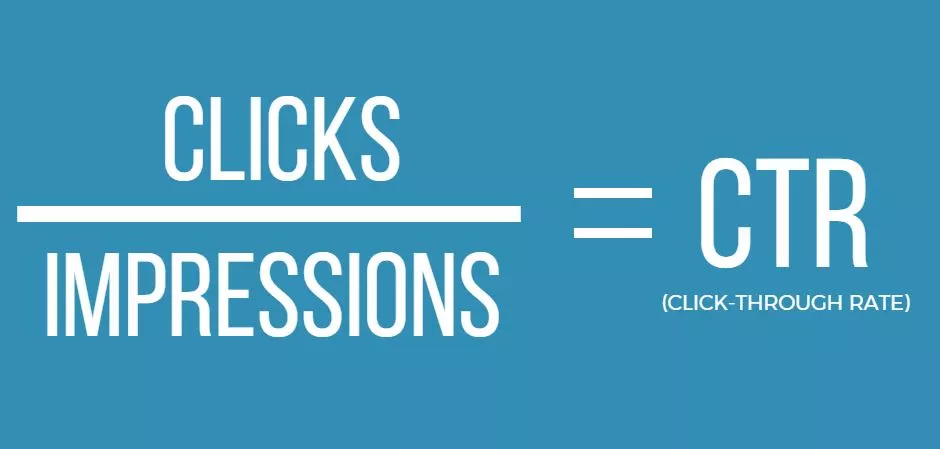
It’s important to know how to calculate CTR in general. The formula for click-through rate is Total Clicks/Total Impressions x 100
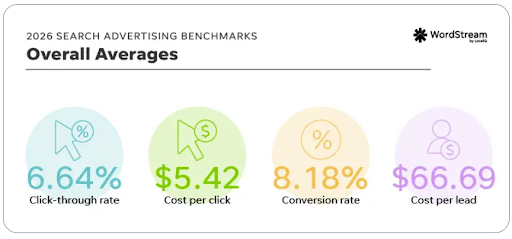
As of 2026, the average click-through rate in Google Ads in 2026 is 6.64%.
As this formula suggests, it’s equally important to track impressions alongside clicks to get a better feel for how your campaigns are performing.
Imagine sharing your latest blog on your LinkedIn profile or your personal website.
Impressions: This is how many people see your blog. Impressions show how many people notice your content.
Clicks: This is how many people stop and click on your blog, indicating they are interested in learning more.
If lots of people see your blog but no one stops to read it, that may be an indicator you need to improve your content. The key is turning those impressions into clicks by reaching the right people with compelling content.
Click-Through Rate vs. Conversion Rate
In better understanding the click-through metric and what makes it stand out, you might wonder what the difference is between click-through rate and conversion rate. So, how is click-through rate different from conversion rate?
Click-Through Rate
The click-through rate is the percentage of people who click through a link or ad compared to the number of impressions. In email campaigns, it could refer to the number of people who actually click on links within your email after opening it, while in advertising, it refers to the number of clicks out of all impressions for an ad.
Conversion Rate
So, how is click-through rate different from conversion rate? Well, click-through rate only tracks the percentage of clicks you receive, while conversion rates refer to the percentage of times people complete a specific desired action, such as downloading an app or completing a contact form.
What is a Good Click-Through Rate for Each Service?
So, what is a good click-through rate? It depends on where and how you’re showing up.
Click through rate benchmarks vary quite a bit from channel to channel, so rather than chasing one magic number, it’s more useful to understand what “good” looks like for each specific service.
Search Engine Optimization
The ultimate goal of SEO? Landing that coveted top spot on search engine results pages (SERPs). SERP click-through rates are among the highest, especially in the top organic results.
Here’s where CTR shines:
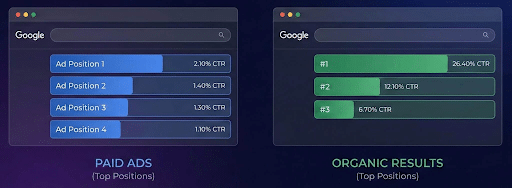
Image Source: Indexsy
According to recent studies, the first position boasts a sizzling 26.4% CTR, while the second place dips to 12.1%. By the third spot, it’s a mere 6.7%.
That said, the modern SERP is more complex than ever. AI Overviews, featured snippets, Shopping widgets, and other SERP features are taking up more real estate at the top of the page, which means organic results can get pushed down, even when you’re ranking well. When an AI Overview appears, it can reduce position one CTR by up to 58%.
This makes it more important than ever not just to rank highly, but also to optimize for the SERP features that drive the most clicks for your target queries. Zero-click searches, where users get their answer directly from the SERP without clicking through, are also on the rise, which is why understanding all of these complexities is a key part of any solid SEO strategy.
To keep your SEO CTR competitive, aim for relevant, high-quality keywords and optimize your website for user experience to climb the SERP ladder and snag those top clicks.
- Research and target a mix of high-volume and long-tail keywords that resonate with your audience.
- Craft compelling content that informs, engages, and answers user queries in 2025.
- Build high-quality backlinks to your website from reputable sources.
- Utilize Google Search Console to identify areas for improvement and track your SEO performance.
Paid Media
Pay-per-click (PPC) advertising lets you target specific audiences. The average PPC CTR is around 6.64%, ranging from 5.56% for the automotive industry to 12.75% in the arts and entertainment industry.
Supercharge your PPC CTR:
- Include special promotions or discounts in your ad copy to grab attention.
- Use strong calls to action that urge viewers to click.
- Target long-tail keywords to reach a more specific and engaged audience.
- Leverage Google Ads extensions like seller ratings and site link extensions to boost ad real estate and value.
Also, keep in mind the difference between display ads and search ads. According to AdRoll, the average CTR for display ads is around 0.35%, while search ads tend to see an average of about 1.91%. That’s because those ads are more passive. The people who see them are typically just browsing. They aren’t actively searching for anything, which is why the average CTR for display ads is considerably lower.
Email Marketing
Email marketing consistently delivers some of the strongest engagement numbers of any digital channel. But if you want to get a real picture of how your emails are performing, you need to look beyond just click-through rate. You need to understand the difference between two commonly confused metrics: click rate and click-to-open rate (CTOR).
- Click rate (CTR) measures how many people clicked a link among everyone who received the email, including those who never opened it.
- Click-to-open rate (CTOR), on the other hand, only looks at clicks from people who actually opened the email. CTOR gives you a much clearer picture of your email’s success.
Email marketing boasts some of the highest CTRs, making it a valuable tool for nurturing leads and driving conversions. The average email CTR hovers around 10%, with industries like transportation services reaching 2.6% CTRs, while personal care services falls around 0.7%.
Fuel your email CTR by:
- Make your CTAs prominent and easy to understand.
- Ensure your emails render flawlessly across all devices.
- Keep your email content concise and visually scannable.
- Use high-quality images that load quickly and enhance your message.
Social Media
Social media advertising through platforms like Facebook, TikTok, X (Twitter), and Instagram offers a dynamic way to connect with your target audience. However, CTRs tend to be lower than other channels:
On the organic side, CTR industry benchmarks reflect how often followers actually click through your posts to visit a page or link. It is heavily influenced by your content quality, posting frequency, and how much your message resonates with your audience.
Facebook organic link CTR averages around 1.21%, LinkedIn sits at about 0.67%, and YouTube thumbnail CTR (for organic video) ranges between 4–5%.
With paid social ads, you tend to reach a more targeted audience, which means your CTR is often higher and more predictable. Facebook Ads, LinkedIn Ads, and YouTube Ads all have their own CTR industry benchmarks that vary by industry, but the key difference is that paid ads put your content in front of people who may never have heard of you, making the creative and targeting even more critical.
Social Media CTR strategies:
Whether you’re running organic or paid social, these strategies can help improve your results:
- Create a sense of urgency with limited-time offers or exclusive content.
- Use strong action verbs like “download,” “sign-up,” or “learn more” to drive clicks.
- Incorporate high-quality images and videos that grab attention in feeds.
- Tailor your content and approach to each platform’s unique style and audience. For example, leverage sound and captions on platforms like TikTok.
What Is a Good Click-Through Rate for Each Industry?
The industry-standard click-through rate depends on the kinds of audiences you’re targeting, competition, and placement, among other factors. Let’s consider the different click-through rate benchmarks by industry.
Here are some of the average click-through rates for the most popular industries, according to WordStream:
- Attorneys & Legal Services – 5.87%
- Automotive (Repair, Service, & Parts) – 5.56%
- Automotive (For Sale) – 8.28%
- Health & Fitness – 5.81%
- Finance & Insurance – 9.83%
- Home & Home Improvement – 6.47%
- Dentists & Dental Services – 5.66%
- Physicians & Surgeons – 6.61%
- Real Estate – 7.61%
- Restaurants & Food – 6.83%
- Shopping, Collectibles, & Gifts – 8.28%
These industry-standard click-through rates can give you a benchmark to serve as a guideline, helping you determine what your ideal click-throughs should be.
Benefits of Keeping Your CTR High
- Boosts Search Ranking and Ad Quality Score: Google loves relevant content. High CTRs signal that your content resonates with users, potentially improving your search ranking and ad quality score. The higher the actual click-through rate, the higher the expected CTR for Quality Score. While this metric won’t directly impact SEO, it can serve as an indirect signal that indicates to Google that users find your content helpful, meeting Google’s E-E-A-T criteria for high-quality content. This translates to more organic and paid visibility, attracting even more clicks. Moreover, it lowers CPCs and improves ad position. For example, a 10% CTR on a well-targeted ad can reduce CPC by up to 20%.
- Uncovers Audience Preferences: CTR data is a goldmine of insights. It reveals what content grabs attention and what gets ignored. Use this knowledge to tailor your strategy and create content your audience craves. For instance, you might run two ads with the same budget, but one with a single varying element has a significantly higher CTR than the other, in which case you might run an A/B test to run two versions with the same element changed to confirm whether audiences prefer one or the other.
- Improves Campaign Performance: Analyze CTR data to optimize your campaigns across all channels, from email marketing to social media. By understanding what resonates best, you can refine your approach and get better results, leading to more website visitors and conversions.
- Increases Brand Awareness: The more people click on your links, the more they’re exposed to your brand. Over time, this consistent exposure can lead to increased brand awareness and recognition
When Should You Calculate Your CTR?
There’s no need to become a CTR-checking machine, but there are some key moments to pay attention to.
- Launching New Content: Just like a delicious new dish at a restaurant, you want to see how your audience reacts to your fresh content. Checking your CTR helps you identify what’s working and where you can improve to make it even more irresistible.
- Running Ad Campaigns: CTR is your secret weapon when it comes to ad campaigns. Regularly monitoring your CTR allows you to optimize elements like headlines and visuals for better performance, maximizing the impact of your ad spend.
- Revamping Old Content: Sometimes even the best content needs a refresh. Checking the CTR of older pieces can help you understand what resonated with your audience before. Use that knowledge to breathe new life into the content and make it shine again.
- Keep track of your CTR in Google Analytics 4 (GA4): you’ll need to set up event tracking for link clicks by using GA4’s built-in ‘Event’ reports. This allows you to monitor the number of users who clicked on specific links or buttons. You can further analyze CTR by creating a custom exploration in GA4’s ‘Exploration’ tab, where you can calculate the click-through rate by dividing the total number of link clicks by the total event impressions. This provides a detailed view of how effectively your links are performing across your website.
Actionable Tips for Improving Your Click-Through Rate
Among many other possible improvements, using dynamic keyword insertion in Google Ads can increase CTR by up to 25%, as seen in ecommerce campaigns.
It also helps to optimize your website with good designs and high-quality landing pages, as this can increase your Quality Score in the eyes of Google.
A higher Quality Score will help you boost rankings and, subsequently, click-throughs. A well-designed website also naturally encourages more people to visit and explore.
Quality content, calls to action (CTAs), and mobile responsiveness are also critical in developing click-worthy Google sites.
Other actionable improvements include:
Leveraging AI Tools for CTR Improvement:
- Use AI-Powered Audience Segmentation: Leverage AI to analyze user behavior patterns and segment audiences based on their interests, demographics, and engagement history, delivering more personalized content.
- AI-Based Ad Creative Generation: Utilize AI tools like AdCreative.ai or Phrasee to create and optimize ad copy and visuals that resonate with different audience segments, enhancing engagement.
- Dynamic Content Personalization: Implement AI-driven dynamic content that adapts to each user in real time, presenting the most relevant ads or products to improve CTR.
- Automated Performance Monitoring: AI tools can continuously monitor and analyze campaign performance, identifying underperforming ads and suggesting actionable optimizations.
- Predictive Analytics: Use AI tools to predict future trends and user behavior, allowing for proactive adjustments to content or campaigns before engagement drops.
Improving CTR in Email Marketing
So, what is a good CTR for email? Generally, you’ll want to achieve a click-through rate of around 2-5% in most cases.
The following are some of the main strategies to boost your click-through rate with high-quality emails:
- Write Compelling Subject Lines: Subject lines should be short, engaging, and unique from others in people’s inboxes. When appropriate, use emojis to further help your emails stand out.
- Personalize Your Emails: It’s also important to personalize your emails to speak more directly to recipients. Address them by name and use messaging and content that connects with them based on where they are in the sales funnel. You can also personalize content based on their interests and their initial source of contact.
- Optimize for Mobile: Most people today check their email on their phones. Ensure your emails are easy to view and read on mobile devices, including smartphones and tablets.

Optimizing for Different Platforms
Want to increase click-through metrics for Google Ads and other essential platforms? Here are a few platform-specific tips to boost your click-through rate:
- Google Ads: In addition to enticing ad copy, click-worthy Google sites, and high-quality visuals, you can increase your click-through rate for Google Ads with ad extensions, which add even more detail to your ads and can make them appear more prominently on the page. Also, use negative keywords to funnel more relevant traffic to your ads, making the most of your ad spend.
- Email Marketing: Create a sense of urgency to take advantage of fear of missing out (FOMO), with subject lines and content that indicate that a benefit will only last for a limited amount of time before it’s unavailable to recipients.
- Social Media Ads: Harness the power of video when possible to drive more engagement, and make your ads appear more like traditional posts in people’s feeds. Eye-catching visuals and good copy can more easily get people to stop scrolling.
What Factors Might Be Influencing Your CTR?
If you want to learn more about how to improve click-through rates, the following key factors could impact your results:
- Title Tags: The title tags that people see in search engines could be affecting your CTR, as these are likely the first items people see in search results. Title optimization should include targeting relevant keywords and clearly indicating what’s on the corresponding page, encouraging more people in search engines to click through.
- Meta Descriptions: In addition to your title tags, you should optimize your meta descriptions, which are directly below. These descriptions should be short and to the point, with a brief call to action to move more people through. While they do not directly impact SEO, they can support title tags by confirming the page’s relevance to the search query.
- SERP Position: The position of your page for a search will impact SERP click-through rates. The first few results at the top of the page tend to get the most clicks, and everything after them sees a significant dropoff. As such, it’s important to do what you can to stay on top of SERPs with effective SEO.
- Schema: In helping you climb to the top of search engine rankings, be sure to optimize your pages with schema structured data markup. These tags indicate to Google what your content is about, which can help you show up higher in search results, especially for more relevant search queries that are more likely to see a good click-through rate.
- Brand Trust: People will be more inclined to click links and ads corresponding to brands that they already trust. With more brand recognition and awareness, you can build trust among audiences, but appearing toward the top of search results is often enough to get more people to trust you and click.
- Mobile Usability: Your website must be mobile-friendly to do well on Google and other platforms. Even if people initially click through to your site, mobile users may instantly go back if they don’t have a good experience with the mobile version of your site.
- Site Speed: Another big factor to consider is your page loading speed. The longer it takes for your pages to load, the more likely people are to click away from them, and the more your page could fail to appeal to Google’s Core Web Vitals, potentially leading your site to fall off.
- Location of Ads: Where your ad appears on a webpage can also affect your CTR. Traditionally, those large banner ads haven’t performed as well as their slimmer counterparts, like skyscrapers and medium rectangles. Even the newer large rectangle format seems to be a better click magnet.
Actionable Tips to Improve Your CTR
Here are some surefire strategies to achieve a good click-through rate:
On-Page Optimization
To start with, focus on your on-page SEO elements like:
- Titles
- Descriptions
- Schema
Content Optimization
Additionally, be sure to optimize your content, including:
- Headlines
- Images
- User Experience
Incorporate keywords and make sure your page has good Core Web Vitals that make your content easy and convenient to navigate.
Testing
You should also conduct regular testing to gauge the performance of your website and other content, including A/B tests that run two iterations of the same content pieces with a single item switched out.
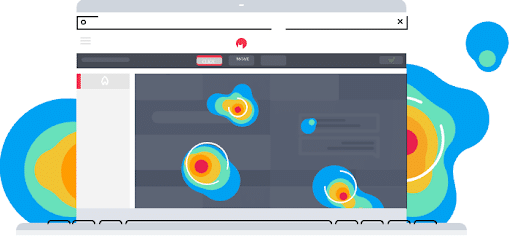
You can also use tools like Hotjar to see how people engage with your website via heatmaps.
Additional Ad Optimization Strategies:
- Target Ad Placement Based on Engagement: Analyze where your audience interacts the most and place ads in high-traffic, relevant areas like mobile-first platforms or specific time slots to maximize engagement.
- Optimize Headlines and Visuals: Ensure headlines are attention-grabbing and visuals are relevant, aligning with audience preferences and context of the ad to boost click-throughs.
- Utilize Retargeting: Show ads to users who have interacted with your brand but haven’t converted, increasing the chances of re-engaging them with targeted messaging.
- Ad Frequency Capping: Avoid overwhelming users by setting limits on how often the same user sees an ad to prevent fatigue and improve CTR.
A/B Testing for Ad Optimization:
- Test Multiple Headlines and CTAs: Run A/B tests on different versions of headlines and calls to action to determine which ones resonate most with your audience.
- Experiment with Visual Elements: Conduct A/B tests on different ad visuals or designs, such as image vs. video ads, to identify which formats generate more clicks.
- Vary Targeting Parameters: Test different audience segments by altering demographics, interests, or behavioral triggers to find the highest-performing target group.
- Measure Engagement Across Platforms: Run A/B tests on multiple platforms (e.g., Facebook vs. Google Ads) to determine where your ads are more effective and adjust your strategy accordingly.
These strategies help leverage AI and A/B testing to continuously optimize your campaigns, ensuring higher engagement and improved CTR over time.

7 CTR Mistakes to Avoid
To keep people clicking through and engaging with your content, avoid the following common mistakes:
1. Clickbait Titles

Maybe these were once pretty effective, but many people today are more wary and cautious when they see a title that looks suspiciously overpromising or simply deceiving. Titles should accurately reflect the contents of the corresponding page.
2. Irrelevant Pages

Pages might also be irrelevant and not contain the kind of content that people want to see. This could lead to high bounce rates, which could hurt your pages’ performance, especially in search results.
3. Slow Load Times

If pages take too long to load, this is another way to drive more people away. Pages should take no longer than a few seconds to load. You can increase page load speed by pre-rendering content and using lazy loading, which involves loading content only as the user scrolls down.
4. Mobile Unfriendliness

As mentioned, people want to enjoy a seamless experience on all devices. Test your website to ensure it’s mobile-friendly for smartphone and tablet users.
5. Weak Calls to Action (CTAs)

Make sure your calls to action are clear and relevant. What will drive people to the next course of action? You can try testing content with different CTAs to see which drive the most clicks.
6. Overcrowded Design

Web pages could be highly relevant and rich in information, but too much clutter on the page could distract and even annoy visitors to the point of leaving. Try to use empty space when appropriate and evenly distribute text, images, and other content throughout each page.
7. Poor Audience Targeting

Targeting the wrong audience is another way to reduce your CTR. Take steps to ensure your content is reaching the most appropriate audiences by conducting market research, seeing who your competitors are targeting, and segmenting your audience into different groups.
How to Track CTR
Tracking CTR isn’t a one-size-fits-all process. The right tool depends on what you’re actually measuring. Here’s a quick breakdown of where to look:
- Google Search Console (GSC) is your go-to for SEO CTR. It shows you exactly which queries are driving impressions and clicks in organic search, making it the most accurate source for SERP performance data. A quick note on impressions: Google is recently rolled out a fix for a logging error that caused Search Console to over-report impressions starting May 13, 2025. This correction means you may see a drop in reported impressions, but clicks and all other metrics remain accurate. See the Data anomalies in Search Console page for details.
- Ad platforms like Google Ads, Meta Ads Manager, and LinkedIn Campaign Manager are where you’ll track paid media CTR. Each platform provides built-in reporting that breaks down CTR by campaign, ad set, and individual ad.
- Email Service Providers (ESPs) like Mailchimp, Klaviyo, or HubSpot track both click rate and click-to-open rate directly within their dashboards.
- Google Analytics 4 (GA4) is best used to track on-site CTR, such as how often users click internal CTAs, buttons, or links on your website. By setting up event tracking in GA4, you can monitor which on-page elements are driving the most engagement.
The key takeaway here is to use the right tool for the right channel. Pulling CTR data from a source that wasn’t designed for that channel can lead to incomplete or misleading numbers, and that’s the last thing you want when making decisions about your strategy.
Frequently Asked Questions About Click-Through Rates
1. What is CTR in marketing?
Click-through rate (CTR) tells you how many people actually click on your online ads or content. A high CTR means your marketing is catching eyes and sparking interest, which is key to driving sales and conversions. The better your CTR, the more bang you’re getting for your marketing buck.
2. How can I improve my average click-through rate with video ads?
Keep your video ads concise and engaging. Viewers appreciate quick, valuable information. Since many might be watching on mute, craft a message that works visually and with captions.
3. How does my average click-through rate affect my PPC quality score?
A strong CTR on PPC ads translates to a higher Quality Score from platforms like Google Ads. This score rewards relevance and engagement, potentially lowering your ad costs.
4. Can having a high average click-through rate ever be a bad thing?
While a high CTR is generally positive, clicks on irrelevant keywords can be misleading. Focus on attracting clicks from genuinely interested audiences who are more likely to convert into customers. Similarly, a high CTR with very expensive keywords might still result in a loss if the cost per click is too high.
5. How can I improve my YouTube CTR?
Resist clickbait tactics! Create high-quality videos that genuinely interest your target audience and provide value.
6. Is a 10% click-through rate good?
For ads, it depends on your audience’s reach. Generally, a 10% CTR is considered decent. In SEO, a 10% CTR is good for results outside the top 2 positions.
7. What is a good click-through rate for 2026?
Over 3% is a healthy CTR for Google Ads, while Facebook Ads typically aim for over 8%. In SEO, the higher you rank, the higher your CTR should be.
8. Is a high click-through rate good?
A high CTR is excellent, but conversions are king. Many clicks with no resulting sales mean you might be spending money ineffectively.
9. Which social media platform will give me the highest CTR?
Facebook takes the crown! The highest typically averages a 1.61% CTR, with the average being 0.9%.
10. Does my industry affect my click-through rate?
Absolutely! Competitive industries like retail and email marketing typically have lower CTRs due to audience saturation. Exceptional content is key to standing out and attracting clicks. Additionally, consider your audience’s preferred platform. What works on LinkedIn might not resonate on TikTok. Tailor your approach to each platform.
11. What are impressions vs. click-through rates?
Impressions are a component used to help calculate CTR. While CTR measures the rate at which people click through ads, links, and other elements to track engagement and conversions, impressions track only the number of times an ad or another piece of content gets in front of users.
12. How do you calculate click-through rate?
If you want to know how to calculate a CTR, you can easily do so by using the formula: CTR = Clicks / Impressions x 100.
13. What is a good CTR for email marketing?
In many cases, a good CTR for email marketing falls around 2% to 5%. However, the precise ideal CTR for email campaigns will depend on the industry, email type, and other factors.
Want to know how to find the click-through rate of ads? You can easily do so using tools like Google Analytics and Google Search Console, along with social media marketing tools and other reports and analytics solutions.
Improve Your Click-Through Rates with the Help of Ignite Visibility
Understanding CTRs is key to optimizing your marketing efforts. Even if your numbers are average or a little low, don’t worry!
Ignite Visibility can help you improve your CTRs by:
- Crafting compelling calls to action
- Developing engaging content formats
- Optimizing your keyword selection
- And so much more!
Our digital marketing efforts are ready to work with you to improve your click-through rates across all channels, including SEO, PPC, social media, and email marketing.
Explore all the ways our conversion rate optimization services can help you reach your business goals!