

Effective web content management is crucial in keeping up with the ever-evolving trends of the digital marketing industry. Businesses must be able to develop and deliver personalized content that resonates, and the right content management system (CMS) is the key. Choosing the ideal CMS will allow for sufficient scalability, a stronger content strategy, and a better user experience on your website, moving more people down the funnel.
In this blog, Head of Engineering, Lucas Dantas, will look at two of the most popular CMSs, Adobe Experience Manager and Contentful CMS, and help determine which is best: AEM vs. Contentful.
What You’ll Learn:
- Understanding Contentful and Adobe Experience Manager
- Feature-by-Feature Comparison
- Use Case Scenarios
- Decision-Making Checklist
- FAQs
Expert Opinion on AEM vs. Contentful
To get the most from your website and app content, you need a robust CMS that gives you total control over your content strategy and delivery. Two options that many professionals use include Contentful and Adobe Experience Manager (AEM), both of which offer plenty of appealing features, but which work for different applications.
Like other critical management software, there is no one-size-fits-all CMS solution—you need to make the right selection based on your business model, content management structure, and other needs.
Generally, if you need a highly efficient solution that offers scalability and ease of content management for more agility, you might opt for Contentful, while AEM is more suitable for advanced content management needs.
Understanding Contentful and Adobe Experience Manager
When deciding between AEM vs. Contentful, take into account the nature of each and how the platform works. Here is a breakdown of both solutions to help you decide which one to implement.
Contentful CMS
Contentful is a “headless” and cloud-based CMS that can help professionals manage content across platforms, including websites, digital displays, and mobile applications. Its combined efficiency, scalability, and overall flexibility make it a great solution for many applications.
Part of what makes Contentful different from the Adobe CMS system is its “headless” design, meaning that users focus on managing the content on the backend without controlling how it appears on the screen to end users. In turn, you have more freedom to design and develop the user interface (UI) however you see fit.
The fact that Contentful is headless means that it takes an API-first approach, which allows it to easily integrate with many other systems and software to fit into your existing workflow. Yet another benefit of Contentful is its ease of setup for developers, making it even simpler to pick up and use based on your development needs.

Adobe Experience Manager
Is Adobe Experience Manager a CMS? Put simply, yes. In fact, it’s an excellent alternative to Contentful.
One of the main Contentful competitors is Adobe’s content management software, AEM, which is a more advanced solution that can help large enterprises efficiently manage all of their content assets across platforms, from websites and mobile apps to various customer touchpoints along the buyer’s journey.
Unlike Contentful’s purely headless CMS, AEM is a hybrid that can work as either a headless CMS or a traditional, full-stack option based on your needs. Using it as a traditional CMS eliminates the need to use any separate systems or tools, giving you a central platform to manage all of your content in one place.
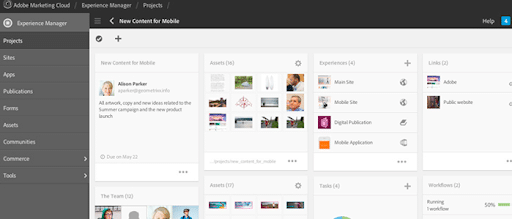
The benefits of AEM include enterprise-grade digital experience features using a combination of media, such as text, images, videos, and certain types of interactive elements, making it easy to deliver a consistent and personalized experience to all target audiences.
Another advantage of Adobe’s CMS system is its integration with the Adobe Cloud ecosystem, which helps ensure it connects with Adobe design software for even more ease of integration.
Feature-by-Feature Comparison
Let’s get a bit more granular when looking into the differences between AEM vs. Contentful.
Usability
Contentful offers superior ease of use to help teams efficiently manage and create content across platforms. For example, a small ecommerce business just starting out might benefit from using this platform to develop and manage everything from product descriptions and images to customer testimonials on an easy-to-use platform.
Meanwhile, Adobe’s content management system CMS comes with somewhat more of a learning curve, although it is very developer-friendly. An example of use here could include a large multi-language website that must balance translation with personalization, in which case developers can use AEM’s advanced features to assist with content authoring and workflow management across the site to deliver a consistent experience to international users.
Customization
Contentful is highly flexible as a headless CMS tool, helping with agile content modeling and allowing for easy API integrations to further improve customization.
Of course, one of the benefits of AEM also applies to customization, as you can harness the power of many features to develop a fully personalized CMS experience. This level of customization makes the Adobe CMS capable of meeting the highly specific needs of enterprises.
Integration
The headless structure of Contentful allows for simplified integration with frontend platforms, with the cost of potential additional development using those platforms.
If you need a solution for an enterprise with more complex integration needs, you might turn to AEM instead, as this platform offers robust integration capabilities as well for enterprise ecosystems.
Scalability
Contentful’s API-first approach makes it extremely scalable as your needs change.
At the same time, one of the core benefits of AEM also involves scalability to meet the ever-changing needs and complexities of enterprise systems.
Security
Security will be something of a separate consideration for Contentful as a headless CRM.
AEM, on the other hand, automatically provides you with comprehensive security features and enterprise-level compliance.
Support
If you need sufficient support to help with integrations and implementation, Contentful offers dedicated Customer Success and Professional Services with its Premium Tier, including 24/7 support based on your needs.
With AEM, you get access to Adobe’s dedicated support services, which is crucial in helping you navigate potentially complex integrations, upgrades, and custom options.
Pricing
With Contentful, you get multiple pricing options across three tiers based on your needs, including a Premium tier with custom pricing based on your specific needs for more flexibility. Pricing starts at $500/month.
Meanwhile, AEM’s intended use for larger enterprises with more complex needs makes it more expensive, with custom price points typically falling around tens of thousands of dollars.
Use Case Scenarios
When deciding on AEM vs. Contentful, consider the ideal use cases for each.
When to Use Contentful
Here are some instances when you might implement Contentful CMS:
- Multichannel Content Delivery: Use this platform if you need a headless CMS that can deliver content on multiple channels, including websites, mobile apps, and digital displays, separating content from other frontend systems for presentation.
- Agile Development and Iteration: If your website and other platforms need frequent updates, and you need to develop content fast, Contentful’s API integrations can make it easy to quickly set up personalized digital experiences as needed.
- Scalability and Flexibility: Need a solution that can scale with you as your needs evolve? Contentful is great for maximizing content availability and the efficiency of delivery through its content delivery network (CDN) and cloud-based infrastructure.
- Integration With Your Existing Tech Stack: Easily integrate Contentful into other platforms in your workflows, including analytics, marketing automation, and personalization solutions.
When to Use AEM
Alternatively, you would use Adobe CMS for the following:
- Managing an End-to-End Digital Experience: Using AEM, you can effectively manage and deliver web content and many other digital experiences to audiences while maintaining a consistent brand identity across all of your content.
- Advanced Targeting and Personalization: This tool can also help you precisely target your audience segments and harness the power of personalized content to connect with all potential and new customers.
- Large-Scale Management of Digital Assets: As one of the most robust Contentful competitors, AEM is also great for managing large volumes of content to keep things consistently organized, from images and videos to various documents and collective experiences using groups of various assets.
- Integration With Adobe Solutions: If you’re already working with Adobe products, including Photoshop and other software in your content development ecosystem, you may benefit from implementing AEM for maximum compatibility with your current setup.
Decision-Making Checklist
Consider the following as you weigh the benefits of AEM vs. Contentful:
| Factor | Choose Contentful if… | Choose AEM if… |
| Team Size | You’re working with a small to mid-sized team in need of an agile solution. | You need a more advanced solution for a large enterprise that can meet more stringent IT, marketing, and development needs. |
| Content Strategy | You want to deliver content on websites, apps, digital displays, and other platforms with optimal flexibility. | You have more extensive requirements for personalized experiences on a larger scale across several platforms and with many digital assets. |
| Tech Resources | You’ll benefit from a headless, API-first platform that can integrate with frontend development tools. | You are currently working with an Adobe ecosystem and want more control for your development team with a hybrid CMS. |
| Growth Plans | You’re starting small and want to scale quickly, with rapid product launches and the need to target new markets and experiment with new experiences. | You require a solution that can handle exponential growth as your business and content library rapidly expand without compromising performance at any point. |
| Compliance Needs | You seek more standard security measures such as two-factor authorization and access control, as well as data encryption, which you may need to supplement with other frontend solutions. | You require more advanced security solutions to maintain consistent compliance at the enterprise level. |
FAQs
1. What is the main difference between Contentful and Adobe Experience Manager?
The primary difference between Contentful and Adobe content management software is the scope of the sites and operations for which they are intended. Contentful is perfect headless CMS for startups looking to expand rapidly while managing their growing content library, while AEM is better for well-established enterprises that need to effectively manage many digital assets as they grow with a hybrid CMS.
2. Is Contentful better for startups than Adobe Experience Manager?
Yes, Contentful is generally the better option for businesses just starting out, as it allows for more agility and flexibility as a headless CMS that can work with frontend CMS solutions. As such, it’s more cost-effective than the more advanced solution that is Adobe content management software.
3. Does Adobe Experience Manager offer headless CMS capabilities like Contentful?
If you require a headless CMS, AEM is a viable option as a hybrid CMS that can function as either a traditional or headless CMS. It really depends on your unique requirements and what level of integration and control you need for content management.
4. Which CMS is easier to integrate with third-party tools: Contentful or AEM?
Contentful’s API-first approach makes it more capable of integrating with third-party tools like frontend design tools, reporting and analytics platforms, and more. Meanwhile, AEM is good for integrating with other Adobe products if you are currently implementing these solutions.
Get the Right CMS Solution With Ignite Visibility
Looking for the perfect CMS to integrate into your content strategy? Ignite Visibility could direct you to the right solution and help you manage, develop, and deliver all of your content to your target audience based on your specific business goals and objectives.
When you turn to us, you’ll get:
- Market research to help identify your target audience
- Help with developing content that speaks to each audience segment
- Access to the best CMS tools for managing your content across platforms
- Deliver content on your websites, mobile apps, social media platforms, and more
- Continually monitor and measure the results against your goals
- And more!
Reach out to us today to request a free proposal and get started with a custom digital marketing solution!

