Although influencer marketing is a great way to connect with audiences, you need to measure your campaigns to gauge success. Using the right key performance indicators (KPIs) based on your goals will help you determine what’s working and what isn’t, which can help you further optimize your campaigns for long-term success.
As the influencer landscape continues to evolve, it will be increasingly important to track the right influencer marketing KPIs to stay ahead of competitors using these strategies, keeping you in the forefront in your industry with measurable ROI.
In this blog, Ignite Visibility’s Sr. Social Media Strategist, Ashley Nigro, will give some guidance on setting KPI goals for influencer marketing campaigns.
What You’ll Learn
- Understanding Influencer Marketing KPIs and How They Work
- How to Set KPI Goals for Your Influencer Campaigns
- Tools to Measure Influencer KPIs
Our Expert Insights on Influencer Marketing KPIs
Knowing the right KPIs for influencer marketing campaigns will help you determine how well your efforts are performing, but the key is to choose your influencer marketing metrics based on both your goals and industry averages.
Action Item: Determine what you want to achieve with your influencer marketing strategy, whether it’s to increase brand awareness, generate engagement, or boost conversions. Based on these goals, you can then identify the metrics that matter most and set specific KPI goals for influencer marketing campaigns.
Understanding Influencer Marketing KPIs and How They Work
KPIs for influencer marketing consist of various metrics that help measure your campaigns’ results against your goals. Using influencer marketing analytics tools and reports, you can use these KPIs to determine whether your efforts are effective or if they need more optimization.
When selecting influencer marketing KPIs, you should avoid vanity metrics that may appear great, but don’t actually give you any valuable insights into your campaigns. Instead, choose only the actionable metrics that align with your KPI goals for influencer marketing campaigns.
For example, when setting goals for influencer marketing, you might opt to boost brand awareness with your campaign, in which case you would want to track metrics like reach or impressions, while trying to drive more conversions would have you focusing on conversion rate, click-through rate, and sales, among other related KPIs. Conversely, evaluating influencer engagement rates might be more crucial if you want to increase engagement with your brand.
Also, keep in mind that when gauging influencer marketing ROI, the various influencer marketing KPIs you track could apply to both your organic and paid marketing campaigns.
As you identify the right KPIs and measure influencer campaigns with meaningful insights, you can maximize return on investment (ROI) and keep your campaigns cost-effective.
So, what is the definition of a rate in influencer marketing, and what goes into setting goals for influencer marketing? Let’s jump in!
How to Set KPI Goals for Your Influencer Campaigns
Before you choose your influencer KPIs, use your goals as a guideline. These goals could include a certain number of visitors to your website, a set dollar amount in sales, or others that would make your campaign a success.
To ensure your KPIs align with your goals, there are some key steps you can take, such as:
- Setting KPIs that are specific, measurable, attainable, relevant, and timely (SMART) in connection with your goals.
- Developing a visual representation of your KPIs and how they relate to each goal across your entire business, such as via a PuMP results map clearly indicating how each KPI would factor into your goals and campaigns.
- Determining whether each KPI can truly help you gauge progress toward each goal.

Just remember, the kinds of influencers you work with will help dictate how to measure influencer marketing success. For instance, micro-influencers will prioritize trust and engagement among niche audiences, while brand awareness will likely be the primary goal with macro- and mega-influencers with millions of followers.
With a better idea of how to set KPI goals for influencer campaigns, let’s look deeper into some of the most important KPIs for influencer marketing:
Reach & Awareness KPIs
At the top of the sales funnel, you’ll want to reach as many people as possible within your target audience. Through maximized reach and brand awareness, you can establish a connection with audiences using influencer marketing, gaining their trust and recognition as they begin the buyer’s journey.
If your goal is to boost reach and awareness using influencer marketing, here are some critical influencer marketing metrics to track and some goals to set for each:
1. Impressions
This influencer marketing KPI measures the number of times an influencer’s videos and other posts reach a potential viewer, but these people may not actually view the media. It’s a good indicator of the kind of reach your influencer campaigns are getting at the top of the funnel.
The average cost-per-thousand-impressions (CPM) for businesses to target is around $10, but this will vary based on factors like industry, the size of the influencer, and the platform you use.
2. Follower Growth
When working with influencers, track their follower growth along with your own on social media. Follower growth indicates the popularity of influencers and brands as they continue to reach more people.
Setting goals for follower growth could go by the total number of followers you want to see in a given period. While there isn’t much data around follower growth rates in influencer marketing, you can track the growth rate of certain influencers to determine which would likely help achieve your goal.
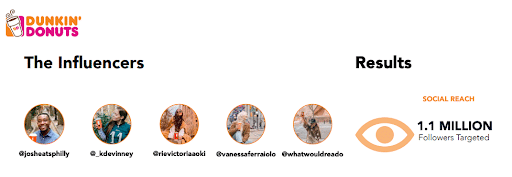
In analyzing ROI from influencer marketing, let’s take Dunkin’ Donuts’s example. The brand wanted to grow its follower base on Instagram while raising awareness for its espresso, positioning it next to leading coffee brand Starbucks.
Working with a range of nano-influencers, the company was able to expand its reach to 1.1 million followers on Instagram, culminating in 21,000 likes, 965 comments, and a 5.2% engagement rate.
3. Social Share of Voice (SSoV)
This metric helps compare brand mentions and discussions between your brand and competitors’ on social media. The larger your SSoV compared to the competition, the higher your visibility and recognition among audiences. Brand mentions could include direct (tagged) and indirect (untagged) mentions.
You can calculate this metric by dividing brand mentions by your industry total and multiplying it by 100 to give you your SSoV percentage. Set your SSoV goal based on competitors’ percentages.

Engagement KPIs
Going beyond reach, you’ll want your audiences to engage with your brand and the influencers promoting it. Here, you would measure various engagement metrics, including:
1. Likes, Comments, & Shares
These influencer marketing metrics keep track of the number of likes, comments, and shares for each influencer post. They indicate how people connect with content and the personalities behind them.
When setting goals around these metrics, calculate the total number of likes, comments, and shares for each post and measure them against competitors, which will give you a good idea of the level of engagement you want to achieve.
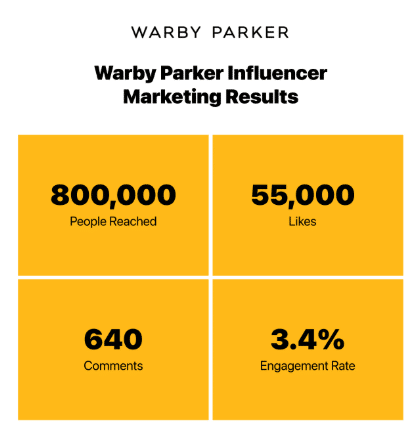
Warby Parker is one brand that really succeeded in getting these influencer metrics up. The eyeglass brand knows how to run an influencer marketing campaign and track key metrics for influencer campaigns, with its “Wearing Warby” campaign connecting with seven micro-influencers on both YouTube and Instagram
These influencers demonstrated how Warby Parker’s glasses helped them in their daily lives.
The results? Take a look:
2. Engagement Rate
Factor in likes, comments, and shares, along with clicks, into your overall engagement rate. This rate will let you know how people connect with influencers and your brand.
You can calculate the engagement rate by dividing the total number of social media interactions by the influencer’s followers and multiplying by 100 to get a percentage.
The majority of influencers have an engagement rate of around 1% to 3%, but micro-influencers tend to have higher levels of engagement among their audiences because of their smaller loyal following.

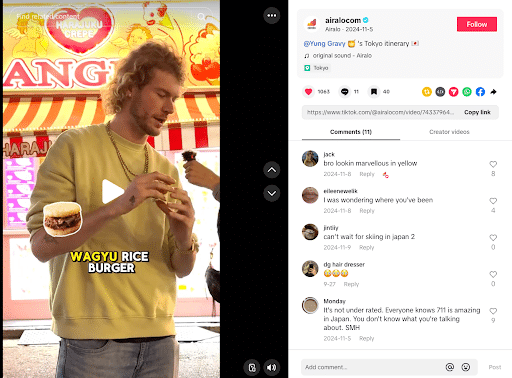
Let’s look at an example of a brand that was able to get an impressively high engagement rate: the Airalo app. This app aims to help smartphone users lower their roaming bills as the very first eSIM store that allows people to buy mobile data plans on the fly whenever they’re in another country.
The company behind it sought to boost awareness and connect with the travel community via TikTok. Specifically, the company partnered with various micro-influencers who each gave tips and hacks for travelers to follow while exploring the features and benefits of the Airalo app.
These efforts culminated in some impressive influencer marketing KPIs, including a 12.3% engagement rate, 2.1 million views, and a $0.23/install rate.
3. Click-Through Rate (CTR)
The CTR will show how many people are clicking through influencer ads and converting through calls-to-action (CTAs). Tracking this metric will help you determine how effective your campaigns are at getting people to move along the buyer’s journey.
The average CTR differs depending on the platform and industry. For instance, one recent year on Instagram saw an average CTR of 1.08%. Your goal could depend on the kind of CTR your competitors are getting or previous campaigns.
4. Sentiment Analysis
You’ll want people to speak positively about your business, which is where sentiment analysis comes into play. By conducting a sentiment analysis, you can measure positive interactions vs. negative interactions, which will help determine brands’ and influencers’ reputations among audiences.
When selecting an influencer, try to find one with a considerably higher number of positive interactions across all mentions.

Conversion KPIs
You must track your campaigns’ conversions, as high conversion rates will yield more profitability and help you make the most of your budget.
The following are some conversion KPIs that can help measure influencer campaigns:
1. Sales Conversions
After people engage with your brand and click through influencer ads, you need to measure all corresponding sales conversions. These can include sales made through affiliate links, discount codes, and other elements in your influencer campaigns.
The average conversion rate for influencer marketing campaigns is around 1% to 5%, with a good goal being 3% or higher. Again, various factors, such as industry and platform, can affect this goal.
2. Cost Per Acquisition (CPA)
The CPA measures how much it costs to acquire each customer through influencer marketing. Generally, this cost will be higher the more popular and bigger an influencer is, with costs potentially reaching tens of thousands of dollars.
Consider starting out small and going for nano- or micro-influencers to launch your campaigns. The average CPA for nano-influencers on Instagram is around $20 to $200, while micro-influencers come at an average cost of $35 to $450.
3. Return on Investment (ROI)
Your ROI will measure the overall profitability of your influencer marketing efforts. Different factors will impact your ROI goals, but the average ROI for influencer marketing campaigns is about $5.78 per dollar spent.

A great example of a brand that saw high influencer marketing ROI was Kettle + Fire, a company that sells healthy bone broths that aimed to develop more of a reputation on social media.
To achieve this goal, the company connected with various Instagram influencers adhering to the company’s brand requirements. At the same time,
Ultimately, this campaign led to a revenue of $4 for every $1 in Facebook Ad spend.

Content Performance
Measuring influencer content performance is critical for gauging the content’s quality. If people constantly interact with influencers and their content, there’s a good chance those influencers will drive more interaction for your brand.
Here are some influencer marketing KPIs to measure content performance:
1. Story Views & Video Completion Rates
Using analytics tools, measure story views and completion rates for all videos. If people are normally watching all the way through an influencer’s videos, this clearly indicates quality content. Also, look for trends in views or completion rates. If these metrics decline with recent videos, this could correspond to a decline in popularity.
A good starting point for video completion rate (VCR) is between 70% and 80%, but this will vary based on the industry, influencer, and platform.
One example of a brand that wanted to maximize views was the Cake app, which targeted non-Korean and non-English speakers as a free language-learning app. The company’s goal was to connect with people in South America who want to learn English, leading the Cake app to partner with influencer Carina Fragozo, who used YouTube videos to discuss the app’s various features with South American audiences. The end result was a reach of 1.2 million views.

2. User-Generated Content (UGC)
Another measure of quality and popularity is UGC from influencers’ followers. Good influencers will encourage their followers to develop their own content, which could incorporate your brand and offerings.
What is the definition of UGC in influencer marketing, exactly? Generally, it refers to followers’ content that connects with your brand, getting more people to engage with you alongside the influencer encouraging them to create content. You can then use this content in your own marketing efforts, providing you with convenient assets.
Check to see how much UGC influencers get, which can tell you what level of engagement they have among audiences.
Audience Quality KPIs
Even if an influencer has plenty of loyal followers, those followers must align with your target audience. There are some KPIs that can help you measure audience quality among influencers, such as:
1. Audience Demographics
Take a look at a prospective influencer partner’s audience demographics. These aspects could include location, age, occupation, interests, and behaviors. It’s best to line them up with your audience segments to ensure you’re reaching the right people.
Try to find nano- and micro-influencers who target your niche audience segments, which can help you maximize reach and exposure to capture every type of relevant audience.
2. Audience Authenticity
Some influencers engage in black-hat marketing tactics to appear successful online. For instance, they might pay to have bots follow them or like and comment on their posts. They might also join engagement pods to encourage groups of users to engage regularly with posts.
You can determine authenticity by looking closer at engagement and the length of time the influencer has been around. Additionally, you could conduct a sentiment analysis to see what people are saying about the influencer. If an influencer appears relatively new with thousands of followers, inauthentic comments, and other suspicious metrics, it might be best to stay away.

Tools to Measure Influencer KPIs
If you’re not sure how to measure influencer marketing strategies, there are plenty of influencer marketing analytics tools available.
Some of the most popular and effective options include:
Google Analytics 4 (GA4)
Google Analytics can measure influencer campaigns by tracking various metrics, including engagement rates and new visitors to your website according to traffic sources. In the process, you can see how many people are coming from influencer campaigns and content.

Social Media Analytics Tools
You can also use native influencer marketing analytics tools on platforms like Instagram and TikTok to measure various metrics. They’re often the best means of tracking engagement metrics such as likes, comments, and shares.

Third-Party Influencer Platforms
When prospecting influencers, there are some third-party tools you can use to analyze and assess influencers across platforms.
For example, Traakr can give you insights into influencer audiences’ demographics and behaviors. It also helps you find influencers based on the topics and discussions they cover on Instagram, Facebook, and other platforms.
Meanwhile, Upfluence can help with everything from influencer identification and campaign management to analytics, with other services helping you fully manage your strategy.

Emerging and AI-Powered Influencer Marketing Tools
In addition to the above tools, there are other emerging solutions and those that use AI to help measure and boost influencer marketing ROI.
Tools like HypeAuditor use AI, for instance, in evaluating influencer engagement rates and other metrics to help identify fake followers, which can maximize authenticity.
How does consumer behavior influencer marketing strategies? Viral Nation could tell you this when setting goals for influencer marketing as it uses AI and predictive analytics to project campaign success. Specifically, this tool looks at behavioral data to provide forecasts of campaign outcomes.
To ensure you know how to measure influencer success for each campaign, use a combination of compatible tools that can give you a comprehensive view of influencer performance, measuring key metrics for influencer campaigns while analyzing ROI from influencer marketing efforts.
FAQs
1. What KPIs should I track for influencer marketing?
The key metrics for influencer campaigns will depend on the goals you set for your campaigns. For example, you might track likes, shares, and other engagement metrics if your goal is to establish a foothold on a particular platform, while conversions and sales will matter more for conversion goals.
2. How do I measure ROI from influencer campaigns?
When analyzing ROI from influencer marketing, measure the influencer metrics that correspond to your goals. Based on how these metrics perform, you can better determine whether you’re getting the most from your influencer marketing budget and determine how to continually optimize.
3. Which engagement metrics matter most?
All engagement metrics matter when trying to build your reputation on social media with influencer marketing, but some will matter more than others based on your specific objectives. In some cases, evaluating influencer engagement rates might matter most, while likes, shares, and comments will be more important for individual posts.
Achieve KPI Goals for Influencer Marketing Campaigns With Ignite Visibility
Influencer marketing can be a great way to connect with audiences via social media, but you must know how to measure influencer marketing strategies against your goals. Ignite Visibility can help you set the right KPI goals while connecting you with the best influencers to help achieve them.
With our influencer marketing services backing your brand, you can:
- Identify the right influencers based on your budget, industry, and audiences
- Determine which KPIs to track
- Align each influencer marketing KPI with your goals
- Measure the results using in-depth analytics
- Continually optimize your campaigns
If you would like to get started with a winning strategy, get in touch with our experts today.