


Greetings are a standard part of human connection. These interactions matter just as much for businesses as they do in a social context.The first impression is everything as you introduce new or potential customers to your brand. A good welcome email series can significantly help with customer onboarding and retention, engaging new customers and keeping them moving down the sales funnel toward repeat sales.
Making this connection in the inbox with a welcome email sequence requires a strategic approach. As with anything in email marketing, there are best practices, things to avoid, and statistics to inform decisions.
In this blog Alex Folkard, Lifecycle and Email Marketing Manager, will share facts about an email welcome series, why it matters, and how to create flows that make customers feel warm and welcome.
What Are Welcome Emails?
Welcome emails trigger when someone engages with your brand. It could be a customer, subscriber, or prospect. It represents the first time they provide you with their email address.
While you might start with a basic welcome email to initiate the onboarding process, a welcome email series comprising multiple emails can continually engage new audiences. A smooth welcome series email flow will supercharge your email marketing efforts and supplement others, ultimately maximizing retention.
Events that activate a welcome email series include:
- Signing up for a newsletter
- Requesting a meeting or product demo
- Starting a free trial
- Making a purchase
- Creating an account
- Downloading gated content
The initial start of the welcome email flow would correlate to the specific action the person took and provide resources, information, and content. Users expect them and will open them. A welcome email with a link to download something can have an open rate of 94% and a click-through rate of 31.43%.
From there, the welcome email sequence can branch off in different directions depending on the objective for that person. This nurture series can:
- Keep the lead warm by sharing content that moves down the funnel, ending with the conversion offer.
- Resources and training materials can promote user adoption among those on a free trial or beginning to use your product.
- Showcase more solutions that complement what a customer already has with upselling and cross-selling promotions.
- Deliver promotional offers to drive sales.

The Importance of a Welcome Email Series
A welcome email sequence is crucial because it enables nurturing across the funnel. No matter the stage of the prospect, welcome emails can deliver the right information at the right time to nudge them down the funnel. You stay top of mind during the buying journey.
You can also learn more about prospects through their interactions with a welcome email series. View what they are clicking by topic or format to discern where their interests and challenges lie. With this intelligence, you can personalize future communications to be more relevant.
Now, let’s look at the six reasons why email series are important.
1. Welcome Emails Outperform Other Email Types
A welcome email series helps brands build relationships, and they have high engagement rates. The benchmarks for welcome emails are often much higher than others:
- 63.91% open rate
- 14.34% click-through rate
- 22.44% click-to-open rate
2. Welcome Email Series Delivers Specific Content to Customers
Content customization starts with the first email as a response to the person’s action. Content in the emails directly relates to what someone expects and wants. It can range from top-of-the-funnel downloads to onboarding tutorials. With a sophisticated email marketing system, you can create an automated email sequence that parallels the buying journey.
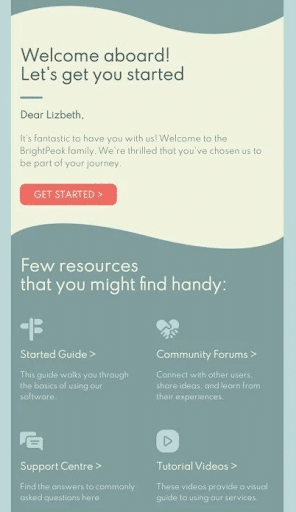
For example, let’s look at a welcome email for a free trial. The first one welcomes them to the product with tutorials and resources. The sequence continues with bite-sized content on how to use specific features. It’s an education series that drives adoption and converts a trial customer into a permanent one.
3. Automated Welcome Emails Save You Time and Money
Companies can’t keep up with email campaigns manually. Automated email sequences offer an efficient way to scale. There are varying degrees of functionality with email platforms, but most of these have automation features. You can set up a sequence of welcome emails that trigger once someone takes an action.
Then, those emails pace out based on the timeframes you set. Also, if people don’t open an email, you can have a rule to resend it.
Automation is a huge time saver, with 70% of business leaders stating that they can save up to 30 hours a month with workflow automation.
4. Welcome Email Campaigns Take Recipients on a Journey
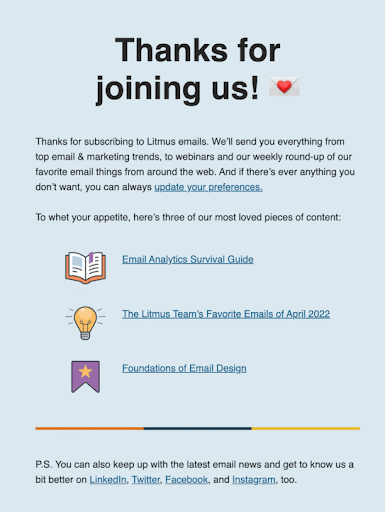
One of the leading reasons why welcome emails matter is the multiple touchpoints. You are taking people on a journey. It began with a warm hello, resources, setting expectations, and confirmations.
The journey continues as you educate and engage customers with your brand’s personality. The welcome series cements their beliefs and thoughts about your business.
5. Welcome Emails Foster Trust and Loyalty
Everything you learn about a prospect or customer enables you to tailor marketing to them. They’ll appreciate how relevant the information is, which increases their loyalty and love for your brand.
For example, every open or click registers a data point about what they like and when they engage. This information syncs to your CRM with everything you know about the customer.
You’re also showing up continuously—a constant in their inbox with more to share. You can “measure” trust and loyalty as an engagement metric. Analyze what they are clicking on and if that’s a sign of their furthering confidence in your brand. For example, a case study is a piece of content that indicates high interest. It also showcases how you followed through and provided solutions for a company just like them. When these signals occur, a welcome email campaign can move to the conversion email. It keeps the pace of the relationship relative, so you’re not jumping to the sale too soon.
For future email campaigns, this allows you to segment more precisely by product, challenge, motivation, industry, location, or any other key differentiator. Segmentation fuels high-performing email marketing, with marketers stating it’s the most effective strategy.
Types of Welcome Emails to New Customers
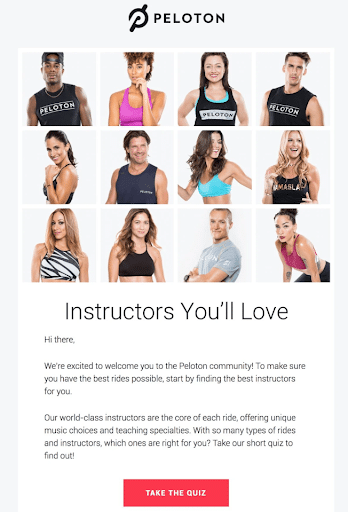
It’s important to diversify your welcome email design and content. The best welcome emails will incorporate a mix of messages, visuals, and layouts to connect with audiences while building trust and recognition for your brand.
The following are the specific types of welcome emails to new customers:
1. Confirmation Emails
One way to kick off your welcome email series is to send a confirmation email.
This email could request subscribers to confirm their email after opting in to a campaign or confirm a product or service order.
It’s a great way to welcome people aboard before continuing engagement with future emails.

2. Introduction to Brand Values and Story
By bringing people into your welcome series email flow, you can give recipients a proper introduction to your brand and what it’s all about.
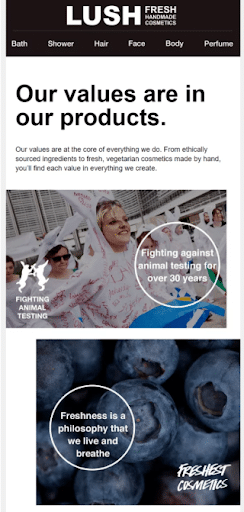
Here’s where you can shine as a storyteller, showing how your brand aligns with your subscribers’ values and narrative.
For example, you could tell all about your brand vision and mission, crafting a story that engages subscribers while giving your brand a more human touch. You may also summarize your values and how they drive your offerings.
3. Product or Service Overviews
Another kind of content you could use in your welcome email sequence is a collection of product or service overviews, from highlights of new product launches to personalized recommendations of existing solutions based on the subscriber’s preferences.
These can be some of the best welcome emails to boost sales and move more people to the bottom of the funnel.
4. Exclusive Offers or Discounts
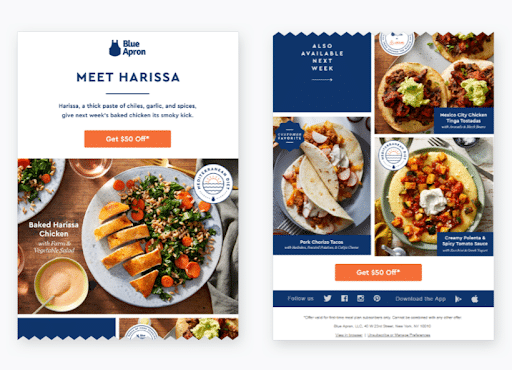
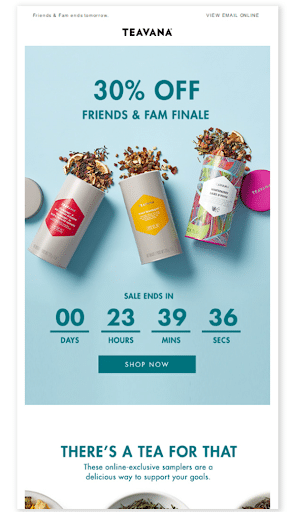
Have any exclusive deals or promotions for your email recipients? Include these in your welcome series when appropriate.
Like personalized product and service overviews, this kind of email welcome can lead to more immediate sales, especially if you have something like a limited-time offer that’s soon to expire.
Your customers will want to take advantage of these deals while they can.
5. Customer Testimonials and Social Proof
People trust other people’s opinions, whether from strangers or people they know. This applies particularly to opinions about products, services, and brands, with over 90% of people reading customer testimonials and other reviews before buying, and over 80% trusting these reviews as much as personal recommendations.
So, to supplement your personalized product and service recommendations, it’s best to show what other customers have had to say, which can be even more convincing.

Crafting an Effective Welcome Email Sequence
With a better idea of the types of welcome emails to new customers, let’s consider how to put together the perfect welcome series email flow.
Generally, a strong welcome email series will consist of about three to five emails.
- Ideally, the first email will go to the recipient as soon as they opt in as a confirmation email.
- From there, you’ll want to send the rest of your welcome emails about once every two to three days.
These email welcome series best practices help ensure your emails consistently engage recipients without annoying them.
To develop the best welcome email series, you must also determine what kind of content strategy will guide your emails. For example, you might develop a sequence like the following: Confirmation Email > Brand Value Email > Product Overview > Exclusive Personalized Offer.
Over time, as you test your strategy and emails, you can determine which sequence works best for each audience segment.
Designing Your Email Welcome
A good welcome email design is crucial when putting together your welcome email series.
There are multiple email welcome series best practices to consider during the design phase, including:
Making Your Emails Mobile-Responsive
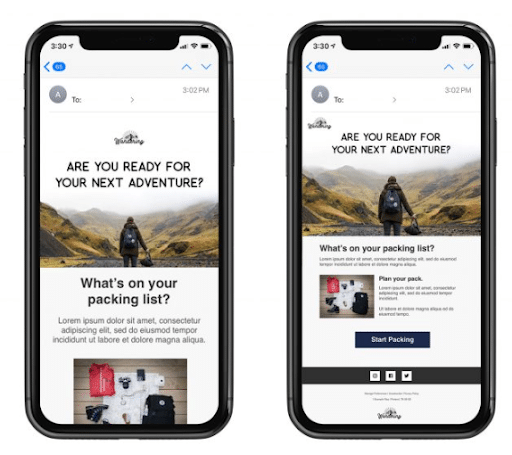
Your emails must create a seamless user experience for desktop and mobile users. Test your email layouts on mobile screens to see how they look before launch.
Establishing the Right Visual Hierarchy and Layout
It’s also important to determine what kind of layout and visuals will make your emails readable and engaging.
Keep text concise and to-the-point to keep people moving down the email, with an even mix of empty space and visuals to avoid making your emails look too “loud.”
Also, start with the most important information toward the top of the email, exploring the topic further below before ending with an enticing call-to-action (CTA).
You may implement header images, followed by boxes of text below, with other images complementing those text boxes, or you might go for an even more minimalist welcome email design.
Using Images and Branding Elements
A welcome email series should be visually engaging to reel in subscribers. At the same time, they should very clearly come from your brand as an effective introduction.
Incorporate high-quality images that resonate alongside your text, and add logos and brand color schemes where appropriate to build more brand recognition.
The messaging you use should also be uniquely yours, from your subject line to the body text and CTAs.
Best Practices for Welcome Email Series
Let’s take a look at some key email welcome series best practices to implement in your content, such as:
Crafting Compelling Welcome Email Subject Lines
Without good subject lines, people won’t be likely to click on and read your very first welcome email, let alone the rest of your welcome email sequence.
When writing your welcome email subject lines, consider the following:
- Always include a “thank you.” People want you to show them appreciation for subscribing and directing attention toward your brand. For instance, you might say, “Thank You for Your Purchase, [Name]! Enjoy Your New [Product]!”
- Add confirmations when appropriate. When a person completes an order or a signup, always confirm this with your email. An example here might include “Thanks for Signing Up, and Welcome Aboard, [Name]!”
- Keep it simple. Don’t overly complicate your subject line—instead, ensure it’s short and direct, leaving the rest of the mystery to the email itself.
- Summarize the content. Recipients should also know what they can expect when they open the email, so don’t leave it too much of a mystery.
Personalize Your Emails
Always personalize emails to speak more directly to recipients.
Be sure to start with personalized welcome email subject lines, addressing the person by name or at least using messaging that appeals to that recipient’s audience segment.
Within your email, you can also use the recipient’s name in a customizable template. In the case of product overviews, customer testimonials, and other content, you may also make personalized suggestions and show reviews related to that particular audience segment or the offering your recipients are considering.
Segment Your Audiences
Additionally, segmenting your audiences can help you develop fully tailored welcome email series that truly appeal to each subscriber.
To assist with this process, engage in market research, request feedback from existing customers, and look at competitors to see what they’re doing (and what they’re neglecting to do).
Once you’ve completed your research, you can create audience personas that represent each segment, indicating what kind of offers, language, and other elements will resonate with them.
Automate Processes and Time Things Right
Use email marketing tools and templates to simplify the process of developing and optimizing your campaigns. The right solutions will help you save a lot of time on developing your welcome series and figuring out how to boost conversions and sales with your emails.
Another aspect here is timing, as you need to pinpoint not only how frequently to send your emails, but also what time of day to send them based on when your audience is most active.
Measuring Welcome Series Success and Optimization
To get the best results from your email strategy, you need to measure your campaigns and continually optimize them over time.
In tracking your welcome email series, you’ll want to measure one or more of the following key performance indicators (KPIs) based on your goals:
- Open rate
- Click-through rate (CTR)
- Bounce rate
- Delivery rate
- Click-to-open rate (CTOR)
- Conversion rate
- Unsubscribe rate
- List growth rate
- Return on investment (ROI)
To figure out how to create the best welcome emails, you can also conduct A/B tests, running two versions of the same email with a single variable. For instance, you might include a different set of images in both emails with the same text, or vice versa.
Based on how each email performs, you can decide which to use in your next and future campaigns.
Then, as you collect data about your campaigns, you can make iterative improvements over time. Eventually, you’ll be able to hone your strategy and get the best possible results with a welcome email sequence that really works.
FAQs: Welcome Series Emails
1. What strategies can optimize mobile responsiveness in a welcome email series?
Best practices for mobile responsiveness in email include ensuring your email template is scalable and flexible, testing it on multiple devices, using larger fonts that are easier to read on small screens, choosing single-column layouts, and making buttons stand out.
Google also has a framework called Accelerated Mobile Pages (AMP) for Email, which makes it easy to develop emails with dynamic content for mobile devices. This framework allows you to easily integrate mobile-friendly designs along with interactive elements like carousels, forms, and lists, right into the user’s inbox.
2. Can integrating social proof in welcome emails increase engagement?
Yes, people want to hear from real customers to determine if a product or service works. They are more likely to believe them than a brand. Testimonials, star ratings, and case studies can all drive engagement, which you can measure by clicks.
There are plenty of ways to integrate different forms of social proof into your emails. For example, when promoting a particular product, an e-commerce site could include customer reviews for said product to complement an overview, encouraging the customer to give it a shot.
3. How often should businesses update their welcome email content?
It’s a good idea to revisit welcome email content at least every six months. If there are significant changes to products, onboarding, or resources, this should prompt a refresh. Also, you’ll need to update the content when you add new solutions.
In addition, always ensure the welcome email series aligns with the user journey from initial contact to conversion. Doing so will help with your lifecycle marketing efforts as you work to keep the transition from prospect to customer as smooth as possible. Keep in mind that changing user behaviors and market trends could also change conversion intent, potentially requiring you to pivot your campaigns accordingly.
4. What are the common mistakes to avoid in your welcome email series?
The biggest mistake is not sending one! Following welcome email series best practices to avoid sending them too late, poor design, irrelevant content, and lack of personalization. This can impact the performance of a welcome email series.
5. How do welcome emails support SEO strategies through increased site visits?
Site traffic is a critical component of SEO, as search engines consider high traffic a sign of high-quality and relevant content. The traffic from an email is referral, not organic, but it still increases the overall visits to your website. If people spend more time on your site and visit many pages, this engagement supports SEO.
6. Can a welcome email series be used for cross-selling or up-selling products?
Yes, welcome emails are a good channel for upselling and cross-selling. They can introduce new products that complement the purchase and encourage people to check out what else you have that they’ll want. Be sure it’s not a hard sell. What you reveal to them should align with their needs, and you can customize this based on the data you collect about them.
7. What’s the role of visual content in making welcome emails more appealing?
Visuals matter whether you have a physical product or not. They should be crisp, modern, and relevant. Product images should showcase its effectiveness and features. For those in the solution space, images should represent the buyer and their environment.
8. How can A/B testing enhance the effectiveness of your welcome email series?
A/B testing provides great insights. Typically, there will only be one difference—the subject line, CTA, or image. You can compare the metrics by running two options concurrently to determine which copy, CTA, or visuals were most appealing.
You can use a wide variety of tools to help with testing, deliverability, and analysis, including Litmus, Email on Acid, and Validity.
9. Do welcome emails have a direct impact on referral marketing success?
Yes, they can when some part of the series incentivizes them to refer a friend. The value must be something they want, like a discount or free item. It also needs to be easy for them to refer friends, colleagues, or family.
10. What metrics should be analyzed to measure the success of a welcome email series?
The metrics that matter are open rates, click-through rates, click-to-open ratios, and unsubscribes. Fluctuations of these indicate there may be some friction. Dig into the data to see where engagement begins to fall off.
11. How can AI or behavioral triggers personalize a welcome email sequence?
Both of these elements can help with personalization efforts in various ways. One of those ways involves developing dynamic content based on subscriber data, such as demographics and signup sources. This personalization can impact everything from the subject line to the CTA.
Meanwhile, AI can also make personalized product or service recommendations based on a user’s interactions with a website and expressed interests.
12. How do you handle consent and preference centers in welcome series email flows?
You need to keep your email series compliant with all relevant privacy rules and regulations.
In doing so, obtain clear and explicit consent from potential subscribers, making sure they opt in voluntarily. Also, make it easy for users to opt out if they wish to do so, and share an unchecked checkbox on forms enabling users to agree to receive additional marketing emails.
In addition, incorporate a detailed privacy policy and make it readily available to recipients.
Finally, maintain compliance with CASL, CAN-SPAM, GDPR, and other relevant privacy regulations.
Need Help with Your Email Marketing?
Now that you know the importance of an email welcome series, you’ll want to launch or improve it. It’s one part of email marketing, which is one area of your entire inbound marketing efforts.
Managing all these initiatives requires skilled resources across content, design, strategy, and operations. If you want to get more out of your marketing without delays and overhead, we can help.
Here are 4 signs you could benefit from our new Welcome Series offering:
- You’re using paid channels to drive leads, but are having trouble converting.
- You’re stretched thin and don’t have adequate resources to create an effective email program.
- Your sales team is spending too much time following up with leads when they should be focused on sales.
- You have a welcome series in place, but it’s not performing. Our clients are seeing between 8-22% of total revenue coming solely from their welcome series.
Contact us today to start the conversation.
