

Cost-per-click, or CPC, refers to the cost associated with running digital ads based on the number of clicks those ads receive. With CPC advertising, brands do not pay a flat fee for their ads. Rather, they pay per click.
But in order to understand that spend, and better yet, how much it will cost you as an advertiser, you need a working knowledge of cost-per-click or CPC.
In this article, Briana Miller, Paid Media Strategist, will explain exactly what CPC is, how it’s determined, and how you can lower your CPC and still maintain quality clicks.
What You’ll Learn:
- What is CPC?
- How is CPC Determined and Calculated for Each Network?
- How to Lower Your CPC
- CPC Pros vs Cons
- What is a Good CPC?
- Examples of PPC Ads
- Frequently Asked Questions
TL;DR
This article will cover the following key aspects of cost per click:
- What is CPC? Total ad spend divided by clicks.
- How is CPC calculated and determined?
- The average CPC for various platforms, including native and social ads
- How to lower your cost per click without compromising campaigns
- What is a good CPC?
What is CPC?
The term CPC stands for cost per click.
It’s a bidding model that means you pay a certain amount every time someone clicks on your ad.
Essentially, it is a method of billing that companies use to place online ads on various sites. However, the definition is often muddled a bit because the term is often used synonymously with PPC.
Therefore, to completely understand CPC advertising to its fullest, it is best first to know a few things about PPC advertisements and how they work.
PPC Basics
When you run an ad in the newspaper, on TV, or on a billboard around town, there is a price to take up that space. The same goes for when you put ads on websites online, you have to pay for that space.
Typically this is done one of two ways: CPM or PPC.
CPM, or cost per mille (the Latin and old French word for thousand), represents the number of impressions (viewers) in thousands that your ad receives, regardless of how many times it was actually clicked on.
However, with this model, if your ad runs on a well-frequented site, they could charge you thousands with no one actually paying attention to or clicking on your specific ad.
However, with this model, if your ad runs on a well-frequented site, they could charge you could be charged thousands with no one actually paying attention to or clicking on your specific ad.
On the other hand, the PPC method is not concerned with how many people are exposed to your ad. It only charges you when someone clicks on your ad. This means you only pay for the people who actually take an action that is beneficial to you.
What is CPC: Cost Per Click in Detail
What is CPC in marketing? The CPC, which stands for cost per click, is the actual price paid each time someone clicks on one of your PPC ads or banners.
It’s most often used when advertisers or companies have a specific budget, usually a daily or monthly one.
Many different types of ads use a CPC or PPC model. This includes:
- Image ads
- Video ads
- Text ads
- Shopping ads
- Social media ads on X, Instagram, LinkedIn, and Facebook
Some of these CPC ads are featured only on one site, such as Facebook ads, whereas others are featured across a variety of sites, such as the Display Network which includes Google, Google-owned, and partner sites).
Cost per click = Advertising cost/number of clicks
Once you have a maximum CPC in mind, you can start your campaign. Your maximum budget can be set as a daily or monthly budget, and it will depend on your strategy, goals, keywords, competition, and account configuration. For example, let’s say you use a network that charges $1 per click, and your daily budget is set to $1000. That would mean that you could get only 1000 clicks per day.
For example, let’s say you use a network that charges $1 per click, and your daily budget is set to $1000. That would mean that you could get only 1000 clicks per day.
After that number is reached, the website your ad is appearing on will simply remove your ad for the rest of the day.
Each click is a visit or type of communication with your website, landing page, or company product and shows how much attention your product or site is getting from the public.
When you invest in a PPC campaign of any kind, this is the attention you’re buying. Which means the cost per click is pretty significant. If you’re paying too much, the return on investment (ROI) will not be worth it and cause you to lose money instead.
However, underpaying is possible too. At first, it may seem like that means you’re saving money. But just like most things, you get what you pay for.
Paying less than average may seem ideal, but it may not be identifying and targeting clicks that are valuable to you. The key is to find clicks that are both of guaranteed quality and inexpensive.
Each network or ad company usually sets the CPC by a bidding process or a formula.
Actual CPC vs. Max CPC
While max CPC refers to the highest bid limit an advertiser is willing to pay for a click, actual CPC refers to the final amount advertisers have to pay when someone clicks based on auction dynamics and Ad Rank, with actual CPC often being lower than the max CPC.
CPC vs. CPL, CPA, and ROAS
What is CPC vs. other forms of PPC measurement? Cost per click is the amount advertisers need to pay for ads based on clicks, while cost per lead (CPL) charges advertisers based on the number of times users complete a particular conversion action, such as completing a lead gen form.
Meanwhile, cost per acquisition (CPA) covers the total amount businesses spend to acquire a paying customer, signup, or another desired conversion action. Return on ad spend (ROAS) calculates the total revenue earned against the amount spent on an ad campaign, which can help gauge profitability.
Expert Opinion on CPC in Marketing
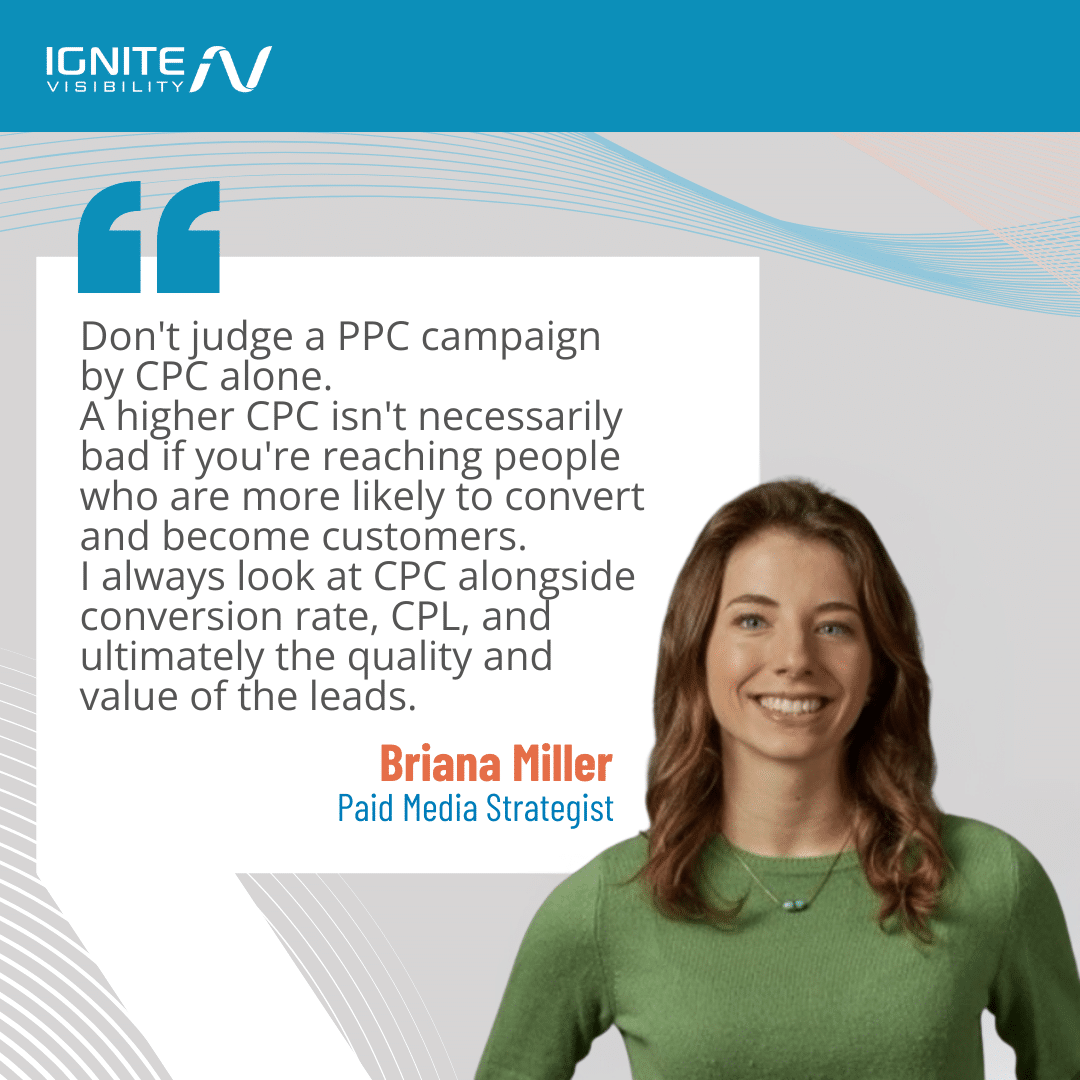
One of the biggest mistakes I see advertisers make is treating a lower CPC as proof that a campaign is improving.
In practice, I’ve seen campaigns where CPC increased because we shifted budget toward more competitive, higher-intent searches, but CPL and overall lead quality improved. I would rather pay $10 for a click that has a strong chance of becoming a customer than $3 for traffic that rarely converts.
CPC is useful as a diagnostic metric, but I always evaluate it alongside conversion rate, CPL or CPA, and ultimately the value of the leads or revenue being generated.
The right approach to PPC with CPC in mind can help you achieve the best results. For instance, here at Ignite Visibility, we helped one multi-location home services franchise implement PPC to boost lead volume by 82% while reducing CPL by 32%. We also enabled an online tutoring platform to attract more leads with a combination of social media marketing and PPC campaigns, including Meta Ads, to significantly grow its social media presence.
Campaigns like these look closely at CPC to help determine how much to spend and how to continually improve ad strategies.
How is CPC Determined and Calculated for Each Network?
The formula for CPC might be simple, but ad networks today typically determine the actual CPC of ads using real-time auction models.
For example, Google Ads calculates actual CPC based on Ad Rank, auction competition, ad quality, bids, context, and assets. As a result, advertisers can more effectively avoid wasted ad spend in their campaigns with more precise calculations.
You might worry about a high CPC, but the fact is that ads with a steep CPC can still be profitable. Highly targeted and well-placed ads can attract high-intent, high-value leads who are more likely to convert into paying customers, making more expensive campaigns worthwhile in many cases.
Let’s take a look at some CPC marketing costs for various platforms, which can inform your CPC strategy.
Below I have listed a few of the most widely used networks and ad types out there, as well as how they determine your CPC.
Google Ads
Since Google is the most widely used search engine in the world, its ad network, Google Ads, is typically at the top of the list for online advertisements.
These ads may cost you more than Bing, but because more people see them, the chance of your ad being clicked on is typically higher.
Google allows you to place ads in the search results, on private websites, or both.
If you run ads on a private site, Google only gets a certain percentage of the CPC. However, if your ad is in search, they get all of it, as there is no publisher or website to pay.
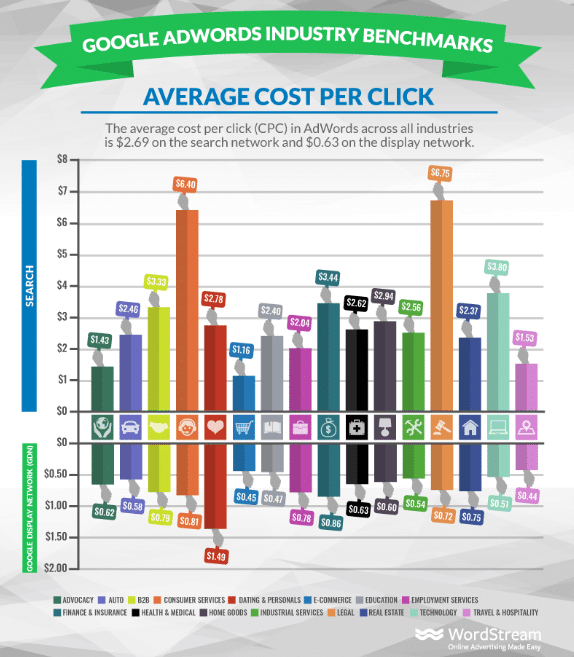
Here are the current benchmarks for the average CPC of Google Ads across industries:
Microsoft Advertising
Using Bing, the second largest search engine, you can post ads through Bing, Microsoft, Yahoo, and their search partners.
Though second to Google in traffic, Bing still boasts about 900 million searchers per month. They also claim the ability to reach up to one billion users on platforms like Microsoft Edge and Outlook. .
Unlike Google, Bing offers a bit more flexibility in scheduling, location targeting, and budget. With Bing, you also gain access to the entire Microsoft Search Network, which includes Bing, AOL, and Yahoo. It also tends to have an older, more intelligent, and wealthier demographic or audience.
Because there isn’t as much competition on the channel, Bing can also give better ad positions for a lower CPC and typically have a higher ROI.
Bing also uses your quality score in relation to those who are bidding against you to give you an ad rank, which also determines where on the search results page your ad will appear. Bing then uses that ad rank to calculate your CPC for that specific ad.
Some current industry Microsoft Advertising benchmarks for CPC in marketing include:
- Automotive: $2.52
- B2B Services: $1.16
- Consumer Services: $1.78
- Education: $2.79
- Legal Services: $1.42
- Real Estate: $2.88
- Tech: $1.95
Meta Ads
Facebook, as the most popular social media network in the world, is another top place to run PPC ads. It’s also one of the best places to do so if you want to sell products or services based on particular interests or demographics.
A somewhat frustrating aspect of Meta Ads is that its requirements are constantly changing. Even though it can be time-consuming, it is important to not only keep up with their changing CPC but also their changing rules. Not following these rules could affect your CPC, and even the status of your brand’s account, in the long run.
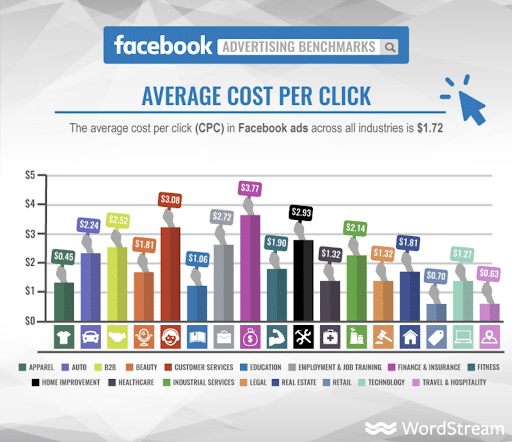
Facebook differs slightly from search engines in how they calculate CPC. Today, Meta uses an ad auction process that considers factors like bid, estimated action rate, and ad quality.
Native Ads
CPC in marketing also applies to native ads, which blend naturally into content across the web, often as banner display ads. Platforms like Taboola and Outbrain use real-time bidding to determine how often ads will appear and their specific placement. Factors to help determine cost per click here might include geographic targeting and your specific vertical or niche.
How to Lower Your CPC While Maintaining Value
The key to success with your PPC ads is to make sure you are paying the least amount possible per click while maintaining a high quality of clicks.
Here are a few ways to make sure you are doing just that.
Raise Your Quality and/or Relevance Score
Some networks, such as Google, offer discount CPC pricing to PPC campaigns with high-quality scores.
This means your ads are well-managed, have high click-through rates (CTR), including text, lead, and landing pages that are specific to search goals, and have closely related ad groups.
Currently, campaigns with Google Quality Scores of six or higher can help brands reduce their CPC, helping maximize their ROAS.
Ultimately, the Quality Score is a diagnostic indicator to help gauge campaign effectiveness, with ad quality contributing to Ad Rank and auction outcomes in many instances.
You can improve your Quality Score by being specific with your ad targeting, as this is a key factor and requires narrowing down your perfect target audience.
Both Meta and Google offer audience demographics reports that can help you do this.
Another way to improve your score is to put more thought into the messaging and imagery used in your ads. Use A/B testing to see what really works for your audience.
This will help you increase your click-through rates.
Keyword Relevance
Besides everything else that goes into your CPC, keyword relevance also plays a big part. If you are using the wrong keywords, it could have a negative impact on your campaign.
If you start to notice that a specific keyword isn’t performing well, remove it from future ad campaigns. Instead, do more research on related keywords that will have a more positive impact on your CPC.
Don’t just focus on targeting the keywords you want to appear for, either. In addition to target terms, add any negative keywords that are irrelevant to your ads, which will further narrow your targeting and ensure you get the most from your ad spend.
Continually optimizing search terms based on performance will also help you keep your ads well-targeted and relevant, such as optimizing keyword targeting for seasonality and market trends.
Another thing that is going to severely impact your CPC is the quality of your ad and/or landing page.
If your audience isn’t getting excited or intrigued by your ad, they aren’t going to click on it. Use appropriate colors, easy-to-read font, eye-catching images, and perfectly crafted copy to grab their attention and drive them to click.
The same goes for your landing page. If you get over the hurdle of getting a consumer to click on your ad, you also have to provide a quality landing page. Consumers will make a decision about your product or service within seconds of landing on your page. Make sure you make a good impression and inspire them to stay.
Quality of Your Ad & Landing Page Alignment
Another thing that is going to severely impact your CPC is the quality of your ad and/or landing page.
If your audience isn’t getting excited or intrigued by your ad, they aren’t going to click on it. Use appropriate colors, easy-to-read font, eye-catching images, and perfectly crafted copy to grab their attention and drive them to click.
The same goes for your landing page. If you get over the hurdle of getting a consumer to click on your ad, you also have to provide a quality landing page. Consumers will make a decision about your product or service within seconds of landing on your page. Make sure you make a good impression and inspire them to stay.
By aligning your keywords to your ads and your ads to your landing pages, you’ll be able to improve overall performance as you boost conversions. However, lower CPC shouldn’t be the sole objective; as mentioned, a high CPC could land you better ad placement that adds more value to your campaigns, maximizing profitability in the long run.
Bid Strategy
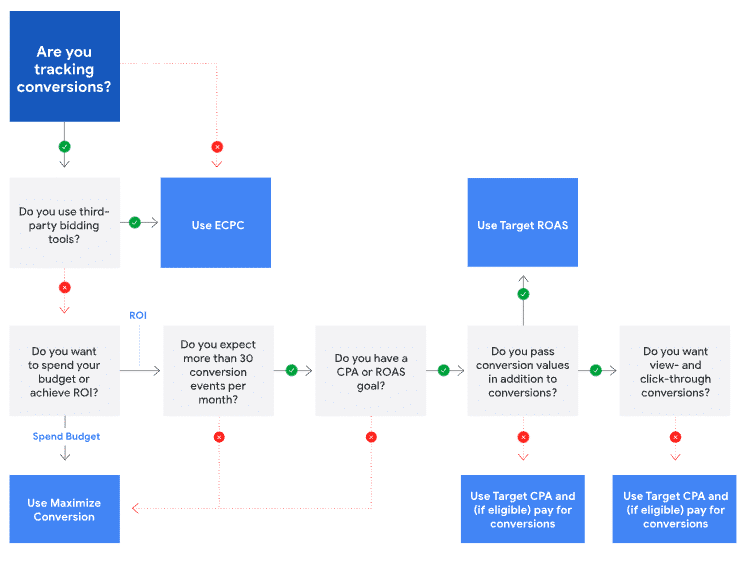
You can also reduce your CPC with the help of smart bidding on platforms like Google, with the ability to set target cost-per-acquisition (CPA) and target ROAS goals.
In addition, use maximum CPC limits to prevent campaigns from bidding highly on weak clicks, and give your automated bids some time to learn and build your data, which can help with optimization over time.
Geographic and Device Targeting
If you’re trying to reach people in specific regions, target exact areas by choosing certain cities or zip codes, removing locations where you won’t find customers.
You can also see if different devices perform better, whether you’re getting more clicks from desktop or mobile devices. Reduce bids on devices that don’t perform well.
Conversion Data
Track meaningful conversion actions, including sales and leads instead of page views. Also, make sure tracking tags and UTM parameters work properly, which will maintain good-quality data.
Providing algorithms with clean conversion data will also help you find cheaper yet high-quality clicks.
CPC Pros and Cons
Like any other type of advertising, CPC has a list of pros and cons.
Some of the great things about CPC advertising include:
- Only paying per click, instead of per exposure.
- The ability to successfully target your ad to your preferred audience.
- The ability to physically see your campaign’s effectiveness with a variety of statistics.
- The high-level customization options are available to advertisers.
However, CPC advertising also comes with some downsides. Cons of CPC advertising include:
- Acquiring the skills necessary to run an effective campaign. With so many different platforms, it can be difficult to keep up with the changing requirements.
- The fact is that clicks don’t always convert. There is still work to be done after you convince a consumer to click on your ad.
- There is a pretty decent time commitment involved in being successful with this type of campaign.
- The fact that you need to keep an eye on costs to ensure they don’t add up too quickly.
As with every business decision, be sure to weigh the pros and cons and how they apply to your business before deciding to move forward on this type of campaign.
What is a Good CPC?
Going beyond “what is CPC,” what is a good CPC?
First of all, there is no such thing as a universal “good CPC. A good CPC will vary by industry. You also need to consider things like keyword match, device type, competition, ad rank, and other factors.
It’s also going to vary depending on the platform. Bing tends to offer a lower CPC than Google, again because of the level of competition.
You should also evaluate CPC against other metrics like conversion rate, CPL and CPA, conversion value, RAOS, customer lifetime value, and profit margin. Consider whether those metrics elevate to the point of maximizing revenue even with a high CPC.
While you might find certain averages out there to guide you, such as WordStream’s $5.26 average Google Ads CPC, your costs could vary greatly depending on industry and account-level performance.
Look at what your industry average is and what kind of performance you’re currently experiencing, which can help you figure out what kind of CPC you’re likely to pay for high-performing ads.
What is CPC: Examples of PPC Ads and How Much it Costs to Run Them
What is CPC based on search intent, and what are some of the costs you can expect? Let’s break this down in the following table:
| Keyword Intent | Average CPC | Primary Conversion Goal | Why CPC Is High or Low | What to Optimize |
| Informational (e.g., “how to” searches) | Lower, ~0.50 to $1.50 |
|
Low due to weak immediate buying intent and reduced immediate auction pressure from transactional competitors | Top-of-funnel optimization with loose match types to capture broader audiences, with optimizations for micro-conversions and retargeting |
| Commercial (e.g., “best healthcare provider reviews) | Moderate, ~$2.50 to $5.50 |
|
Balanced between high and low, as you can target terms with high search volume with generic or fragmented intent | Middle of funnel optimization with a transition from broad to phrase matching, along with linking ad copy to precise landing page headlines |
| Transactional (e.g., hire enterprise SEO agency) | High, ~$6.00 to $15.00+ |
|
High because of more intense real-time auction pressure and the potential for higher customer lifetime value leading to more aggressive bidding | Bottom of funnel optimizations like exact match keyword targeting and the use of more negative keywords for efficient targeting to reach high-intent audiences |
| Branded Intent (e.g., “[company name] pricing”) | Very low, ~$0.20 to $0.90 |
|
Lowest due to high historical CTR and maximum Quality Score parameters | Brand protection by isolating from non-branded traffic and using extensions to maximize ad space usage |
Frequently Asked Questions
1. What is CPC?
CPC is a pay-per-click (PPC) metric that tracks the cost per each click on an ad. Using the right bidding strategies and continually optimizing your campaigns can help reduce your CPC, but sometimes a high CPC is worth the expense if your ads maximize revenue.
2. Why is my CPC so high?
If you’re in an industry that has a high value per conversion then it is not uncommon to see occasionally high CPCs. Certain industries simply have more competitive advertisers who are willing to pay more per click. If that’s not you, there are a few things you can do to lower your CPC. Try raising your quality score, refining your reach and then expanding your reach.
3. What is a good CPC?
The short answer is, “it depends.” On average, you should be spending $20 per click on your ad, resulting in a 5% conversion rate. Of course, this also depends on your product or industry, as your ideal cost per click should be determined by your target ROI. For most businesses, a 5:1 revenue-to-ad-spend is considered just fine.
4. What is the maximum CPC?
Maximum CPC is the highest amount you’re willing to pay for a click on your ad. The maximum CPC set doesn’t necessarily mean it’s the amount you will actually pay for the click. If you’re not sure of what to choose for the highest amount per click, Google Ads calculates actual CPC using Ad Rank and auction dynamics.
5. What is manual CPC bidding?
In CPC advertising, manual CPC bidding occurs when advertisers place the maximum CPC for each ad by hand instead of enlisting the help of automated bidding strategies.
6. What is the enhanced CPC?
Enhanced CPC is a retired automated conversion bidding strategy in Google Ads that adjusts your bids to help maximize ad conversions. As of March 2025, enhanced CPC is no longer a functioning feature, with remaining campaigns migrated over to standard manual CPC.
7. Is it better to have a high or low CPC?
You want to aim toward having a low CPC. A lower CPC means you can stretch your budget further, which means more potential leads. It also works well with niche keywords that aren’t as competitive. However, a high CPC in marketing can yield high ROI if you get valuable ad placements reaching audiences who are likely to become customers.
8. What’s the difference between CPC and CPM?
When you look into CPC advertising, you’ll also see the term cost per thousand, or “CPM (cost per mille) come up. The M represents the Roman numeral for 1000 (1000 impressions). While CPC focuses on the cost for each person who clicks on your ad, CPM focuses on how many people see your ad, but don’t necessarily click on it.
How Ignite Visibility Can Help With Your CPC Strategy
With a better understanding of CPC marketing, you can better plan your PPC strategy. At Ignite Visibility, our experts will work with you to develop a solution that complements the rest of your marketing efforts.
Our team will help you:
- Identify actual CPC on platforms like Google, Bing, and other relevant channels
- Develop high-quality ad copy and creative
- Integrate ads into your SEO, social media, email, and other marketing efforts
- Continually measure and optimize your strategy
- And more!
Want to learn more about how we can help boost your strategy? Learn more about our PPC management services and capabilities.
