

A machine-readable website may soon need to do more than tell search engines what a business is. It may also need to tell AI agents what customers can do with that business.
For multi-location brands, we see three layers taking shape: Google Business Profile for local identity, schema for meaning, and WebMCP for action.
In this blog, Chris Pahla, SEO Manager, discusses these layers and how they play into each other to make for fully AI-readable websites that can dominate both traditional and AI search results.
TL;DR
- Machine-readable websites may soon need three layers: GBP for identity, schema for meaning, and WebMCP for actions.
- GBP helps machines identify locations, while schema helps them understand businesses, services, and relationships.
- WebMCP could allow AI agents to complete actions like finding locations, requesting quotes, or booking appointments.
- Multi-location brands should focus on clean location data, accurate GBP listings, and strong schema foundations.
- As AI evolves from answering questions to taking actions, agent-ready websites may become increasingly important.
Jump To:
- The Machine-Readable Website Is Moving From Answers to Actions
- Layer 1: Google Business Profile Creates a Machine-Readable Local Identity
- Layer 2: Schema Gives a Machine-Readable Website Meaning
- Layer 3: WebMCP Could Make the Machine-Readable Website Actionable
- Why WebMCP Could Matter More for Multi-Location Brands
- What Multi-Location Marketers Should Do Now
Expert Insight
For years, SEO teams have worked to make brands easy for search engines to find and understand. AI agents add another layer. They may not just find information. They may act on it.
That could be a big shift for multi-location brands.
A customer might ask an AI assistant to find the nearest location, check whether it offers a service, and book an appointment. A franchise buyer might ask it to find available markets and request information.
This means marketers should start thinking beyond rankings for machine-readable SEO. Your location data must be clear. Your website must explain your entities to make it AI-readable. And your key conversion paths should be easy for both people and machines to use.
With the right approach to AI SEO, Ignite Visibility has helped many multi-location clients significantly boost their AI visibility, including an automotive services franchise that moved from #3 to #1 in AI share of voice among competitors and saw a 25% increase in AI mentions from agents.
Knowing how to make a website AI agent-ready with the different layers involved, including Google Business Profiles and WebMCP for local SEO, can give your brand the lift it needs to flourish online.
Pro Tip: Map your highest-value customer actions now. Ask which ones an AI agent could complete if your site exposed them as clear, structured tools.
The Machine-Readable Website Is Moving From Answers to Actions
SEO has always involved making information easier for machines to process.
Google crawls a page. Structured data gives it more context. Google Business Profile provides local business data.
WebMCP introduces a different idea.
What is WebMCP, exactly?
Google describes WebMCP as a proposed web standard that lets websites expose structured tools to AI agents. Instead of making an agent work out how to click through a website, a site can tell the agent which actions are available and what information each action needs.
That difference matters.
Think about the evolution this way:
| Layer | Main Job | Example |
| Google Business Profile | Identity | “This business exists at this location.” |
| Schema | Meaning | “This page represents this business, service, or location.” |
| WebMCP | Action | “Here are the actions an agent can perform.” |
These layers are not replacements for one another.
They solve different problems.
For multi-location businesses, the long-term opportunity may come from connecting all three.
Layer 1: Google Business Profile Creates a Machine-Readable Local Identity
For a franchise with 500 locations, there is no single local identity.
There are 500 of them.
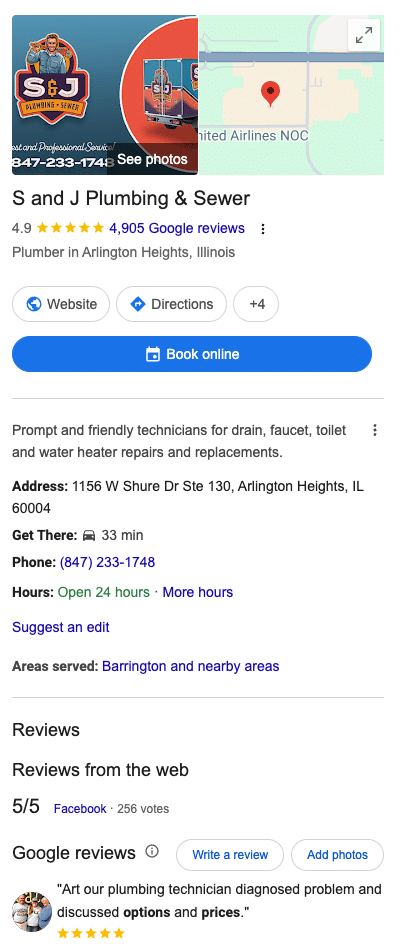
Each location may have its own:
- Name
- Address
- Phone number
- Hours
- Reviews
- Categories
- Services
- Photos
- Website or location page
Google Business Profile helps Google connect those signals with a real-world place.
That is why GBP remains a core part of our multi-location SEO strategy.
A strong corporate website alone does not tell Google everything it needs to know about each branch.
Consider a customer searching for an emergency plumber.
The national brand may be relevant. But Google also needs to know which location serves that customer, whether the location is open, and how the customer can contact it.
For multi-location, machine-readable SEO, that local identity layer is essential.
Where GBP Has Limits
Google Business Profile is powerful, but it lives inside Google’s ecosystem.
It helps Google understand and present local businesses. It does not create a universal action layer for every AI agent.
This is where the distinction between the three layers starts to matter.
GBP answers:
Where is this business, and what do we know about it?
Schema answers a different question.
Layer 2: Schema Gives a Machine-Readable Website Meaning
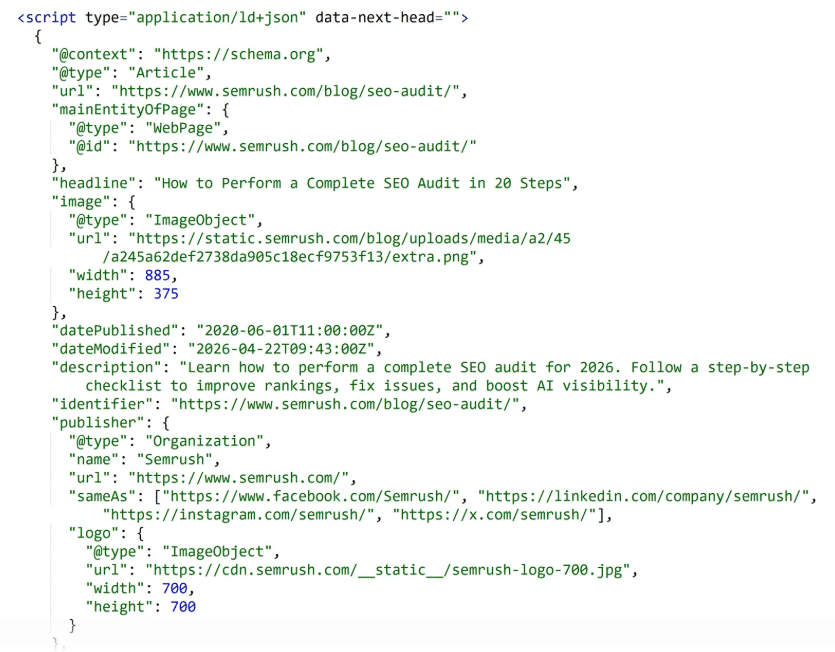
Schema adds structured information to your website.
Google recommends LocalBusiness structured data for local businesses and says brands should define each business location as a LocalBusiness type, which uses Schema.org vocabulary typically written in the JSON-LD linked data format. Google also supports properties such as addresses, opening hours, phone numbers, and other business details.
For multi-location sites, this can help create clearer relationships between the national brand, individual locations, services, and pages.
For example, a location page may communicate:
- This is our Scottsdale location.
Schema can help machines process that statement in a structured format:
- This entity is a LocalBusiness.
Its address is X.
Its phone number is Y.
Its URL is Z.
That makes schema an important part of franchise SEO, especially when hundreds or thousands of location pages follow the same site structure.
Despite this importance, fewer than 33% of websites use schema to its full potential, leaving many opportunities to boost citations on the table.
Schema Helps Explain What Things Are
This is the key point.
A schema describes.
It helps a machine understand entities, attributes, and relationships in AI-readable websites.
But adding LocalBusiness schema does not automatically give an AI agent permission or instructions to perform every function on your website.
Knowing that a dental office exists is one thing.
Knowing how to schedule an appointment with that office is another.
That brings us to WebMCP.
Layer 3: WebMCP Could Make the Machine-Readable Website Actionable
WebMCP stands for Web Model Context Protocol, and it’s different from browser MCP in that it works natively within the website as opposed to an outside server.
It is still a proposed web standard, so marketers should not treat it as a new ranking factor or a required SEO implementation.
But the idea behind it deserves attention.
According to Chrome’s WebMCP documentation, websites can expose structured “tools” to AI agents. Those tools have names, descriptions, and input requirements that tell an agent what it can do.
WebMCP currently includes two approaches.
The declarative API can add annotations to standard HTML forms.
The imperative API can use JavaScript to define more complex tools and functions.
Imagine a home services franchise.
Today, an AI agent may need to interpret the website to visually:
- Find the location search.
- Enter a ZIP code.
- Select a branch.
- Find the right service.
- Open a booking form.
- Fill in the customer’s information.
- Submit the request.
That creates many points of failure.
With an agent-ready action layer, the website could expose clearer tools such as:
- find_nearest_location
- check_service_area
- get_location_services
- request_estimate
- book_appointment
The agent would not have to guess what buttons mean or which fields belong together.
The website would define the action.
That is a major difference.
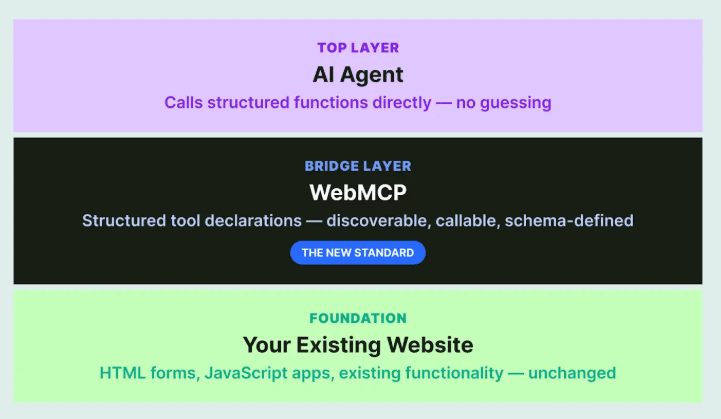
GBP vs. Schema vs. WebMCP: How the Three Layers Could Work Together
This is where I think the conversation becomes much more interesting for multi-location marketers.
We should not ask:
Does WebMCP replace schema?
It should not.
A better question is:
What happens when machines can identify, understand, and act on a local business?
Consider this request:
“Find the closest HVAC company near me that services heat pumps and schedule an appointment for tomorrow.”
Several things need to happen.
Step 1: Identify
The system needs reliable information about nearby locations.
Google Business Profile and other local data sources can help establish those local entities.
Step 2: Understand
The system needs to understand what each location does.
The website, location pages, service content, internal links, and structured data can help establish those relationships.
Step 3: Act
The system needs a reliable way to perform the task.
This is the problem WebMCP is trying to address.
The result could look something like this:
GBP → Where you are
Schema → What you are
WebMCP → What an agent can do with you
That is the three-layer model multi-location marketers should watch, with WebMCP for multi-location businesses serving the action element.
Why WebMCP Could Matter More for Multi-Location Brands
Almost every business wants leads.
But multi-location businesses have an extra problem: routing.
A lead must reach the right location.
Take a 600-location home services franchise.
An AI agent cannot simply “book Brand X.”
It may need to determine:
- Which franchise territory covers the ZIP code
- Which location provides the requested service
- Whether that location is open
- Whether an appointment is available
- Where the lead should be routed
- Which CRM or booking system should receive it
This complexity makes structured actions more valuable through WebMCP for multi-location businesses.
The website could eventually expose a tool that accepts a ZIP code and service type. The system behind it could return the correct franchise location before the agent moves to the next step.
This could turn location architecture into more than an SEO issue.
It could become part of an agent routing system.
The Machine-Readable Website Could Change Local Conversion Paths
We often think about local SEO as a funnel:
Search → SERP → Location Page → Conversion
AI agents could shorten that journey.
A future path could look more like:
Request → Business Discovery → Agent Action → Conversion
The user may not need to visit every page involved in the process.
That does not mean websites become less important.
It could mean their role changes.
The website may become both a human interface and a machine interface.
For humans, you still need:
- Useful content
- Strong UX
- Local proof
- Reviews
- Clear offers
- Conversion-focused pages
For machines, you may increasingly need:
- Clear entities
- Consistent location data
- Structured relationships
- Semantic HTML
- Structured actions
- Reliable APIs and forms
This builds on the work brands are already doing through AI SEO.
The next step may be moving from being cited by AI to being usable by AI, which, again, is where WebMCP for franchises can help.
What WebMCP Could Mean for Franchise Development
There is another side of franchise marketing that deserves attention: Franchise development.
These sites have very different conversion goals from consumer-facing location sites.
A prospective owner may want to know the following:
- How much does the franchise cost?
- What markets are available?
- What experience do I need?
- What financing options exist?
- What support does the franchisor provide?
- How do I request franchise information?
Today, a buyer may research these questions across many pages.
An agent could change that process.
Imagine someone asking:
“Find home service franchises under $500,000 that have territories available in Ohio and let me request information from the best three.”
That is much closer to an action workflow than a traditional keyword search.
A franchise development site could eventually expose tools such as:
- check_available_territory
- get_investment_range
- get_candidate_requirements
- request_franchise_information
- schedule_discovery_call
That creates an interesting challenge for franchise marketing.
Franchisors have spent years optimizing pages to earn the click.
They may also need to think about how they earn the agent action.
Machine-Readable SEO May Gain a New Conversion Metric: Agent Completion
Marketers should also think about measurement.
If an AI agent completes an action without following the same page path as a human, traditional analytics could miss part of the story.
Pageviews may become less useful for some journeys.
Instead, we may need to measure events such as the following:
- Agent tool discovery
- Tool invocation
- Location lookup
- Service-area check
- Appointment request
- Franchise territory lookup
- Lead submission
- Completed booking
- Failed agent action
This becomes even more important for franchises.
Corporate teams need to know not only whether AI drove a lead, but also which location received it.
The same applies to franchise development. Teams need to know which AI-driven interactions became qualified candidates, discovery calls, applications, and signed franchise agreements.
This fits a larger change already happening in search marketing.
Visibility alone is not enough.
We need to connect visibility to revenue.
A New Risk: Your Locations May Give Machines Conflicting Information
There is another side to all of this.
More machine-readable layers create more chances for disagreement.
Imagine that:
- GBP says a location closes at 8 p.m.
- The location page says 7 p.m.
- Schema says 9 p.m.
- A booking system allows appointments until 8:30 p.m.
- An agent-facing tool returns different availability.
Which source should the agent trust?
For one location, this is a data cleanup problem.
For 2,000 locations, it becomes a governance problem.
Multi-location brands should start thinking about a single source of truth for location data.
That source should feed as many systems as possible.
This can include:
- Google Business Profiles
- Location pages
- Schema
- Store locators
- Booking systems
- Local listings
- Internal databases
- Future agent tools
The goal is not simply NAP consistency anymore.
It is entity and action consistency.
What Multi-Location Marketers Should Do Now
I would not recommend rushing to add WebMCP to every franchise website tomorrow.
The standard is still developing.
But I would use it as a reason to audit whether your digital foundation is ready for agent-led experiences.
Start with these six steps.
1. Build a Clean Location Data Source
Create one reliable source for:
- Location IDs
- Names
- Addresses
- Phone numbers
- Coordinates
- Hours
- Services
- Service areas
- Booking URLs
- Franchise territories
Then identify every system that uses this information.
2. Audit Your Google Business Profiles
Make sure each legitimate location has accurate information.
For large brands, create a process for openings, closings, duplicates, category changes, hours, and ownership changes.
3. Audit Your LocalBusiness Schema
Google recommends defining each location as its own LocalBusiness entity.
Check whether your markup reflects the information users can actually see on the page.
Google also makes an important point: correct structured data does not guarantee a rich result.
Schema should support your information architecture, not become a box-checking exercise.
4. Map Your High-Value Actions
List the actions customers take on your site.
For example:
- Find a location
- Request a quote
- Check a service area
- Schedule an appointment
- Make a reservation
- Contact a branch
- Check franchise territory availability
- Download a franchise report
- Schedule a franchise consultation
Then ask:
Could an agent complete this action without guessing how our interface works?
That question alone can uncover UX and technical problems with WebMCP franchise territory lookup, AI agent location routing, WebMCP appointment booking, and more.
5. Make Forms Clear and Semantic
WebMCP’s declarative approach builds on standard HTML forms.
That gives marketers another reason to make forms clear and accessible.
Use descriptive labels. Keep fields logical. Avoid unnecessary steps. Make validation messages clear.
Good machine UX often starts with good human UX.
6. Start Testing, Not Overhauling
Technical teams can begin testing WebMCP on low-risk actions.
A location finder is a good example.
A tool could accept a ZIP code and return matching locations without creating a transaction.
This lets teams learn how agents interact with structured tools before exposing higher-risk actions such as purchases or bookings.
WebMCP Is Not an SEO Ranking Factor
This point is important.
There is currently no reason to claim that adding WebMCP will improve Google rankings.
WebMCP is a proposed standard for agent interaction, but WebMCP for local SEO doesn’t influence understanding or discovery.
Schema does not guarantee higher rankings either. Google says valid structured data does not guarantee that a rich result will appear.
And GBP remains part of Google’s local business ecosystem rather than a universal AI protocol.
Treating all three as “SEO hacks” misses the larger point.
The opportunity is architectural.
The web is gaining new machine users.
Your website may need to serve humans, search crawlers, AI answer engines, and AI agents.
Each one interacts with information differently.
Security and Governance Will Matter
Giving agents structured ways to perform actions also creates risk.
Researchers are already studying attacks against agent-accessible WebMCP tools, including attempts to alter which tools an agent sees or how those tools are described, including WebMCP analytics.
Authentication and permissions are also active areas of discussion around the emerging standard.
That should matter with regard to WebMCP for franchises and enterprises.
There is a large difference between allowing an agent to:
Find a nearby store
and allowing it to:
Submit personal data or complete a transaction.
Brands will need clear controls around:
- Authentication
- User consent
- Tool permissions
- Personal information
- Third-party scripts
- Logging
- Failed actions
- Fraud
- CRM submissions
For large franchise networks, governance will be just as important as implementation.
From Search Engine Optimization to Agent Experience Optimization?
SEO is not disappearing.
Neither are Google Business Profiles, location pages, schema, reviews, links, or strong content.
Instead, another layer may be forming on top of them to make for AI-readable websites.
We spent years asking:
Can Google find us?
Then:
Can Google understand us?
More recently:
Can AI recommend us?
The next question may be:
Can an AI agent do business with us?
That is why WebMCP is worth watching.
The brands that prepare for this shift will not simply add another piece of markup. They will build a cleaner system connecting location data, entities, services, actions, and measurement.
Build a Multi-Location Strategy Ready for Search and AI
Multi-location marketing is getting more complex. Customers can now discover businesses through search results, Maps, AI answers, and emerging agent-led experiences.
Ignite Visibility helps enterprise and franchise brands build scalable strategies across multi-location, franchise, and AI SEO, along with multi-location marketing.
Our approach connects local visibility, strong location data, conversion strategy, and measurement across every market.
With our expertise, you can:
- Develop high-quality, complete Google Business Profiles for every location
- Properly implement schema markup to give your pages meaning
- Implement WebMCP analytics, AI agent location routing, and other tools to get AI to take action
- Integrate SEO into a comprehensive digital marketing strategy
- And more!
If AI agents become another major path between customers and businesses, the goal stays the same: make sure your brand is easy to find, easy to trust, and easy to choose.
Ready to strengthen your multi-location search strategy? Learn more about our multi-location SEO, franchise SEO, and AI SEO solutions.
