Buyers, especially B2B ones, are busy. B2B social media marketing helps you meet them where they’re already spending time, like LinkedIn. In a recent study, 76% of B2B marketers shared that LinkedIn is among their top three most effective channels for publishing thought leadership.
But you can’t just post more and expect success. You have to know how to turn that attention into qualified opportunities.
In this blog, our Social Media Manager, Chanel Lapointe Allard, will walk you through the benefits of B2B social media, how to build your own strategy, and 10+ content ideas.
What You’ll Learn:
- What is B2B Social Media Marketing?
- What Are the Benefits of B2B Social Media Marketing?
- How Do You Choose the Right Platform?
- Create a B2B Social Media Strategy
- B2B Social Media Strategy Ideas
- Common Challenges B2B Social Media Marketers Face (And How to Overcome Them)
- B2B Social Media FAQs
TL;DR
- Define the buying group. B2B purchases involve several people, such as users, champions, finance, procurement, and other influencers. Write down what each role cares about and what evidence they need.
- Prioritize channels. Pick one or two platforms where you have proof that your buyers are active. LinkedIn and YouTube are strong starting points for many B2B brands.
- Publish useful expertise. Share content built on real expert knowledge, such as case studies, tutorials, and plain-language analysis. Use AI to support your experts, not replace them.
- Connect leads to CRM outcomes. CRM stands for customer relationship management, the system that tracks your leads and deals. Tag your links and agree on what counts as a qualified lead. Then follow each inquiry through to meetings, opportunities, and revenue.
What is B2B Social Media Marketing?
B2B social media marketing is using social platforms to connect with and engage other businesses. It’s about building relationships with founders, department heads, procurement leads, or team managers. Typically, you can reach them in three main ways:
- Organic content: Sharing valuable posts, videos, and helpful blogs demonstrates your expertise and nurtures long-term partnerships.
- Paid campaigns: Paid media ads put your message in front of a defined business audience.
- Expert participation: When you or your team members engage in comments, group discussions, or live conversations online, it shows potential customers that you’re an expert they can trust.
Business to business social media marketing works best when your content helps buyers solve a problem. The right content shows what your company knows and gives people a reason to trust you. Over time, that trust can turn into conversations and relationships with your sales team, leading to sales and customer loyalty.
B2B vs B2C Social Media Marketing
B2B and B2C social media share a lot of the same strategies and tools. The differences come down to who you’re talking to and what they need from you. Here’s a quick comparison of B2B vs B2C social media marketing:
| Factor | B2B Social Media Marketing | B2C Social Media Marketing |
| Audience | Professionals and teams who buy for an organization. There could be several different decision-makers. | Individual consumers who usually buy for themselves or their households. |
| Buying Process | Often longer, with more steps and more people involved. Not every B2B sale is slow. | Often shorter and more personal. Some consumer purchases still involve careful research, so they may be longer. |
| Content Needs | Clear, practical content that helps buyers compare options and feel confident. | Content that grabs attention and builds a connection. Many brands use visuals, humor, and storytelling. |
| Success Measures | Qualified leads, sales conversations, pipeline opportunities, and customer retention. | Sales, repeat purchases, reach, reviews, and customer loyalty. |
While different, both audiences are still human and will respond to a good story. Strong B2B social marketing can be warm, funny, and memorable, while still being useful and informative.
Which platform you use matters, too. Both brands can use LinkedIn, X, Facebook, Instagram, YouTube, and TikTok. The right mix depends on where your audience spends time.

What Are the Benefits of B2B Social Media Marketing?
Social media is a powerful tool that can seriously improve your customers’ buying journey. Here are some benefits of B2B social media marketing and how you can use them to your advantage.
Brand Recognition
Buyers are more likely to consider brands they already know. Social media gives you steady, low-cost opportunities to reach your target market. By sharing useful posts, joining industry conversations, and commenting on other people’s ideas. Over time, your name becomes familiar to the people who will make purchasing decisions in the future.
Community Building
Social media platforms serve as meeting places where businesses can engage with their audience and foster relationships. This helps build a loyal community around the brand. By engaging with your audience, answering questions, and providing value, you can build trust and loyalty. Remember, happy customers are repeat customers!
Lead Generation
Effective B2B social media marketing can help businesses generate high-quality leads. By promoting products or services on social media, businesses can attract potential customers and direct them toward their conversion-optimized web pages.

Content Distribution and Discovery
Your blog posts, whitepapers, and case studies need an audience. Social media helps you find that audience. Posting your content on social media helps people find you who may never have found you on their own. This can lead to more referral traffic to your site and help more people discover your brand.
As you promote your content through various channels, look for signs of interest such as likes, shares, and comments. While they don’t guarantee traffic or rankings, they do show that your audience is interested in your content.
Customer Insight
Social media shows you what your market is talking about. Here you can see which questions people ask, the problems they share, and what topics get the most replies. You can also use it to see what your competitors post and how people react to it. You can then use this information to shape your content, messaging, and product conversations.
Sales Support
Your sales team can use social media, too. Posts and comments help them see what prospects care about before the first sales call. Plus, when buyers have already seen your expertise, sales conversations often start with more trust and go more smoothly.
My Expert Insight on B2B Social Media Marketing
The best B2B social media marketing feels like a good conversation. You share what you know, answer questions, and pay attention to the people you want to reach.
Over time, decision-makers start to recognize your brand. That familiarity builds trust. The right level of trust can open the door to real sales conversations, especially when your content helps people solve day-to-day work problems.
Social media also expands your audience, bringing more visitors to your website and introducing your company to people who might not have found you otherwise.
We saw this first-hand recently, when we revamped a social media marketing strategy for a national quick-service restaurant (QSR) franchise. The right mix of organic and paid social media, tied to their SEO and CRO strategies, drove a 56% quarter-over-quarter increase in total leads and a 15% decrease in cost per lead (CPL). By putting the right people in front of the right content, it opened more doors for the right sales conversations.
How Do You Choose the Right Platform?
You don’t need to be on every network. There are just too many social media platforms for B2B marketing to keep up with at this point.
A smart B2B social media strategy starts with where your buyers already spend time. Let’s take a look at some things you can do to find out where your ideal audience is.
Start with Buyer Evidence
Before you open an account on any platform, check whether your buyers actually use it. Here are some steps you can take to figure it out:
- Ask your customers: Go straight to the source. Add a “How did you hear about us?” question to your forms and onboarding calls. Ask them flat-out if they found you on social media.
- Ask your sales team: Ask them which platforms prospects mention the most in conversations and focus more attention there.
- Check your analytics: See which social sources are already sending visitors to your site. You can easily find this information in Google Analytics or on your website’s built-in analytics dashboard.
- Look at your audience: Check their job titles, industries, and company sizes in each platform’s follower data. Where are you seeing the most decision-makers?
If you can’t find any evidence that a particular platform would be helpful to add to your strategy, don’t add it yet. Keep your team focused on the channels you know are active and working instead of trying to keep up with the latest platform.
Social Media Platforms for B2B Marketing – Platform Decision Matrix
The chart below will give you a good idea of which platforms to start looking at.
| Platform | Buyer Presence | Channel Purpose | Useful Formats | Resource Needs | Success Measure |
| Professionals, decision-makers, and industry peers | Expert content and professional targeting | Text posts, carousels, articles, short-form video | Moderate. Needs steady posting and expert voices | Qualified leads, demo requests, and engagement from target accounts | |
| YouTube | Buyers researching a product or learning a skill | Demos and tutorials | Product walkthroughs, how-to videos, webinar replays, customer stories | High. Needs video planning, production, and editing | Watch time, referral visits, and leads from video calls to action |
| Facebook and Instagram (Meta) | Buyers who already know your brand, plus broad audience | Visual proof and retargeting | Customer photos, behind-the-scenes clips, event highlights, retargeting | Moderate. Needs strong visuals and an ad budget for retargeting | Return visits, form fills from retargeting, and views of proof content |
| X/Twitter | Industry voices, journalists, and active commentators | Industry conversations | Short posts, news reactions, event updates, replies | Moderate. Needs quick response and daily attention | Quality replies, mentions by industry peers, and referral visits |
| TikTok | Buyers who watch short videos in your industry | Expert-led short video | Quick tips, myth-busting clips, and FAQs | High. Needs on-camera experts and frequent video | Views from your target audience, saves, and referral visits |
| Buyers in visual niches | Visual inspiration and discovery | Infographics, product images, product galleries, idea boards | Low to moderate. Needs strong images and organized boards | Saves, referral visits, and leads from linked pages | |
| Niche consumers | Listening and expert answers | Comments and answers to questions | Moderate. Needs time to learn each community | Useful replies, topics you learn from, and referral visits |
How to Prioritize Your Time
For most B2B brands, two platforms make a strong starting pair:
- LinkedIn comes first for expert content. Here you can share knowledge with professionals and target by job title, industry, and company size.
- YouTube comes next for demos and tutorials. Buyers often want to see how something works before they talk to sales and YouTube is an excellent place to store that content.
After that, you should add other platforms only if your buyer evidence supports it:
- Meta: Use it for visual proof, such as customer stories and event photos. It’s also a good option to retarget people who have visited your site.
- X/Twitter: This is a good option to join industry conversations as they happen.
- TikTok: Use this platform for short, expert-led videos. Let your specialists answer common questions on camera to add a little human touch to your content.
- Pinterest: Use this platform if your industry is visual. Design, architecture, and product-focused businesses are common examples.
Reddit gets an honorable mention. It’s not for everyone, but it can be useful if your buyers ask questions in niche communities. It’s most frequently used for social listening. Some brands will add helpful answers if they have something worth sharing.
If you do end up exploring Reddit, always be open about who you are. Disclose your brand affiliation whenever you post or comment. Reddit also recommends a 90/10 approach: 90% non-promotional participation and 10% brand messaging.
B2B Social Media Examples in Action
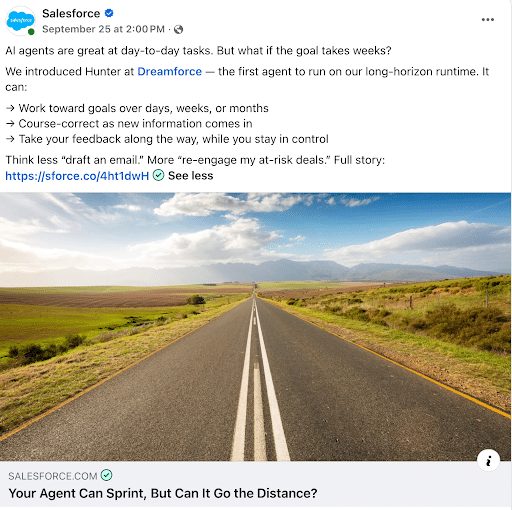
Real posts teach more than profile pages. Here are some B2B social media marketing examples in action:
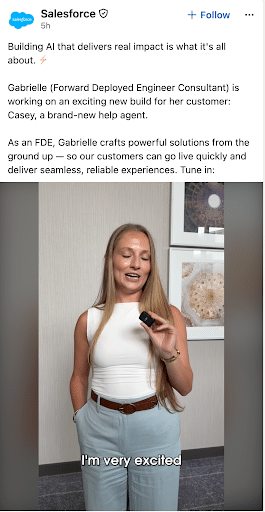
In this LinkedIn example, Salesforce shares some news about a new product and invites the audience to learn more.
X/Twitter
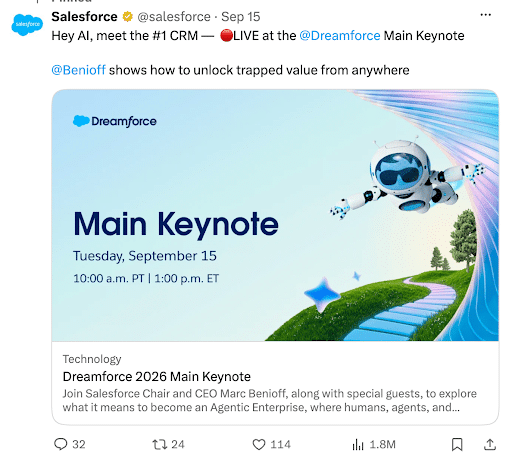
In this X/Twitter example, Salesforce shares a new webinar and invites prospects to join them to learn about a new product.
In this Facebook example, Salesforce introduces a new product and invites prospects to its website to learn more.
TikTok
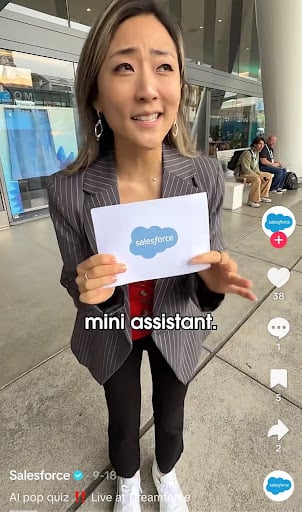
In this TikTok example, Salesforce humanizes its brand with some behind-the-scenes content at a convention.
TikTok B2B social media strategy example
Choose, Test, and Review
Pick one or two platforms and run social media content on them for a set period of time, like 90 days. Monitor your data and keep track of your wins.
Keep working on the channels that bring you qualified leads, and pause the ones that don’t. Following these B2B social media best practices will help your team focus time and budget on what works.
Create a B2B Social Media Strategy
A strong B2B social media strategy connects your posts to your business needs. Let’s look at some B2B social media best practices you can put into action today.
Goals and Audience
When preparing your social media strategy, start with one business objective, not a long list. Consider pieces such as:
- Objective: Look at what result you want to achieve with your posting, such as more qualified demo requests from mid-sized manufacturers.
- Baseline: Look at where you stand today, such as how many qualified demo requests came in from social media last quarter to establish your baseline.
- Measurable target: Now make a note of the number you want to reach and the date you want to reach it by.
- Budget: Calculate how much you can spend on production, software, and paid media.
- Owner: Name one person who is responsible for the results.
Next, separate your brand-building goals from your demand-capture goals. You’ll need different content and different measures, so mixing them together can make results hard to read.
| Brand-Building Goals | Demand-Capture Goals | |
| Purpose | Help the right accounts know and trust you | Turn people who already have a need into conversations with your team |
| Typical Content | Expert posts, original research, short videos, event recaps | Demo offers, case studies, comparison guides, and webinars |
| Early Measures | Relevant reach, engagement from target accounts, branded searches | Qualified inquiries, booked meetings, and opportunities created |
Once you’ve defined your goals and understand the types of content you need to make, it’s time to define your ideal accounts and the people who influence their decisions.
B2B purchases rarely rest with one person. One recent report found that more than 40% of B2B deals stall because of internal misalignment within buying groups. It also describes “hidden buyers,” whose influence may not be visible but can speed up or stop a deal.
In a typical B2B buying situation, group roles look like this:
- Users: These buyers care about daily workflow and the ease of adoption. They want to know that your product will make their lives easier.
- Champions: This group cares about solving a visible problem with a tool that they can easily justify to leadership.
- Finance: This group is concerned with cost, payback, and risk. Will your tool or service be worth it financially for the company?
- Procurement: This group is concerned with vendor stability and contract terms. They want to know if you’re a reliable company to work with.
- Other influencers: This group consists of integration, security, and strategy. They each have their own concerns.
Content and Calendar
Instead of posting whatever comes to mind, pick three or four buyer-problem themes. Tie each one to the questions buyers ask as they move from awareness to evaluation to purchase.
Creating a content calendar that clearly states what you’re talking about, who you’re targeting, and where and when you’re posting will keep your team on the same page.
Brand consistency really matters here, so make sure everyone agrees on these basics:
- Voice: How your brand sounds, including words and phrases you do and don’t use.
- Visuals: Logos, colors, and layouts for posts and videos.
- Terms: The names you use for products, features, and services.
- Approved claims: Statistics, customer results, and comparisons that have been checked and are safe to repeat.
A 90-Day Campaign Plan
Let’s take a look at this hypothetical 90-day B2B social media marketing plan. It’ll give you a better idea of how the pieces fit together for a full campaign.
The scenario: A software company sells workflow software to operations leaders at mid-sized companies. Its objective is to increase qualified demo conversations with those leaders.
- Primary channel: LinkedIn
- Supporting channel: YouTube for demos and tutorials
- Production budget: [amount] for expert time, design, and video editing
- Media budget: [amount] for paid promotion, kept separate from production
- Marketing owner: Content Marketing Manager
Sales owner: Sales Development Lead
Days 1 to 30: Validate buyers, audit content, and set up tracking
- Interview three to five customers and review recent sales calls to confirm buyer problems and objections.
- Audit existing content to see what already answers those problems.
- Set up UTM naming rules, GA4 key events, and CRM fields for source, campaign, and qualification stage.
- Record your baseline numbers.
Days 31 to 60: Publish expert content and test one offer
- Publish expert-led posts on LinkedIn tied to your buyer-problem themes.
- Post one tutorial or demo on YouTube and share it on LinkedIn.
- Test one offer, such as an operations checklist or a short webinar.
- Have the Sales Lead follow up on every inquiry within the agreed time.
Days 61 to 90: Review qualified opportunities and refine
- Review which posts, formats, and offers led to qualified conversations, not just clicks
- Ask the sales team what buyers said and which questions came up.
- Keep what worked, drop what didn’t, and adjust next quarter’s plan.
Engagement
Social media works best when it includes real conversations. Keep the habits that already work, like replying to comments and messages or joining relevant industry discussions. Then add some structure so nothing falls through the cracks:
- Assign owners: Decide who answers comments, who handles messages, and who escalates promising conversations to sales.
- Agree on a follow-up time: For example, you might want to reply to every inquiry within one business day.
- Define qualification: Write down the questions that tell you whether an inquiry is ready for sales, such as a role, company size, timeline, and need.
- Pass along the context: When an inquiry moves to sales, copy the post, the conversation, and the buyer’s question into the CRM, so the first call picks up where the social media conversation left off.
The key to engagement is to keep it as authentic as possible. Repetitive promotional replies, automated comments, or engagement pods can sometimes do more harm than good.
Experts and Employee Advocacy
Your company page is only one voice. Since buyers often trust people more than logos, don’t be afraid to turn advocacy into a repeatable workflow. This could look something like this:
- Interview an expert: Ask one specialist to talk through a problem they see often.
- Preserve their perspective: Keep their words, examples, and opinions. You can edit for clarity, but don’t flatten their voice or change their opinions.
- Support voluntary sharing: Offer drafts and ideas, and then let people decide whether to post or not. Sharing works best when it’s a choice.
- Collect buyer questions: Ask experts and salespeople to pass along questions they hear a lot. Use them for future content.
Paid Advertising
Paid social can add reach and speed to a plan that is already working. Once you decide what you want the ad to do, match the audience, offer, destination, and follow-up to that purpose.
Here are some key ideas to keep in mind:
| Paid Goal | Audience | Offer | Destination | Follow-Up |
| Awareness | Target roles and industries that don’t know you yet | Useful expert content or research | Article, video, or resource page | Retartget engaged viewers with the next step |
| Retarging | People who watched, visited, or engaged with your content | A deeper guide, case study, or webinar | Landing page tied to their interest | Invite a demo or conversation |
| Lead Capture | People ready to take a clear next step | Demo, consultation, or high-value guide | Landing page or lead form | Sales follow-up within the agreed time |
As you test out new strategies and ideas, make sure you only change one thing at a time. You can try different audiences, compare messages or creative, and then judge results by cost per qualified lead next to total cost per lead. A cheap lead that never becomes a conversation is not a bargain.
Measuring and Analyzing Success
If you’re doing all this work, you’ll want to see the results. That’s where metrics come into play. Organize them by purpose so each number answers a clear question:
- Relevant reach and engagement: measure impressions and engagement from target roles and accounts, as well as the quality of the replies
- Qualified inquiries and meetings: Qualified form fills, replies that become conversations, booked meetings
- Opportunities, pipeline, and revenue: Opportunities created, pipeline value, closed revenue
Before getting started, set up a tracking checklist that includes:
- Consistent UTMs: Use the same naming rules for every tagged link.
- GA4 key events: Mark actions that show real buying interest, such as a demo request, as key events.
- CRM fields: Add fields for source and campaign.
- Qualification stages: Define each stage, such as a new inquiry, qualified lead, opportunity, and closed.
- Sales feedback: Ask the sales team regularly which leads are a good fit and why.
When you report on the pipeline, keep social-sourced and social-influenced separate. Social-sourced means the lead came in because of a social interaction. Social-influenced means it had a social touchpoint along the way, but may have started elsewhere.
Also keep timing in mind. An attribution window is the period after an interaction during which you can credit a conversion to it. B2B buyers often take weeks or months to decide, so a post can influence a deal long after the campaign ends. Choose your windows ahead of time and document them.
Finally, use these definitions:
- Cost per qualified lead = relevant campaign spend ÷ qualified leads
- Overall ROI should include production, software, and management costs, not just ad spend.
- Attribution does not prove causation. A deal that touched social may have closed for other reasons. Use this data to learn, and avoid claiming more than it can prove.
An Ignite B2B Social Campaign Example
B2B social media marketing strategies don’t have to live only on LinkedIn. Meta can also work when the buyer is a business investor. One recent Ignite Visibility campaign for a franchise brand shows what that looks like in practice.
The Challenge
A service and retail franchise wanted to sell more franchise locations. It faced three problems:
- The cost of acquiring a new franchisee was rising.
- Deal flow was inconsistent and hard to predict.
- Its targeting wasn’t reaching qualified investor audiences.
Ignite’s B2B Social Media Marketing Strategy
After studying the client and their current issue, we built a paid social program on Meta around the way investors actually move from interest to conversation. It looked like this:
- Meta Instant Lead Forms: Prospects could raise their hand in-platform without leaving for a separate page, keeping the first step simple.
- Investor-focused targeting: Audience layers were built around the kind of person who buys a franchise, not the general consumer.
- AI scheduling and lead filtering: AI-driven tools helped schedule conversations and screen leads, so the sales team could spend its time on the people more likely to be a fit.
- CRM support: CRM systems were part of the tech stack, which gave the team a place to track and follow up on each inquiry.
The campaign produced two franchise deals across four locations, at a cost of $3,500 per location.
B2B Social Media Strategy Ideas
Good B2B social media strategies start with a question your buyer is already asking, not a content format. Here are ten ideas to get you started:
Lead Magnets
A lead magnet should answer the question “Is there a practical tool that helps me start solving this problem?” The goal is to bring in qualified leads who share their contact details in exchange for something useful, like a checklist or template.
Educational Content
Educational content asks questions like “How does this work and what should I do about it?” This type of content builds trust with the right audience and encourages them to visit your site. It could be a text post, an article, or a single-image post linking to a longer resource, like a whitepaper.
Case Studies
Case studies aim to build consumer confidence during evaluation and requests for a conversation. They show that the company has worked with a company similar to the buyers’ and achieved strong results.
Tutorials
Tutorials show people how your product or service works. The goal is to give them a clearer view of your product and a shorter path to booking a demonstration. A great tutorial could be a step-by-step walkthrough of one singular task or an entire workflow.
Expert Q&As
Live, recorded, or text Q&As are a great way to share visible expertise with your potential consumer. You can also encourage engagement by asking those watching to send in their own questions to be answered.
Original News Analysis
Did a new regulation, report, or industry shift just happen? Break it down using plain language to help your audience understand it better. This provides them with quality information while also proving your authority on the topic and encouraging return visits from people who want your take on breaking industry news.
Useful Polls
Polls are a good way to share information while also driving engagement. Ask your audience a question about a real decision they could face. Follow that poll with a post sharing the results. This provides audience insight, gets you ideas for content, and sets up conversations with the right people.
Problem-led Demonstrations
A short video or an image series is an effective way to demonstrate how you can solve a problem. This shows your audience how your product works and that it can solve their specific problem.
Team and Culture
People want to work with people. Posting content that shows your team culture builds familiarity and trust, with hiring as a secondary benefit. Make posts or videos that show how your team does its work, share a specialist spotlight, or identify your values coming to life in a real project.
Buyer-relevant Milestones
Sharing buyer-relevant milestones, such as earning a new certification or introducing an integration with a new tool, helps you build credibility while they evaluate their options.
When deciding which type of content to use in your B2B social media campaigns, look at what matches your buyers the best. Educational content, news analysis, and polls suit buyers who are still learning. Case studies, tutorials, and demonstrations are better for buyers who are already comparing their options.
You should also consider who will be consuming your content and what their role in the process is. Don’t forget to consider your own capacity, too. One strong Q&A each month often does more than several thrown-together posts.
Finally, compare each post against your goal. Which ones moved the needle? Which ones need to be reconsidered?
Emerging Trends in B2B Social Media Marketing
The biggest shift in B2B social media marketing right now is how teams are using AI. It can save your team real time, but it can also fill feeds with posts that don’t say anything.
The best B2B social media marketing strategies use AI to support expert thinking, not replace it.
Using AI to Support Your Team
AI works best as an assistant for tasks around your expertise, such as organizing research, repurposing content, creating rough first drafts, or planning and queuing posts on your calendar.
Every piece of content that touches AI should still pass through someone who knows the subject. Before anything goes live, have an expert check these three things:
- Accuracy: Verify every statistic, claim, and customer result against its original source.
- Confidentiality: Make sure no client names, internal numbers, or private details are shared, and avoid pasting sensitive information into any AI tools that your company hasn’t approved.
- Brand Voice: Confirm that each post sounds like your company and reflects a real point of view that matches what’s in your brand guidelines.
That last part is incredibly important. More and more social media platforms are cracking down on “AI slop.” LinkedIn even posted an update in September 2026 calling it low-effort. The update also gave users an option to report content on the platform as “AI slop.”
Avoid getting caught in the AI slop trap by reaching each piece of content and asking yourself if it’s something only your team could share. Customer lessons, specific examples, or a position you’re willing to defend are better than generic advice.
Choosing Creators and Industry Voices
Creator partnerships can extend your reach when you choose them carefully. Whether you’re working with an independent expert, a niche newsletter writer, or an industry commentator, evaluate their expertise against these four questions:
- Subject expertise: Does this person have real, demonstrated knowledge of the topic your buyers care about?
- Relevant buyer audience: Do their followers include the roles, industries, and company sizes you want to reach?
- Evidence quality: Are their posts backed by firsthand experience, sources, or data, or do they disclose sponsored relationships clearly?
- Measurable objectives: Can you define what success looks like in advance, such as qualified visits, booked conversations, or content downloads? Can you track it with tagged links?
A smaller creator with a focused, credible audience may be a better fit than a large account with a broad following. Start with one clear goal and a small test, then expand it if your results justify it.
Common Challenges B2B Social Media Marketers Face (And How to Overcome Them)
Let’s be real, B2B social media isn’t always a walk in the park. Luckily, most of them have a practical fix. Use this checklist to match each problem to one action your team can take this month.
- Limited Resources → Use fewer channels and a repeatable workflow – Prioritize your efforts, focus on the platforms that give you the best return, and consider outsourcing some tasks. Tools like scheduling platforms can also be a lifesaver. A repeatable workflow will serve you better than an ambitious plan nobody can sustain.
- Poor lead quality → Create qualification feedback and assigned follow-up – Lots of forms fills can look like progress even when few of those people are a good fit. Ask your sales team to mark each inquiry as qualified or not qualified, and to note the reason. Use that feedback to adjust your messaging, audiences, and offers. Also make sure every inquiry has a named person responsible for following up within the time you’ve agreed on. Quality tends to improve when everyone can see what is working.
- Unclear ROI → Agree on shared reporting definitions – Focus on key metrics like lead generation, website traffic, and engagement rates. Use analytics tools to track your progress and adjust your strategy accordingly. Remember, it’s often about building relationships and brand awareness, which can be harder to quantify. Make sure marketing and sales are looking at the same numbers and reaching the same conclusions. Some of social media’s value, such as brand recognition, is harder to measure. Say so openly, and track it separately from your lead and pipeline results.
- Constant platform changes → Hold a scheduled content and performance review – Social media platforms are constantly evolving, and it can be exhausting trying to stay on top of everything. Put a recurring review on the calendar instead. At each review, look at which posts and formats led to qualified conversations, which ones didn’t, and what you should test next. Base your changes on your own results and on what the platforms say in their official guidance. Avoid rumored tricks or “hacks” unless you can verify they work.
A short, steady routine like this helps your team spend less time chasing trends and more time building trust with buyers. If you’d like experienced support here, B2B social media services can help you plan, publish, and measure your success without adding too much to your already overflowing plate.
B2B Social Media for Franchise Businesses
Franchise brands run two kinds of marketing at once. One speaks to local customers. The other speaks to business audiences, such as prospective franchisees, suppliers, and partners. This section focuses on the second kind, because it needs its own B2B social media strategy.
With franchise social media, three groups matter the most:
- Franchise development: Prospective franchisees are making a major investment. Expert content, franchisee stories, and answers to common due diligence questions can help them feel confident enough to start a conversation.
- Supplier relationships: Sharing system milestones, new partnerships, and useful industry insights to keep suppliers engaged.
- Business partnerships: Property developers, lenders, and complementary brands can all support your growth. Thoughtful posts and direct conversations on LinkedIn can keep you visible to them.
Local consumer promotions still matter, but they belong in your consumer marketing plan. Keeping them separate helps each audience hear what it needs.
Separate Investor Inquiries from Customer Leads
Prospective franchisees and customers want very different things, so give each group its own track:
- Forms and offers: Investor forms might ask about territory and investment range. Customer forms might ask about booking a service.
- Ownership: Corporate or franchise development teams should own investor inquiries. Local teams usually own customer leads.
- Follow-up: Agree on a response time and a qualification process for each track. Pass the context for every inquiry into your CRM.
- Reporting: Track investor inquiries by qualified conversations, discovery calls, and signed agreements. Track customer leads by bookings, visits, and sales.
Keep Brand Consistency Across Locations
Decide which parts of your brand are fixed across the system, such as your logo, core messages, and approved claims. Then decide what can change locally, such as photos, team introductions, and community stories. Clear boundaries help each location contribute without drifting from the brand.
Where Rallio AI Can Help
Corporate teams need control over the brand’s messaging, while local teams need speed and relevance. Rallio is an AI-powered platform built for multi-location brands.
Its Post Library and Scheduling System offer pre-approved content that users can customize and schedule, and its AI tools help local teams turn their own updates into posts. That gives each location brand-guided drafts and localized publishing without starting from a blank page.
A tool can organize the work, but people still build relationships. Have a franchise development expert review investor-facing content for accuracy, tone, and compliance. Make sure a real person answers comments, messages, and inquiries.
B2B Social Media FAQs
1. Why is social media important for businesses?
Social media can significantly enhance brand awareness, customer loyalty, and lead generation. It offers a platform where businesses can reach their target audience efficiently, encourage engagement, and forge personal connections.
2. What are the top social media platforms for businesses?
Facebook, Instagram, X, LinkedIn, and Pinterest are popular platforms. The choice depends on the nature of your business, the target audience, and your marketing objectives.
3. How often should a B2B company post on social media?
You should post as often as your team can keep up with while still sharing something useful. A steady, sustainable schedule works better than a high-volume plan that burns out your experts. Start with a pace you can maintain, such as a few well-made posts each week. Then review your results every month or quarter and adjust. Let your own data show you which cadence and formats lead to qualified conversations.
4. How do I measure the success of my social media efforts?
Key metrics are Likes, Shares, Comments, Click-through Rate (CTR), and Conversion Rate. These demonstrate both engagement and conversion effectiveness, offering insights for performance improvement.
5. How does social media contribute to SEO?
Although social signals aren’t direct SEO factors, high-quality shareable content can increase visibility, drive traffic to your website, and indirectly boost your search engine rankings.
6. Can social media work with a small following?
Yes. The right audience matters more than a large one. A small following of your ideal buyers, partners, and industry peers can spark more useful conversations than a big, unfocused one. Share expert content that speaks to their problems, and join the discussions they’re already having. Then measure success by qualified conversations and meetings, not follower counts.
7. Should all B2B content be gated?
No. Keep educational content ungated, such as blog posts, social posts, short videos, and basic guides. It builds trust and helps buyers find you. Save registration for offers that clearly justify sharing contact details, such as original research, templates, in-depth reports, or live webinars.
8. How much should I budget for B2B social media?
Your budget depends on your goals, industry, and how much your team can handle in-house. Consider these four areas: content, management, tools, and media. Start with a focused plan on one or two platforms, then expand when your results support it.
9. How long before I see results from B2B social media marketing?
It depends on your campaign goals and your sales cycle. Reach and engagement from the right audience may show up first. Qualified conversations usually come next. Pipeline and revenue take longer, especially when several people are involved in the purchase decision. Set expectations for each stage before you launch, and review progress regularly.
Ignite Your B2B Social Media Marketing Success
Social media isn’t just about selling; it’s about building real connections with the people behind the brands. If you want to get the best results from your strategies, consider working with our B2B social media marketing agency.
Our award-winning B2B social media marketing services can help you transform your social media presence into a place where your sales relationships start. Let’s work together to:
- Position your company as an industry leader
- Create engaging content that captivates your audience
- Build strong relationships with potential customers
Ready to see what B2B social media marketing can do for you? Check out our B2B social media services today!