


With 75% of clients visiting two to five websites before contacting anyone, a well-written, well-designed website is essential for law firms today. Not only does it have to be well-designed and user-friendly, but if you want anyone to find it, you need to invest in law firm SEO.
Let’s talk more about how you can use lawyer SEO marketing to help your site climb to the top of rankings for relevant keywords and attract more high-quality leads.
What You’ll Learn:
- Why Law Firm SEO Matters
- Essential Local SEO Strategies for Law Firms
- Our Approach to SEO for Law Firms
- Crucial Legal SEO Ranking Factors
- The Role of User Experience (UX) in SEO
- Measuring Success: How to Track and Evaluate Your Law Firm’s SEO Performance
- When Should You Hire an Agency for Law Firm SEO?
- Law Firm SEO FAQs
What Is Law Firm SEO & Why Does it Matter
Law firm SEO is the strategic process of improving a law firm’s visibility in search results to attract prospective clients. It’s how potential clients can find you in their time of need.
Recent data shows that 99% of people seeking legal advice now start with a search engine. This shift has made organic search the single most important channel for legal growth.
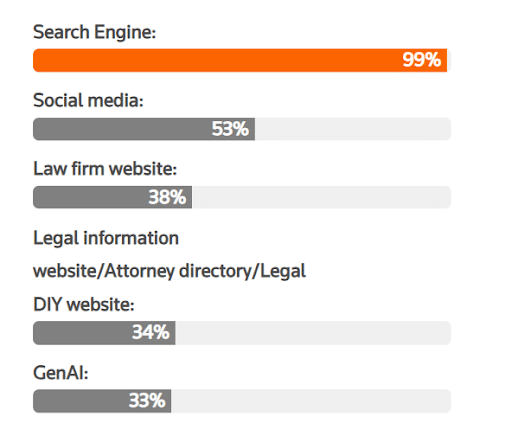
While traditional referrals remain valuable, the modern client journey is mobile-first and research-heavy. Potential clients are no longer just looking for a phone number. They are vetting expertise, reading reviews, and comparing options before they ever make a call. Effective law firm SEO positions your practice as the authoritative solution they need from the moment they start their search.
Why It Matters: ROI, Brand & Lead Quality
Investing in SEO offers advantages that paid advertising simply cannot match, particularly in terms of trust and long-term asset-building. While Pay-Per-Click (PPC) campaigns can provide immediate visibility, they operate on a rented model. Your visibility stops the moment you stop paying. SEO builds a sustainable owned asset that compounds in value over time.
- Superior Lead Quality: SEO targets active intent, users actively searching for a solution, rather than interrupting passive users with ads. This results in significantly higher engagement. Recent industry data reveals that legal SEO leads have an average conversion rate of 7.5%, compared to just 2.2% for PPC leads.
- Cost Efficiency (Rent vs. Own): In highly competitive practice areas like personal injury, PPC costs have skyrocketed. Keywords such as “car accident lawyer” are now incredibly expensive.
- Brand Authority: Ranking at the top of Google signals credibility. Users inherently trust organic results more than sponsored spots. Appearing in the top three organic positions suggests that Google recognizes your firm as a leading authority in your field, a psychological validator that paid ads cannot buy.
How it Differs From Traditional SEO
While the foundations of SEO, such as keywords, site speed, and backlinks, apply to all industries, the stakes in the legal sector create an entirely different playing field.
Law firms operate under Google’s strictest quality standards, known as YMYL (Your Money or Your Life). Because legal content can significantly impact a person’s future, finances, and well-being, Google holds legal websites to a much higher standard of accuracy and authority than it does for typical e-commerce or lifestyle blogs.
The following table breaks down the key distinctions between standard SEO and the specialized approach required for law firms:
| Feature | Traditional SEO | Law Firm SEO |
| Competition Level | Moderate to High | Hyper-Competitive: You are competing against firms with decades of history and big budgets. |
| Content Standards | General utility and relevance | Strict YMYL & E-E-A-T: Content must be authoritative, often reviewed by attorneys and cited correctly. |
| Local Focus | Optional (depending on business) | Mandatory: The Local Pack (Map Results) drives almost half of the clicks, so proximity is a major ranking factor. |
| User Urgency | Varies (often research-based) | High Urgency: Uses often need immediate representation (ex: DUI lawyer near me), requiring fast-loading mobile pages |
The Technical Edge: Local Pack & Zero-Click
To succeed today, firms must look beyond the traditional SERP ranking. Two emerging elements are redefining success: the Local Pack and Zero-Click features.
The Local Pack
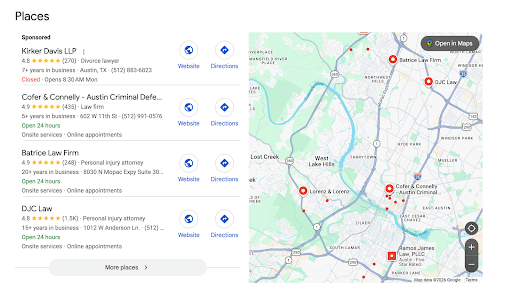
The Local Pack serves as your digital storefront. When a user searches for a nearby lawyer, Google displays a map showing three businesses, their star ratings, and contact info.
Securing a spot here is often more valuable than ranking #1 organically because it appears at the very top of mobile searches. With “near me” mobile searches growing rapidly, appearing in the Local Pack is pretty much a necessity.
Zero-Click
Meanwhile, the rise of Zero-Click searches means users often get their answers without visiting a website. These searches come from Google’s AI Overview and Featured Snippets, making their positions very valuable.
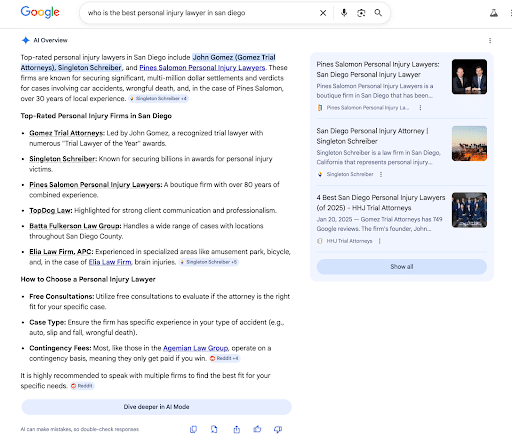
To stay visible, your content must be structured to answer specific legal questions concisely. This will increase the odds that Google cites your firm as the source of truth.
Essential Local SEO Strategies for Law Firms
Appearing in the Map Pack or on Zero-Click search results ties into your local SEO for law firms strategy. Since “law firm SEO” can encompass a wide variety of law specialties, in order to appear in the right place, you need to understand the locally targeted keywords for your specific industry. After all, what good is it to appear in the Map Pack for personal injury law if you’re a bankruptcy lawyer?
You also need to take your geographic location into account. This will help you connect with potential clients who are near you, which is important for the client, but also weeds out any leads in areas where you aren’t licensed to practice.
Over one-third of all organic search traffic for location-based businesses is local, and search engines prioritize location-specific results.
For example, a search for “car accident lawyer” in Raleigh, North Carolina, will produce different results than the same query in Los Angeles, California.
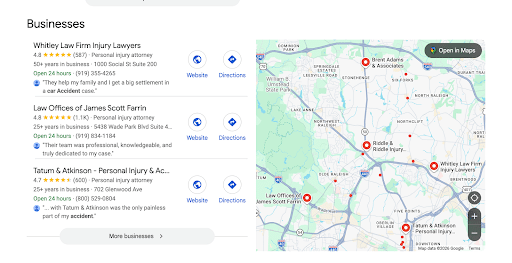
And here’s the same search in Los Angeles, California:
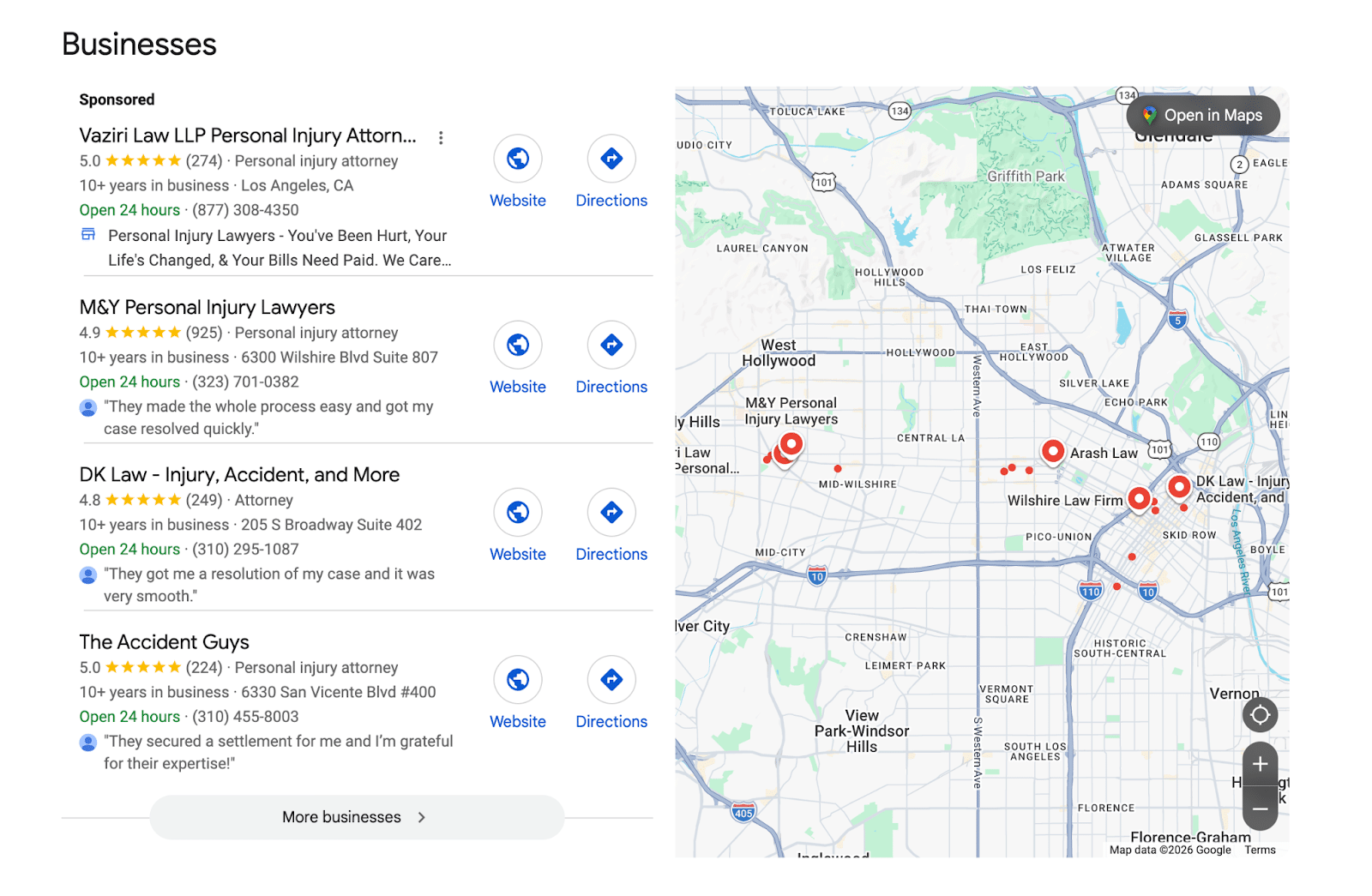
Local SEO goes beyond rankings and geographical connections. It can also help build credibility and trust within your community.
Firms can further enhance their reputations by creating educational content that addresses common legal questions. A comprehensive local SEO strategy includes:
- How-to guides
- Blog posts on key legal topics
- Frequently asked questions (FAQs)
- Locally-focused content
- Articles simplifying complex legal issues
By addressing these areas, your firm can position itself as a trusted authority, attracting both local clients and a broader audience seeking expert guidance.
Here are some strategies you can use to boost your local SEO rankings and visibility:
Optimizing Google Business Profile (GBP)
Your GBP is your new homepage. To optimize it for 2026, make sure to:
- Get specific with your categories. Do not just list “Law Firm.” Use highly specific primary categories like “Personal Injury Attorney” or “Estate Planning Lawyer” to match intent.
- Upload high-quality photos of your team and office. Profiles with photos receive 42% more requests for directions.
- Engage with your audience. Use the Q&A feature to populate common legal questions (and answers) before clients even ask them.
Building “Review Authority”
Reviews are a ranking signal, but response rate is equally critical. Responding to every review signals to Google that the business is active.
Aim for a steady stream of new reviews rather than just a high total number. This is incredibly important because 83% of consumers check your online reviews.
Winning “Near Me” Queries
“Near me” searches are growing daily. To capture this traffic, you must start identifying hyper-local keywords. Think “Chicago Loop divorce lawyer” vs. just “Chicago lawyer”.
Ensure your website is optimized for mobile voice search, as many “near me” queries are spoken into smartphones while users are on the go.
Local Citations & Schema Structured Data: NAP Consistency
Your Name, Address, and Phone Number must be identical across the web. Discrepancies between your website and directories confuse Google and tank rankings.
You also need to implement LocalBusiness or Attorney schema on your website’s backend. This code explicitly tells search engines your practice areas, hours, and location coordinates, helping you qualify for “rich results” in search.
Community Signals
Google looks for proof that you are actually part of the community. Sponsoring local charity events, participating in legal clinics, or getting featured in local news outlets creates “local relevance” that competitors cannot fake. Links from local chambers of commerce or state bar associations act as powerful geographic validators.
Beyond Google
While Google is king, do not ignore Apple Maps and Bing Places. Apple Maps is the default navigator for millions of iPhone users.
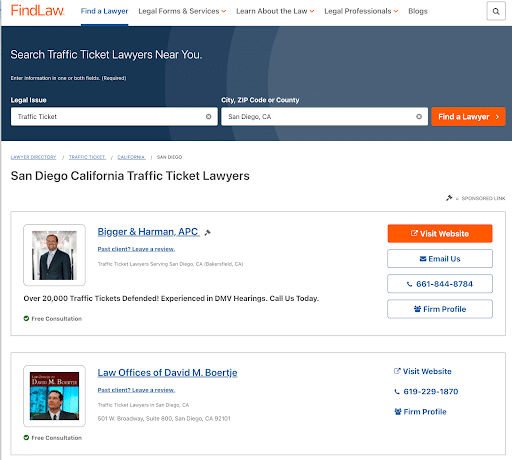
Maintain profiles on high-authority legal directories like Avvo, Justia, and FindLaw, as these directories often rank highly for local search terms.
Understanding Search Intent for Legal Queries
Ranking for high-volume terms means nothing if the traffic doesn’t convert. Legal sector SEO requires you to understand the “why” behind a search. This is the difference between a curious reader and a paying client.
Keyword Research Basics
Effective legal keyword research looks past search volume to identify user needs. For example, a user searching “car accident statistics 2024” is likely a student or researcher, offering zero ROI.
On the other hand, a lower-volume search like “what to do after a truck accident in Atlanta” signals a victim seeking immediate guidance. Successful firms target valuable long-tail keywords that mirror specific legal problems rather than broad, undefined terms like “lawyer.”
Intent Taxonomy
Legal searches generally fall into three clear categories:
- Informational: The user has a problem but isn’t ready to hire (ex: “grounds for divorce in California” or “is jaywalking a crime”).
- Commercial Investigation: The user is vetting options (ex: “best immigration lawyers reviews” or “personal injury attorney contingency fees”).
- Transactional: The user is ready to retain counsel immediately (ex: “DUI defense attorney near me” or “call workers comp lawyer”).
Semantic Clustering
Google now ranks topics, not just keywords. Semantic clustering involves grouping related terms to create comprehensive content assets.
For a personal injury site, a page shouldn’t just target “dog bite lawyer.” It must also address semantically related queries, including topics like “strict liability laws,” “average settlement for nerve damage,” and “owner negligence.” This will help establish true topical authority and capture traffic across the entire subject spectrum.
Prioritization
To maximize ROI, law firms must prioritize Bottom-of-Funnel keywords first. While informational guides build long-term trust, transactional queries pay the bills.
Focus your initial SEO efforts on high-urgency terms like “emergency bail bond hearing” or “contest a will lawyer” before expanding into broader educational content. Capturing the immediate need funds the long-term growth.
Our Approach to SEO for Law Firms
Here at Ignite Visiblity, we focus on building campaigns tailored to your state and practice area’s specific regulations. Our data-driven approach combines technical precision with authoritative content creation to secure sustainable rankings that turn searchers into signed clients.
Let’s take a look at some of the best legal marketing SEO strategies we use to help our clients protect their reputation while expanding their digital presence.
Technical SEO Essentials
The first step in our process is a full law firm SEO audit. This will help us assess your current performance and determine where we should make changes first.
Some of the main areas to look at in an audit include:
- Page speed
- Backlink profile
- Internal linking structure
- Mobile friendliness
- User experience
- Keyword usage
- On-page optimization
- Content quality
A law firm SEO expert will be able to conduct a thorough audit and use the results as a roadmap for the rest of your campaign.
Keyword Research & Intent-Driven Topic Clusters
Keywords are the phrases and words people type into search engines. Effective SEO depends on detailed keyword research—carefully deciding what keywords to target with your content.
For example, say you wanted to increase inbound organic leads on your firm’s website. You would pick keywords relating to your firm’s specialties and target them with search-optimized pages (landing pages, blog posts, etc.).
But how do you know what keywords to target? By using keyword research tools, which give detailed information about each keyword.
To illustrate, imagine you’re a firm in San Diego that wants to boost traffic fast. You’d use a tool like Ahrefs to search for a term like “immigration lawyer San Diego.”
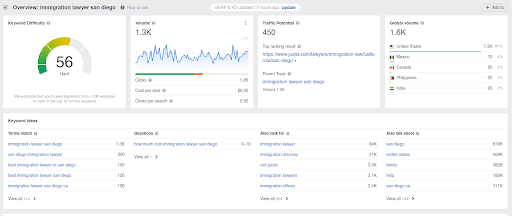
This data tells you it’s a valuable keyword (see the $8 CPC) but it’s hugely competitive. Ranking for this term might take years, which is incompatible with your goal of boosting traffic fast.
So instead, you find an easier variation, like “San Diego immigration lawyer free consultation.”
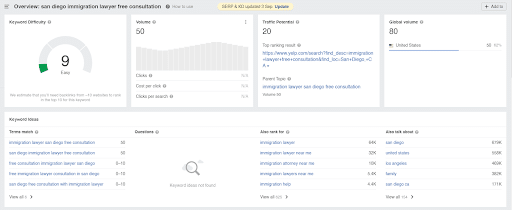
As you can see, this term is much easier to rank for. The right page would probably rank you on page one easily, potentially getting you dozens of leads each month.
When selecting keywords for law firm marketing SEO, it’s important to do some search intent-based clustering. Here, we would organize keywords based on where people are in the funnel, putting terms into the following categories:
- Informational: “how to file a personal injury claim,” “what to do after a car accident,” “how much does an attorney cost”
- Navigational: “[law firm] personal injury website,” “[law firm] slip and fall attorneys,” “findlaw immigration attorney directory”
- Commercial: “top criminal defense lawyers in [city],” “trusted [city] attorneys,” “best seo for law firms”
- Transactional: “hire a personal injury attorney,” “schedule an attorney consultation,” “legal help for a car accident injury”
On-Page SEO Checklist for Lawyers
After completing keyword research, it’s time to take care of your on-page SEO. This process involves optimizing web content for lawyers, including high-quality service pages, blog posts, and other content, with effective keyword targeting and a solid website structure.
Your website should blend both usability and good optimization to appeal to both search engines and potential clients.
Here is an on-page SEO checklist for your law firm’s website:
- Title Tags: Include specific Practice Area + City/State (e.g., Personal Injury Lawyer in Austin, TX).
- Meta Descriptions: Write compelling, 155-character summaries with a clear Call to Action (CTA) and phone number if possible.
- URL Structure: Keep URLs short, clean, and keyword-rich (e.g., /practice-areas/car-accident-lawyer).
- Heading Hierarchy: Use one H1 tag per page (the main title) and organize content with H2s and H3s for readability.
- Keyword Placement: Naturally include primary and secondary keywords in the first 100 words, headers, and image alt text.
- Internal Linking: Link to related practice areas, case results, and attorney bios to keep users on the site.
- Schema Markup: Implement Attorney or LegalService structured data to help Google understand your business details.
- NAP Consistency: Ensure Name, Address, and Phone number in the footer match your Google Business Profile exactly.
- E-E-A-T Signals: Include an author bio or medically/legally reviewed byline to establish expertise and authority.
- Mobile Responsiveness: Verify the page loads quickly and text is readable on mobile devices.
Content Strategy: Pillars, Clusters, & AI Readiness
All of your content should be informative and clear, showcasing your firm’s knowledge to earn people’s trust. At the same time, you should align your content with searcher intent.
Focus on a hub-and-spoke model, also known as a Pillar and Cluster content model. This type of site architecture signals to Google that you possess total topical authority over a practice area, rather than just ranking for a few isolated keywords.
- Pillar Pages: These are comprehensive, high-level guides covering a broad practice area (e.g., “The Ultimate Guide to Divorce in Florida”) that serve as the central hub for user traffic.
- Topic Clusters: These are specific, supporting articles that link back to the pillar (e.g., “Alimony calculations,” “Child custody mediation,” or “Who gets the house?”). This internal linking structure creates a web of relevance that boosts the ranking of the entire group.
Your content must also be AI-Ready. As Google’s AI Overviews start to take up more page space, search engines are prioritizing content specifically structured for machine comprehension.
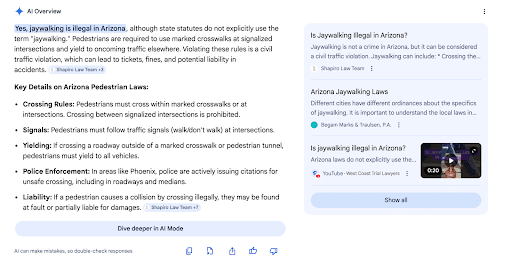
To appeal to these algorithms, content should feature direct, question-based headings and concise, data-backed definitions. This increases the likelihood that your firm will be cited as the “source of truth” in rich snippets and generative AI responses, capturing high-intent traffic without users even clicking a link.
Off-Page Law Firm SEO and Authority Building
In addition to on-page SEO, web marketing for lawyers should implement various off-page SEO tactics. These can include:
Develop Link-Building Strategies
One of the most important off-page strategies is link building for lawyers.
Backlinks are links to your site from other websites. Each one acts as a vote of confidence for your site, like ballots in an election.
Specifically, search engines consider backlinks as a sign of a high-quality website. After all, only great content will make people refer to your site.
How to Get Backlinks
Backlinks are naturally obtained by creating high-quality content that other people reference. For instance, if you write a detailed article on tort law, others may reference it and link to it.
But natural link building takes time, and it can be a slog in the beginning. To build links faster, use these strategies:
- Guest posting. Guest posting is writing “free” blog content for other sites in exchange for a backlink. This is generally the easiest way to get high-quality links.
- Broken link fixing. Use SEO tools to find sites in your niche with links that 404. Offer to replace the broken links with suitable resources of your own.
- Graphic sharing. Create original graphics for your content (more on this below) and share them with other sites. If they think it will help their readers, they’ll use it and link back to your page.
- Just asking. You can reach out to other sites and simply ask them to link to your content. Know that this is saturated and often annoying, so try something like the above that gives value to the site.
- Local citations. Directory listings and local citations could also contain links to your website to support other external links.
- Legal Publications. Certain types of authoritative legal publications, including legal journals and magazines, could link to various entities within the text, including individual attorneys, firms, court districts, or specific legal codes.
Remember that backlinks are worthless if they don’t come from sites in your niche. Cooking, traveling, and beauty blogs won’t do anything for your firm’s site, no matter their reputation.
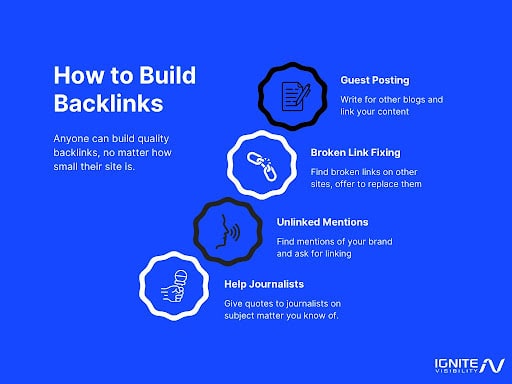
Whatever you do, don’t use black hat tactics when acquiring backlinks. Buying links and spamming backlinks in the comments on other sites will quickly make link building for lawyers a fruitless effort. Ultimately, it could easily earn you a penalty from Google, from which it can be very difficult to recover.
Staying compliant with Google’s spam policies and avoiding link spam will keep web content for lawyers in good standing.
Use Law Firm Local SEO Tactics
As mentioned, lawyers especially benefit from strong local SEO. There are multiple law firm local SEO strategies you can use to grow your online presence.
Optimize Your Google Business Profile
Once you’ve set up your Google Business Profile as discussed above, you should continually optimize it for better rankings.
Be sure to include images for your firm to showcase everything from your location to your legal team. Also, give each location its unique address, phone number, and other relevant details.

You can also update your profile with Google Posts that discuss certain legal topics and link to corresponding blog posts, which will also improve SEO.

Measuring Success: How to Track and Evaluate Your Law Firm’s SEO Performance
You cannot manage what you do not measure, but tracking your ROI goes beyond vanity metrics. Instead, a sophisticated law firm SEO strategy requires a KPI dashboard that directly links search data to client acquisition.
Here are the four categories of key metrics for measuring law firm SEO agency performance:
1. Visibility & Traffic Metrics
Top-of-funnel metrics indicate how well your firm is being found in the digital marketplace.
- Organic Sessions: Focus specifically on organic traffic to transactional pages rather than just blog posts.
- Keyword Rankings: Monitor fluctuations for high-intent terms (e.g., “Chicago accident lawyer”) versus broad informational terms.
- Local Visibility: Track your appearance in the Local Pack for “near me” searches, as this drives most immediate calls.
2. User Engagement Signals
Google uses engagement data to determine if your content actually answers the user’s query.
- Click-Through Rate (CTR): A low organic CTR indicates that your Title Tags or Meta Descriptions are not compelling enough to win the click over competitors.
- Dwell Time & Bounce Rate: If users land on your page and leave immediately, it signals a mismatch between search intent and content quality. High dwell time correlates with higher rankings.
3. Conversion & Revenue Metrics
Ultimately, SEO must result in signed cases. Here’s how to track it:
- Goal Completions: Track specific actions: click-to-call buttons, contact form submissions, and live chat initiations.
- Cost Per Acquisition (CPA): Calculate the total SEO spend divided by the number of signed cases. This is often significantly lower than PPC CPA.
- Pipeline Value: Assign an estimated case value to organic leads to understand the potential revenue currently in your intake funnel.
4. Reputation Velocity
Since reviews impact rankings, they must be tracked as a KPI.
- Review Velocity: The rate at which you acquire new reviews compared to competitors. A stagnant profile loses authority.
- Sentiment Analysis: Monitoring the ratio of positive to negative feedback ensures your “digital reputation” supports your SEO efforts.
By integrating Google Analytics 4 (GA4) and Google Search Console to track these specific KPIs, you move beyond guessing and start making data-backed decisions that drive firm growth.
When Should You Hire an Agency for Law Firm SEO?
Considering how much goes into a successful law firm SEO campaign, it can be daunting to handle on your own, especially if you don’t have a dedicated marketing team to develop and manage your strategies. SEO is also not a one-and-done deal, requiring constant work to get the best results.
To maintain a competitive edge with continuous optimization, high-quality content, and reliable performance tracking, it may be in your best interest to work with a law firm SEO expert.
Specifically, an SEO agency for attorneys will have expertise in the legal industry and know what lawyers and practices are looking for in the perfect campaigns.
It’s often worth an SEO retainer to work with professionals who can get real results with everything from content management and keyword research to link building for lawyers specifically.
The following are some of the main benefits of working with a law firm SEO expert:
- In-depth knowledge around SEO, including the specific needs of law firms when it comes to optimization and content management
- Dedicated experts who are always there to give your strategy the attention it needs
- Detailed real-time analytics and reporting to gauge the success of your campaigns based on your goals
- Continually adapt to the changing needs of the SEO landscape and the legal industry
When looking for the ideal SEO agency for attorneys, you should also go with a company that advertises experience, expertise, and proven results. The right combination will lend years of value to your firm as you get everything you need for long-term growth.
Think about the following:
- Industry Expertise: A good company will have plenty of experience in your industry. Look for a firm that advertises legal experience, ideally within your practice area.
- Case Studies: Your agency should also have plenty of industry-related case studies from previous clients discussing successful SEO services for lawyers, proving the company’s experience and expertise.
- Communication Cadence: The ideal candidate will also maintain transparent and responsive communications, offering a reliable point of contact in the form of a dedicated account manager and regular check-ins.
Law Firm SEO FAQs
1. How long does law firm SEO typically take to see results?
Legal SEO is a long-term investment, not a quick fix. While technical optimizations can show initial movement within 30-60 days, significant ROI and consistent top-tier rankings typically require 6 to 12 months of sustained effort. This timeline varies significantly by practice area and local competition. Patience is key, because unlike PPC, the authority built during this period can generate leads for years after the initial work is done.
2. How do reviews impact local SEO and rankings?
Reviews are a top-three ranking factor for the Google Local Pack. Search algorithms prioritize businesses that demonstrate trust and activity through a steady stream of positive feedback. Beyond just the star rating, Google analyzes Review Velocity (how often you get them), Recency (how new they are), and even keywords within the review text to determine relevance. Additionally, a high review count drastically improves your Click-Through Rate (CTR). Clients are far more likely to contact a firm with 50+ reviews than one with none, signaling to Google that you are the preferred local choice.
3. Can law firms do SEO internally, or should they hire an agency?
While large firms may employ a marketing director, executing a competitive SEO strategy requires a diverse skillset, including technical coding, content writing, link building, and data analysis, which is difficult for a single employee to manage. An agency offers specialized expertise and economies of scale, providing a full team of experts for less than the cost of one in-house salary. For most firms, partnering with a specialized legal SEO agency delivers a strictly better ROI and faster results.
Fully Optimize Your Law Firm SEO With Ignite Visibility
Effective SEO for lawyers can help law firms get and stay on top of the competition, but you may not have the in-house expertise or resources to succeed with your efforts. Thankfully, Ignite Visibility has plenty of expertise in law firm SEO to help your firm dominate search engine rankings and maximize visibility.
With our help, you can:
- Determine what your website needs to thrive with a thorough SEO audit
- Conduct in-depth keyword research to reach audiences at every stage of the client journey
- Create high-quality content, including an aesthetically appealing and search-friendly website that drives traffic and conversions
- Integration of SEO efforts into PPC campaigns and other marketing efforts
- And much more!
If you like the sound of that, reach out to us to find out what we can do for your law firm today!

