Choosing an SEO agency isn’t just about finding a vendor, it’s about finding a partner that can drive measurable business growth. While many agencies promise rankings and traffic, the best partners focus on sustainable performance, transparent reporting, and strategies that support long-term revenue goals.
Many companies evaluate agencies based on projected rankings or traffic increases. The better question is whether the agency can connect SEO efforts to business outcomes. Traffic without conversions rarely delivers meaningful value.
In this guide, Stephanie Peterson, Chief Marketing Officer, walks through the key factors to evaluate when selecting an SEO agency, including the criteria that matter most, common red flags, and the questions every business should ask before signing a contract.
How Do You Choose the Right SEO Agency?
Finding an SEO agency is easy, but finding the right one is the hard part. At a minimum, look for the following basic qualifications:
- Proven expertise in technical, off-page and on-page SEO
- Integration of AI SEO strategies to their program
- Transparent reporting, with a KPI focus on conversions
- Alignment with your unique industry
- Dedicated account manager and clear communication expectations
- Comprehensive discovery and audit phase
- Custom strategy tailored to your business goals and challenges
- Industry-relevant case studies proving long-term client retention
We’ll explore each of these criteria in greater depth below.
When Should You Hire an SEO Agency?
Organic traffic is one of the most powerful drivers of sustainable company revenue if done correctly. Here are some indicators that it’s time to seek an agency partner:
- Organic Leads Have Plateaued: If you see that your organic traffic and leads have either plateaued or started to decline, this could indicate that your SEO strategy has stagnated and isn’t reaching its full potential, in which case an SEO agency could help you rejuvenate your efforts.
- Migration or Redesign Is Inevitable: About to complete a site migration or redesign? Doing so without an expert SEO audit and proper redirects can put your existing rankings and overall performance at risk.
- Technical Backlog Is Growing: You may also need to address many technical SEO elements to resolve various issues, from crawl errors, slow site speed, to poor mobile SEO, all of which may require help from experienced experts.
- Content Lacks Strategy: Your content must align with search intent and optimize for features such as entity SEO and local targeting. SEO experts can develop a strong content strategy that gets real results.
- Internal Team Lacks Bandwidth: As your business and strategy grow, your in-house team may not have the time or resources to focus on your SEO efforts, making an agency ideal to handle your strategy while your team redirects its attention to driving more growth.
- Reporting Cannot Tie SEO to Revenue: Your reports might spend too much time on “vanity metrics” and fail to show how your strategy is boosting profits and ROI, something SEO experts can avoid by developing comprehensive and results-driven reports.
However, there are some circumstances when you might want to wait before choosing an SEO company, such as when:
- You want to focus more on paid media and other strategies
- You don’t have the budget for an SEO agency
- You don’t have the resources for the proper implementation of strategies
My Expert Opinion on Choosing an SEO Company
Effective SEO needs a consistent and continually growing strategy. While there are little “quick wins” you might be able to earn on your own, there’s much more to strong SEO, which requires long-term monitoring and adjustment. It’s not a set-and-forget type of strategy.
With developments like AI Overviews and other answer engine results, SEO is changing considerably, and experienced experts understand how to pivot campaigns to keep up.
As a full-service SEO company, we here at Ignite have helped businesses of all sizes and industries get the most from their SEO strategies. For instance, we managed to get a 43% increase in deals for a health and wellness franchise by optimizing for organic search in addition to paid channels, and we helped a home service franchise appear in more than 15 Google AI Overviews to maximize AI SEO visibility.
Look for a Strategic SEO Partner, Not Just a Vendor
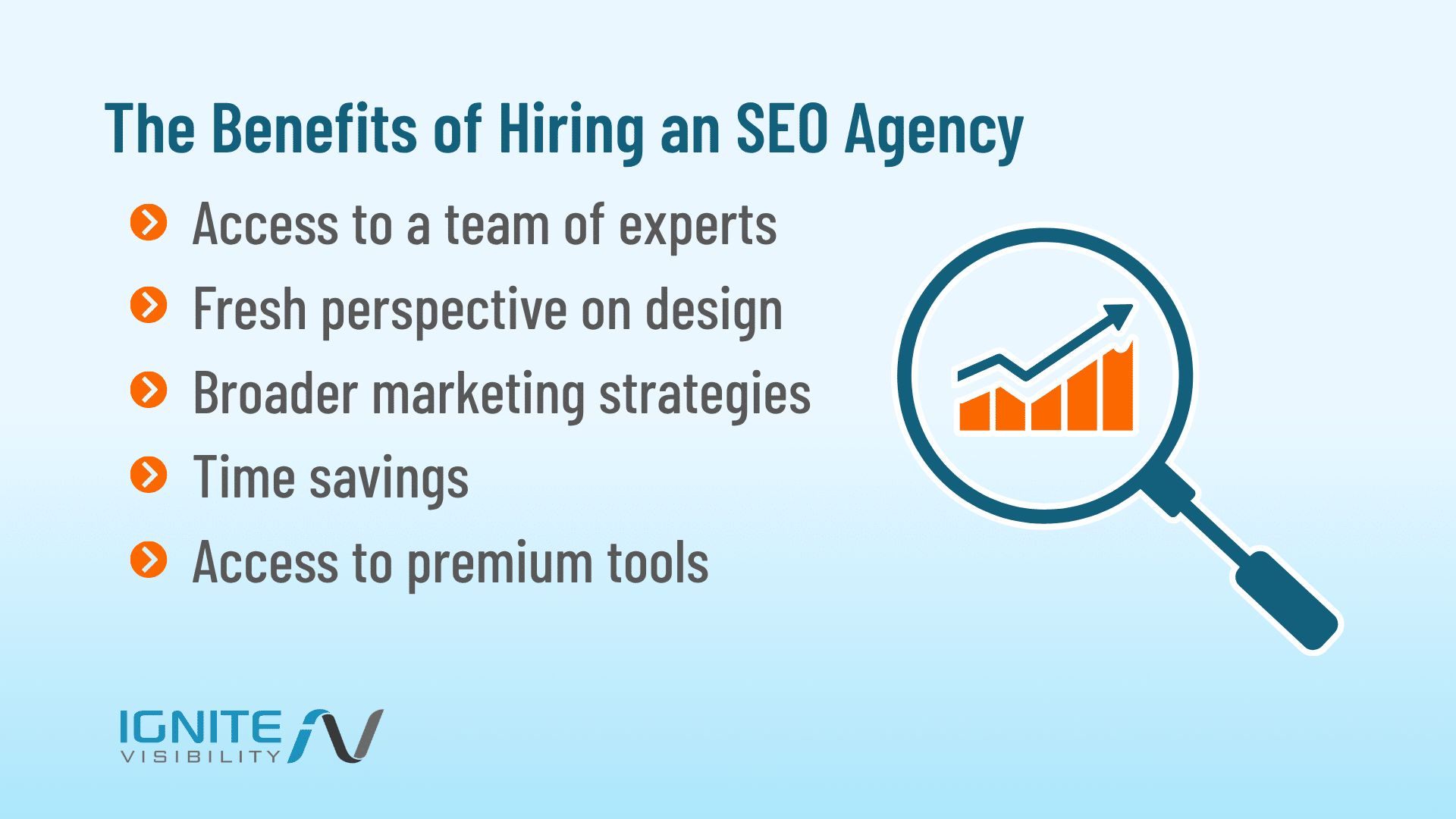
Choosing an SEO agency is one of the most important marketing decisions a business can make. SEO requires an investment of time, budget, and internal resources, from developers and content teams to leadership stakeholders. If you choose the wrong agency, you don’t just lose money, you can also lose valuable time and growth opportunities while competitors continue to move ahead.
The challenge today isn’t finding an SEO company. It’s finding the right one. Many agencies rely on similar audits, keyword reports, automated tools, and templated strategies. While these can be helpful starting points, they aren’t enough on their own to build a strong, competitive SEO program.
The best SEO companies act more like strategic partners than vendors. They take the time to understand your business model, goals, audience, competitors, and internal capabilities before recommending a strategy. Instead of simply delivering reports or checking boxes, they help you make smarter decisions, prioritize the highest-impact opportunities, and adapt your SEO strategy as search continues to evolve.
Now that you know more about the benefits of choosing the best SEO company for your business, let’s get into how to choose an SEO company that’s the right fit for your business.
Define Your Business Goals and Outcomes
Before evaluating agencies, define what success looks like for your business.
There are many goals you might want to achieve with your SEO, such as:
- Higher keyword rankings
- Increased organic traffic for certain pages
- More leads and conversions
- Improved brand awareness
- Appearance in AI search results
Whatever your goals, you must also choose the right key performance indicators (KPIs) and metrics that align with them.
For example, you might want to attract more leads with your efforts, in which case you’d likely focus on metrics like conversion rate and lead acquisition rate. When boosting brand awareness, your top KPI might be share of voice, while organic revenue growth can connect your efforts to goals around profitability.
Just keep in mind that goals like “more traffic” are not actionable, as they’re not specific or well-defined.
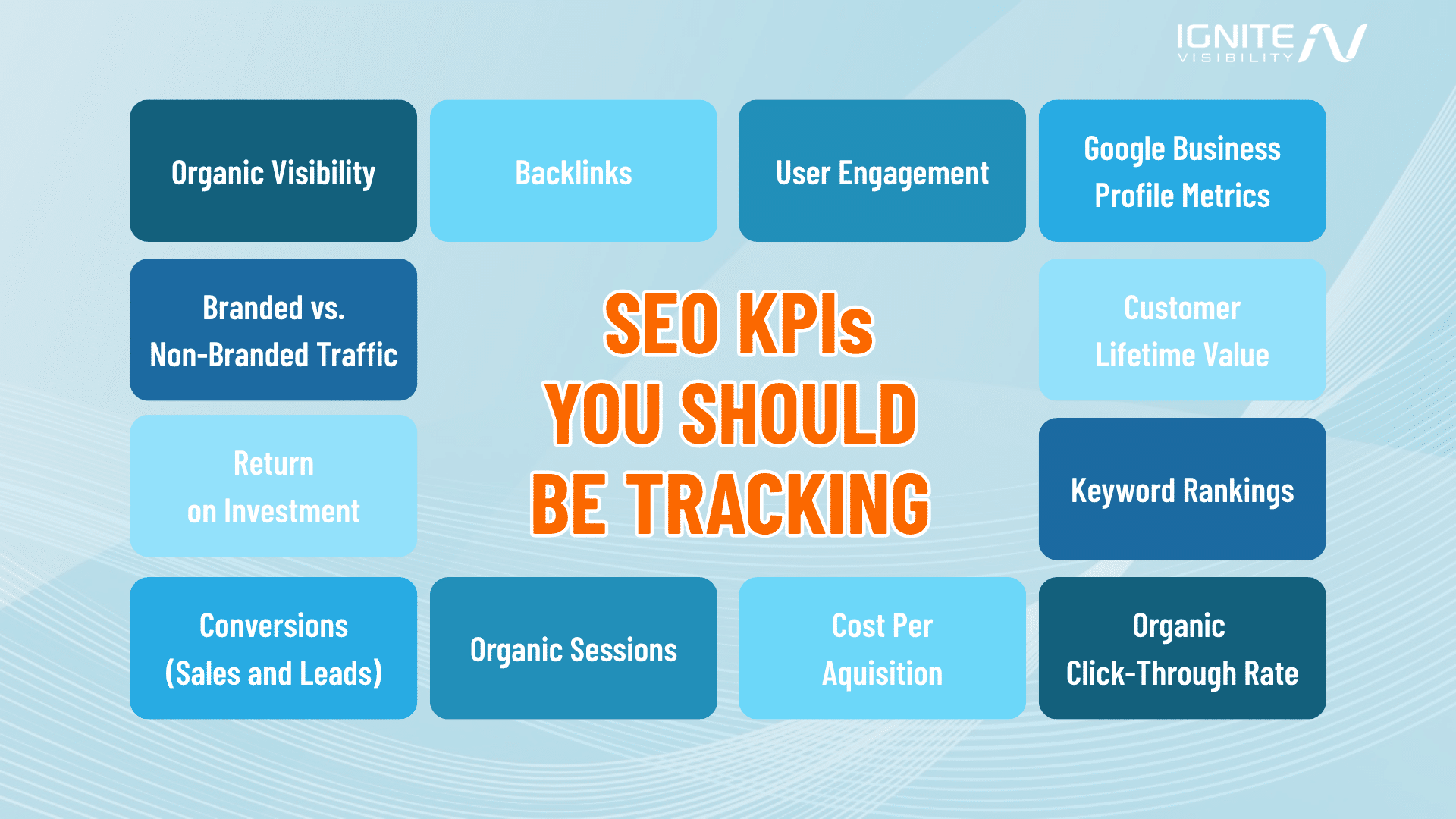
Here are some other KPIs you might target based on your goals:
Know What Type of SEO Agency You Need
Depending on your business and SEO needs, you need to determine how to pick an SEO company by pinning down the specific services you require.
The following is a breakdown of the different types of SEO services and what they entail:
| Service Type | Primary Focus | Core Tasks and Deliverables |
| Full-service SEO | Total management of your SEO strategy | Combines strategy, technical fixes, content creation, and link building |
| Technical SEO | Improving technical SEO elements to improve crawlability, indexability, and user experience | Broken link fixes, faster page speeds, improved mobile optimization, and sitemap management |
| Content SEO | Creating high-quality website copy that appeals to user intent and search engines | Keyword research, blog post creation, developing locally targeted content, and refreshing old content |
| Local SEO | Winning visibility in geo-specific search results | Google Business Profile optimization, local keyword tracking, and citation building |
| Ecommerce SEO | Optimizing online stores to rank specific products and categories | Product description optimization, image optimization for Shopping and visual search, and structured data for product pages |
| B2B/SaaS SEO | Targeting business buyers and software users, often requiring more long-term conversion processes | Product comparison pages, thought leadership content, and signup tracking |
| Enterprise SEO | Managing SEO for large websites with up to thousands or millions of pages | Enabling global and multilingual site versions, aligning data tools, and coordinating large internal teams |
| Digital PR and Link Building | Earning audiences’ and search engines’ trust and building authority with backlinks and positive external brand mentions | Link building on relevant industry websites, pitching to journalists, and guest post writing |
| SEO Consulting | Professional strategy without actual execution and implementation | Custom website audits, SEO guidance around penalties, competitive analysis, and team training |
Red Flags to Avoid During the Vetting Process
In learning how to choose an SEO company, there are some red flags to watch for that might indicate predatory practices.
These warning signs include:
- Guaranteed Ranking Positions: There’s never any guarantee that your efforts will land you the top or even first-page results on search engines, especially as algorithms continually change and trends are never entirely predictable.
- Refusal to Grant Full Analytics Ownership: Avoid choosing an SEO agency that restricts access to Google Search Console, Google Analytics, or other tools, as this indicates a lack of transparency in reporting.
- Relying on Private Blog Networks (PBNs) and Hidden Backlink Profiles: PBNs are networks of fake websites that exist for the sole purpose of linking back to a specific website, while hidden backlink profiles might consist of links on low-quality and spammy sites while preventing SEO tracking tools from seeing them, both of which practices are considered “black hat” SEO techniques that will only serve to hurt your optimization efforts.
- If an agency spends more time talking about rankings than business outcomes, that’s usually a warning sign. Rankings matter, but they only have value when they contribute to leads, revenue, or other meaningful goals.
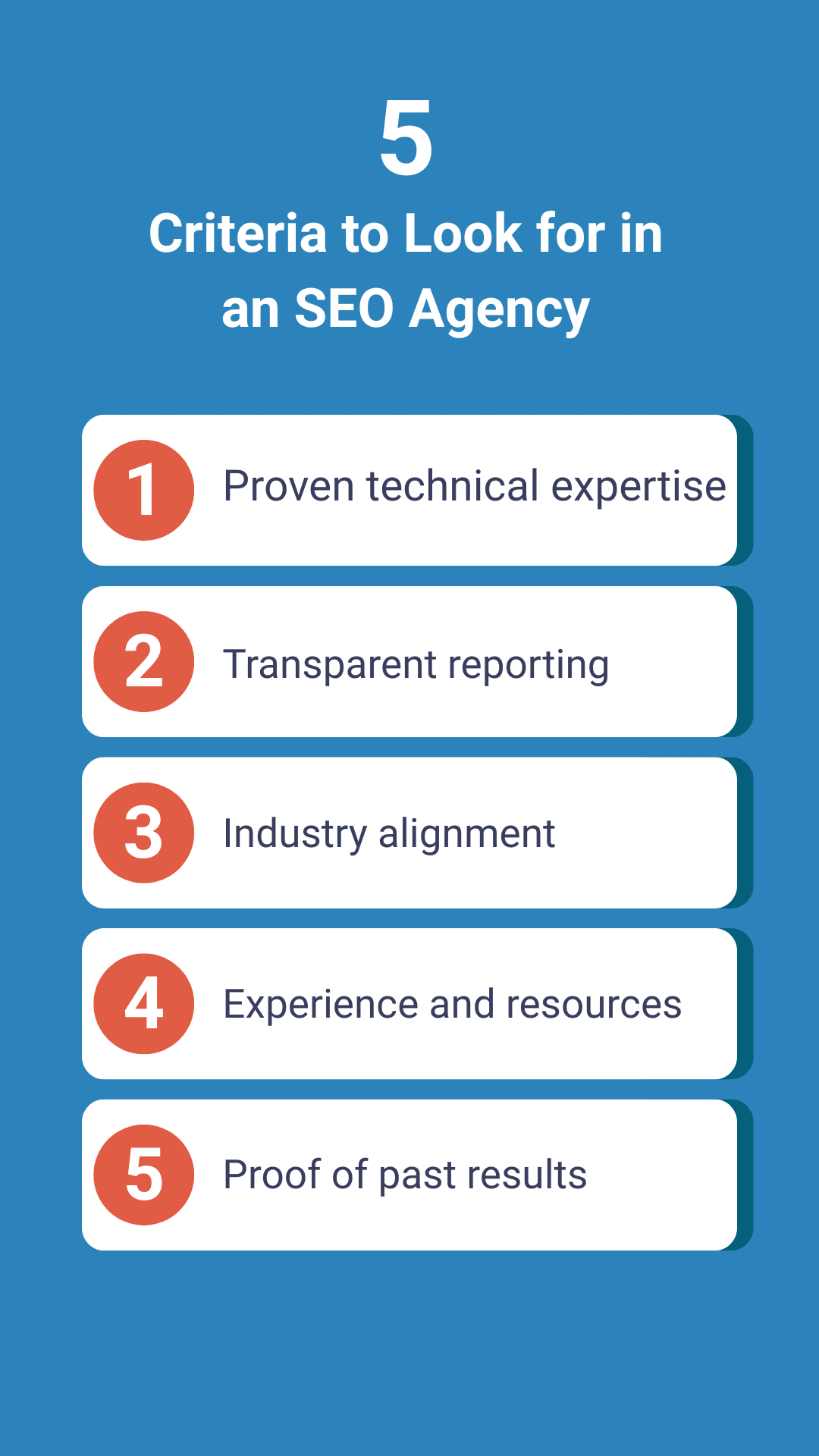
The Selection Framework: 5 Essential Criteria
1. Proven Technical and On-Page Expertise
Case studies and other documentation should highlight the SEO agency’s technical and on-page SEO expertise, including the use of schema structured data, effective keyword selection, and other elements to help their clients achieve top rankings.
2. Clear Reporting Transparency
When choosing an SEO agency, another key factor to look for is transparent reporting. The best SEO companies will give you complete insight into analytical data, including reports from Google Search Console, Google Analytics, Semrush, and other tools, so you’re always in the loop. Communication should also be consistent and relay performance regularly.
3. Strategic Alignment With Industry Verticals
Look for an SEO company that can develop and implement a strategy that works best for your industry. Different verticals will have different needs, whether they involve content optimization, local SEO, or other approaches that help them connect with their target audiences.
4. Team Experience and Dedicated Resources
In choosing a good SEO company, the ideal provider must demonstrate team experience through cohesive strategies that get results, with in-house experts who know what they’re doing. Additionally, the company should be able to show the resources used to develop and execute your strategy, from analytical and keyword research tools to linkable assets and visual media.
5. Case Study Proof With Long-Term Client Retention
Look for detailed case studies that show real results the company has achieved for its clients, with descriptions of strategic tactics and specific metrics showing success. Also, case studies should indicate that the company has built long-term relationships, which in turn shows that clients remain satisfied long after that initial strategy.
Evaluate Proof: Case Studies, References, and Real Results
Another important step involves evaluating proof, including case studies and references, to determine whether the company is getting real results.
Strong proof will cover the following elements:
- Baseline: Case studies and other documentation should establish the client’s baseline metrics, resources, and performance before the SEO agency develops a strategy.
- Problem: Studies should then discuss the specific problem the client faced, including market challenges, performance gaps, and other types of SEO inefficiencies that need some work.
- Strategy: Once the challenge is clearly defined, the agency should explain exactly how it plans to address it and why that approach makes sense, whether it involves on-page SEO, technical elements, AI SEO, or other solutions.
- Execution: The company should describe its plan to execute the strategy, with specific actionable steps like resource allocation and process integration.
- Timeline: Case studies should discuss the timeline expected for the project, from establishing a baseline to execution and measurement.
- Outcomes: SEO agencies need to relay the measurable and quantifiable results they got from the strategy, comparing them against the goals they set with the client.
- Constraints: Part of being realistic entails discussing any real-world limitations that could impact the strategy, including budget constraints and tight deadlines.
- Business Impact: Beyond the metrics, the company should discuss the strategy’s real value to the client, including revenue and ROI, long-term growth, and competitive gains.
Conversely, weak proof will be devoid of these items, with vague “traffic increased” or other claims that don’t give any other context.
Questions to Ask an SEO Agency Before Signing
One last step to take when learning how to choose the right SEO company involves asking the right questions.
During a consultation, you’ll have the chance to raise any concerns you might have or identify any bright red flags before making any type of commitment.
A few essential questions to ask when choosing an SEO company might include:
“How do you handle algorithmic drops?” – If you see a drop in rankings following an algorithm update, your agency should look at the data first to identify the specific problem before taking any action.
“Who does the actual execution vs. account management?” – Find out who would actually be in charge of your account and strategy execution, whether your strategy will involve account managers, SEO strategists, content writers, or development teams.
“What is your methodology for building safe link signals?” – A good SEO company knows not to use spammy link farms and other black-hat attempts to game algorithms, instead appealing to guidelines like Google’s E-E-A-T (Experience, Expertise, Authority, and Trustworthiness) to maintain quality across link-building efforts.
How to Compare SEO Proposals
Don’t just “interview” a single SEO agency; take a look at multiple agencies and compare their proposals.
Here is an SEO proposal scorecard template to give you some direction:
| Evaluation Category | Weight | Agency A Grade (1-10) | Agency A Weighted Score | Agency B Grade (1-10) | Agency B Weighted Score |
| Strategy & Alignment | 25% (0.25) | E.g., 9 | 2.25 (9 x 0.25) | 5 | 1.25 (5 x 0.25) |
| Proof & Case Studies | 15% (0.15) | ||||
| Team & Communication | 15% (0.15) | ||||
| Reporting & Transparency | 15% (0.15) | ||||
| Technical Capability | 15% (0.15) | ||||
| Contract Terms & Price | 10% (0.10) | ||||
| Total Score | Sum A | Sum B |
Contract Terms to Review Before Signing
Finally, look closely at all contract terms, including:
- Scope
- Deliverables
- Timelines
- Pricing
- Cancellation
- Minimum term
- Content ownership
- Data ownership
- Access permissions
- Reporting cadence
- Confidentiality
- Conflicts of interest
- What happens after offboarding (e.g., who gets access to all SEO analytics)
FAQs
1. How do I choose the right SEO agency?
To determine how to choose an SEO agency that’s right for you, consider factors like transparent reporting, expertise, alignment with your industry, team experience, resources, and case study proof. Also, consider the type of SEO you need, e.g., you might need to figure out how to choose a Shopify SEO agency for niche ecommerce sites.
2. How much does it cost to hire an SEO agency?
SEO agency pricing can vary greatly depending on the scope of services, agency experience, and the length of the contract, among other factors.
3. How long does it take to see organic traffic results from an SEO agency?
The answer here depends on elements like competitiveness, algorithmic changes, and your website’s health. In some cases, quick wins like targeting low-competition keywords, may appear within days or weeks, while it can take months to generate meaningful results.
4. How do I know if an SEO agency is doing good work?
You can determine whether your SEO agency is getting results based on detailed reports and measuring KPIs against your goals. If you find that your agency is failing to help you get ahead or constantly changing strategies without improvement, these could be signs it’s time to leave.
5. Should I hire an SEO agency or an in-house SEO specialist?
If you don’t have the in-house bandwidth or resources to handle your SEO, it might be in your best interest to hire an SEO agency that matches your unique needs and budget. On the other hand, you could go in-house if you’re just starting out with SEO and you have dedicated SEO specialists to manage your strategy.
Partner With the Right Experts Here at Ignite Visibility
Now that you know more about how to choose the right SEO company, consider working with the pros here at Ignite Visibility. We have the expertise, resources, and transparency to give you the tailored services you need.
With Ignite behind your SEO strategy, you’ll benefit from:
- In-depth keyword research
- Comprehensive content optimization
- On-page and technical SEO
- Off-page link building and digital PR
- Continuous monitoring and measurement based on your goals
- Regular audits and adjustments as needed
- And so much more!
Interested in getting started? Learn more about our SEO services and find out how we can help you achieve top rankings in your industry.