

As AI continues to integrate across operations, it becomes imperative to develop a transparent and cohesive infrastructure for merging with existing processes. While automation is great for driving efficiency, it shouldn’t come at the cost of human connection. This is where the “Automation Paradox” comes into play: the more we use AI for automation, the more integral human oversight becomes. AI shouldn’t eliminate roles; it should empower individuals to automate the mundane and lean into enhancing communication and connection between teams.
In this blog, Vivian Glazer, Ignite Visibility’s Senior Digital Project Manager, will discuss the role of AI in project management and the ever-increasing need for human oversight of key tasks to realize true automation.
What’s Covered:
- What Can (and Should Be) Automated
- Reallocating Saved Time to Human Touchpoints
- Moving Beyond Traditional KPIs
- Industry Best Practices: Constructing the Hybrid Workflow
- FAQs
The Baseline: What Can (and Should Be) Automated
There are many elements that contribute to effective project automation, from initial goal-setting and planning to execution, monitoring, control, and closing. Project management must also make the most of all available resources, keeping in mind the constraints of time, cost, and scope, all of which are heavily interconnected.
To help simplify and maintain consistent project management, there are some key areas that benefit from project management automation using AI. Some examples of AI in project management include:
- Task Scheduling: AI can help with scheduling various tasks, connecting related ones based on previous projects for consistency, while matching each task to the right person according to skill sets.
- Automated Time-Tracking: Another aspect that AI can automate is time-tracking through automatic activity detection, time sheets, and burn-rate tracking.
- Basic Risk Forecasting: AI can identify and proactively handle potential bottlenecks before they become an issue through predictive and team sentiment analysis.
- Status Reporting: Gain deep and accurate insights into project health, summarize data to present it to stakeholders, and develop custom views for individuals or teams.
- Routine Notifications: AI tools can send automated deadline reminders, handoff alerts, escalation triggers, and daily digests.
While these analytical and planning tasks definitely benefit from AI and automation in project management, many others are better suited for people who can handle that “human” side of management.
My Expert Insight into AI in Project Management
Using AI in project management offers plenty of advantages, with many platforms offering seamless integrations and automations with a simple click of a button. While AI in project management can be a time-saving resource, an effective project manager needs to analyze the benefits and costs before integrating AI into project work.
As studies have found, AI is changing the way people think and do things, and its potential impact on interpersonal relationships is still a bit unclear. Although AI tools are certainly beneficial for simplifying rudimentary tasks, we must not forget about the importance of human connections.
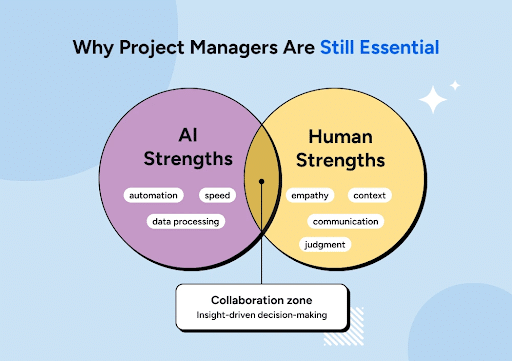
AI can help complete many mundane tasks (like duplication, reminders, and follow-ups) and analytical tasks (like summarizing and synthesizing meeting notes or project summaries). However, AI simply can’t replicate the soft skills that humans can possess and practice (like working with teams to remove blockers, establishing more customized processes, ensuring follow-through, and providing proactive pivots to reach key milestones and metrics).
Additionally, every team needs good leadership to engender sustainable and ongoing success. People must be at the heart of decisions, tailoring each project to its unique requirements, building relationships across teams, and navigating nuances across the organizational landscape.
Most people still seek out that human touch, with one report finding that 71% of people believe AI is incapable of creating genuine human connections.
Maintaining those connections with one another at the individual, team, and organizational levels will keep your operations human at their core, without letting AI run the entire show and fostering a potentially damaging disconnect.
Reallocating Saved Time to Human Touchpoints
Knowing how to use AI in project management means understanding what to leave to machines and what to assign to your teams, largely based on where those saved hours go.
If you want to effectively retain your stakeholders, you need human intervention where it matters most to stand apart. Using AI in project management can free up more than five hours every week to focus on tasks that require a personal touch.
Some of the tasks your team will be able to redirect their attention toward will include:
Client Empathy Mappings
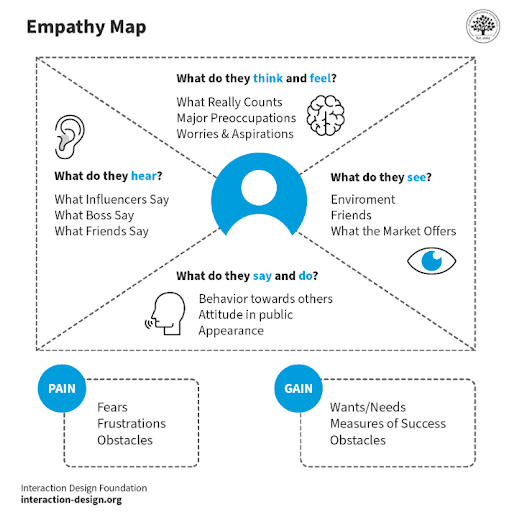
Client empathy maps are reliable visual tools for capturing your target audience’s behaviors, emotions, and thoughts to help you establish a stronger connection with each potential customer.
These maps typically consist of four main quadrants detailing what clients:
- Think and Feel: This quadrant relays clients’ internal thoughts and emotions to guide your strategy, including how they think about your products or services, their unique aspirations, any worries they might have, and emotional responses.
- Hear: You also need to consider what influences your clients socially and what they hear about you or your offerings, whether from influencers, peers, bosses, friends, or family.
- See: What do your clients encounter in their environment? They might observe certain trends, competitors’ strategies, and other people’s interactions with a particular brand or product.
- Say and Do: This details what a client says in interviews and their specific actions when engaging with your brand and offerings.
It’s crucial to have one or more people behind your client empathy mapping strategy to truly empathize with your audience and understand it. AI can automate certain processes like sentiment analysis, but only humans can really comprehend what it means to connect with a brand, client, or customer.
Complex Problem Solving
AI in project management is also currently incapable of solving more complex issues that might come your way.
For example, there may be a conflict between stakeholders that could lead to project delays and overall destabilization. Only members of your organization will be able to negotiate with stakeholders and work to resolve conflicts by understanding the root problem, conducting mediations, and effectively resolving the issue without compromising efficiency. Humans can also more effectively navigate the gray area and providing nuanced and more out-of-the-box creative solutions.
AI and automation in project management could flag certain issues and notify your team, but you must have a person behind your conflict resolution processes to empathize with those experiencing pain points, determine the most appropriate solution, and verify an effective strategy is implemented to resolve the issue.
Building Team Psychology
Good leadership is also something you can’t automate. Strong leaders on your team will be able to give everyone the kind of support and guidance they need to maximize morale and motivation, identifying any areas that might keep your team from doing its best.
One way a leader can inspire your team is by connecting seemingly mundane tasks to more meaningful ends that benefit each member. Leaders should also recognize individual achievements and reward them to keep teams consistently driven.
Additionally, effective leadership will develop and maintain a healthy company culture that makes everyone feel like they’re contributing to something that aligns with their values and aspirations.
Moving Beyond Traditional KPIs
Project management automation could help you track your progress through certain table metrics like “on-time” and “on-budget,” but you’ll want to go beyond those key performance indicators (KPIs) to realize long-term success at every level.
To ensure you’re able to achieve or even surpass your goals, implement certain nuanced metrics on the human end, such as:
- Sentiment Analysis: As mentioned, certain AI-powered social listening platforms and other tools could assist with sentiment analysis at the basic level, but a person will be able to more reliably determine how people feel about a brand or offerings over a machine.
- Client Alignment Scores: Members of your team can also better determine whether each client’s objectives, processes, and emotional expectations align with your deliverables, helping determine potential churn rates and secure improved customer retention. An example here might include a scale of one to five measuring a client’s emotional energy, with five equalling green or maximum trust and one meaning red, which would indicate more reluctance and doubt. You can also track customer satisfaction (CSAT) scores and net promoter scores (NPSs) with client feedback.
- Psychological Safety Levels: Another metric your team should track is psychological safety, which gauges whether the team is “safe” for interpersonal risk-taking. While not applicable to every situation, you might go by the model of the four “stages” of psychological safety, including Inclusion Safety (when people feel like they belong to a team), Learner Safety (when members can continually learn by asking questions), Contributor Safety (when members feel comfortable contributing their own ideas), and Challenger Safety (when members can freely question others and make suggestions).
- Creative Friction Indexes: You must also measure creative friction, or productive friction, to assess the constructive conflict and debate occurring within your organization, measuring both psychological safety and intellectual honesty. In turn, you can encourage healthy debate and diverse viewpoints among teams.

Industry Best Practices: Constructing the Hybrid Workflow
To balance AI and automation in project management with the human element, it’s best to develop a hybrid workflow that harnesses the power of both. A good workflow will incorporate the best project management automation features with ample human oversight, streamlining those repetitive tasks without relying solely on AI.
Here is a strategic framework that can facilitate an even balance:
The Core-and-Shell Hybrid Model
As the name suggests, this model consists of a core and a shell using AI in project management along with human management in an organized, consistent way.
Let’s look at each component:
- Core: This is the central element of your operations that uses AI for data collection and timeline updates, providing you with the analytics and reports you need to make informed decisions. Here is where you’ll automate various menial tasks to free up more time to spend on human-powered management and optimization.
- Shell: Around that core is the human shell, which requires team members and leaders to handle client governance, conflict resolution, and strategic direction. Without a good insulative shell, the core of the hybrid model won’t work the way it should, making the human element even more vital to operational success.
Without an automated core that provides you with raw data, you could suffer from inefficiencies and inaccuracies that keep you from achieving your short- and long-term business goals. On the other hand, that shell comprising your team is equally required to get the most from that data and continually improve your organization.
FAQs
1. What are the main benefits of using AI in project management?
Knowing how to use AI in project management can help you optimize core operational efficiency. Some examples of AI in project management include: automating administrative tasks, predicting risk, analyzing historical data, tracking real-time performance data, and in-depth reporting.
2. Which project management tasks cannot be replaced by AI?
While many repetitive and analytical tasks can benefit from the best project management automation features, others require human oversight that AI simply can’t provide. For example, leaders can provide a level of empathy that machines can’t, motivate teams by understanding individual needs and recognizing achievements, and make ethical decisions with creative problem-solving.
3. How do you measure qualitative or “nuanced” operational metrics?
Using various frameworks and tools, you can track more “nuanced” qualitative metrics with human project management. AI can assist with basic metrics like sentiment analysis, but human leaders are central in measuring metrics like friction scores, collaboration and psychological health, and client alignment.
Use AI in Project Management the Right Way With Ignite Visibility
If you are curious about how to use AI in project management, you must understand the increased need for human involvement. AI is a great asset to your toolkit, but to get the best results from those tools, you need strong leadership at the helm of your operations. AI handles those simple analytical tasks, but leaders and team members will be essential in making sense of that data, driving efficiencies, and developing a culture that boosts morale and satisfaction through empathetic connection.
To help you get the most from your project management automation efforts, Ignite Visibility can:
- Develop a winning marketing strategy tailored to your business
- Utilize AI for audience and behavioral analysis
- Connect you with human account managers responsible for overseeing your strategy
- Continually optimize your strategy for improved performance
- And more!
To learn more about what our solutions can do for your business, check out our lifecycle marketing services and find out how we can drive conversions with a healthy blend of AI and human-driven management.
