Netflix advertising gives brands access to premium streaming inventory through Netflix Ads Suite and approved programmatic partners. The opportunity is larger and more measurable than it was at launch, but the right buying path, creative, targeting, and KPI plan still determine whether the investment works.
In this guide, Scott McCutchan, Sr. Director of Franchise Paid Media, will walk through everything you need to know about Netflix advertising, from setting up your first campaign to measuring success and planning for future innovations.
What You’ll Learn:
- What Is Netflix Advertising?
- Where Do Netflix Ads Appear?
- Ad Formats Available on Netflix
- How Large Is Netflix’s Advertising Audience?
- Targeting Capabilities and Audience Segmentation
- Setting Up a Campaign: Step-by-Step Guide
- FAQs About Netflix Marketing Campaigns
TL;DR: What Marketers Need to Know
- Netflix reported more than 250 million global monthly active viewers in May 2026. Treat that as a dated reach indicator, not a subscriber count.
- Buyers can work through Netflix’s ad platform, approved DSP transactions, or an agency with CTV buying access.
- Current formats include standard video, Pause Ads, single-title sponsorships, QR and interactive experiences, and Live inventory.
Netflix does not publish one universal CPM or minimum spend. Market, format, targeting, season, inventory, guarantees, and buying route affect cost. - Plan measurement before launch. Use reach and quality metrics, brand lift, and business outcomes based on the campaign’s job.
- Netflix is a strong fit when premium reach and brand attention matter. It may be a weak fit when a campaign needs hyperlocal scale, a tiny test budget, or immediate last-click efficiency.
What Is Netflix Advertising?
Netflix advertising is the company’s premium streaming ad inventory. Brands can reach viewers around selected series, films, and live programming using Netflix’s ad technology and approved buying partners.
Where Do Netflix Ads Appear?
For on-demand viewing, ads appear before and during selected titles on Netflix’s ad-supported plan. Netflix describes the experience as a few short ads per hour; the exact load can vary. Viewers generally cannot skip or fast-forward through those ads.
Kids profiles and Netflix games currently do not show ads. Live and special events are different: Netflix says they may include ads across all plans, even when the on-demand experience is otherwise ad-free.
Ad Formats Available on Netflix
When you advertise on Netflix, you’ll have access to several ad format options:
- Pre-roll Ads: These appear before content starts playing. They’re typically 15-30 seconds long and are the first thing viewers see before watching their selected show or movie.
- Mid-roll Ads: These ads play during natural breaks in content. Netflix carefully selects break points to minimize disruption to the viewing experience.
- Post-roll Ads: Shown after content ends, these can be effective for calls to action since viewers have just completed an engaging viewing experience.
Netflix is also testing more innovative formats:
- Interactive Ads: These allow viewers to engage directly with the ad, such as clicking for more information or adding a product to a shopping cart.
- QR Code Integration: Some ads include QR codes that viewers can scan with their phones to visit websites or access special offers.

- Contextual Placements: Ads that align with the content’s theme or setting for increased relevance and engagement.
- Savvy Sponsorships: With exclusive first-ad positioning, a custom bumper, and non-skippable pre-roll, these sponsorship opportunities are an exciting way to get in front of a large audience.

An Expert Opinion on Netflix Advertising
Netflix should not be a vanity placement. Give it a specific role before you buy: incremental reach beyond linear TV, attention around a launch or tentpole moment, brand lift with a priority audience, or measurable downstream action.
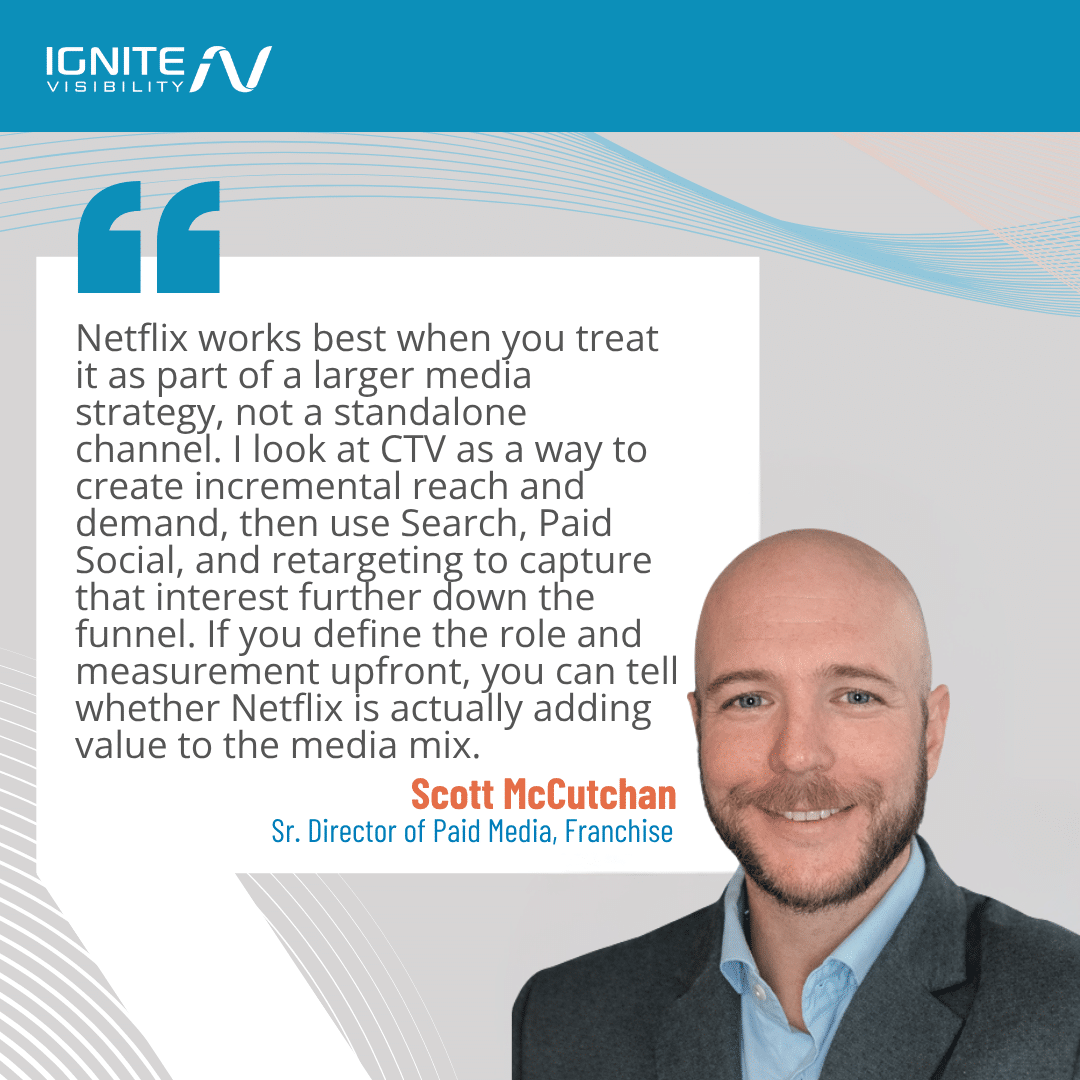
In my experience managing paid media strategies across multiple industries, the strongest CTV campaigns are the ones that are built around a clear customer journey. Netflix should not operate in isolation. It works best when paired with channels that can capture demand created by awareness campaigns, such as Search, Paid Social, and other lower-funnel tactics.
The question is not simply “Did Netflix generate conversions?” The better question is “Did Netflix create incremental demand and reach audiences we could not reach through existing channels?”
Start broad enough for the campaign to deliver, then use the platform’s content, audience, and viewing-experience controls to improve relevance. Compare performance with other premium connected TV environments, not low-cost display. Most importantly, agree on the measurement design before launch. A dedicated landing page or QR experience, consistent campaign taxonomy, and an appropriate lift or conversion study can turn a high-profile placement into a defensible media decision.
Where Netflix Fits in a Full Paid Media Strategy
Netflix works best as part of a broader media ecosystem. A simple way to think about channel roles:
- Netflix / CTV: Build awareness, reach new audiences, create demand
- Paid Social: Generate engagement and consideration
- Search: Capture existing demand from users actively looking
- Retargeting: Re-engage users who have shown interest
A successful Netflix campaign is rarely about replacing other channels. It is about adding incremental reach and influencing customers earlier in the decision journey.
How Large Is Netflix’s Advertising Audience?
Netflix reported more than 250 million global monthly active viewers in May 2026. It also said more than 80% of ad-supported members are active each week. These are Netflix-reported figures, and buyers should confirm the latest market-level forecast before committing a budget.
Do not compare that 2026 viewer figure directly with the 94 million monthly active user figure Netflix shared in 2025. Netflix changed its reporting methodology from users or profiles to an estimated viewer metric. The latest number signals scale, but it is not an apples-to-apples growth calculation.

What Changed in Netflix Advertising in 2026
- Audience scale: Netflix reported more than 250 million global monthly active viewers in May 2026.
- Programmatic access: Netflix’s August 2026 update named CTV Marketplace and DSP-initiated deal workflows with Google DV360, Amazon, Yahoo, and The Trade Desk.
- Pause Ads: Pause inventory became available programmatically across all supported DSPs, with AI-assisted tooling that can adapt existing assets.
- Interactive formats: Send to Phone and Frame Ads moved the platform beyond a standard QR-code description.
- Optimization and APIs: Netflix expanded its Conversion, Reach, and Audience APIs and AI-driven optimization capabilities.
- Measurement: Netflix announced MRC accreditation for U.S. in-stream video impression processing and reporting across CTV, mobile app, and desktop web.
- Next: Netflix announced additional ad countries and more inventory, including video podcasts and vertical video, for 2027. Treat announced features as roadmap items until they are available in the target market and buying route.
Is Netflix Advertising Right for Your Brand?
Netflix advertising is strongest when a campaign needs premium streaming reach, a high-attention launch environment, or incremental reach beyond linear TV and other streamers. Netflix said in May 2026 that 44% of members who see ads on Netflix do not see the same ad on broadcast TV or other streaming services. Treat that as a Netflix-reported planning signal and validate incremental reach in your own campaign.
The platform can also support brand and outcome measurement. Netflix has reported results above television norms and competitor benchmarks, but those figures come from Netflix or commissioned research. Use them as hypotheses for your media plan, not guaranteed results.
| Strong fit | Reconsider or test carefully |
| National or multi-market reach | Very small or hyperlocal audiences |
| Brand launches and tentpole moments | Campaigns judged only on immediate last-click return |
| Premium video creative already available | No budget for compliant, high-quality video |
| CTV or linear-TV incremental reach goals | A test budget too small to generate stable learning |
| A measurement plan for lift or outcomes | No clean conversion signal or study design |
Netflix Advertising for Multi-Location Brands
For franchise and multi-location businesses, Netflix can play an important role in building national awareness while local channels capture demand at the market level.
A common mistake is expecting one channel to do everything. Premium streaming can introduce customers to a brand, while localized Search, Paid Social, and conversion-focused campaigns help turn that awareness into action.
How to Buy Netflix Ads in 2026
There is no single buying path for every advertiser. Access, inventory, controls, reporting, and minimum commitments can differ by market, deal type, and partner. Confirm the route before building the plan.
1. Direct Through Netflix Ads Suite
A direct relationship can give eligible advertisers access to Netflix’s ad technology, inventory, and support. Availability and commercial terms depend on the market and campaign.
2. Programmatic Through an Approved DSP
Netflix supports programmatic transactions through approved partners. As of August 2026, Netflix named Google Display & Video 360, Amazon DSP, Yahoo DSP, and The Trade Desk in its connected TV marketplace and DSP-initiated deal ecosystem. Inventory appears only when the deal is configured correctly, so confirm the deal ID, seat, geography, dates, format, and creative approval status.
3. Through an Agency or CTV Partner
An agency can manage access, audience planning, partner selection, creative specifications, deal setup, reporting, and cross-channel measurement. This route is useful when Netflix is one part of a broader streaming or programmatic plan.
| Route | Best for | Confirm before launch |
| Direct | Eligible advertisers seeking direct platform access | Market, inventory, support, terms, and reporting |
| Approved DSP deal | Teams with programmatic expertise and an existing DSP seat | Partner, deal type, seat, format, geography, and measurement |
| Agency-managed | Brands coordinating Netflix with a larger CTV or paid media plan | Fees, partner access, ownership, reporting, and test design |
Budgeting and Pricing Models
Netflix does not publish one universal public CPM, rate card, or minimum campaign spend. A credible budget comes from a current quote for the intended market, inventory, format, targeting, timing, guarantee, and buying route.
Third-party CPM or minimum-spend estimates can be useful for early scenario planning, but they are not Netflix pricing and can age quickly. Do not present them as a platform promise.
Ask the seller, DSP, or agency for the gross media cost, platform and data fees, creative or certification costs, study fees, cancellation terms, delivery guarantee, makegood policy, and expected reach and frequency. Then compare the plan with other premium CTV options on an equivalent audience and measurement basis.
- Market and geographic scale
- Format and inventory type
- Audience specificity and data fees
- Holiday seasons or major content release windows
- Reserved, guaranteed, or programmatic deal terms
- Creative production, certification, and measurement requirements
Instead of starting with a budget number, advertisers should start with the business objective. Budget requirements will depend on the audience size needed, geographic footprint, desired frequency, creative requirements, and measurement approach.
The right question is not only “How much does Netflix advertising cost?” but “What level of investment is required to generate meaningful reach and measurable impact?”
Targeting Capabilities and Audience Segmentation
A solid Netflix advertising strategy leverages the platform’s impressive targeting capabilities. When you run ads on Netflix, you can target viewers based on:
- Demographics: Age, gender, location, and household income.
- Viewing Behavior: Target based on the genres people watch, viewing time of day, and viewing frequency.
- Content Preferences: Reach viewers who watch specific types of shows or movies that align with your brand.
- Interest-Based Segments: Target viewers based on their interests and lifestyle attributes inferred from viewing habits.
- First-Party Data Integration: In some cases, you can match your customer data with Netflix’s viewer data for retargeting purposes.
- Vendor Third-Party Data Integration: You can also leverage third-party audience data to align your content with viewers based on their preferences.
Netflix continues to enhance its targeting capabilities, striking a balance between precise audience segmentation and user privacy. The platform uses a combination of declared user information and observed viewing behaviors to create valuable audience segments without being intrusive – because who wants their Netflix binge interrupted?
Setting Up a Campaign: Step-by-Step Guide
Ready to launch your Netflix advertising campaign? Here’s how to get started:
Step 1: Give the Campaign One Primary Job
Choose a primary objective such as incremental reach, awareness, consideration, or a measurable business outcome. Add one secondary diagnostic goal only if it will not blur the decision.
Step 2: Choose the Buying Route
Confirm whether the campaign will run direct, through an approved DSP deal, or through an agency. Document who owns the platform seat, deal, audience, creative approval, reporting, and billing.
Step 3: Check Policy and Certification Requirements
Review prohibited and restricted advertiser categories before production. Some creative requires certification. Netflix’s support guidance says initial creative review can take up to 48 hours and recommends submission at least five business days before launch. Build more time for revisions.
Step 4: Design Measurement Before the Buy
Select reach, frequency, brand-lift, conversion, sales-lift, store-visit, or attribution methods based on the objective. Confirm eligibility, minimums, partner support, taxonomy, data flow, and reporting cadence.
Step 5: Build an Audience That Can Deliver
Start with the priority audience and geography. Add content, daypart, device, language, or suitability controls only when they serve the strategy. Excessive layering can restrict scale and make results harder to interpret.
Step 6: Produce and Validate the Creative
Use the current spec sheet for the chosen format and buying partner. Confirm duration, file type, resolution, safe zones, landing URL, tracking, subtitles, rights, and certification.
Step 7: Complete Deal and Launch QA
Verify the DSP seat, deal ID, inventory, dates, time zone, pacing, frequency, bid or rate, geography, audience, creative status, URLs, and measurement tags. Run a pre-launch signoff with media, creative, analytics, and the seller or partner.
Step 8: Monitor and Optimize Against the Primary Goal
Watch delivery, reach, frequency, quality, creative performance, and the selected brand or outcome signal. Make one meaningful change at a time when possible, and document it so the team can explain performance later.
Creative Best Practices for Netflix Ads
The most successful Netflix marketing campaigns don’t just repurpose existing TV ads. To really capture the Netflix feel, ads should acknowledge the unique viewing mindset of streaming audiences and create moments that feel native to the platform.
Here are some creative best practices to follow in order to maximize the impact of your Netflix advertising campaigns:
- Match the Premium Environment: Netflix viewers expect high-quality content. Ensure your ads meet similar production standards.
- Front-Load Your Message: Capture attention in the first few seconds, as viewers may be waiting to resume their content.
- Optimize for Sound-On and Sound-Off: While most Netflix viewing happens with sound on, ensure your ad can communicate visually for those instances when sound is muted.
- Respect the Viewing Experience: Create ads that don’t feel jarring compared to the content they surround. Consider the emotional context of popular shows.
- Keep It Concise: With ad slots typically ranging from 15 to 30 seconds, focus on a single, clear message rather than trying to convey too much.
- Include Clear Branding: Ensure your brand is recognizable throughout the ad, not just in the final seconds.
- Consider Context: When possible, align your creative with the type of content where it will appear for increased relevance.
Measuring Success: Analytics and KPIs
Tracking performance is essential for any advertising effort. When you advertise on Netflix, you’ll have access to several key metrics:
- Impressions: The number of times your ad was viewed.
- Completion Rates: The percentage of viewers who watched your entire ad.
- Reach and Frequency: How many unique viewers saw your ad and how often.
- Audience Insights: Demographic breakdown of who saw your ads.
- Brand Lift Studies: For larger campaigns, Netflix offers brand lift measurement to track awareness and perception changes.
- Website Traffic and Conversion Attribution: Some campaigns can be linked to website visits and conversions through Netflix’s measurement partners.
Expert Measurement Recommendation
One of the biggest challenges with CTV advertising is applying the wrong measurement model. Streaming campaigns often influence customer decisions before a final conversion happens.
Measurement should align with campaign objectives:
Awareness goals
- Reach
- Frequency
- Completion rates
- Brand lift
Consideration goals
- Website visits
- Search lift
- Engagement signals
Business outcomes
- Conversion trends
- Sales lift
- Store visits
- Assisted conversions
Netflix continues to expand its measurement capabilities, recently adding partnerships with third-party verification providers to offer more transparent reporting. When evaluating success, compare Netflix performance against other premium video environments rather than lower-cost digital channels.
Common Challenges and How to Plan Around Them
Netflix can add premium reach, but it is not the automatic answer for every campaign. Plan for the following constraints before signing the insertion order or activating a deal.
| Challenge | Plan for it |
| Access and inventory vary | Confirm market, format, deal, and forecast before promising scale |
| Targeting can reduce delivery | Start with the audience strategy, then add only necessary controls |
| Policy and certification take time | Review category rules early and submit creative ahead of launch |
| Premium creative raises production needs | Scope versions, rights, captions, QR experience, and revisions in the budget |
| Measurement is partner-dependent | Lock KPI definitions, eligibility, data flow, study design, and reporting before launch |
| CTV is not last-click display | Use an appropriate attribution or lift method and compare with premium video peers |
| Viewer experience matters | Control frequency, use relevant creative, and avoid overstating the platform’s ad load |
FAQs About Netflix Marketing Campaigns
1. How do you advertise on Netflix?
Advertisers can buy through Netflix’s ad platform, transact through an approved DSP deal, or work with an agency that has Netflix and CTV buying access. The available route, inventory, and terms depend on the market and campaign.
2. How much does Netflix advertising cost?
Netflix does not publish one universal public CPM or campaign minimum. Cost depends on the market, format, audience, timing, inventory, guarantee, and buying route. Request a current quote and separate media, platform, data, creative, and measurement costs.
3. What types of ads can you run on Netflix?
Current options include standard pre-roll and mid-roll video, Pause Ads, single-title sponsorships, QR and interactive formats, and eligible Live inventory. Format availability varies by market and buying path.
4. How long are Netflix ads?
Standard video durations vary by placement. Netflix lists 10-, 15-, 20-, and 30-second pre-roll creative, with longer mid-roll options. Netflix describes the on-demand ad experience as a few short ads per hour rather than one fixed universal ad load.
5. Can viewers skip Netflix ads?
Viewers generally cannot skip or fast-forward through ads in the ad-supported on-demand experience.
6. Does Netflix show ads on every plan?
On-demand ads are associated with Netflix’s ad-supported plan. Live and special events may include ads across all plans, including plans that are otherwise ad-free.
7. Can small businesses advertise on Netflix?
Possibly, but fit depends on access, market, audience scale, creative readiness, and the budget required to generate useful learning. A hyperlocal business or a campaign judged only on immediate last-click return may be better served by another channel or a broader CTV buy.
8. How do you measure Netflix ad performance?
Start with the campaign objective. Use delivery and quality metrics for execution, reach and frequency for audience delivery, brand-lift studies for perception, and conversion, sales-lift, ROAS, store-visit, or attribution methods for business outcomes when eligible.
Build a Streaming Plan That Proves Its Value with Ignite Visibility
Netflix can be a powerful part of a connected TV plan, but premium inventory alone does not guarantee a strong result. The right campaign connects a clear objective with the buying route, audience, creative, and measurement design.
Our team can help you:
- Evaluate Netflix against other streaming options
- Forecast the audience
- Choose the buying path
- Prepare compliant creative
- Launch the campaign, and
- Measure the result across channels
The future of paid media is not about choosing between awareness and performance. The strongest strategies connect both. Netflix can create the attention and demand that fuel measurable growth when it is supported by the right audience strategy, creative approach, and measurement framework.
Ready to see your work on the streaming screen? Request a free proposal today!