


From retweets to hashtags, today’s social media metrics make for a complex marketing environment.
Aside from tracking sales, how can you know how well your social media is performing? How it measures up to your competitors? Which type of content do you need to produce to outpace them?
Today, Ignite Visibility Social Media Strategist Josh Rohr will address these concerns and more!
He’ll also go over the metrics and social media benchmarking tactics you can use to assess your online marketing performance and refine your strategy.
What We’ll Cover:
- What is Social Media Benchmarking?
- Why is Social Media Benchmarking Important?
- Key Metrics to Benchmark
- How to Set Social Media Benchmarks
- Social Media Benchmarking Best Practices
What is Social Media Benchmarking?
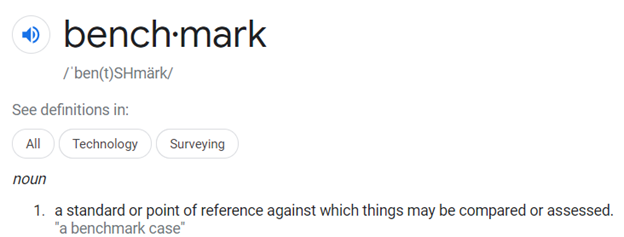
Benchmarking helps you answer the question—“what does success look like?”
Marketers are always looking for new ways to predict, improve, and evaluate the performance of their online campaigns. And for each campaign, benchmarking is the first step towards building a strong, data-based strategy.
Social media benchmarking, in particular, is a way of comparing your social media performance, side-by-side, against your competitors and/or by industry best practices.
Certain social media goals, like brand awareness, for example, can’t really be quantified the way likes or shares can. In these cases, social media benchmarks can be used to determine the non-monetary “return” you’ll receive from your social media investment.
Why is Social Media Benchmarking Important?
If you don’t benchmark social media engagement, it will be much harder to know where your business stands in its respective niches.
Benchmarking on an annual or quarterly basis is critical to contextualize the performance of your marketing efforts.
It allows you to improve your content strategy so it better resonates with your target market. And since you likely share the same buyer persona, a competitive analysis will help pinpoint the areas that need some improvement.
To put this into perspective, let’s say you received more shares on a social media post than you ever have before. Before giving yourself a proverbial pat on the back, ask yourself—“is that good?” It may be good compared to your previous posts, but you’ll want to cast a wider net to cover direct competitors and your industry as a whole. This will give you a better idea of what “good” actually looks like and where you fit on that spectrum.
For example, it seems like Nike is growing their follower base on Instagram at a rate that’s much higher than the industry average. On the surface, that seems impressive until you realize that other brands like Adidas are growing at a much faster rate. Does this present an opportunity to find out which factors have led to that growth?
DIVE DEEPER: Benchmark Marketing: How to Monitor Progress in Digital Marketing
Key Metrics to Benchmark
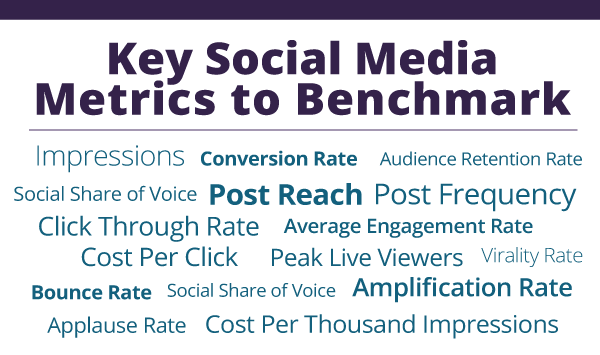
Measuring and monitoring your social media metrics is key to being able to capitalize on different strategies. To make things a little easier for you, we’ve compiled a list of some of the most popular:
- Impressions—Total number of views a piece of content has received.
- Post reach—Number of views by each unique user.
- Post frequency—Number of posts published per day or per week.
- Click through rate—Number of times a user will click on a call to action link in your post.
- Cost per click—Amount you pay per single click on a sponsored paid social media post.
- Cost per thousand impressions—Amount you pay each time one thousand people scroll past your sponsored social media update.
- Conversion rate—Number of visitors who, after clicking on a link in your post, take a specific action divided by the total number of visitors.
- Bounce Rate—Percentage of page visitors who click on a link in your post and leave the page without taking any action.
- Audience retention rate—Indicator as to how long your video content was able to capture the attention of your viewers.
- Peak live viewers—Denotes the highest number of views you had during a live stream.
- Social share of voice—Measures how many people mention your brand on social media compared to your competitors. Mentions can be direct or indirect.
- Applause rate—Number of approval actions (ie. likes, favorites, etc.) your post receives relative to your total number of followers.
- Average engagement rate—Number of engagement actions (ie. shares, comments, etc.) your post receives relative to your total number of followers.
- Amplification rate—Ratio of shares per post to the total number of followers.
- Virality rate—Number of people who shared your post relative to the number of impressions it received during a reporting period.
How to Set Social Media Benchmarks
Now that you have a clear idea of what these metrics mean, let’s delve into how to set social media benchmarks and position your business up for success.
Establish Goals
To start, you’ll have to identify what you’re trying to get out of having a presence on social media in the first place.
What are your business goals? What role will social media play in accomplishing those goals? Are they measurable?
For example, if you’re running an ecommerce business, you’d be interested in driving visitors to your website to buy your products. In this case, you should track click-through rates or conversion rates.
Identify Competitors
Who are your main competitors? This isn’t just a list of brands that are selling the same products or services as you. Your competition can be broken down into several subcategories:
- Direct competitors—Competitors that provide the same types of products or services in your same target market.
- Indirect competitors—Competitors that offer slightly different products or services, but still compete in your target market.
- Replacement competitors—Competitors in a different industry that sell products or services that could be substituted for yours.
- Potential competitors—Competitors who don’t currently serve your market, but may do so in the future.
Choose the Right Social Media Metrics
With such a large pool of social media metrics to measure, you may be overwhelmed with options. But, in reality, you only need to focus on the ones that will bring value to your business, including:
- Brand Awareness—Reach, impressions, fan growth, video views, posting volume
- Consideration—Engagement rate, likes, comments, saves, shares
- Purchase—Clicks, conversions
- Advocacy—Mentions, hashtags, sentiment, share of voice
Record Your Findings
While marketers often look at data because they think it’s something they should do, creating some key takeaways is just as important. After all, you don’t want to gather all this data for the sake of gathering data.
This step is all about interpreting your findings. Write them down and make recommendations on how they’ll likely impact your social media strategy.
Your insights could focus on everything from the types of content that work best, other accounts in your industry to follow, and the best times to post content.
Put Your Insights into Action
Depending on your business goals, it might be a good idea to keep consistent tabs on your metrics or perform another audit after you’ve given yourself enough time to implement a strategy.
But keep in mind that your work here is never done. Keep measuring, evaluating, and adjusting as social media is in a constant state of change.
Social Media Benchmarking Best Practices
Social media contains a wealth of information that is invaluable to digital marketers. To help you leverage that data in the most efficient way possible, we’ve compiled a list of best practices you can use to shape your brand’s marketing strategy:
- No matter which social media channel you choose, be sure to understand the strengths and weaknesses of the platform to better optimize your creative and messaging to reach the right audience. Tailor accordingly, and as we mentioned before, don’t stop analyzing.
- Use historical data from owned channels, as well as competitor and peer performance, to track audience behaviors. Choose competitors, brands, and influencers with similar audiences and resources so you’re comparing your brand to where you can feasibly emulate or learn from.
- Use social listening to monitor keywords, hashtags, and conversations your audience is engaging in to inform content, sentiment, and tone.
- Whenever possible, customize your social media content to provide users with a more personalized experience. Many of today’s consumers prioritize brands that seem authentic and trustworthy.
- Be conscious of data bias. Avoid letting assumptions or confirmation bias skew any possible results.
Wrapping Up
When it comes to your social media strategy, any bit of insight can go a long way.
Benchmarking can help you obtain pertinent information on how your brand is performing when weighed against the industry standard, as well as your direct competitors.
Once you’ve compiled those social media benchmarks and analytics, you’ll be able to set more realistic goals and develop measures to reach your target audience effectively.
