
It’s one thing to drive traffic to your site. It’s another to convert that traffic into customers.
That’s the whole point of conversion rate optimization (CRO). Instead of thinking of it as chasing more form fills or higher traffic numbers, frame it as improving the outcomes that actually move your business forward.
In this ultimate conversion rate optimization guide, Ilya Niazov, Director of CRO, will walk you through his process to help clients improve conversion rates on any website.
What You’ll Learn
- What is Conversion Rate Optimization?
- Why is CRO Marketing Important?
- Create Your Own CRO Process – Step-By-Step
- Real-Life CRO Examples
- Conversion Rate Optimization Tools
- FAQs: Conversion Rate Optimization
TL;DR
- Conversion rate optimization (CRO) helps turn more existing website visitors into customers without spending more on traffic.
- CRO follows a clear five-step process: define your goals, research friction points, prioritize ideas, run tests, and analyze/implement results.
- Even small, well-tested changes, like shorter forms or clearer CTAs, can lead to meaningful gains, but every idea should be tested, not assumed.
- Reliable testing takes planning. Proper sample sizes, enough time to run, and checks like guardrail metrics to catch unintended side effects are all necessary.
- The right mix of tools (analytics, behavioral research, experimentation platforms, and AI assistance) makes CRO more efficient, but human review still matters most.
What is Conversion Rate Optimization (CRO)
Conversion rate optimization (CRO) is the process of improving your website’s user experience so that more visitors convert into actual leads or customers. It entails streamlining the customer journey to keep people moving to the bottom of the funnel with ease.
CRO can be broken down into a simple 5-step process:
- Define business outcomes and measurement.
- Research users and diagnose friction.
- Prioritize hypotheses.
- Design and run the validation
- Analyze, document, implement, and monitor.
But holistically speaking, it’s so much more than that. CRO is about understanding your audience by putting yourself in their shoes, tweaking your website, and continually testing to provide users with the best possible experience that ultimately leads them to the finish line.
The thing about CRO, though, is that it doesn’t follow a one-size-fits-all approach. While most organizations can benefit from CRO principles, formal testing options may be impractical for sites with low traffic or unreliable measurements.
What works well for one business might not work for another. If that’s the case, you can still employ CRO best practices, but with alternatives to traditional testing, such as:
- Usability testing: watching real people use your site and talk through what confuses them
- Surveys: asking visitors directly what stopped them from moving forward
- Heuristic reviews: allowing an experienced CRO expert to evaluate your site against proven best practices
- Before-and-after analysis: comparing performance before and after a change without a live test
Remember, you’re not solely focused on user experience. You’re optimizing your whole business. Potential leads and customers must understand what you’re selling, why you’re selling it, and why you’re the best at it, in order to efficiently optimize your conversion rate.
Why is CRO in Marketing Critical for Success?
Let’s dive into four compelling reasons why CRO deserves a real spot in your marketing plan.
1. The Right Conditions Could Lead to Lower Customer Acquisition Costs
When more of your existing traffic converts, you’re getting more value from the visitors you already have. Since you’re not paying for extra clicks to get extra results, it makes sense that you’ll see lower customer acquisition rates.
However, this only lowers your fully loaded customer acquisition cost (CAC) if your other costs stay steady, too. Fully loaded CAC includes things like ad spend, tools, traffic costs, and team time.
A conversion lift is a strong first step, but it’s not an automatic guarantee that your total CAC will drop. Track both numbers so you’ll know the real impact.
2. A Path Toward a Better ROI
By converting more visitors, you’ll ultimately benefit from a higher return on investment (ROI) over time. Reducing friction in the buyer’s journey often means more prospects complete their purchase instead of dropping off.
That said, a higher conversion rate doesn’t automatically mean higher customer lifetime value (LTV) or better lead quality. Those depend on who converts and what they do after.
CRO can support LTV and ROI gains, but you need to measure them separately to confirm they’re actually happening.
3. Better User Experience
A well-optimized website leads to higher conversion rates and improves user experience, turning casual visitors into leads or customers. Something as simple as a faster page load time or a clearer layout can be the difference between keeping a visitor or losing one.
One of the best ways to improve user experience is to reduce cognitive load. Cognitive load is the amount of mental effort required in information processing. The less a person has to think or search to find what they need, the more comfortable they feel on your site.
Keep things simple and easy to follow. It’s one of the best ways to naturally build a website that converts more easily.
4. Improved SEO Rankings
SEO and CRO in marketing aren’t the same thing, but they overlap in meaningful ways. While Google has confirmed that there’s no single “page experience” ranking signal, Core Web Vitals, like load speed and visual stability, are used by its ranking systems. When you optimize your site for conversions by making pages load faster and easier to navigate, you’re often improving the same qualities Google rewards in search results.
That’s different from saying your Google Analytics engagement numbers, like time on page or bounce rate, directly boost your rankings. Google hasn’t documented those metrics as ranking factors, so we don’t know that for sure. What actually matters is the real experience your pages deliver: fast loading, mobile-friendly design, and useful content that’s easy to find.
Consider that 48% of website visitors will leave your website if images don’t load or if the overall page won’t load in time. A slow or clunky page can hurt both your conversions and your Core Web Vitals.
That’s the real connection between SEO and CRO in marketing. When you build a site that’s genuinely easier and faster for people to use, it supports both goals at once, even if you don’t necessarily mean to.
My Expert Opinion on Conversion Rate Optimization
Conversion rate optimization should be an essential part of any marketing campaign. Driving traffic to your site through solid SEO tactics, is one piece of the puzzle. If you really want to be successful, you have to pair it with an equally solid CRO strategy.
When you run tests and make data-driven decisions based on the results, you start to connect with that existing traffic on a better level without spending any additional ad spend on generating traffic.
Here at Ignite Visibility, we’ve seen how CRO in marketing benefits businesses across all industries. We recently developed a full-funnel marketing strategy for a consumer healthcare client combining SEO, PPC, and CRO. Our work helped our client achieve a 75% increase in bookings, a 115% increase in organic traffic, a 35% increase in Google Business Profile views, and a 4.3% increase in click-to-calls.
CRO is the rising tide that lifts all boats. Imagine all the marketing campaigns you have in place are boats, and CRO acts as a big wave, amplifying all those marketing efforts and increasing your overall ROI.

Is CRO Worth the Effort?
Excellent question and a very common one!
Let’s walk through a simple, real-world example. Say your website gets 10,000 visitors a month and your current conversion rate is 2%. That means about 200 people convert into customers each month.
Now say a CRO test improves your conversion rate by 1 percentage point, moving it from 2% to 3%. That’s an important distinction: a 1 percentage-point increase is different from a 1% relative increase. Going from 2% to 3% is actually a 50% relative lift in conversions, even though it looks like a small change on paper.
Here’s what it looks like in numbers:
- Before: 10,000 visitors x 2% conversion rate = 200 conversions
- After: 10,000 visitors x 3% conversion rate = 300 conversions
- Difference: 100 additional conversions per month, with no additional ad spend

If your average order value is $150, that’s an extra $15,000 in monthly revenue. But revenue isn’t the same as profit. To know whether the test was truly worth it, look at your profit or contribution margin, not just the top-line number.
Let’s say your contribution margin is 40%. That extra $15,000 in revenue translates to about $6,000 in additional monthly profit. That’s the number that actually matters.
You also need to account for the cost of running the test itself. A single A/B test might cost anywhere from a few hundred to a few thousand dollars in tools, design time, and developer hours to set up and implement. If that one test cost $2,000 to run, you’d recover that cost in the first two weeks and continue benefiting from the lift every month after, as long as the change keeps performing.
That’s the real value of CRO. A single, well- run test can pay for itself quickly and keep generating profit long after it’s implemented. And since most websites have many pages, forms, and steps to test and optimize, the opportunity to compound these gains over time is significant.
How to Calculate Conversion Rate
Remember, a conversion can be anything from a product purchase to a form submission to a simple engagement – it all depends on the action you want your users to take.
So how do you measure the conversion rate? Here’s a handy little formula: Conversion Rate = (Conversions / Total Visitors) x 100.
For instance, if you had 100 visitors and 5 of them converted, your conversion rate would be 5%. Simple enough, right?
If there’s one thing I want you to get out of the conversion optimization guide, it’s this: not all conversions are created equal.
- Macro Conversions are the ultimate goal. These are the primary actions you want visitors to take on your website, like making a purchase or signing up for a subscription.
- Micro Conversions are the smaller yet still significant actions visitors take, leading them toward a macro conversion. A micro conversion could be as small as getting someone to add a product to their cart. Although it’s not a full conversion, it’s still important and moves potential customers further down the sales funnel.
The CRO Process
Step 1: Define Business Outcomes and Measurement
Before you test anything, you need to know what “better” actually means for your business. So, what are conversions in marketing?
The conversions worth measuring are the ones that align with your goals, like more purchases, more leads, or more sign-ups. Then, decide exactly how you’ll track them. Without this step, you might improve a number that looks good but doesn’t actually move you any closer to your end goal.
Start by asking what action matters most on each page. A homepage might aim to get visitors clicking into product pages, whereas a checkout page might aim for completed purchases. Choose the outcome that connects to your goals, and then set up tracking in a tool like Google Analytics so you can measure it accurately from day one.
Step 2: Research Users & Diagnose Friction
Once your goals are set, it’s time to find out where people get stuck. Dive into your analytics to figure out where people are bouncing or dropping off your website.
Focus on the highest-volume pages first, and on bottleneck pages like the homepage, checkout flow, or lead form pages. Those pages will generally have the highest impact on your conversion rate.
Here are some additional CRO expert tips for researching:
- Start with quantitative research to identify high-traffic pages with low conversions.
- Engage in qualitative research to uncover the “why” behind low conversions, using heatmaps, session replays, or surveys to pinpoint the reason for drop-offs.
- Look at your competitors with a conversion rate optimization audit to reveal visible offers and funnel patterns. This will come in handy later when you’re generating your hypothesis.
Step 3: Prioritize Hypotheses
With your research in hand, it’s time to turn your findings into ideas worth testing.
Begin by putting yourself in your customer’s shoes:
- What’s confusing? Is it clear what your service or product is?
- Are you being too clever and assuming all your visitors know exactly what your product or service is?
- Is there a gap in your customer journey?
- Is your webpage overwhelming with huge blocks of text?
- Is the website hard to use?
- Is there a lack of congruence between the advertisement they saw right before landing on your website and what they are shown on the site?
If you answered yes to any of those questions, you’re in the right place and in good company. Most sites have room to improve here.
Now, it’s time to turn each idea into a simple if/then hypothesis to determine precisely which conversion optimization best practices will work for you.
For example, you could find that people are not completing a form on a landing page that’s otherwise seeing a lot of traffic from PPC ads, in which case your hypothesis might look like: “If we remove this form field, we expect to see a X% increase in form completions.”
This statement will inform your specific objective, which will subsequently inform your measurements when analyzing the results.
You’ll likely have more ideas than time to test them, so prioritize based on impact and effort. Start with changes on high-traffic pages that could make a big difference and don’t require months of development work. Save the bigger, riskier ideas for later.
Remember: if you can clearly explain what your product is, you’re one step closer to more conversions.
Step 4: Design & Run the Validation
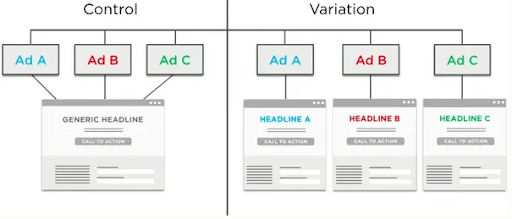
Now it’s time to build your test. This usually means creating a variant, an alternative version of the page or section you’re trying to improve, and running it against the original to see which one performs better. This process is also known as an A/B test.
What Can You Test?
There are many elements of your website you can test in your conversion rate optimization checklist, including:
- Headlines
- Images
- Videos
- Forms
- Text content
- Banners
- Navigation menu
- Calls to action (CTAs)
- Checkout flow fields
- Site search
Here are some conversion rate optimization tips to help with the testing process:
- Focus on high-impact pages with plenty of traffic but low conversion rates, e.g., high-traffic landing pages, checkout pages, and product pages
- Test one change at a time to determine what actually makes a difference in performance
- Prioritize above-the-fold content that tends to drive the most conversions, such as CTA buttons toward the top of the page
- Leverage feedback from users to better determine what’s keeping people from converting, such as design elements that users find clunky or otherwise hurt the user experience
Testing Guidance
Running a good test takes more than picking a winner after a few days. A little planning upfront will ensure your results are trustworthy and accurate.
Before launching, decide on your sample size and minimum detectable effect. What is the smallest lift you actually care about catching?
This helps you know how long a test needs to run and how much traffic it needs to be reliable. Aim for strong statistical power so you can trust a win is real, not just random noise.
A few checks to build into every test:
- Quality assurance: Confirm the test displays correctly across devices and browsers before it goes live
- Sample-ratio mismatch: Check that visitors are being split evenly between variants. An uneven split can skew your results.
- Novelty effects: Watch for early spikes in performance simply because something is new, not because it’s actually better.
- Seasonality: Account for holidays, sales, or traffic changes that could affect results unrelated to your test.
- Guardrail metrics: Track other important numbers, like average order value or bounce rate, to make sure a win in one area isn’t hurting another.
Step 5: Analyze, Document, Implement, and Monitor
Now that your test is up and running, here are some metrics that are typically tracked for CRO purposes:
- Conversion rate
- Revenue per visitor
- Cost per acquisition
- Cart and checkout abandonment rates
- Click-through rate
- Average order value
- Return on investment
You don’t have to track every single one of these KPIs, but you do need to track the ones that correspond with your company’s goals.
Once your test has run long enough to gather solid data, it’s time to review the results.
Not every test will win, and that’s okay. Even when a test doesn’t improve conversions, it still teaches you something valuable about what your audience does and doesn’t respond to.
Wins: These are the glorious moments when your tests reveal significant improvements and send your conversion rates soaring. Celebrate these victories, but also document and implement the successful changes to keep reaping the rewards.
Learnings: As mentioned earlier, not every test will be a winner, but that doesn’t mean you’ve failed. When a test doesn’t win, treat it as a learning, not a failure. Use what you discovered to shape your next hypothesis. Maybe a different image, a clearer headline, or simpler copy will perform better next time.
The following are some recent stats that could guide your CRO marketing strategy:
- The average B2C conversion rate is 2.1%
- The average B2B conversion rate is 1.8%.
- Adding a video to a landing page can boost conversions by as much as 80%
- The right conversion rate optimization tools can lead to a 223% ROI
- Only 39.6% of businesses have a specific CRO strategy in place, and 22% are happy with their conversion rates
- A/B testing is the second most popular method for improving conversion rates
- Only 22% of businesses are satisfied with their existing conversion rates
Once you have a winning test, it’s time to implement it and put it into play on your website. Then, be prepared to iterate, innovate, and repeat the process. Stay curious and keep testing.
Keep in mind that CRO isn’t a one-time thing. Like most digital marketing strategies, it is always evolving. There are always more elements to optimize, increasing your conversion rate as you work to perfect the experience you offer.
Real-Life CRO Examples
Let’s take a look at CRO in real life.
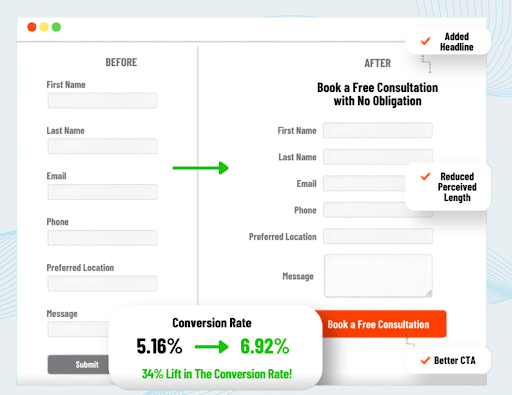
Lead Gen Site Increased Submissions by 34.19%
Recently, Ignite helped a lead gen site generate more consultation requests by simplifying the lead form’s appearance and strengthening its conversion copy.
This process increased the conversion rate from 5.16% to 6.92%.
A/B Testing Leads to 45% Increase in Phone Call Clicks
In another example, Ignite helped a telecommunications company increase their conversion rate by focusing on A/B testing and improving the quick navigation menu.
The A/B testing led to a 7.42% increase in form submissions and a 14.81% increase in phone clicks.
To improve user engagement, we also updated the quick navigation menu. This optimization led to a 9.41% increase in form submissions, a 45.18% increase in phone call clicks, and higher page views for key sections.
Upsell Removal From The Add-To-Cart Confirmation Popup
A recent test we ran for a client resulted in a 118% increase in the purchase conversion rate!
For this test, we decided to focus on their upsell attempts every time a user decided to add any product to the cart. Heatmap data showed that more often than not, users clicked away from the upsell modal which appeared every time a user clicked on the add-to-cart button. The website data also showed that less than 10% of people actually purchased upsell options from this somewhat aggressive upsell popup.
The hypothesis was that the user felt overwhelmed when bombarded with additional options in the form of a lengthy upsell section within the confirmation popup modal. The obvious test was to remove the upsell portion of the modal to minimize the sales pressure and feeling of overwhelm in hopes that more people would continue adding the product to the cart and ultimately completing the checkout.
And that’s exactly what happened!
The 118% increase in purchase conversion rate resulted in a $11,600 increase in additional monthly revenue which more than offset any potential losses from not getting an upsell.

Banner Removal Test
Would you believe us if we told you we increased this client’s conversion rate by 25% just by removing what many CRO experts would say is actually a best practice?
With this simple banner removal test, they secured an extra $30,000 with no additional ad spend!

For this test, we put ourselves in the client’s shoes and realized an issue with the user experience – the banner at the top of the page has a CTA that said “Call Now.” This client offers a service for people that are sick, and we realized the last thing someone who is sick wants to do is get on a call. Not only that, but it was also hard for the client to navigate to the cart page and other product pages since the banner was blocking the entire navigation menu.
So what did we do?
We removed the banner completely. This improved visibility of the navigation menu significantly helped the client secure more conversions.
Helpful Conversion Rate Optimization Best Practices
The best practices below are common in CRO strategies. Keep in mind, though, that every website and audience is different. Treat each one of the following best practices as a hypothesis to test, not a guaranteed win.
Here are 7 CRO best practices to try on your own site.
Sticky Navigation
A sticky (or fixed) navigation menu stays visible as users scroll down your page. This keeps your main CTA within reach at all times.
Having your CTA readily available this way makes it easier for visitors to take action without scrolling back to the top, but test it to confirm it doesn’t distract from your content or feel cluttered on mobile devices.
Shorter Forms
Long forms feel like a big commitment. Try removing non-essential fields to see if it lowers abandonment rates and improves completion rates. Just be sure you’re not cutting forms your sales team actually needs.
Video
Adding video to a landing page can help explain your product and build trust faster than text alone. Test where it’s placed and how long it runs, since a poorly placed video can slow down your page.
Popups
Popups can capture attention for offers or lead magnets, but they can also frustrate visitors if timed poorly. Test different triggers, like exit intent or time-on-page, to find a balance that helps rather than annoys.
Urgency
Limited-time offers or low-stock messages can encourage faster decisions. Use them honestly and test their impact. Overused urgency tactics can erode trust over time. So, if you’re going to say this is the “last call!”, make sure it actually is.
Testimonials
Real customer testimonials near your CTA can build confidence when someone is deciding to convert. Test placement and format, such as text versus video, to see what resonates most with your audience.
Above-the-Fold CTAs
Placing a CTA above the fold means visitors see it without scrolling. This can boost visibility, but test it against other placements, since some pages perform better with more context before the ask.

CRO Tool Chest
Want to excel with your CRO strategy? There are plenty of helpful conversion rate optimization tools out there you can use, but remember with 20% of tools you can get 80% of results.
Here’s how to think about your CRO tool test, organized by what each tool does.
Measurement
Measurement tools track what’s happening on your site. They show how many visitors you’re getting, where they come from, and whether they’re completing the actions that matter most.
- Google Analytics (GA4): Tracks website traffic, user behavior, and audience demographics, giving you the baseline data every CRO strategy starts with
- Adobe Analytics: A more advanced option for larger businesses that need deeper reporting and cross-channel tracking.
Behavioral Research
Once you know where drop-off is happening, behavioral research tools help you understand why. These tools show you how real visitors interact with your pages.
- Contentsquare/Hotjar: Offer heatmaps, session recordings, and on-site surveys so you can see exactly where users click, scroll, and get stuck.
- Microsoft Clarity: A free tool that provides heatmaps and session replays to help pinpoint usability issues
Experimentation
Experimentation tools let you actually run your A/B tests and measure which version performs better.
- VWO, Optimizely, or AB Tasty: Popular platforms for running A/B and multivariate tests, often with visual editors that don’t require a developer for every change.
- Custom platforms: Larger businesses with development resources may build their own testing infrastructure for more control and flexibility.
Voice-of-Customer Research
Numbers can show you what’s happening, but they can’t always tell you why. Surveys and interview tools let you ask visitors directly about their experience, what confused them, or what almost stopped them from converting.
AI Assistance
AI tools, like Pathmonk, are becoming increasingly useful throughout the CRO process, but they work best as an assistant, not a replacement for human judgment.
- Synthesis and ideation: AI can summarize research findings and suggest hypotheses worth testing.
- Coding support: AI can speed up building test variants, especially for smaller changes.
- Quality assurance: AI can help catch errors before a test goes live.
Always have a human review AI-generated suggestions and/or code before launching the test. While AI can accelerate your strategy, the final call should always stay with your human team.
Conversion Rate Optimization FAQs
1. What is a good conversion rate?
The average and ideal conversion rate depends on factors like your industry, but the generally accepted rate is around 2% to 5% for most businesses. Ultimately, a “good” conversion rate depends on your specific goals.
2. How long should a CRO test run?
A CRO test should run for a minimum of two weeks to get a good handle on behavioral cycles and collect sufficient data to inform your CRO marketing efforts. Keep in mind, however, that two weeks can cover weekly cycles, but it’s not a universal minimum. Always base test duration on pre-test calculations, business cycles, novelty effects, and experiment design.
3. What is statistical significance in CRO?
Statistical significance in a CRO marketing strategy refers to the probability that conversions increase due to a change when measuring a control and variant, with the ideal outcome being around 95% or higher. A/B testing over a period can help determine whether changes improve your conversion rate.
4. What tools are best for CRO?
There are many conversion rate optimization tools you can use to test your CRO strategy and analyze results, including:
- Hotjar for developing heatmaps and recording sessions among users
- Visual Website Optimizer for A/B testing
- Microsoft Clarity for analysis and insights
- Google Analytics for monitoring traffic and user behavior
- ChatGPT and other AI platforms for content optimization
5. What’s the difference between CRO and SEO?
SEO brings more traffic to your site through higher search rankings, while CRO optimizes the user experience to convert that traffic into paying, long-term customers.
6. What are common CRO mistakes?
There are multiple mistakes that marketers could make in a CRO marketing strategy, such as:
- Testing too many changes at once
- Overlooking qualitative data, e.g. why people are converting more with a certain change
- Failing to optimize for mobile users
- Blindly implementing conversion rate optimization best practices without testing
- Not testing long enough to gauge the effectiveness of changes
7. How much traffic do I need for A/B testing?
You generally need at least a few thousand visitors per month per page to run a reliable A/B test. However, the exact number depends on your current conversion rate and how big a change you’re hoping to detect. Pages with low traffic or very small conversion rates can take weeks or months to reach statistical significance. If your site doesn’t get enough traffic, consider other research methods.
8. Can CRO reduce lead quality?
Yes, CRO can reduce lead quality if the change makes it easier to convert without also filtering for the right audience. For example, removing form fields can boost completions but may bring in leads who aren’t a good fit. That’s why it’s important to track lead quality alongside conversion rate, not just the conversion number.
9. What should low-traffic websites use instead of A/B testing?
Low-traffic websites can rely on usability testing, customer surveys, heuristic reviews, and before-and-after analysis instead of A/B testing. These methods don’t require a large sample size and can still uncover meaningful friction points. Once traffic grows, A/B testing becomes a more reliable option.
10. Can CRO hurt SEO?
CRO itself doesn’t hurt SEO, but certain changes made during testing can if you don’t manage them carefully. For example, slow-loading test scripts, duplicate content from testing tools, or intrusive popups can affect Core Web Vitals and user experience signals Google considers. Working with a team that understands both CRO and SEO helps avoid these conflicts.
Launch Your Own CRO Strategy Today!
This conversion rate optimization guide can get you started with a CRO strategy, but you may need some expertise to get the best possible results.
For some help with your optimization efforts, consider Ignite Visibility’s digital marketing solutions. We’ll determine your individual needs and give you the guidance you need to succeed with CRO and much more.
With our help, you’ll be able to:
- Identify your biggest drop-off points
- Dive into analytics to understand why
- Determine what ideas you want to test
- Identify winners of tests and implement them
- Measure the results of your campaigns with detailed analytics and reports
- And much more!
To find out how we can help you boost conversions, learn about our CRO services and what they can do for your CRO marketing efforts.