
Facebook remains one of the best platforms to use for social media marketing, with over 3 billion active users today, and the average person spends around 31 minutes every day on the site. Figuring out the best time to post on Facebook can help you reach the right people at the right time, but while industry and general benchmarks are important, there isn’t a universal “best time” for all brands due to factors like demographics, geography, content type, and objectives.
In this article, Mady Lewellyn, Social Media Manager, will break down how to find the times that work best for both your brand and your audience to increase your engagement, your reach, and even your sales.
What You’ll Learn:
- What is the Best Time to Post on Facebook?
- Why Benchmark Studies Disagree on the Best Times to Post on Facebook
- How to Find the Best Time to Post on Facebook For Your Brand
- Best Times to Post on Facebook By Day
- Rallio, Your Tool and Scheduling Resource
- FAQs: Best Times to Post on Facebook
Quick Answer: Benchmark Best Times to Post on Facebook
To help you find the best time to post on Facebook today, you need to establish a strong benchmark. Different studies highlight the best day and time to post on Facebook across industries, which can give you an idea of where to start, though studies vary considerably.
According to Influencer Marketing Hub, some optimal times for posting on Facebook are Wednesdays at 11 am and 1 pm.
When are most people on Facebook? Well, some other recommended times include:
- 9:00 am – Monday through Friday
- 11:00 am – Monday, Tuesday, and Thursday
- 3:00 pm – Monday and Tuesday
- 4:00 pm – Wednesday, Thursday, and Friday
- 6:00 pm – Friday
Generally, your own data regarding engagement and performance will help identify the best time to post on Facebook for your business.
Why Benchmark Studies Disagree on the Best Times to Post on Facebook
Benchmark studies often disagree on the best time to post Facebook posts because of several factors, such as:
- Different data sets involving various influencing factors
- Looking at one or multiple specific industries that vary from one another
- Analyzing the best day and time to post on Facebook within particular time zones
- Basing results on different content types, such as standard text posts vs. video posts
- Varying definitions of engagement
These are some of the main reasons why it’s a mistake to rely solely on industry studies to gauge the best time to post on Facebook. For example, while a source like Influencer Marketing Hub might determine that the best time to post on Facebook is Wednesday morning, you might discover through your own data that, in your specific case, the best time to post on FB is Saturday afternoon.
Expert Insights: When to Post On Facebook
If you’re looking for the best times to post on Facebook, I’ve found that this largely depends on your audience. Identifying the right times to post can significantly boost your Facebook marketing efforts in the long term.
Contrary to one-size-fits-all solutions, the optimal time to post varies significantly across brands, influenced by factors like audience demographics, industry, and content type. Conducting thorough social media audience analysis can reveal precise posting times tailored to your specific brand and audience needs.
It’s essential for brands to dive deep into their own Facebook analytics to understand when their audience is most active and responsive. This data-driven approach not only helps in building a consistent posting schedule tailored to your specific audience but also ensures that your content has the best chance of being seen and interacted with.
By aligning your posting schedule with your audience’s Facebook usage patterns, you can significantly increase the effectiveness of your social media strategy. You can use industry benchmarks as a starting point, but you should always count on your own engagement data to identify the best time of day to post on social media, whatever channels you use.
Pro Tip: Be sure to analyze the Posts section to see when your fans are online the most. You can find all the data you’ll need directly in the app.

What Facebook Signals Matter More Than Timing
Before determining the best times to post on Facebook, it’s important to understand how the platform’s algorithm works. There’s ultimately more to it than mere timing.
The main factors the algorithm takes into account to display posts include:
- Relevance: The algorithm looks at each user’s interests and preferences to personalize their feed with the content they’re most likely to enjoy, along with specific preferred content types.
- Engagement: Additionally, Facebook considers interactions among users for each post, such as likes, shares, and comments, including the number and frequency of comments.
- Recency: Facebook tends to prefer newer posts over older ones, although the algorithm could bring older posts to the fore if they’re relevant and engaging.
- Creative Quality: The quality of the creative design will also impact performance significantly, which is why you need to optimize captions, images, videos, and headlines with every post to capture audiences.
- Format Fit: Another factor to consider is your content format fit, as certain types of posts might get more engagement for your brand than others; look at posting trends in your industry to give you some ideas of how to gain more traction on the platform.
Even with these algorithm-driven feeds in place, it’s still critical to determine the best day and time to post on Facebook if you want to maximize engagement.
Some types of content do better on the algorithm than others, such as:
- Short videos and Reels that can quickly grab people’s attention
- Facebook Live videos that encourage real-time comments and interaction
- Reviews and testimonials for your business
- Questions and polls that further boost engagement
- Infographics, memes, and other visual content
- Highly relatable posts that reflect your audience’s personal experience
How to Find the Best Time to Post on Facebook For Your Brand
Finding the best time to post on Facebook for your brand involves understanding your target audience and tailoring your strategy to their preferences. Here’s a step-by-step guide:
Step 1: Check Meta Business Suite Insights
So, what is the best time to post on Facebook? The data within Meta Business Suite reports should give you some ideas from the start.
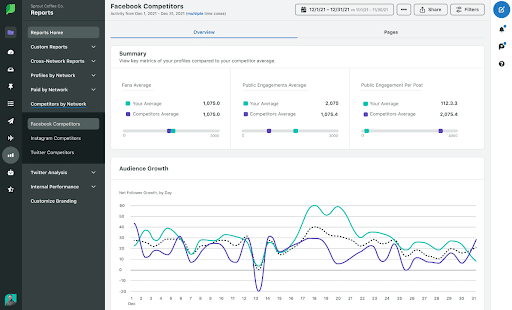
Within Meta Business Suite, you can go to your “Insights” tab and view either your Content Reports or Planner Reports. Based on your posting history, you can see post performance and compare your overall performance to competitors.
Meta Business Suite provides just about all of the data you need in a centralized dashboard.
Step 2: Pull Top-Performing Posts
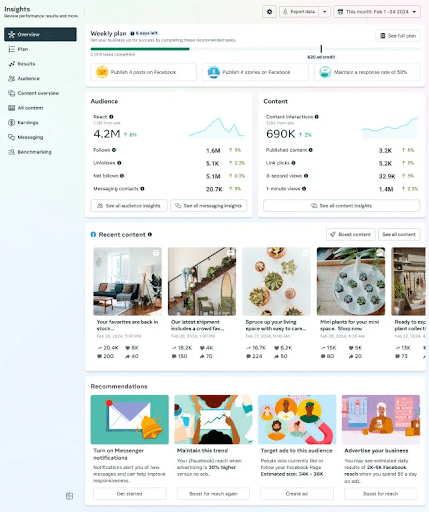
Looking at your data within the “Insights” tab, audit your top-performing posts based on their Engagement Rate and Reach.
You can then decide which timing, content type, and other factors contribute to strong performance.
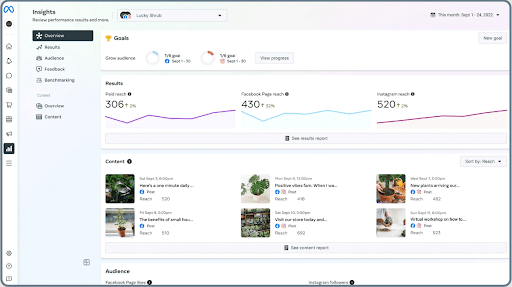
For instance, in the Overview dashboard, you’re able to see recent content and metrics like views, link clicks, shares, reacts, and comments. Keep in mind that your top-performing posts will be those that achieve a particular goal.
Step 3: Segment by Format
You may also find that post performance varies based on the format of your post. For example, you could discover that your Reels do better in the evenings, while images or link posts see more engagement on weekday mornings during people’s commutes.
From there, you can determine the best time to post on Facebook for each content type.
Step 4: Compare Weekdays vs. Weekends
It’s also crucial to look at when people are most active throughout the week.
An example here could include a brand in the financial industry, which could determine that the best time to post on Facebook is Wednesday mornings when professionals are commuting and interested in finance news, while the best time to post on FB is Saturday afternoons for audiences with more in-depth financial tips.
Conversely, some brands might see more engagement for professional posts on Sunday, while people seek more entertaining content to break up their work weeks.
Step 5: Test Consistently
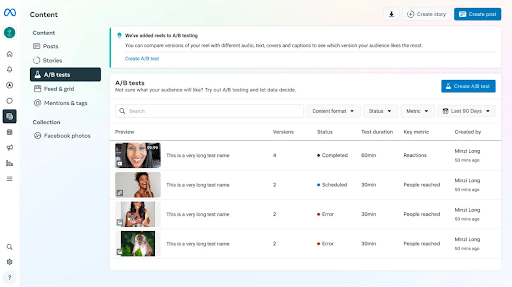
To further pinpoint the best time to post Facebook posts, conduct regular A/B tests trying out certain variations.
For example, you might try to post two different content types at the same time and day to see which drives more engagement. Another test could entail posting the same post at two different times on the same day.
Always consider your goals and what you want to achieve to guide your testing, drawing from past data.
Use Meta Business Suite, Not Generic Guesswork
Although industry studies and other sources could help you get a rough idea of when to post on Facebook, you need better data from tools like Meta Business Suite.
Formerly Facebook Business, Meta Business Suite gives you all of the resources you need to identify the perfect time to post.
To access your page and profile insights on Meta Business Suite, take the following basic steps:
1. Log in to Meta Business Suite
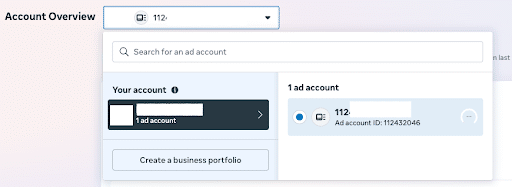
2. Choose the dropdown menu in the top left to choose your connected Facebook Page
3. Go to Insights.
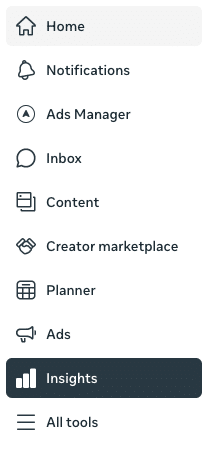
4. View performance metrics for a particular period and specific content pieces within the Overview tab, or look at your posts specifically within the Content tab.
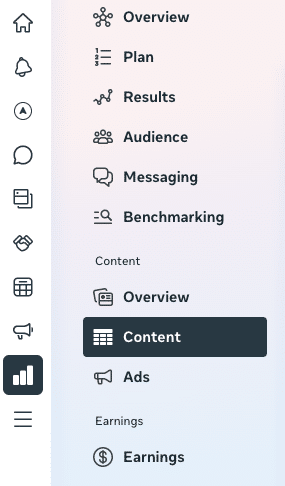
Check out the Audience tab to see details like demographics, including age, location, and gender.
Remember, setting clear goals for your posts will help you determine which metrics truly gauge your performance and how to grow on social media.
There May Not Be a Single Best Time to Post
Despite all the data in the world, it’s nearly impossible to draw definite conclusions or determine a one-size-fits-all approach.
According to the company’s most recent investment report, Facebook currently has roughly 3.03 billion monthly active users, which is more users than any other social media platform.
This activity is a blessing and a curse. Yes, at least part of your audience is almost sure to be there. But so are all of your competitors.
Increased competition means less exposure for your brand, and with such fierce competition, the most popular times to post could be the worst for your business, as you’re that much more likely to get lost in the shuffle.
Because of this, it’s increasingly important for you to rely on your own analytics and engagement rates to narrow down the times that work best for you.
Additionally, you should conduct A/B testing of your Facebook posts over a two- to four-week period, which can help you more effectively narrow down the best times to post on Facebook. For example, when trying to figure out the best time to post on Facebook on Monday, you may run one post at 9 in the morning and another around noon. You might also try optimizing the content itself, whether it’s a different header, caption, or image, seeing which drives the most engagement at what time.
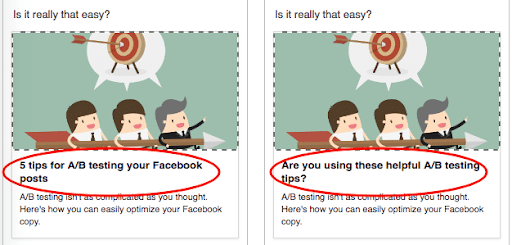
It’s equally important to measure key performance indicators (KPIs) on social media to confirm the best time to post on Facebook. These critical KPIs and marketing metrics could include click-through rate (CTR), engagement rates, and variable reach, depending on when you post.
Just remember, the Facebook algorithm also prioritizes recency and relevance, so while it’s important to identify the best time to post on FB, this isn’t the only factor to consider.
This chart outlines the best times to post on Facebook, broken down for each day of the week:
Best Times to Post on Facebook By Day
| MONDAY | 9 am, 11 am, 3 pm |
| TUESDAY | 9 am, 11 am, 3 pm |
| WEDNESDAY | 9 am, 10 am, 1 pm, 4 pm |
| THURSDAY | 9 am, 11 am, 4 pm |
| FRIDAY | 11 am, 4 pm, 6 pm |
| SATURDAY | between 10 am and 2 pm |
| SUNDAY | between 9 am and 2 pm *least active day |
You’ll also want to ask, “What are the specific days when most people are on Facebook?”
According to data from Buffer, generally, the best day of the week to post on Facebook is Friday, which sees the most engagement throughout the entire day. Meanwhile, the worst days are Saturday and Sunday, which see far less engagement compared to other days of the week.
Best Time to Post on Facebook by Goal
You should also consider the objective you want to achieve with your posts. Sometimes, one schedule will be insufficient when your objectives dictate different posting times.
For example, the following are the best days and times to post on Facebook for key metrics:
- For Likes: The best time to post on Facebook for likes is typically at peak engagement hours, when people are actively browsing and scrolling their Facebook feeds for a few minutes and throw out a few likes.
- For Clicks: Meanwhile, a good time to post on Facebook for clicks is usually around midday, when people are taking a break and want to consume content beyond Facebook.
- For Shares/Comments: People tend to connect with posts through shares and comments on the platform during the weekends or evenings, but keep in mind that weekends are the times that generally see the least engagement.
In the end, this approach is often more strategic than day-by-day lists.
Best Times to Post on Facebook by Audience Type
You must also consider the type of audience you want to target to identify a good time to post on Facebook.
Different audiences will be active at different times.
B2B audiences might consist of professionals who are more active in the mornings during their commutes or during break periods in the afternoon, potentially engaging more throughout the workweek.
Meanwhile, local businesses could find that their local audiences are most active during peak business hours, seeking everything from local restaurants and events to emergency services throughout the day.
Ecommerce audiences, on the other hand, might seek impulse purchases or deals before or throughout the weekend.
Parents, students, and multi-time-zone audiences will also exhibit unique behaviors, depending on their specific schedules and the nature of your business and industry.
In Meta Business Suite, you can see which audiences engage the most and when based on your content types, timing, and other factors.
Best Times to Post on Facebook by Content Type
The fact is that different types of content will do better at certain times and on certain days. For instance, you may discover that, for videos, the best time to post on Facebook on Wednesday is in the evenings, while link posts leading to your site observe mornings as the best time to post on Friday.
When is the best time to post on Facebook for each content type?
Here are some guidelines:
Traditional Videos
The best time to post on Facebook for videos is generally in the evenings, when people are home from work and actively looking through their feeds for entertaining content that’s easy to digest. Longer videos are particularly good to post around this time. The weekends also tend to favor video content when people are looking to relax.
Reels
For Facebook Reels, you could find the best time to post on Facebook to be during weekday mornings when people are looking for some early stimulation, along with afternoons during lunch breaks, and in the evenings when people are winding down for the day. Weekends also tend to see a lot of Reel engagement.
Image Posts
Meanwhile, for images, the best times to post on Facebook are around the late mornings and early afternoons when people want to consume some quicker content while taking a break. People also often look at image posts during that “afternoon slump” as they seek distractions.
Link Posts
These posts tend to lead to blog posts or other types of longer-form content outside of Facebook. Weekend mornings and evenings are often the best days and times to post on Facebook with this content. During this period, people often have more time to read or view longer content pieces, although Buffer recommends early-morning link posting to gain more traction in people’s feeds over the course of the day, ensuring more people see the content later.
Live Posts
What is the best time to post on Facebook Live? The answer here will depend largely on when your audience is most active and likely to engage. Some brands might find that the middle of the week is when they can conduct live sessions that really connect, while others might determine that the weekend sees people with more free time to spend viewing Live posts.
Promotional Posts
Want to promote your brand or offerings with a post? Similarly, you will likely benefit most during those times when high-intent audiences are most likely to connect. People here might be actively interested in your brand and ready to make a purchase at various times throughout the day or week.
In addition to these content types, you should also take into account the performance of organic vs. paid social content on the platform. Organic content relies more heavily on the algorithm, so relevancy, recency, and engagement will play key roles in determining performance. Meanwhile, with the right targeting, paid content can benefit from more flexible scheduling while reaching the right people at the right time.
Ideally, a good blend of organic and paid content will help you perform better overall as you maximize visibility and engagement.
Rallio, Your Tool and Scheduling Resource
In answering the question of what is the best time to post on Facebook, you can use various tools to help you schedule posts and further refine your timing.
If you need a tool that’s better for local businesses, use Rallio to help determine the best time to post on Facebook. It can help with scheduling, engagement, and analytics.
Some of the pros include enhanced local SEO features, and scalability for multi-location businesses and franchises.
Don’t forget to take a look at your social media analytics to spot traffic and engagement patterns, determining when your audience is at its most active and most likely to engage.
Pro-Tip: Trying to reach audiences across the country or the globe? Take into account time zones when scheduling. You can save more time by batch scheduling content in advance as soon as you create it.
Common Mistakes to Avoid
There are multiple mistakes that businesses often make when figuring out the best times to post on Facebook.
- Over Posting: Some businesses over-post, which can fatigue your audiences or cannibalize your posts collectively as the algorithm struggles to determine which to show to users. Instead, try to determine the most optimal frequency for posts, which is typically around three to five times per week.
- Posting at the Wrong Times: Here’s another issue, making it important to use analytics tools and scheduling solutions to help pinpoint the time when your audience will probably engage with your posts.
- Pay Attention to Critical Analytics: Don’t ignore audience analytics, either, which is another critical mistake. Pay attention to CTR, reach, and engagement metrics like likes and shares to determine how well your posts are performing, and optimize your strategy accordingly.
Also, while you might find generic “best times” to post in your industry, don’t rely on these alone; do some testing to see which of your posts perform the best and when.
How Often to Post on Facebook
In addition to proper timing, you need to maintain a good posting cadence to regularly engage audiences.
For some brands, three to five times per week is enough, while others might want to post more or less frequently, depending on post and audience activity.
For instance, a B2B business targeting busy professionals may post around one to twice per week with valuable information and promotions, while an ecommerce brand could more consistently promote specific products and features.
Through A/B testing, you can better figure out the right posting frequency over time.
FAQs: Best Times to Post on Facebook
1. When is the best time to post on Facebook?
The best times to post on Facebook for engagement will vary based on numerous factors, like your industry, audience demographics and behaviors, and your particular brand. While many studies exist with general best times, it’s best to stick with your data and insights to identify the right posting times.
2. What is the best day to post on Facebook?
You should figure out which day to post along with the time, as the best time to post on Facebook on Wednesday will differ from the best time to post on Friday, for example. The specific day will depend on factors like your industry and when your audience is engaging with social media.
3. How many times should a business post on Facebook per day?
Typically, it’s best for businesses to post around three to five times per week, which is frequent enough to maintain engagement without leading to over-posting issues like fatigue and poor visibility. However, this frequency is merely a rough guideline, as posting frequency will vary from business to business.
4. Does content type affect the best time to post on Facebook?
Yes, the type of content you post will impact the ideal time to post, whether you’re posting videos, images, or links to other content. You may find that videos perform better when people want entertainment after work, for instance.
5. How can I find my best posting times on Facebook?
Looking into your industry and audience, especially with the help of the right social media management tools, can give you an idea of the right times to post on Facebook and other platforms. Meta Business Suite offers meaningful data to help determine the best day and time to post on Facebook.
Boost Your Facebook Engagement With Ignite
So, when is the best time to post on Facebook? There’s no one-size-fits-all answer.
Enter Ignite Visibility.
Our clients trust us to make the best of their online reputations. Whether you’re a B2B or B2C company, we’re here to support your business goals.
Ignite can help you:
- Develop an overall social media marketing plan
- Run a winning paid advertising strategy
- Create interactive content
- Find the perfect influencers
- And more!
Ready to get started? Speak with an expert today!